
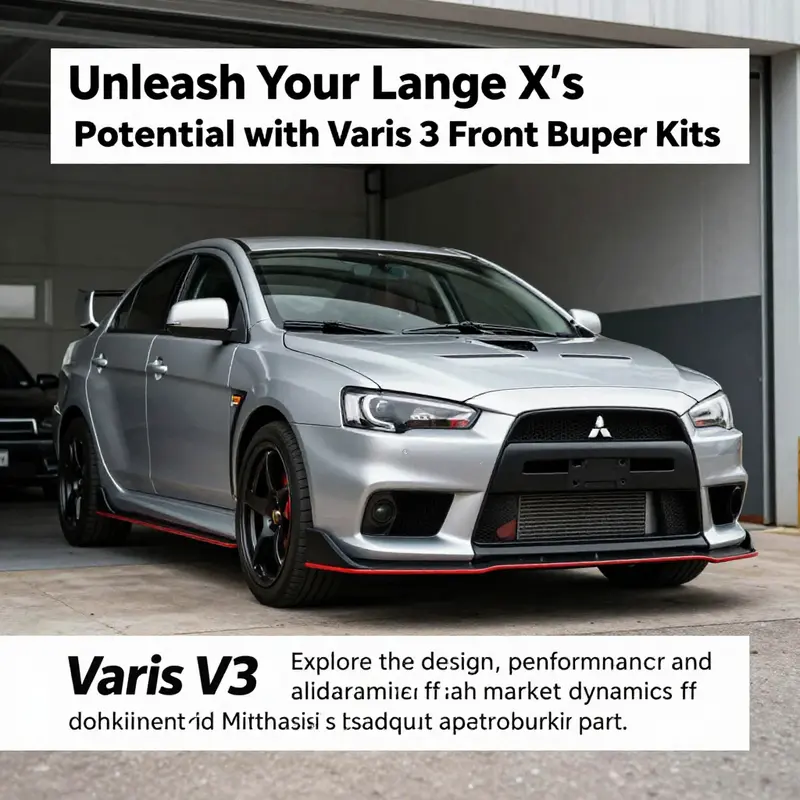
The Mitsubishi Lancer Evolution X is a car synonymous with performance and precision, and its aesthetic appeal plays a vital role in its identity. Among the many enhancements available, the Varis V3 Style Front Bumper Kit stands out as a top choice for Evo X enthusiasts and business owners alike. This article delves into the striking design and features of this aftermarket kit, the performance enhancements it offers, and the current market trends and pricing that impact your purchasing decisions. Together, we will explore how this kit could elevate your vehicle’s performance and visual identity.
Sculpted Aggression: The Varis V3–Style Front Bumper for the Evo X — Design, Function, and Fitment

Sculpted Aggression: The Varis V3–Style Front Bumper for the Evo X — Design, Function, and Fitment
The front end of a performance car announces intent. On the Lancer Evolution X, that announcement becomes unmistakable when a V3–style front bumper is installed. This chapter walks through the layered logic behind that transformation: why the V3 silhouette reads as performance at a glance, how its shapes work aerodynamically, what materials and fitment choices mean for durability and serviceability, and the practical considerations owners face when choosing, installing, and maintaining a full grille-and-bumper kit. The aim is to present a continuous, detailed narrative that ties visual character, functional engineering, and real-world ownership into one coherent view of what this front-end upgrade delivers.
At first look the V3–style bumper reshapes the Evo X personality. The silhouette is bold: a large, pronounced front lip, oversized central intake, and sharp, angular flanks combine to create a race-inspired stance. These elements are not merely decorative. The pronounced lower profile increases the effective surface that interacts with high-velocity air under the car, producing measurable front-end downforce. That downforce counteracts lift at speed, improving front-axle load and thereby enhancing steering feel and high-speed stability. Designers of such kits balance visual aggression with aerodynamic purpose; the deep lip looks low and purposeful because it is shaped to coax airflow into predictable patterns rather than simply to appear dramatic.
The central intake area is another defining feature. A large, well-contoured opening allows greater volumes of air to reach the radiator, intercooler, and engine bay when compared with more conservative factory openings. That increased airflow can support higher sustained engine loads, especially under hard driving or track use where cooling margins become critical. At the same time, integrated ducts and sculpted surrounds channel air away from the wheel wells and toward heat-exchange surfaces, reducing turbulent pockets that would otherwise degrade cooling efficiency. Designers often pair the bumper with a matching grille element that completes an air-management strategy; a grille designed to smooth incoming air while filtering debris helps maintain consistent airflow to the systems that need it most.
A distinctive aspect of the V3 look is the integration of fog light housings and winglets into the bumper’s overall aerodynamic plan. These recesses are not afterthoughts; they are positioned to manage vortices created by the transition from bumper to fender. When shaped correctly, these features stabilize the boundary layer along the bumper’s outer edges, delaying flow separation and reducing drag penalties that might otherwise offset the benefits of increased downforce.
Material choice plays a central role in how a bumper performs over time. Common options include high-strength composite resins and reinforced fiberglass blends. These materials allow complex shapes—sharp edges, deep channels, and integrated lips—while offering impact resistance sufficient for road use. Composite options can be engineered for a balance of stiffness and controlled flex: enough give to absorb minor impacts without cracking, and enough rigidity to hold aerodynamic shapes under load. Higher-end versions may incorporate carbon fiber reinforcements in visible sections or use carbon fiber for the lip to lower weight and stiffen the assembly. Regardless of the material, precise mold tooling and quality control determine whether the bumper docks cleanly to factory mounting points and aligns with adjacent panels.
Fitment is where design intent meets ownership reality. Although the V3–style bumper is designed for the Evo X platform, differences in trim lines, model years, and optional factory equipment mean that an owner must verify compatibility. Subtle variations—sensor locations, tow hook access, fog light connectors, and the curvature of fender edges—can require either variant selection or minor modifications. Professional installation is recommended because correct alignment involves more than bolting the assembly into place. Mounting points must be torqued to specification, and in many cases the grille area or inner fender liners must be adjusted to eliminate rubbing and to ensure clearance for steering and suspension travel. Some owners choose to fine-trim bumper lips or adjust splash guards for optimal wheel clearance. When performed by an experienced technician, these tweaks preserve appearance and prevent stress fractures caused by improper load distribution.
Complementary components amplify the benefits of a well-designed front bumper. Pairing the bumper with side skirts and a rear diffuser brings the underbody into an integrated aerodynamic system. The front lip helps set the pressure differential between the vehicle’s nose and its underfloor, while side skirts limit cross-flow that would otherwise bleed air from beneath the chassis. The rear diffuser then recovers and smooths that airflow, converting kinetic energy into usable downforce. Owners who build a cohesive aerodynamic package not only refine handling balance but also preserve on-track stability under braking and cornering. Visually, the result is a coherent, purposeful aesthetic that reads as earned rather than merely bolted-on.
Beyond aerodynamics and cooling, the V3–style bumper also affects practical aspects of daily use. The lower lip sits closer to the road, which can increase the risk of curb and driveway impacts. Choices in material and lip design can mitigate some of this risk: replaceable lips, modular designs, or using a more impact-tolerant composite for the lowest sections all help keep repairs simple and cost-effective. Owners who regularly encounter steep driveways or rough curbs might select a configuration with a slightly raised lip or plan for an aftermarket skid protector. Conversely, those who prioritize maximum visual aggression and track performance accept the trade-off and adapt driving habits accordingly.
Installation also touches on incandescent details: fog light wiring harnesses, parking sensor relocation, and tow-hook access. A thoughtful kit will include provisions for these elements, but the installer must ensure that rerouted wiring remains protected from heat and abrasion. Where parking sensors are present on a factory car, owners can choose sensor retainers that maintain functionality or opt to relocate sensors to preserved locations on the new bumper. These practical decisions influence not just the initial install cost but the vehicle’s compliance with safety and inspection standards in various jurisdictions.
Customization is a natural outgrowth of the V3 aesthetic. Many owners treat the front bumper as the focal point and build outward: a contrasting grille insert, painted or exposed carbon fiber lips, and complementary hood vents or engine-bay ducting. These choices should be coordinated with the bumper’s functional intent. For example, enlarging open areas without supporting ducts or heat-management fittings may increase intake volume but also increase the likelihood of unconditioned air bypassing the intercooler, reducing net cooling efficiency. Similarly, a grille with smaller openings might improve aesthetic cohesion but can compromise radiator performance unless offset by ducting that draws sufficient air through the heat exchangers.
Cost considerations are multifaceted. The price of a full bumper-and-grille kit reflects material quality, manufacturing precision, and the inclusion of ancillary elements such as mounting hardware, ducts, and light housings. Higher-end carbon options carry a premium for material and labor; composite and fiberglass alternatives offer cost savings at the expense of slightly higher weight or different flex characteristics. Installation costs vary by region and shop, but professional fitment typically includes test-fitting, finishing (sanding and priming mating surfaces), painting or clear-coating visible areas, and electrical work. Budgeting should account for paint-matching the bumper to the vehicle, replacing or adapting factory grille inserts, and any minor bodywork needed to ensure perfect panel gaps.
Legal and regulatory factors also matter. Changes to the front end that affect bumper height, lighting alignment, or crash-cushion performance can be subject to inspection in some regions. Owners should confirm that modifications meet local vehicle standards and that any required safety systems—sensors, airbags, or pedestrian-safety features—remain operational. Documentation from the kit supplier and a comprehensive install record can ease inspections and preserve resale value.
Long-term maintenance is generally straightforward but more frequent than with stock parts. Road debris, stone chips, and parking scuffs are more common where lips protrude. A preventive care routine extends service life: regular washing to remove abrasive grit, touch-up of chips in painted surfaces, and inspection of mounting points for loosening or fatigue. If the bumper uses visible carbon fiber components, UV-resistant clear coats protect fibers from yellowing and moisture ingress. For owners who track the car, post-event inspections for micro-cracks at mounting tabs and along the lip are recommended; repeated track stresses can reveal areas that benefit from reinforcement or replacement.
Real-world experience shows several patterns. Owners who use the V3–style bumper primarily for street driving appreciate the immediate visual upgrade and the improved cooling margin in warm climates. Those who run track days notice improved high-speed stability, but also report that full aerodynamic benefits emerge only when the bumper is part of a matched set including side skirts and rear aero elements. Fitment anecdotes underscore the value of professional installation: even small misalignments can produce audible wind noise or uneven panel gaps that detract from the aesthetic. Where owners made small trimming adjustments themselves, results were mixed depending on their familiarity with bodywork techniques; many ultimately sought professional correction to achieve factory-level fit and finish.
Choosing the right version requires attention to detail. Verify the part’s intended model-year range and trim compatibility before purchase. Confirm whether the kit includes mounting hardware and grille inserts or whether those are sold separately. Ask the supplier for detailed fitment guides and photographs of previous installations on the same model. If possible, view an installed example in person to assess gap alignment and finish quality.
For those comparing alternatives, consider these key differentiators: material composition and finish options; whether the lip is replaceable or integral; the presence of ducting for intercooler and radiator airflow; and the extent to which fog light housings and sensor mounts are retained. A modular design that allows replacement of the most vulnerable lower sections can lower long-term ownership costs. Conversely, an integrated carbon fiber piece presents a premium look and weight savings but may cost more to repair or replace after damage.
The V3–style bumper is more than a cosmetic upgrade. Done well, it redefines the car’s presence and enhances functional performance by improving cooling and aerodynamic balance. Done poorly, it becomes a source of irritation: misaligned panels, increased maintenance, or clearance headaches. The path to a successful upgrade runs through careful selection, professional installation, and thoughtful integration with the rest of the vehicle’s aero and cooling systems.
Owners who approach the change as a system upgrade—rather than a single-piece swap—reap the most satisfaction. When a new bumper is chosen with awareness of material trade-offs, fitment nuances, and complementary components, the result is a front end that looks aggressive and performs consistently under both street and track conditions. The V3 silhouette signals intent, but the real achievement lies in harmonizing that visual aggression with structural quality and functional engineering.
For additional fitment information and technical specifications, consult a dedicated front bumper resource that outlines the large surround and lip configurations in detail: Varis 3 Style Front Bumper Large Surround & Front Lip – AliExpress
For owners seeking genuine OEM alternatives or reference parts during the selection and installation process, a useful internal resource is the CZ4A Lancer Evolution X front bumper (genuine).
Aggressive Aero and Cooling Gains: How a Varis V3‑Style Front Bumper Transforms the Evo X

Performance Enhancements of the Varis V3‑Style Front Bumper for the Mitsubishi Lancer Evo X
The Varis V3‑style front bumper is more than an aesthetic statement for the Lancer Evolution X; it is a purposeful aerodynamic tool. Its bold surround, pronounced lip and integrated grille rework the way air meets the car. The result is a measurable shift in how the Evo X behaves at speed, how the engine breathes, and how the whole package responds under load. This chapter explores those changes in depth, focusing on aerodynamics, cooling, materials, fitment and the real-world implications for both road and track use.
At first glance, the V3‑style bumper reads as aggressive styling. A closer look reveals complex shaping: large intake openings, carefully contoured channels, and a forward‑projecting lip. Every surface is oriented to influence airflow. The large surround creates a widened face that captures and redirects incoming air. The forward lip intercepts the lower airstream and forces it along the bumper underside, rather than allowing it to roll beneath the car. That simple redirection reduces the air pressure under the chassis and helps lower aerodynamic lift. For a car like the Evo X, which relies on balanced front and rear load to maintain grip, that reduction in lift translates directly to improved high‑speed stability and sharper turn‑in.
Downforce is not created by styling alone; it is the consequence of pressure differentials. The V3 geometry encourages higher pressure at the bumper’s leading edges and lower pressure below the car. When air is gently shepherded away from the undertray, front axle load increases subtly without violent aerodynamic penalties. The effect is most noticeable during high‑speed sweepers and long braking zones. Drivers report a more composed nose, less mid‑corner understeer onset, and increased confidence when committing to a corner at track pace. On the street, this manifests as more predictable stability during highway lane changes or during wet, high‑speed passages.
Equally important to handling is how the bumper manages airflow to cooling components. The integrated grille and internal intake ducts are designed to optimize airflow to the radiator and intercooler. Instead of a single shallow opening, multiple channels funnel air more directly to the cores. This targeted feeding improves heat exchange efficiency, reducing intake and coolant temperatures under hard driving. For tuned Evo X builds that push boost and sustain high heat load, this is a significant benefit. A bumper that feeds the intercooler more effectively helps minimize heat soak, preserves power delivery, and protects the engine’s longevity during extended spirited sessions.
Thermal management also benefits from the bumper’s openwork design. Larger, well‑placed openings reduce restriction to airflow while maintaining a degree of protection from road debris. The grille is integrated to complement the bumper’s ducting, not simply to fill space. This integration allows air to be split between cooling needs and aerodynamic control. The balance is critical: excessive ventilation can undermine aero stability, while insufficient flow will allow heat to build. The V3‑style layout strikes a compromise, leaning toward performance without entirely sacrificing front end sealing.
Material choice plays a direct role in performance outcomes. High‑quality bumpers are produced in fiberglass, urethane, or composite materials. These provide stiffness and impact resistance while being light enough to keep unsprung mass low. Carbon fiber components, used in higher‑spec versions, further reduce weight and add rigidity. Weight savings at the front of the car improve turn‑in response and reduce inertia during directional changes. The top‑end composite faces also resist deformation under heat and stress, maintaining the designed aerodynamic profiles lap after lap.
Durability matters when a bumper is expected to do more than look good. Composite construction offers resilience against small impacts and better recovery from stone chips. Compared to cheap aftermarket or thermoplastic alternatives, a well‑manufactured V3‑style assembly holds its shape and fitment over time. That consistent fit is not cosmetic alone. Aerodynamic behavior depends on precise panel alignment. Gaps, sagging lips, or warped sections alter airflow unpredictably. A durable bumper keeps the original aerodynamic intent intact and ensures that cooling channels remain effective.
Fitment and installation are important considerations for achieving the promised performance. A bumper must align precisely with the car’s mounting points and adjacent panels to avoid unwanted airflow turbulence. Careful installation includes proper reinforcement where needed, secure mounting of the grille and ducting, and checking for any rubbing or contact with moving components. Some owners pair the bumper with other aero parts such as side skirts, splitter mounts or rear diffusers. When these parts are designed to work as a system, the performance gains multiply. A front lip without matching undertray work will help, but the most coherent results come from an integrated aero package.
Real‑world testing brings these theoretical gains into focus. On the street, drivers feel the immediate visual impact, but the tangible benefits appear once the speed rises. The front end resists mid‑corner instability and keeps the car tracking cleanly through sustained high‑speed sections. On a closed circuit, the bumper’s flow management results in more consistent lap times, particularly in longer sessions where cooling limits before the upgrade would have caused power drop due to heat soak. Sustained runs show a flatter torque curve and less aggressive detuning, which is particularly valuable for cars that have undergone engine tuning and increased boost pressures.
The bumper also contributes to driver confidence. A predictable aero balance means fewer sudden handling shifts when a gust of wind hits or when the car crosses different pavement surfaces. That steadiness allows a driver to be more precise with inputs, which often yields faster, safer driving. For enthusiasts who compete in time attack, club track events, or hill climbs, that incremental consistency can be the difference between a good run and a personal best.
However, there are trade‑offs to consider. A more aggressive bumper reduces ground clearance at the front. While a pronounced lip improves aero efficiency, it increases the risk of contact with speed bumps, steep driveways, and curbs. Owners should consider road conditions and intended usage. For a track‑only car, a low lip is acceptable. For daily drivers, reinforcement options or removable splitters can offer a compromise. Additionally, the wider face of the V3 design can be more exposed to debris, meaning that maintenance and inspection should be more frequent.
Another practical matter is sensor and light integration. Modern cars often contain parking sensors and advanced lighting assemblies. Aftermarket bumpers must either retain sensor pockets or provide workable alternatives. An informed installation will account for these items, repositioning or re‑calibrating sensors where necessary. Visibility and legal lighting requirements must be maintained to avoid regulatory issues.
Aesthetic integration should not be overlooked. The V3 silhouette changes the visual balance of the Evo X. When combined with a complementary hood, side skirts, and rear aero elements, the transformation reads as cohesive and purposeful. Many owners follow the bumper upgrade with a refined cooling package, such as larger intercoolers or relocated reservoirs, to fully exploit the improved airflow. These supporting modifications often yield the best overall performance returns, because the bumper enables them to operate closer to their design potential.
Buying considerations are practical and nuanced. Verify fitment for the specific model year and trim, as small differences in mounting points can lead to complications. Choose a vendor who provides clear fitment instructions, hardware, and a return policy. Inspect the part upon arrival for cracks, warping, or finish defects. For painted bumpers, check color match and surface finish before full installation. For larger builds, consider professional installation; correct alignment and duct routing are worth the labor cost.
Maintenance and longevity hinge on care and usage. Regularly inspect the lip and lower edges for chips and cracks. Clean the grille and ducts to maintain proper airflow and prevent obstruction. If the vehicle sees track use, check all mounting points after each event and replace any degraded fasteners. Visual inspection of the intercooler and radiator fins behind the grille will catch early signs of impact or clogging, preserving cooling efficiency.
On value, the bumper offers both cosmetic and functional returns. It elevates the car’s presence while delivering tangible performance advantages. For those planning further engine or aerodynamic work, the bumper becomes an enabling component rather than a simple accessory. It sets the foundation for improved cooling, more predictable handling and a more effective aero package overall. When paired with carefully chosen complementary upgrades, the collective effect is greater than the sum of parts.
Legal and insurance aspects deserve attention. Some jurisdictions restrict modifications that alter vehicle width, forward projection, or impact safety systems. Before committing to installation, check local regulations and consult with insurers about coverage implications. Keep original parts intact until the upgrade has been verified for road legality and fit.
Finally, the community knowledge around this upgrade is substantial. Many owners document dyno tests, temperature logs and track lap comparisons. These shared experiences can guide expectations and installation choices. If you seek practical examples, consider resources that present verified fitment results and owner feedback. A useful reference for genuine Evo X bumper fitment and related components is the CZ4A Evo X genuine front bumper page, which discusses OEM and aftermarket options.
For those ready to pursue the V3‑style front bumper path, it is worth seeing existing product listings and fitment details. A current example listing for a V3‑style front bumper with large surround and integrated front lip is available on an international marketplace, and it includes specifications and photos that help evaluate the part before purchase: https://www.aliexpress.com/item/1005002987474697.html
In summary, upgrading to a V3‑style front bumper on the Lancer Evolution X redefines the car’s aero and cooling behavior. It reduces lift, improves engine bay airflow, and supports the demands of higher output builds. The benefits are most evident under sustained performance conditions and when paired with a coherent set of supporting upgrades. Practical considerations such as fitment, material quality, and maintenance ensure those gains are realized and retained. When executed correctly, the result is a sharper, more resilient Evo X that not only looks aggressive but performs more confidently where it matters most.
Aggressive Air, Clear Value: Market Pulse and Price Realities of the Evo X Varis 3 Front Bumper Kit with Grille

When owners turn their attention to the front end of a high-performance sedan like the Mitsubishi Lancer Evolution X, they often confront a simple truth: the look and the flow of air around the nose define the car’s identity almost as much as its engine tuning. The Evo X front Varis 3 bumper with grille and bumper kits sits at a compelling intersection of form and function. It is not merely a cosmetic upgrade; it is a carefully sculpted aero package that signals intent while promising tangible gains in how air moves across, under, and around the car at speed. The market for these kits has proven resilient, driven by replacement needs, the desire for a bold and recognizable stance, and a growing appreciation for the intricate work that carbon fiber and high-strength resins can deliver. To understand why this particular front-end package remains a focal point for Evo X enthusiasts, it helps to look at pricing dynamics, ongoing market trends, and the engineering logic embedded in the V3-style design.
From a pricing perspective, the ecosystem around the Evo X Varis 3 front bumper kit reveals two worlds coexisting in a single market. On the one hand, there is a robust used-part segment that underscores the lasting value of carbon fiber components. A recent listing on a well-known auction platform features a pre-owned Varis carbon fiber front bumper lip for the Evo X priced at $900, with a best-offer option. That price, not a discount but a reflection of a true carbon fiber piece in a used state, speaks volumes about how these parts retain value after installation. Buyers who seek more than just a cosmetic upgrade see such used components as a way to preserve performance potential while managing cost—a reminder that high-end aero parts do not simply depreciate in a straight line the moment they leave the factory floor. They often hold up well, buoyed by the perception of durability, texture, and the prestige of a carbon-fiber surface that is both lighter and stiffer than standard resin composites.
On the other side of the spectrum, new aftermarket rallying points for Evo X owners present a different pricing narrative. A complete Varis 3-style front bumper large surround with a front lip can be found on major cross-border marketplaces for around US $566.44, tax excluded. This figure captures the common pattern in the market: a full front-end package that includes the bumper shell, an integrated grille, and a lower guard—delivered in a kit designed for straightforward installation and a cohesive aesthetic. The price point is compelling for a wide audience, especially when one considers the total package of performance-oriented aerodynamics, weight considerations, and the visual impact that a wide-body appearance generally entails. It is not merely about the sticker price; it is about what you gain in terms of airflow management, front-end rigidity, and the ability to align the kit with other aero pieces, such as side skirts, front lips, and lower diffusers, to craft a consistent, race-inspired silhouette.
Yet the pricing story does not stop there. The Evo X market for Varis 3-style front ends reflects a broader push toward high-contrast, aggressive styling that also happens to offer practical aerodynamic benefits. Enthusiasts often pair the Varis kit with carbon-fiber hoods, side skirts, and even rear diffusers to create a cohesive, performance-oriented package. The V3-style is notable for its dramatic intake openings, oversized front lip, and a front fascia structure that appears to bite into the air. The visual impact is not purely about aggression; it communicates a philosophy of engineering where large, well-shaped openings and sculpted air channels channel air with intent. This dual appeal—bold aesthetics and purposeful aerodynamics—helps explain why the kit remains in steady demand even as other parts come and go in the market.
The pricing dynamics also reflect broader global patterns. A 2026 industry synopsis highlighted a surge in interest in V3-style front-end kits across renowned platforms and forums. The surge is not simply about a retro-tinged look or a trend driven by social channels. It is about a convergence of factors: the continuing appeal of carbon fiber’s lightness and rigidity, the practical benefits of improved engine bay cooling and under-hood airflow, and the cultural pull of a design language that instantly communicates a car’s performance intent. In the Evo X’s lifecycle, those factors translate into a strong resale environment for stock pieces that get swapped for high-end aftermarket alternatives. Enthusiasts understand that a properly installed Varis-style front end can preserve or even enhance the car’s balance at high speed, provided the rest of the aero package is also top-tier, and fitment is precise. The market thus rewards both the new kits and the well-preserved used components that keep these cars on the road, on forums, and on the show-and-shine circuit.
What, specifically, makes the Varis 3 design so attractive to Evo X owners? The V3 styling signature revolves around aggressive lines and expansive air intake geometry that suggests a race-ready physiology even when the car is parked. The kit typically includes a front bumper with a lip, an integrated grille, and sometimes additional aero elements like a lower guard or air ducts designed to improve feeding air into the radiator and the intercooler. The materials, commonly carbon fiber or high-strength composite, deliver a combination of stiff, lightweight performance with a tactile texture and a premium look that owners value. The front bumper’s design does not exist in isolation; it is intended to work with the wider bodywork, including fender flares or wide-body kits, to deliver a coherent, cohesive profile that reads as a purpose-built machine rather than a modified sedan.
To speak practically about installation, many Evo X players who invest in the Varis 3 front end anticipate a multi-piece fitment process. The bumper itself is designed to align with the vehicle’s geometry, but as with any wide-body or aero-centric kit, precise mounting and potentially repainting are required to achieve a flawless finish. Prospective buyers know that fitment quality varies by supplier and factory tolerances. A well-regarded kit will come with a grille component that matches the bumper’s lines, ensuring the entire hardware assembly looks integrated rather than cobbled together. The overall effect—improved downforce at high speeds, cleaner boundary-layer airflow, and a front end that reads as a single aero package—depends on careful preparation, proper mounting hardware, and, crucially, the choice of color and texture in the paint process to preserve the carbon fiber’s aesthetic appeal.
Beyond cost and installation, the Evo X Varis 3 front bumper also occupies a cultural niche. The Evo X, with its already dramatic silhouette, becomes a canvas for enthusiasts who want to signal their taste for precision engineering, not just more horsepower. The kit’s bold geometry—its sculpted air inlets and the way the lower lip interacts with the car’s stance—speaks to a broader desire to marry performance with presence. In that sense, the kit is both a performance upgrade and a statement piece. This dual role helps sustain the market’s vitality: it is not simply a replacement; it is a purposeful modification that can redefine how the car is perceived on the street and on the track.
From a supply-chain and import perspective, the Evo X Varis 3 front bumper kit functions within a global marketplace. Buyers in North America, Europe, and parts of Asia often weigh the costs of import duties, shipping insurance, and potential delays against the value of having a piece that directly reflects a specific aero philosophy. The complete kit often includes a bumper shell, lip, and grille, with the option for additional elements such as side–vent modules and air-management devices that can be integrated later. Some buyers also consider complementary pieces such as a carbon-fiber hood, matching side skirts, or a rear diffuser to maintain visual harmony across the vehicle’s profile. The decision to pursue a full aero upgrade versus a single- piece replacement frequently hinges on budget, the car’s existing condition, and the owner’s long-term plans for the build. Enthusiasts who want to preserve or enhance their car’s resale value tend to favor high-quality, authentic-looking materials and precise fitment over cheaper, non-replicated alternatives, even if the latter carry lower upfront costs.
All of this helps to explain the market’s enduring interest in the Evo X front Varis 3 bumper with grille and bumper kits. The kit represents a curated approach to front-end aerodynamics that is as much about identity as about physics. It is a statement that a car’s face—its grille, its lip, its lines—can convey intent, discipline, and the aspiration to blend road manners with the contemplation of a race circuit. The market’s pricing signals reflect a balance between the desire for premium, high-performance materials and the practical reality of a niche, enthusiast-driven consumer segment where supply remains somewhat limited and dedicated sellers command a premium.
For readers who want a deeper, more practical understanding of how these kits evolve across generations, a related resource on Varis’ approach to aero parts across different Evo generations offers a broader context. See evo-8-9-varis-front-bumper-with-carbon-lip for a representative look at how the same design philosophy translates into earlier platforms, shedding light on how engineering principles carry through a family of cars and how that lineage informs the Evo X’s front-end execution. This cross-generation perspective helps demystify why the Varis V3-style front end resonates—its core ideas are repeatable, scalable, and adaptable as the chassis evolves.
In summary, the Evo X front Varis 3 bumper with grille and bumper kits remains a distinguished choice for those who want to combine aggressive styling with thoughtful aerodynamics. The pricing spectrum—from the roughly US $566.44 for a complete new kit to the higher value attached to carbon-fiber used components—reflects a market that recognizes both the performance potential and the aesthetic impact of these parts. The trend line, supported by a 2026 market analysis, points to sustained demand for distinctly styled front-end aero packages that deliver both presence and performance. For Evo X owners who view their car as a dynamic project rather than a static display, the Varis 3 kit offers a coherent path: a front end that looks aggressive, breathes more efficiently, and pairs with other aero pieces to form a unified, high-contrast silhouette that captures attention wherever the car travels. Internal and external conversations around this kit—ranging from fitment discussions to long-term ownership considerations—continue to shape how buyers assess value, risk, and payoff when they place an order and embark on the installation journey.
For readers who want to explore related aero options that share the same design language, the Evo 8-9 Varis front bumper with carbon lip offers a useful reference. This piece of context helps stakeholders understand how a design family translates across generations and why the V3 approach has enduring appeal in the Evo community. By examining these lineage connections, enthusiasts gain a more nuanced sense of what a Varis-style front end brings to a modern Evo X and how it complements the broader aerodynamic strategy that underpins high-performance street machines.
External resource: For further details on availability, specifications, and pricing, see the AliExpress listing that catalogues a Varis 3-style front bumper large surround with front lip, a useful reference point for current market conditions and shipment contexts: https://www.aliexpress.com/item/1005005789895374.html. This external link provides a practical snapshot of the modern pricing environment and how such kits are positioned in online markets today.
Internal link: For a related exploration of Varis’ front-bumper philosophy in an earlier Evo generation, you can review the Evo 8-9 Varis front bumper with carbon lip page, which illustrates how the design principles carry across generations and inform the Evo X’s front-end philosophy. evo-8-9-varis-front-bumper-with-carbon-lip.
Final thoughts
In summary, the Mitsubishi Lancer Evo X Front Varis 3 Bumper with Grille and Bumper Kits is not just an aesthetic upgrade; it is a comprehensive enhancement to both design and performance suitable for automotive enthusiasts and business owners. With its striking design, superior materials, and the promise of improved aerodynamics, it represents a significant investment in the future of any Evo X. Keeping an eye on market trends and pricing will empower customers to make informed choices that align with their passions and business strategies.