

The Mitsubishi Lancer Evolution VIII (EVO 8), a renowned icon in the performance car market, is not just about power and speed; it’s also about precision engineering and aesthetics. Central to its appeal among car enthusiasts is the rear trunk spoiler, designed to enhance both aerodynamic efficiency and visual allure. This article delves into several aspects of the EVO 8 spoiler: the aerodynamic benefits that it brings to high-speed stability, the material specifications that ensure durability and performance, the installation compatibility across models, current market trends that influence consumer choices, and the tangible performance enhancements that a quality spoiler can deliver. Each chapter aims to provide business owners with a comprehensive understanding of how these elements can influence not only their product offerings but also their competitive stance in the automotive aftermarket.
Harnessing Downforce: The Aerodynamic Story of the EVO 8 Rear Spoiler

The rear trunk spoiler designed for the EVO 8 era is more than a visual flourish on a high-performance four-wheel drive. It sits at the crossroads of form and function, where air behaves like a measured instrument in the hands of a committed driver. In the lineage of aerodynamic upgrades for the Lancer Evolution line, the EVO 8 spoiler represents a focused attempt to transform high-speed stability into repeatable handling, especially as the car corners harder, brakes deeper, and shifts weight more aggressively than a stock chassis would otherwise permit. This is not merely about pushing air up and out of the way; it is about shaping the air that stays near the car long enough to influence traction, pitch, and the subtle balance that keeps a car predictable when the pace quickens on a track or a back road tucked with compression and camber changes.
One of the most compelling aspects of a purpose-built rear spoiler is its construction. The EVO 8 spoiler in question is fabricated from full carbon fiber, a material chosen not only for its aesthetic appeal but for its strength-to-weight ratio. Carbon fiber provides the stiffness required to resist flutter and the micro-variations in angle that occur as speed climbs. At the speeds where aero performance becomes a meaningful variable—roughly mid-teens to the hundreds of kilometers per hour—the spoiler’s rigidity helps maintain a consistent downforce load across the entire span. The result is improved tire grip at the rear axle, a crucial factor when the car enters a high-energy corner, and the driver needs predictable rear-end behavior to set the line through the apex and accelerate out with confidence.
The spoiler’s primary purpose is downforce generation, which translates directly into enhanced traction. At high speeds, the rear wing or spoiler works by accelerating airflow over its profile to create a pressure differential. The higher pressure under the spoiler and the lower pressure above it produce downward force on the trailing portion of the vehicle. This downforce is most noticeable during cornering and braking when tires are loaded more heavily than in a straight-line acceleration. In the EVO 8’s chassis, that downward load helps counter the natural tendency of a performance hatch to lift at the rear as speed increases, especially when the roofline and rear glass present a profile that can act like a lifting surface if not managed correctly. For a driver who is chasing lap times, this translates into a more planted stance, a more linear turn-in, and a rear end that feels negotiable rather than skittish. The effect is a chassis that communicates more clearly, letting the driver gauge grip and adjust throttle application with less guesswork.
Beyond downforce, the spoiler contributes to airflow management in a way that improves the car’s aerodynamic efficiency. It slows the formation of turbulent air behind the car, which can act as a drag-inducing wake that saps speed and unsettles the rear tires. By shaping the trailing wake, the EVO 8 spoiler reduces drag drag in a manner that fringes into fuel economy benefits under specific conditions, and more importantly, reduces the pitch and body roll that often accompany aggressive braking or rapid steering inputs. The synergy between reduced rear wake and balanced downforce yields a more predictable dynamic response. The car remains responsive to steering inputs, yet its rear end does not behave like a tail that is fighting the wind to stay in line with the front end. This balance is vital when the vehicle is being pushed to the edge, whether on a circuit or a twisty mountain road.
From a broader engineering perspective, the EVO 8 spoiler is a nod to how performance cars evolve. The rear spoiler becomes a component that allows a chassis that is already agile to find a more stable platform for high-speed maneuvering. In practice, that means less body roll and reduced pitch during dynamic maneuvers. When a driver noses into a corner with real velocity, the car’s weight shifts aft; without rear downforce, the rear tires can lose contact pressure and slide toward the limit. With the spoiler in place, the rear tires are more consistently loaded, and the driver can push harder through the mid-corner phase before the car reaches the exit. The overall sense is of a car that feels restrained by its own grip, rather than restrained by the limits of aero-induced instability. This is the kind of advanced handling quality that enthusiasts seek when they choose a functional upgrade over a purely cosmetic one.
The EVO 8 spoiler’s impact on handling is not limited to the track or to the moment of peak speed. In real-world driving, the effect translates into a broader dynamic envelope: the car becomes more linear in response as wheel load shifts. This linearity is especially valuable during dynamic changes in load, such as when the driver toggles from quick direction changes to a mid-cautious straight-line run. The spoiler helps maintain a more uniform rear grip, which reduces the chance of an abrupt oversteer that can surprise an unprepared driver. In essence, the spoiler creates a more predictable rear axle behavior, enabling the driver to focus on racecraft and corner sculpting rather than fighting with an unpredictable rear end.
Styling, of course, remains part of the equation. A well-executed aero component often wins a dual victory: it improves function while complementing the fierce, purposeful look of a high-performance car. The EVO 8 spoiler’s crystalline carbon texture catches light while hinting at performance engineering under the surface. The silhouette is aggressive enough to communicate intent without appearing out of place in a lineup that includes other carbon accents, vortex generators, or edge-specific shaping. For a car that often spends time both on the street and on the track, that dual purpose matters. The aesthetic upgrade reflects a shift in how the owner chooses to present the vehicle to the world, signaling an appetite for precision, speed, and a careful respect for the science of air. The interplay between looks and function feeds a broader conversation about what tuning means: not simply making a car faster, but making it more confident in its own momentum.
All of this is not merely theoretical. Real-world testing and the accumulated experience of enthusiasts point toward tangible benefits. A properly designed EVO 8 spoiler can significantly reduce body roll and pitch during aggressive cornering and dynamic maneuvers. The result is a more planted and responsive feel—an incremental but meaningful improvement that translates into more consistent lap times and a driver’s greater willingness to push at the limit. It is a careful balance of leverage and restraint: enough downforce to stabilize the rear and improve tire contact patch, but not so much that the front breakaway becomes slower to rotate or the car loses its nimble character. The EVO 8’s aero package therefore becomes a story of compromise crafted through engineering intent and tested in the wind tunnel of real-world roads and raceways.
The practical takeaway for someone investigating this modification is that the spoiler is not a generic add-on; it is a calibrated component whose effect depends on the wider aerodynamic context of the car. The rear spoiler interacts with the trunk, the roofline, and the underbody flow to produce a coherent downforce profile. It is essential to consider the entire aero ecosystem—the balance between front-end lift, rear downforce, venting, and the vehicle’s suspension geometry—when evaluating whether to adopt such a piece. The EVO 8, in its most effective configurations, showcases how a single, well-placed aero element can anchor a broader performance strategy. It is not simply about looking fast; it is about feeling fast in a controlled, repeatable way, even when the track demands aggressive tires, precise throttle modulation, and a driver who knows how to read the air as it slides across the car’s surfaces.
For enthusiasts who want to explore related aerodynamic upgrades while maintaining a cohesive aero philosophy, there is value in looking at other carbon-integrated components that complement the rear spoiler’s effect. In particular, a carbon lip for the front end and other carbon-fiber aero pieces can contribute to overall downforce management, reducing adverse pitch and harmonizing the airflow across the vehicle. The move toward carbon fiber as a unifying theme helps keep weight down and stiffness up, preserving the chassis’ intent while enabling more aggressive tuning and higher confidence at the limit. If you choose to explore such related components, you can examine the integration of carbon front aero pieces alongside the EVO 8 rear spoiler to see how a complete aero kit can change the sensation of speed from the moment you start the car to the moment you extract the last tenth from a corner.
In the larger arc of performance evolution, the EVO 8 spoiler narrative emphasizes a philosophy: a car’s aero package should be a coherent statement about how air can be managed to improve stability, grip, and predictability without surrendering the machine’s genesis of nimbleness. It is the difference between chasing speed and building it with intent. The rear spoiler, crafted for the 2003–2007 EVO 8 and the later EVO 9, reflects a disciplined approach to engineering where downforce is not merely a byproduct of style but a calculated outcome that makes a driver’s experience more precise and more enjoyable, whether on a race track or a back road that demands a steady hand and a keen eye for the road ahead. As the chapter moves toward broader discussions of aero balance and chassis tuning in the chapters to come, this spoiler’s role remains a quiet, effective anchor—one that helps the EVO 8 remember what it promised on the first turn of the key: a car that can deliver speed with control.
Varis front bumper with carbon lip is one example of how carbon-fiber aero pieces often accompany rear-downforce upgrades. While the bumpers and lips serve their own purposes, their presence completes a philosophy of aero-minded modification, where each piece contributes to a balanced, repeatable, and road-credible performance package. The journey through these parts is not about chasing a single upgrade, but about building a cohesive system that honors the car’s engineering heritage while inviting a driver to explore new levels of confidence at the limit. External resources on vehicle aerodynamics provide a deeper theoretical backdrop for these practical observations and can illuminate how wind tunnels and computational simulations converge with hands-on testing to shape what a modern race-inspired car can become on the road and on the track.
External resource: https://www.sciencedirect.com/topics/engineering/vehicle-aerodynamics
Weight, Wind, and Downforce: Material Realities of the EVO 8 Rear Spoiler
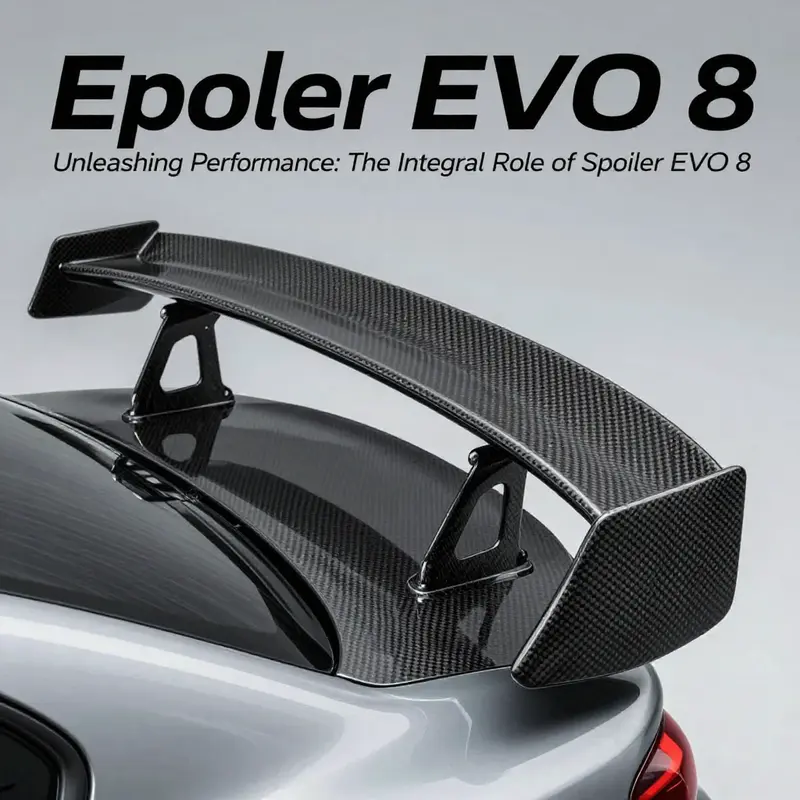
Across the lineage of the Mitsubishi Lancer Evolution, the rear trunk spoiler on the EVO 8 is more than a styling cue. At high speeds, it is a working part of the car’s aerodynamics, a discreet air management device that helps keep the tail planted and the chassis predictable. In the racing-informed culture around the EVO 8 and its EVO 9 kin, the choice of spoiler material becomes a quiet negotiation between weight, rigidity, and cost. While stock configurations favor balanced, predictable performance, aftermarket rear spoilers—crafted from carbon fiber, fiberglass, or ABS plastic—offer a spectrum of gains and compromises. The material decides not only how the spoiler looks but how it behaves when air flows over the coupe at speed. This is not merely about a clean silhouette; it is about engineering the unseen forces that press down on the car as it moves and about how those forces translate into stability for the driver under demanding conditions.
The material selection begins with a straightforward calculus: weight reduction versus structural stiffness. ABS plastic, the most approachable option, is celebrated for its cost efficiency and easy molding. It can be produced in large quantities, and it accepts mounting hardware with relative ease. For everyday use and street-driven EVOs, an ABS spoiler offers a lightweight upgrade that preserves a balanced feel around town and on smooth highways. Yet it carries tradeoffs. The material’s rigidity is respectable for casual spirited driving, but under the heat of track sessions or aggressive cornering, ABS can flex more than fiberglass or carbon fiber. That flex translates to less consistent downforce and, over time, a perception of diminished responsiveness as wind loads grow and the chassis enters high-g regimes. Still, for budget-conscious enthusiasts who want a visible upgrade without a dramatic jump in price, ABS provides a reliable first step toward enhanced aesthetics and a modest aero improvement.
Fiberglass represents the middle ground. Its strength-to-weight ratio typically outpaces ABS, and its rigidity surpasses that of the most common ABS variants. Fiberglass spoilers can be shaped with a more aggressive contour, enabling lines that underscore a performance stance while retaining practical durability. The material’s rigidity means the spoiler maintains its geometry under gusts and during high-speed shifts in air pressure. That stability translates to a more predictable downforce profile, which translates into tactile feedback through the steering and seat of the EVO during aggressive driving. Car builders appreciate fiberglass because it can be tailored to bespoke forms without the raw expense of premium carbon fiber. In the EVO 8 community, fiberglass spoilers are often chosen by those who want a performance-oriented look without committing to the high price tag of carbon while still seeking a noticeable uplift in how the rear of the car behaves when pressure builds behind the bumper.
Carbon fiber—whether standard prepregs or the more refined dry carbon variants—delivers the apex of performance in this trio. True dry carbon is pre-impregnated and cured under vacuum pressure, a manufacturing discipline that yields exceptionally high stiffness and a significantly reduced weight. The result is a spoiler that not only looks the part of a serious performance machine but also contributes to aerodynamic efficiency. Lighter mass at the rear means less rotational inertia and a more favorable moment for the tail to respond to rising air loads, which matters when the EVO is pushed toward the limit on a winding road or a track. For track-focused builds and premium show cars alike, carbon fiber offers a compelling blend of rigidity, surface finish, and fat-free weight. The visual appeal—those razor-sharp weaves under clear coat—also plays a decisive role in why carbon remains a coveted choice among EVO 8 owners who treat the car as a blend of performance and display.
All three materials influence, in different degrees, the spoiler’s effect on the EVO 8’s aerodynamics. They affect how efficiently the spoiler generates downforce, how it interacts with air flowing over the trunk, and how drag forces are managed as speed climbs. A lighter spoiler made from carbon might not only improve raw acceleration through weight reduction but also contribute to the overall balance of the car when combined with other aero components. In contrast, a fiberglass spoiler, while heavier than carbon, can be tuned to deliver a more assertive downforce gradient at the rear, potentially enhancing rear-end stability without the premium cost. An ABS spoiler, though lighter than some fiberglass options, will generally produce a different feel altogether, emphasizing durability and user-friendliness over the most aggressive aerodynamic performance.
Weight and stiffness, however, are not the only considerations. The EVO 8’s trunk design—its curvature, mounting surface, and available hollow in the deck—sets the stage for how a spoiler will align with the car’s tail. As a consequence, fitment becomes critical. A properly engineered spoiler must sit flush with the trunk line, with mounting points that distribute loads evenly and prevent stress cracking over time. The installation process itself is part of the performance story: it determines how the aero device behaves at speed and how well it retains its geometry through vibration and heat cycles. In this sense, the material choice links directly to practical durability. Carbon fiber units, while more brittle to impact than fiberglass or ABS, are often reinforced by careful engineering of the mounting interface and protective clear coats that resist UV exposure and stone impacts. Fiberglass units may stand up to occasional hits with more forgiveness, while ABS units benefit from tolerant tolerances that ease misalignment risks during installation.
Beyond the physics of downforce and drag, the choice of material carries a narrative about the EVO 8’s character. A carbon fiber spoiler speaks of a high-performance intention, signaling to the world that the car is a serious machine built for speed and precision. Fiberglass whispers of a hands-on approach, where builders enjoy shaping and refining a component that holds its own on the track while achieving a more aggressive silhouette than stock. ABS tells a story of practicality, a practical upgrade that satisfies the eye and the wallet without demanding a leap into higher costs. In this way, the material selection is as much about identity as it is about function. Enthusiasts weigh not only the compound’s mechanical properties but also how the material frames the car’s stance under light and shadow, how it ages with use, and how it harmonizes with other visible and hidden parts that contribute to the EVO’s aero personality.
There is also a broader aesthetic logic to consider. Spoilers do not exist in a vacuum; they occupy a position at the rear that is highly visible on the road and in show environments. The material finish—gloss or satin, warp-free surface, weave alignment in carbon—affects perceived quality. Carbon fiber and dry carbon often present a premium sheen that deepens with weathering and care, while fiberglass can be finished to a very high standard but may show more pronounced texture or seam lines if not finished meticulously. ABS, while functional, typically emphasizes smooth contours and even paint adhesion, yielding a clean, factory-like appearance that still communicates a performance upgrade. For many EVO 8 owners, the decision is a blend of objective performance goals and subjective assessment of how the spoiler will look when the car is parked in a showroom, on a street, or at a track exit. In the end, the narrative of material choice mirrors the rider’s intention for the vehicle.
To illustrate how these choices play out in practice, consider the way owners pair a spoiler with other carbon or composite accents around the car. It is common for enthusiasts to curate an aero ensemble that ties the rear spoiler to other carbon or composite panels on the car, a visual and functional strategy that reinforces the idea of a coherent performance package. For those who want to explore related carbon detail options on the EVO 8-9 chassis, a related component can be reviewed here: evo-8-9-varis-front-bumper-with-carbon-lip. The link demonstrates how designers coordinate front and rear aero elements to present a unified, purposeful silhouette while optimizing air management along the whole car.
Yet even as the material selection shapes performance and appearance, practical realities temper expectations. Carbon fiber and dry carbon units carry price premiums, but they also deliver longevity under vented heat conditions and sustained aerodynamic performance. Fiberglass offers a robust, mid-range option that can be refreshed with refinished surfaces and updated contouring. ABS provides an accessible, serviceable upgrade that keeps the EVO 8 approachable for a broad range of budgets. In every case, the spoiler contributes to a larger aero strategy that includes how the front splitter and underbody flow are managed, how the rear diffuser shapes the wake, and how the car’s overall weight distribution responds to the wind’s shifting pressure. The EVO 8, with its 2003–2007 lineage, benefits from spoiler choices that respect the architecture of the chassis while inviting modern aerodynamic thinking. The result is a car that looks fast even when standing still, and when moving, feels surgically stable rather than squirrely.
As owners weigh the choice, they are mindful not only of how a spoiler changes the rear’s bite at speed but how it fits into the car’s maintenance and ownership experience. Carbon fiber demands careful cleaning to preserve weave integrity and UV resistance; fiberglass requires attention to surface finishing to prevent micro-cracks from propagating; ABS benefits from consistent mounting and protective coatings to guard against warping in high heat. The practical maintenance story is a reminder that performance upgrades are not a one-time decision but an ongoing dialogue with the car’s behavior over time. The most satisfying outcomes often emerge when the material choice is matched to the driver’s goals: a goal-oriented path that couples track readiness with street reliability and a cohesive visual statement.
The EVO 8 spoiler tale thus becomes a meditation on how materials frame capability. It is a reminder that every gram saved, every rigidity gained, and every finish choice contribute to how the car communicates with the road. In a chassis that already embodies a balance of turbocharged thrust and agile handling, the rear spoiler’s material story completes the picture: it is the quiet engineer’s answer to the question of how to keep the car composed as speed climbs and forces push back. The EVO 8’s aerodynamics do not live in a single component; they reside in the relationship among weight, stiffness, and geometry. The spoiler, as a carefully selected material, helps ensure that the rear remains planted when it needs to be and that the car responds with confidence to quick steering corrections, throttle modulation, and corner entry speeds. This is the essence of spoiler evolution for the EVO 8—where every material choice aligns with the driver’s intent and every drive becomes a dialogue with air itself.
External resource for broader context on spoiler design and standards: https://www.autosport.com/motorsport-news/2026/01/28/understanding-evo-x-duckbill-spoiler-complete-guide-to-standards-properties-and-industrial-applications/.
Edge and Aesthetics: Installing and Assessing the EVO 8 Rear Spoiler for Stability and Style

The EVO 8 rear spoiler is more than a design flourish. In the world of high‑speed driving and track-inspired street performance, a trunk spoiler made from full carbon fiber is as much about control as it is about charisma. When mounted on a Mitsubishi Lancer Evolution VIII, the spoiler works with the car’s existing aerodynamics to generate downforce across the rear axle at speed. The result is a more planted feel when the road narrows and the throttle is pushed open. Enthusiasts often cite improved stability in mid-corner transitions and at the limit, where the rear end can come alive under acceleration or braking. A well‑designed spoiler helps box in the airflow, reducing rear lift and smoothing out the turbulence that naturally forms behind a high‑performance hatch. The carbon fiber construction is not simply about lightweight bragging rights. It is about a stiff, durable form that resists deformation under load and temperature changes, ensuring that the spoiler remains true to its intended angle and position even after years of heat cycling and road use. Beyond the science of downforce, there is a subtler but equally important effect: the visual cue of serious performance. A low-slung, carbon fiber rear spoiler signals intent. It communicates that the vehicle is tuned to stay composed at speed and that the owner values both function and form. Yet, for all its aerodynamic promise, the EVO 8 spoiler must be treated as part of a system. Its effectiveness depends on how well it integrates with the rear deck, the trunk lid’s geometry, and the mounting points that anchor it to the sheet metal. In this sense, the spoiler becomes a test of compatibility as much as of design. A spoiler that looks right but is misaligned or poorly secured can introduce flutter, creases, or even a compromise in the trunk’s seal. The significance of fitment cannot be overstated. When a spoiler aligns with the curvature of the hatch and sits flush against the surface, it minimizes gaps that can trap air and generate unwanted vibrations. A snug fit also preserves the trunk’s weather sealing, preventing water intrusion that could corrode fasteners or dull the finish over time. The EVO 8 is known for sharing its rear structural language with adjacent generations, notably EVO 7 and EVO 9. This shared geometry is a practical boon for compatibility. The rear mounting points, deck curvature, and hatch lip design tend to follow a family pattern across these models, which means many spoiler designs marketed for one model are described as compatible with others in the same generation family. This cross‑generational compatibility is not universal, however. Some early iterations of the Lancer Evolution family pursued different rear-end architectures or altered hatch dimensions enough to render a spoiler incompatible. In those cases, attempting a no‑cut, bolt‑on installation could result in misalignment, increased wind noise, or even structural stress at the mounting points. The rule of thumb for the EVO eight era is straightforward: verify the compatibility list and confirm that the mounting pattern matches the trunk’s geometry before purchase. The practical takeaway is to look for a design that explicitly states compatibility within the EVO VII–IX span. This approach reduces the risk of misfit and simplifies the installation process, ensuring that the spoiler works harmoniously with the car’s silhouette and its aluminum or steel subframes. For those who want maximum assurance, the simple bolt‑on route remains the best path. The majority of aftermarket spoilers in this category are designed to attach through existing holes or with minimal modifications to the trunk lid. The process typically involves removing the old hardware, aligning the spoiler with the hatch, and tightening a series of hardware nuts or bolts that pass through the deck. The objective is to achieve a precise alignment where the trailing edge of the spoiler sits just clear of the hatch’s edge, while the leading edge begins to meet the top surface with a seamless transition. This is less about forceful clamping and more about minute adjustments to achieve a crisp, level line along the car’s rear profile. The installation flow often includes a careful test fit before any adhesive is used, followed by a final torque specification for each fastener. In many setups, the finishing touch is a light sealant or seam tape to protect the joint from moisture ingress. A lot of what makes the EVO VIII’s rear end feel cohesive is an iterative approach: mount, check alignment, refine, reseat, and recheck. For typical street use, a straightforward bolt‑on arrangement is sufficient, and it preserves the hatch’s integrity without requiring any cutting or structural modification to the vehicle. This preserves factory resale value and keeps the package reversible if one decides to revert to stock in the future. For owners seeking a performance edge beyond a fixed rear spoiler, there is a broader spectrum of modification ideas. Some builders explore adjustable or winged rear configurations that allow the angle of attack to be tuned for specific tracks or driving styles. In these setups, the spoiler is paired with a set of strengthened brackets, sometimes referred to as wing brackets, that connect to the deck in a way that permits some degree of articulation. The practical considerations here are substantial. Adjustable systems demand more careful alignment, robust fastening to resist stress at speed, and, in some cases, interior reinforcement to prevent squeaks or rattles as the chassis flexes. They also introduce a higher maintenance obligation, because the more complex hardware and moving parts can demand periodic inspection after aggressive driving. For a road car that is used for spirited weekend sessions rather than full‑on competition, the industry consensus tends to favor the simpler, bolt‑on approach. It delivers the essential aerodynamic effect without the added complexity and risk of a more aggressive setup. In addition to fitment and installation, the conversation around spoilers inevitably touches on materials and finish. The carbon fiber option is prized for its stiffness and lightness, which help keep the mass bias predictable as the car transitions through fast corners. Some buyers opt for a painted ABS alternative, which can be more economical and easier to color match with the vehicle’s exterior. The choice between carbon fiber and painted plastic comes down to balance: weight savings versus cost, and the owner’s preference for a sportier look versus a more understated profile. Whichever material is chosen, the finish matters. A spoiler that has been prefinished to a precise color code will blend with the trunk without demanding a costly paint job. If the owner prefers a different tone, the unit can be repainted to match the car’s color. In all cases, meticulous preparation—surface cleaning, proper adhesion, and a careful curing schedule—ensures that the spoiler remains secure and visually cohesive for years to come. The broader lesson here is clear: the EVO 8 rear spoiler is not a standalone accessory. It is a performance component whose value is realized only when its geometry, mounting method, and finish are aligned with the car’s chassis and the owner’s driving goals. When installed on the EVO VII–IX family with the right mounting pattern, it delivers a meaningful uplift in rear stability—an uplift that complements the mid‑range balance of the Evolution VIII. It is a reminder that performance upgrades, even those that seem purely cosmetic at first glance, operate within a tightly coupled system. The result is not merely a look that signals speed; it is a balanced, repeatable experience at the wheel. As builders and drivers move from concept to execution, the practical essence remains consistent: choose a spoiler that fits the EVO 7–9 platform, install it precisely on a clean, well‑secured trunk, and respect the edge between airflow and structure. In this way, the EVO 8 spoiler becomes a functional piece of aero, a tactile confirmation that the car’s design language extends into how it grips the road at velocity, and a statement that the pursuit of speed is as much about intelligent integration as it is about bold lines and carbon fiber shine.
Downforce as Identity: The Market Rise of the EVO 8 Spoiler

The rear trunk spoiler on the Mitsubishi Lancer Evolution VIII has long been a hinge between aesthetics and function. In today’s market it assumes a more intentional role, acting as a tuned interface between aerodynamics, weight, and the car’s overall balance. For the EVO 8, a generation iconic among enthusiasts, the spoiler is not merely a styling cue; it is designed to contribute measurable downforce at speed, translating into stability, traction, and confident handling in fast sweeps and tight corners.
In this climate, buyers seek both the look of a performance stance and a real upgrade in on-road behavior. The material story—full carbon fiber and advanced composites—now underpins opts that save weight without sacrificing rigidity. This is not a cosmetic upgrade; it is a performance enhancement that happens to look striking. The market is gravitating toward integrated aero solutions rather than standalone add-ons, with spoilers designed to work in concert with the rear hatch, spoiler geometry, and the car’s chassis.
Industry trends point toward packages that bundle aero with brakes, tires, and suspension tuning. When a spoiler’s downforce is paired with a calibrated rear diffuser and compatible chassis geometry, the improvement becomes tangible on real roads and track days. The shift reflects a broader industry move toward intelligent, multi-part upgrades that emphasize efficiency as well as presence.
Beyond parts, information flows through enthusiast communities and trusted guides. Buyers increasingly rely on credible sources that map OEM options alongside reputable aftermarket routes, helping distinguish durable designs from flash-in-the-pan offerings. The emphasis on genuine materials—carbon fiber’s stiffness, fatigue resistance, and heat tolerance—means that sourcing is as important as fitment and finish.
From a design perspective, the best EVO 8 spoilers respect the car’s lines while delivering function. Depending on the trunk geometry, a spoiler may sit flush or slightly raised to manage the wake without creating drag penalties. The aim is to balance a bold visual statement with a rigorous assessment of how geometry affects rear axle load, weight distribution, and everyday usability.
Ultimately, the EVO 8 spoiler exemplifies a broader move toward coherent performance packages. Buyers increasingly expect a complete, compatible upgrade rather than a single-piece add-on. The carbon trend, when properly integrated, yields gains in weight, stiffness, and dynamic balance that justify thoughtful investment and careful comparison across OEM-like options and aftermarket alternatives.
For readers starting their journey, practical guidance centers on compatibility checks, material selection, and total package fit. A thoughtful approach weighs downforce potential, weight penalties, and how the design interacts with other rear-end components, ensuring trunk access and seal integrity remain intact. In short, choose a spoiler that aligns with driving goals and maintenance realities as much as with appearance.
Beyond the Badge: Spoilers, Aero, and the EVO 8 Era

The rear trunk spoiler on the Mitsubishi Lancer Evolution VIII sits at a quiet crossroads between engineering intent and automotive theater. For the EVO 8 and its EVO 9 successor, the full carbon fiber spoiler was marketed as a precise component of the car s aero package. Its stated purpose was straightforward in concept: to influence the air that rushes off the back of the car at speed, to shape the wake, and to add a measure of downforce that helps keep the hatch planted through high speed transitions and aggressive corner work. In practical terms, the spoiler sits atop a tapered trunk lid, a location that makes it an obvious visual cue of performance. When the car is moving, the spoiler threads the air toward the rear, and in the best cases it contributes to the vehicle s stability by smoothing out the flow where the roofline meets the hatch. For enthusiasts, this is part of the EVO s visual signal and tactile feedback: the car feels more secure when the tail is more firmly anchored, and that sense of control is part of the driving experience as much as the speedometer reading or the exhaust note.
Yet a careful review of available material around the phrase Spoiler EVO 8 reveals a nuanced truth: the term is often used to describe aesthetic upgrades such as lip spoilers and other appendages that align with the car s aggressive silhouette, rather than a device delivering consistent downforce gains in typical driving conditions. In other words, the popular use of Spoiler EVO 8 often signals style and a badge driven look as much as, if not more than, a measurable improvement in downforce. The research landscape does not yield a robust set of engineering data showing a clear, independent performance uplift from a specific EVO 8 spoiler in isolation. Instead, what surfaces in discussions about performance optimization for the EVO 8 is a more complex picture: the chassis, tires, alignment, and brake balance together with a properly designed aero element shape the feel and stability more than any single cosmetic add on.
That framing opens a broader conversation about where performance actually comes from in modern performance packages. The EVO 8 context sits alongside a different yet instructive narrative from another corner of advanced sports engineering. In a field far from the EVO s hatchback silhouette, the Specialized Epic 8 EVO, a downhill mountain bike designed for speed through rough terrain, exemplifies how performance is often a function of an integrated system rather than a single piece. The bike s improvements do not hinge on one flashy component; they come from a set of coordinated advances: enhanced suspension kinematics that reduce pedal bobbing by a significant margin, and a front end travel allowance of up to 130 millimeters that expands the rider s control on technical ground. The bike s progress also includes a refinement in geometry that follows a progressive path toward greater capability, efficiency, and confidence for the rider. This juxtaposition a aero part marketed for stability on a street or track driven car and a biking platform engineered for downhill competitiveness underscores a central truth in performance culture: meaningful gains rarely arrive from a single, isolated upgrade. They arrive when the system as a whole is tuned for harmony, whether the stage is a tarmac sprint or a descent through gnarly terrain.
With that context, the EVO 8 spoiler should be read as part of a broader design philosophy rather than a solitary performance lever. The use of full carbon fiber carries its own rationale beyond the sleek surface. Carbon fiber brings a high stiffness to weight ratio, an advantage that affects the lid s response to air pressures and the overall mass that must be moved at speed. A well executed carbon spoiler also carries functional benefits in manufacturing and durability: the weave and resin systems can be tailored to resist the stresses of sudden gusts and cornering loads, while maintaining a clean aesthetic that resonates with the era s emphasis on lightweight yet strong construction. The visual language visible carbon fiber, precise edges, and a flush integration with the trunk lid appeals to enthusiasts who want both form and function in equal measure. Still, the practical implications of this material choice rely on a meticulous fit, robust mounting, and careful alignment with the rest of the car s aero profile. A spoiler that is not properly tuned or integrated can introduce ineffective drag, a disturbed laminar flow, or even structural vibrations that detract from the driving experience. In other words, the carbon spoiler s promise rests on precision, not merely presence.
The practical takeaway for a reader surveying the EVO 8 s aero upgrades is nuanced. On the street or a circuit day, the addition of a spoiler especially one sized and shaped to complement the EVO s geometry can contribute to a more confident, planted feel at high speeds. The stabilization it promises is a function of the spoiler s interaction with the rear wake, the car s suspension setup, and the tires ability to maintain traction through the rear axle. Yet the question of how much downforce is actually generated, and whether that downforce translates into a measurable advantage in time or lap consistency, remains less transparent in the documented data. In some cases, the perceived stability is as much about the driver s perception and the car s balance as it is about an objective, quantifiable improvement in downforce. It s a reminder that performance is often an emergent property of how parts work together, not a single component s isolated effect.
Within that frame, the EVO 8 spoiler becomes a study in the broader aesthetics versus aero debate that shapes the aftermarket and enthusiast communities. The momentum of a well executed carbon spoiler paired with compatible rear end components and a proportionate canopy of air management features provides a cohesive look and a coherent feel. It aligns with a culture that values clean lines and purposeful engineering as much as it does the thrill of speed. Enthusiasts often pair this spoiler with complementary body parts to maintain a harmonious visual narrative a rear bumper designed for modern aerodynamics, side treatments that echo the spoiler s line, and a set of wheels that completes the silhouette. The relationship between the spoiler and the rest of the EVO s body kit is therefore not incidental. It signals intent, communicates performance minded design, and offers a tangible signal to onlookers of the owner s commitment to the car s performance identity.
For readers seeking a practical lens, consider how this concept translates to what aftermarket parts add beyond looks. The inclusion of a rear spoiler invites a re evaluation of the car s overall aero balance: how does air cling to or separate from the fastback profile, how does the rear diffuser manage the wake, and how do tires and brakes respond to the car s altered load distribution? These questions anchor the discussion in a broader engineering framework that transcends the EVO 8 and touches the universal trade offs of aerodynamic design. Aesthetic upgrades matter, but when paired with thoughtful engineering they become part of a coherent system that supports performance without compromising reliability or daily usability.
In the context of this chapter it is appropriate to acknowledge an adjacent aspect of the aftermarket ecosystem. The EVO 8 s visual and aerodynamic upgrades do not occur in a vacuum; they interoperate with other body components and with the owner s goals whether those are sharper handling on a track, improved confidence in fast road driving, or simply a striking cohesive look. A practical example of how these parts relate is the ongoing ecosystem around the EVO s body kit, including the OEM rear bumper options and compatible parts that shape the overall aero and visual stance. A reference to the rear bumper option can be found here: OEM rear bumper for Mitsubishi Evolution 8-9. This link demonstrates how enthusiasts curate a complete package that respects both form and function rather than chasing a single feature in isolation.
External reading can broaden the perspective on the physics behind downforce and drag. For a broader, technical view of how aero components influence stability and efficiency, see the external resource on downforce and aerodynamics. This broader context can help readers separate marketing from measurable effects and better appreciate the EVO 8 spoiler as part of a holistic approach to performance tuning.
Final thoughts
The Mitsubishi Lancer Evolution VIII spoiler is more than just a visual enhancement; it’s a critical component that can redefine the driving experience. From the aerodynamic benefits that stabilize the vehicle at high speeds to its appeal in the burgeoning aftermarket, understanding the full scope of the EVO 8 spoiler can offer business owners insights into consumer preferences and performance demands. By recognizing these elements, companies can better position themselves in a competitive automotive landscape, catering to enthusiasts who value both style and substance.