

The Mitsubishi Lancer Evolution X, known for its remarkable performance and motorsport heritage, is propelled by the powerful 4B11T engine. This article explores its performance specifications, groundbreaking technological innovations, and enduring impact on automotive engineering. By understanding these critical aspects, business owners can appreciate the evolution of high-performance automotive engineering and its influence on market trends and consumer preferences.
The Heartbeat of a Rally Legend: Inside the 4B11T Powerplant that Fueled the Evo X
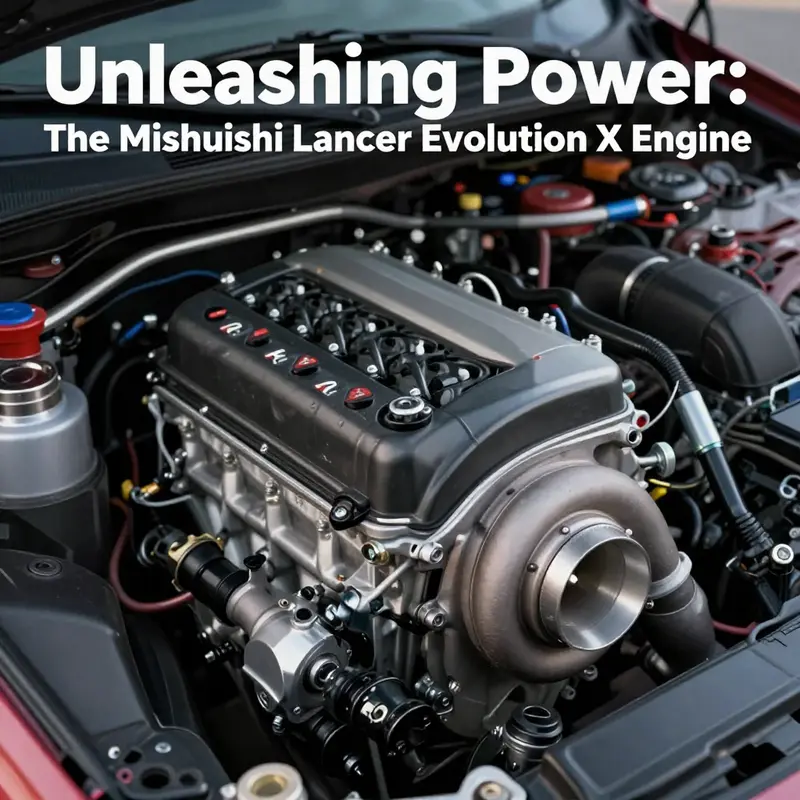
The Evolution X wears its name with purpose, signaling the culmination of Mitsubishi’s engineering arc in the Lancer line and the pivot from naturally aspirated rally DNA to a turbocharged, track-ready era. At its core sits a compact, force-fed champion: a 2.0-liter inline-four that blends rally-bred temperament with modern precision. The engine that powers the Evo X—commonly known by its code, 4B11T—embodies a philosophy of balance. It must deliver immediate response, sustainable high-speed performance, and robust reliability under track pressures, all while fitting within a sophisticated, all-wheel-drive chassis system designed for the cornering and grip demanded by competitive rally heritage. In this sense, the 4B11T is less a mere power unit and more the living heart of a car whose handling, acceleration, and durability are interwoven with Mitsubishi’s S-AWC philosophy, which marries advanced diffs, yaw control, and braking harmony into a single, sail-shaped cruising and cornering profile.
From the outset, the 4B11T is a departure from the older, naturally aspirated engines that powered earlier Evolutions. It represents a new era in which forced induction, careful turbo dynamics, and valvetrain control converge to extract peak efficiency across a broad rpm band. The engine’s displacement—1998 cubic centimeters in most markets—places it in the sweet spot for a balancing act between high-end power and low-to-mid-range tractability. It’s a unit that was designed to respond quickly to throttle input, yet to maintain a steady surge as the turbo builds pressure. In a car whose entire mission is to harness power through four wheels with minimal delay, the turbocharger is not merely an add-on; it is a foundational element of the vehicle’s personality.
Architecturally, the 4B11T is a double-overhead camshaft (DOHC), 16-valve inline-four with Mitsubishi’s MIVEC variable valve timing. This combination is more than a mechanical detail; it is a deliberate attempt to shape the engine’s breathing across the entire rev range. MIVEC optimizes valve timing for both intake and exhaust, dialing in torque and response when the driver is asking for urgency at low speeds, and smoothing the transition to higher rpm where the engine’s breathing becomes more constrained. The result is not merely more horsepower at peak; it is a more usable, more linear power curve that keeps the Evo X feeling eager whether the road is winding or the straightaway is open.
The turbocharger—an IHI unit, frequently described in the Evo X’s documentation as VF23 or VF24 depending on year and trim—was chosen to balance rapid spool with sustained top-end power. This is a critical detail. In a car where throttle response and midband torque can determine the winner on a tight corner, the nature of the turbo’s response matters as much as the absolute peak numbers. The Evo X often uses a twin-scroll arrangement, a configuration designed to separate hot exhaust pulses and feed them efficiently into the turbine, reducing lag and improving throttle response. This kind of turbo architecture complements MIVEC’s timing strategies by offering a more predictable torque delivery as boost builds, allowing the driver to place the car with accuracy and confidence in corners.
Power outputs recorded across markets for the Evo X sit in a relatively tight corridor, with factory figures commonly cited in the high 290s horsepower, occasionally creeping toward three hundred. The spectrum—from roughly 291 to 303 horsepower—reflects the natural variation between model years, trims, and tuning approaches, including the Final Edition’s celebrated 303 hp calibration. Torque follows a similarly broad lane, generally reported in the mid to upper three hundred-newton-meter range, with higher torque figures associated with the more aggressive Final Edition calibrations. What matters in daily driving or track settings is not simply the peak figure but how the engine reaches, sustains, and delivers that torque. A good torque curve under boost means strong midrange acceleration, confident overtaking, and predictable pull through corner exits.
The Evo X’s compression ratio—usually quoted around 9.0:1 in many technical resources—complements the forced-induction approach by balancing efficiency with the ability to withstand sustained boost without knocking. A slightly lower compression ratio, coupled with modern engine management, allows for more aggressive ignition timing and higher boost pressures, translating to a robust and coherent power delivery that remains reliable during repeated high-load sessions. The fuel system plays a critical role here as well. In a car designed for performance driving, the Evo X adopts a sequential fuel delivery approach, with fuel being precisely metered to keep air-fuel ratios favorable across rpm and boost levels. Some detailed sources describe the system as sequential multi-port injection, which points to the same underlying goal—precision and consistency—though the exact implementation may vary by market or exact model year. Either way, the fuel system is engineered to supply the engine with the correct mixture at all times, ensuring power, responsiveness, and efficiency under pressure.
What makes the 4B11T particularly compelling in the Evo X isn’t only its mechanical backbone. It is the way that engine management and drivetrain integration harness the engine’s output to extract maximum performance from the car’s all-wheel-drive system. Mitsubishi’s S-AWC—Super All-Wheel Control—binds together an Active Center Differential (ACD), Active Yaw Control (AYC), and ABS/EBD into a package that choreographs how power is distributed and how braking and steering forces are managed in concert. This architecture is more than an instrument of traction; it becomes an extension of the driver’s intent. In practice, the 4B11T’s torque and throttle response feed into an AWD system that can pre-load the front wheels, adjust yaw dynamics, and stabilize the chassis through corners with a precision that feels almost surgical. In the Evo X, the engine and the chassis are not separate systems but two halves of a tuned instrument designed to work together, day in and day out, whether the road is a fast mountain pass or a race track.
The performance envelope of the Evo X—when the engine, turbo, and drivetrain cooperate—often translates into a 0–100 km/h (0–62 mph) time hovering near 5.9 seconds. That figure speaks to the synergy of a compact turbo four, a carefully matched turbocharger, and a drivetrain that can apply power with front-to-rear balance and minimal slippage under load. It is a demonstration that a modern hot sedan can deliver the immediacy and thrill of a purpose-built rally car without sacrificing everyday drivability. The results are not accidental. They come from a philosophy that values throttle response, linear torque delivery, and stable high-speed behavior as core competencies of the engine’s character, rather than merely chasing peak numbers on a dyno.
The engine’s durability and potential for evolution have contributed to the Evo X’s enduring appeal. For enthusiasts, the 4B11T is an invitation to explore performance upgrades that can push power and response beyond stock levels while retaining reliability enough for track days and street use. Upgrades such as larger intercoolers, higher-capacity fuel systems, more aggressive turbochargers, and ECU remapping are common routes through which the engine’s capabilities are expanded. Within tuner communities, the 4B11T has earned a reputation for robustness and a willingness to respond to careful, well-planned modification strategies. In this sense, the Evo X engine is not just a factory spec machine; it is a platform with a living, modder-friendly lineage that continues to attract new generations of drivers who want to connect a high-performance powerplant to a chassis designed for precision, balance, and aggressive pace through corners.
A practical perspective on maintenance and heat management is essential for owners considering extended track sessions or ambitious tuning. The Evo X employs an enhanced cooling system to handle sustained high-power operation, guarding against heat soak and helping preserve performance over long stints. The intercooling strategy—intercoolers that either use air-to-water or air-to-air configurations in different variants—plays a central role in maintaining charge stability under boost. The interplay between intake temperature, combustion efficiency, and knock resistance is a subtle but critical thread in the engine’s behavior. The result is a powertrain that can deliver consistent performance throughout a session, not just in a single, peak-engined moment. In this context, the 4B11T is not simply about chasing numbers; it is about maintaining the relationship between timing, boost, and fuel as conditions change, from chilly morning runs to the heat of afternoon corners.
The 4B11T’s rally-inspired DNA rests in more than name or lineage. It represents a deliberate bridging of eras: the enduring zeal of the 4G63 lineage—famous for its torque delivery and tunability—reimagined through modern electronics, precise fuel control, and sophisticated turbocharging. In the Evo X, that blend lands as a chassis that sounds, feels, and behaves like a track-ready sedan, even when it is being piloted through a curving mountain road in a quiet residential area. The Final Edition’s 303 hp calibration is not simply an end-state; it signals a philosophical capstone—an acknowledgment that this engine could be tuned and elevated while still preserving the reliability and tractable nature needed by enthusiasts who drive their cars both on the street and on the track.
For the curious builder, there is an element of almost ritualized sourcing and component selection. A billet-block approach to the engine’s bottom end, for example, has become a noted upgrade path in certain circles, reflecting a desire to increase rigidity and reduce flex under high-performance regimes. The catalytic interface between such hardware and the control algorithms of the ECU is complex, but it is precisely these relationships that define a modern performance engine. The idea is to push the engine’s limit with confidence, knowing that the fundamental structure—crankcase stiffness, piston stability, and rod integrity—has been fortified to withstand more aggressive boost and higher revs. In the community of enthusiasts, such hardware upgrades are often accompanied by careful calibration and a disciplined approach to cooling, fueling, and lubrication. And while the essence of the Evo X engine remains rooted in its factory specification, the door to further performance is open to those who respect the machine’s design constraints and understand how to optimize it without compromising reliability.
The Evo X also carries a legacy that matters beyond numbers. It was the final chapter in Mitsubishi’s Lancer Evolution saga—a vehicle that carried a rally story into everyday roads and race circuits alike. The engine’s robustness and tuning potential have ensured that the Evo X remains a favorite among collectors and track-day enthusiasts. This enduring appeal is not merely nostalgia; it is a testament to a powerplant that could be trusted to perform and to adapt, a rare combination in a market defined by rapid technological change. In this respect, the 4B11T stands as a landmark in modern performance engineering: capable, adaptable, and deeply connected to a history of rallying that continues to captivate drivers who crave precision, speed, and the thrill of controlling immense torque through a refined, responsive 2.0-liter heart.
To summarize, the 4B11T engine in the Evo X represents more than a high-spec power unit. It is a carefully engineered collaboration of turbocharged performance, variable valve timing, and sophisticated all-wheel-drive integration. It embodies Mitsubishi’s commitment to delivering a balanced experience, where the engine’s torque married to a well-calibrated drivetrain yields confidence in the hands of drivers at the limit. It is a powerplant designed not only for peak horsepower figures but for the way those figures feel in real-world driving—how quickly power arrives when the driver wants it, how smoothly that power builds, and how predictably the car behaves as it accelerates out of corners. It is the heartbeat of a car that remains a symbol of engineering ambition, a car whose legacy invites new generations to explore what a high-performance sedan can be when it is built on principles of rally history, precise engineering, and a relentless curiosity about how to make power meet pavement with clarity and control.
For readers who want a closer look at the materials and upgrade options that sit adjacent to the engine, there is a growing catalog of performance hardware that enthusiasts reference when planning a build. In particular, upgrade components marketed toward the 4B11T family, including a billet block option, illustrate how builders seek greater rigidity and durability to sustain higher power levels while maintaining the engine’s reliability under track conditions. The adaptability of the 4B11T—its willingness to respond to holistically designed upgrades and ECU calibrations—continues to be a central factor in why this engine remains a cornerstone of Evo X lore and a source of ongoing fascination for the tuner community. For readers who want to explore cross-referenced details, a deeper dive into a billet-block option can be found here: 4B11T billet block. This link is a practical reminder that the Evo X’s engine is not only about what Mitsubishi built at the factory, but also about what the community has imagined and implemented in pursuit of higher performance, reliability, and driving joy.
Looking beyond the specifics of the engine’s internal hardware, what remains striking about the Evo X is how the engine’s character is inseparable from the chassis and electronic controls that define the car’s on-road personality. The 4B11T’s torque characteristics, boosted by turbo dynamics and smoothed by MIVEC timing, feed into an S-AWC system that actively manages grip, understeer, and yaw—a combination that makes the Evo X surprisingly tractable at the limit yet capable of delivering a raw, focused driving sensation when the driver wants it. This is not merely a matter of horsepower; it is a matter of how that horsepower is delivered, how the car’s platforms and electronics react to the driver’s input, and how that reaction translates into meaningful, confidence-inspiring performance. In the end, the Evo X engine’s story is a story of partnership: between the engine’s mechanical architecture, the turbo’s responsiveness, the valvetrain’s timing, and a drivetrain that asks for precision, not simply power. The result is a car that feels alive, a vehicle whose engine not only moves air and fuel but also shapes the way the vehicle sits, breathes, and executes each line through a corner.
External resource: Official technical specifications and detailed data for the Evo X engine can be found at the Mitsubishi technical specifications page: https://www.mitsubishimotors.com/technical-specs/
Turbocharged Precision, Rally-Bred DNA: Inside the Evo X Engine
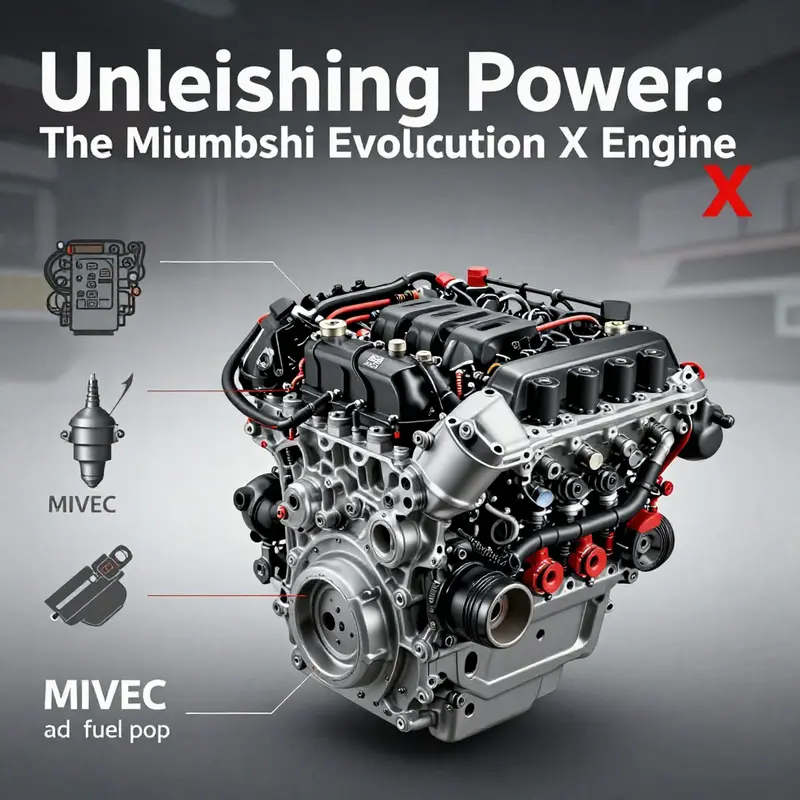
The engine of the Evolution X stands as a crystallization of a lineage that married endurance racing with street practicality. It is a compact, force-fed powerplant whose core design—a 2.0-liter inline-four with four cams and sixteen valves—embeds a philosophy of balance: high specific output, broad torque delivery, and a linear, predictable response that remains friendly to both track sessions and everyday driving. This chapter follows the thread from architecture through behavior on road and track, showing how the engine’s engineering choices translate into the Evo X’s notable performance and its reputation among enthusiasts who prize tunability and durability as two sides of the same coin. In tracing these choices, one encounters a philosophy that treats power not as a sudden surge, but as a controlled, repeatable drumbeat that keeps the chassis connected to the surface beneath the tires, no matter how aggressively the throttle is pressed or how aggressively the corners unfold ahead.\n\nAt the heart of the engine is a displacement just under two liters, a compact volume that suits the chassis’s balance and weight distribution. With a 9.5:1 compression ratio and a compact bore-and-stroke relationship, the engine embodies a design that aims for efficient warm-up, robust torque production, and reliable operation across a wide RPM spectrum. The architecture hinges on dual overhead camshafts and a sixteen-valve arrangement, a configuration that is particularly well suited to modern valve timing strategies. The engine breathes through a fuel system calibrated for sequential injection, delivering precise amounts of fuel in sync with the intake and exhaust cycles. This is more than a matter of piston movement; it is a carefully choreographed interaction between air, fuel, and ignition that must remain consistent as rpm climbs and the demands of the chassis shift with cornering loads, grip levels, and elevation changes.\n\nWhat elevates this engine beyond a simple air-and-fuel machine is the adoption of electronic valve timing control that governs both the intake and exhaust cams. This variable valve timing system lets the engine optimize valve opening and closing across the entire rev band. In practical terms, that means the engine can deliver strong torque at relatively low engine speeds for quick responses in street driving, while also maximizing high-RPM flow to sustain power toward redline. In the Evo X, this approach translates into a broad, usable torque curve and a power delivery that feels both linear and anticipatory. The sensation when the accelerator is pressed is not a sudden, dramatic spike but a confident, progressive surge that builds trust between driver, engine, and tires. The effect is especially noticeable when the car is exiting a corner; the torque comes up smoothly, enabling controlled acceleration without the need to chase peak boost through a narrow RPM window.\n\nBeyond the core breathing and timing logic, the engine integrates a forced-induction approach that emphasizes both raw pace and steady, repeatable delivery. A twin-turbo arrangement, paired with a well-integrated intercooler, expands the engine’s effective volume by compressing intake air and cooling it before it enters the cylinders. The result is more air per combustion event, which, in turn, supports higher boost at a wide range of engine speeds. The twin-turbo strategy helps flatten the power curve, reducing the characteristic “on-off” feel that often accompanies turbocharged four-cylinders when the boost arrives in a narrow zone. With the Evo X, boost comes in a way that respects grip and chassis balance, producing acceleration that remains controllable even as corner entry becomes more aggressive and exit speeds rise.\n\nThe numbers—power and torque—are a telling part of the story, but they require careful interpretation. Factory ratings have hovered around the high two- to low-three hundred horsepower range, with torque figures spanning a broad spectrum that reflects trim levels and tuning emphasis. In more general terms, the engine produces power near the upper 200s to just over 300 horsepower, and peak torque sits well above the 300-Nm mark, with variations depending on model and configuration. A useful way to think about it is that the Evo X’s engine is designed to deliver close to 300 horsepower with a torque peak that remains accessible in the midrange, rather than peaking only at the top end. This combination makes the car feel eager and responsive in everyday driving, while still offering serious performance when the road demands it. The presence of a compression ratio of 9.5:1 underlines a deliberate choice: it balances the benefits of efficient compression with the robustness needed to tolerate boost and high-load operation. In practice, this translates into a power plant that starts easily from a cold engine, maintains stable performance as temperatures rise, and tolerates a broad spectrum of fuel and driving conditions with a predictable response.\n\nThe engine’s breathing and boosting are matched to the Evo X’s driveline and chassis architecture in a way that reinforces the car’s overall dynamic identity. Power from the engine is complemented by the all-wheel-drive system’s central differential, torque vectoring, and brake-based yaw control, which coordinate with the engine’s torque delivery to maintain traction through corners. The synergy is not accidental; it is the result of a concerted engineering effort to ensure that the engine’s torque, when applied through the drivetrain, translates into composure on the road. When the driver places a demand on the throttle, the system responds with a measured combination of grip, weight transfer, and torque management that helps the car maintain line and speed through bend after bend. This is one of the Evo X’s enduring appeals: the sense that the engine’s power is not just impressive on a straight line but also coherent and manageable as cornering load increases.\n\nFrom a durability perspective, the engine’s architecture emphasizes reliability that supports high-performance usage. The displacement, the modular nature of the valvetrain, and the robust cooling strategy work together to enable sustained operation at elevated power levels. This is not an engine that delivers peak numbers and then becomes fragile under sustained track use; rather, it is designed to tolerate repeated high-load cycles, provided maintenance is kept current and the air and fuel quality remain within expected ranges. This robustness is part of why the Evo X retains resonance among enthusiasts who pursue both spirited street driving and occasional track days. The car’s powertrain philosophy—where engine responsiveness, torque delivery, and driveline control are tuned to work in harmony with the chassis—helps explain why the Evo X remains a favorite for those who value both performance and chassis communication.\n\nThe engine’s heritage adds another layer to its character. It traces a direct line back to a family of engines famous for durability and tuning potential. This lineage carries with it rally-bred DNA, where the aim has long been to convert compact displacement into serious performance without sacrificing reliability. The Evolution X thereby represents a continuation of a story: a story where small, efficient, highly engineered powerplants are asked to operate at or near their limits, and where the surrounding hardware—suspension, exhaust, aerodynamics, and the control systems—are designed to extract maximum potential while preserving daily drivability. In this light, the Evo X’s engine is not an isolated unit but a central piece of an integrated performance package that relies on feedback between engine, driveline, and chassis to achieve its dynamic goals.\n\nAs for the specifics that enthusiasts often chase—peak horsepower, peak torque, and the speed at which the car can accelerate from a standstill—the Evo X blurs the line between raw numbers and real-world behavior. The 0–100 km/h sprint, for example, has been cited in various contexts as being under five seconds, depending on the exact configuration and the conditions under which testing occurs. In some detailed assessments, performance times have hovered around four-and-a-half to five seconds for well-prepared configurations, while more conservative or showroom-like settings might report closer to five seconds. These figures are not only about the engine’s push; they reflect the full package: turbocharging efficiency, throttle response, turbo lag management, intercooling effectiveness, transmission behavior, and all-wheel-drive control dynamics. The result is a powertrain that can feel brisk and urgent when the throttle is carved into, but that can also be gentle and predictable when cruising or negotiating traffic. In other words, the engine’s personality is shaped by its integration with the car as a whole, rather than by its numbers alone.\n\nA useful thread to pull in understanding the Evolution X engine is the way it intersects with the car’s tuning culture. The engine’s architecture is widely regarded as friendly to modification, thanks in part to its compact size, robust internals, and the broad space available for airflow and cooling improvements. From a performance-tarts perspective, this means enthusiasts often pursue enhancements that emphasize improved airflow to the turbochargers, more efficient intercooling, refined fuel and ignition maps, and upgraded cooling to sustain higher boost across longer periods. The off-the-shelf and aftermarket ecosystems have grown around the premise that the engine can be made to deliver more with careful, deliberate tuning rather than through brute-force changes that compromise reliability. In practice, this has meant that the Evo X has remained a canvas for enthusiasts who value not only peak power but also predictability under load. The engine’s electronic controls, designed to adapt to varying conditions, can accommodate changes that expand the envelope without sacrificing drivability or durability, provided the modifications are carried out with the same respect for the balance that the factory engineers sought to achieve.\n\nTo appreciate the engine’s technical details in the context of the Evo X’s broader engineering, it helps to consider how the powerplant interacts with specific components aimed at controlling traction and stability. The vehicle’s drivetrain integration is not merely about getting power to the wheels; it is about delivering that power in a controlled, confident manner. The software that coordinates the center differential, the torque distribution between the front and rear axles, and the yaw-control strategy works in concert with the engine’s torque characteristics. When the car enters a corner and the throttle is applied, the system moderates the slip, modulates the distribution of torque to the wheels with the goal of preserving a stable path, and uses brake-based vectoring to fine-tune the car’s orientation. The engine, in turn, contributes by providing a torque profile that the control system can manage effectively. The result is a vehicle that can carve through a bend with a degree of precision that makes the driver feel connected to the road and confident in the car’s reactions. This is not just about raw speed; it is about confidence, repeatability, and the sense that the car’s dynamics are predictable even when the dynamics themselves are complex and demanding.\n\nAn image often used to describe this engine’s ethos is that of a well-coordinated orchestra. The turbochargers are the brass section, delivering power in a steady, predictable swell; the valve-timing system is the woodwinds, enabling nuanced responses across a wide range of RPM; the fuel system is the percussion, providing rhythm and consistency as load and boost rise. The cooling system acts as the conductor, keeping the ensemble in harmony when the tempo quickens under track conditions. When all these elements work together, the Evo X reveals how a modern turbocharged four can combine the intensity of a performance machine with a level of reliability and everyday usability that keeps it relevant beyond the race track. This balance is at the core of the engine’s appeal: it is not merely capable of impressive peak numbers but is equally capable of delivering a coherent, confident drive on ordinary roads and on demanding circuits alike.\n\nFor readers who want to explore a tangible piece of the engine’s development story, a look at the hardware upgrades that underpin performance can be enlightening. One such upgrade area—often cited by builders and tuners alike—centers on strengthening the bottom end to handle higher torque levels and boost pressures. A billet-block upgrade, for instance, is a product category that represents a strategic investment for those who want greater durability under sustained high-load operation. While this paragraph cannot name specific products in detail, the concept is straightforward: improving the engine block to better withstand the pressures of boosted operation contributes to reliability during track sessions and aggressive street driving. It is a reminder that the Evo X’s engine is not only about what comes from the factory but also about what can be achieved when the engine is supported by a thoughtful, well-executed upgrade path. For readers who wish to learn more about such hardware considerations, a reference page on billet-block upgrades offers a practical entry point to understand how strength and rigidity play into improved performance and long-term durability. See the linked resource for a concrete example of this upgrade approach: https://mitsubishiautopartsshop.com/4b11t-billet-block/.\n\nThe chapter would not be complete without acknowledging the engine’s broader significance within the Evolution lineage. The Evolution X marks a high-water point in Mitsubishi’s performance engineering strategy, a synthesis of rally-derived DNA and modern engineering tools that yielded a car capable of rapid acceleration, precise handling, and refined daily usability. The 2.0-liter turbocharged inline-four is a microcosm of that strategy: it embodies a compact, efficient architecture that is versatile enough to respond to the demands of the road and the track, all while carrying the weight of a storied motorsport heritage. The engine’s characteristics—broad torque across the midrange, a willingness to spin up smoothly toward redline, and a robust structure that can tolerate tuning—are what have kept the Evo X relevant in enthusiast communities. The vehicle’s capacity to deliver an engaging soundtrack of power, a stable chassis under load, and a sense of perpetual readiness for the next corner keeps it both a benchmark and a source of inspiration for those who seek to understand how a small displacement unit can deliver such a satisfying blend of speed and control.\n\nIn closing, the Evo X engine is more than a collection of numbers or a catalog of features. It is a carefully balanced system whose design choices were made to maximize the relationship between power, weight, and grip. By optimizing valve timing, breathing, and boost delivery, while maintaining strength and reliability, the engine gives life to a car that can feel both ferociously fast on a track and reassuringly predictable on a public road. It stands as a testament to an era of performance engineering where rally heritage and street usability converged into a unique driving experience. As a result, the Evolution X remains a central reference point for discussions about how to design a high-performance powertrain that remains accessible and controllable under a wide range of driving conditions. The story of its engine, therefore, is not just about the moment of peak power, but about the ongoing dialogue between engineering ambition and the realities of real-world driving that define what the Evolution line has come to symbolize.\n\nExternal reference: https://www.mitsubishimotors.com
Turbocharged Lineage: The 4B11T Engine of the Evolution X and Its Enduring Impact on Modern Performance Engineering

The Mitsubishi Lancer Evolution X stands as a milestone not merely for its aggressive styling or its apex of all-wheel-drive choreography, but for the engine that underpins its reputation: the 4B11T 2.0-liter turbocharged inline-four. This powerplant, born from a lineage that began with the rally-hardened 4G63 family, embodies a careful fusion of traditional high-performance engineering and modern efficiency-driven design. In the Evolution X, the 4B11T did more than propel a sedan with extraordinary pace; it signaled a broader shift in how performance engines could be both powerful and responsive across a broad RPM spectrum while still meeting contemporary standards for reliability and emissions. Its story unfolds in the way the engine is integrated with the chassis, its technological cadence with the car’s drivetrain, and the way enthusiasts have reimagined its potential through measured, capable tuning.
At its core, the 4B11T is a 2.0-liter inline-four with turbocharging that balances lightness and strength. The Practical core is straightforward: a compact, high-revving block matched with dual overhead camshafts and a 16-valve layout that keeps the breathing clean and efficient. The engine’s compression ratio sits at 9.5:1, a value that reflects a design tuned for torque and broad power delivery rather than a pure high-compression, naturally aspirated profile. Fuel delivery is performed through sequential or direct-injection strategies depending on the model year and market calibration, a choice reflecting Mitsubishi’s ongoing push toward cleaner combustion and better throttle response under boost. The turbocharger, typically the IHI family variants VF23 or VF24 depending on trim and production window, pushes air into the combustion chamber with a brisk, linear response. Within this architecture, MIVEC—Mitsubishi’s Innovative Valve timing Electronic Control system—plays a pivotal role by modulating valve timing to optimize torque at low revs and sustain power through the mid and upper ranges. The result is a powerplant that can feel deceptively tractable in daily driving yet eager when the accelerator demands it.
In the Evo X, performance figures do not tell the whole story; they merely outline the canvas on which the engine’s character is painted. Factory horsepower in the Evo X spectrum generally falls in the 287 to 303 horsepower band, with torque peaking between roughly 270 and 311 lb-ft. Those numbers reflect a car that is quick from a standstill, responds to throttle inputs with immediacy, and maintains a broad, useable torque curve that keeps the car feeling eager in everyday driving while still sprinting to impressive times on a track. The Final Edition of the Evo X is commonly cited as the most aggressively tuned factory version, pushing toward the upper end of that horsepower envelope. Yet even with these official figures, the 4B11T’s real strength lies in its blend of low-end response and midrange surge—traits that allow the car to retreat from corner entry with confident, linear acceleration, a critical asset in corners where grip, power, and steering feel must be harmonized for corner exit tempo.
The engine’s relation to the car’s drivetrain architecture is not incidental. The Evolution X is widely praised for its Super All-Wheel Control system, a synthesis of the Active Center Differential, Active Yaw Control, and ABS/EBD logic that augments grip and steering fidelity. The 4B11T’s torque production is matched to this system in a way that ensures torque vectoring and traction management are not just features on paper but tangible benefits in motion. The engine’s torque plateau—whether in the lower range or at peak boost—feeds the AWD system in a manner that helps the Evo X to flatten the club of grip limits on wet or uneven surfaces. In practice, the car feels willing to rotate under power when the driver is precise with inputs, yet remains predictable and forgiving enough to inspire confidence at the limit. This alignment between engine output and electronic and mechanical torque distribution is a core reason why the Evo X remains a benchmark for tuners who seek a balanced, tractable platform for increasing boost while preserving daily drivability.
The evolution from the older 4G63T-driven eras to the 4B11T era marks more than a simple power upgrade. It represents a shift in engineering philosophy—toward refined internals, more controlled combustion, and a disciplined approach to boosting. The 4B11T integrates a forged steel crankshaft and an architecture that emphasizes durability as boost levels rise under track use or aggressive tuning. The move to direct fuel injection in the 4B11T family improves combustion efficiency and, with it, fuel economy under light load. This is not merely about reducing consumption; it is about enabling the engine to breathe more cleanly at higher boost pressures, while the electronic control strategies fine-tune timing to keep knock in check across a wide operating envelope. In effect, Mitsubishi built a powertrain that could deliver big performance without surrendering the reliability standards expected from a modern performance sedan.
One of the more nuanced facets of the 4B11T’s design lies in how it accommodates boost while allowing the engine to behave predictably in a street-driven car. The sequentially injected fuel system, combined with the engine’s DOHC configuration, helps achieve well-formed spark, controlled fuel delivery, and the ability to sustain high speeds without a disproportionate drop in efficiency. The turbo architecture and intercooling work in concert with the engine’s valve timing strategy to smooth boost onset and suppress surge imbalances that could unsettle the midrange. In a car as chassis-focused as the Evo X, the engine has to feel dependable at the edge of grip when pushed into corners or pulled through a long straight. The 4B11T’s tuning for this purpose—together with the electronic aids—means that this powertrain can deliver a sense of continuous, rising performance rather than a sudden spike in torque that might unbalance the chassis dynamics.
The Evo X also stands out for its tuning culture, where enthusiasts have continuously explored the upper echelons of what the 4B11T can sustain. In factory form, the engine is robust; in tuned configuration possibilities, it becomes a testbed for learning how turbocharged four-cylinders can behave when boosted to the edge. The high-performance variants and the aftermarket ecosystem around these engines illustrate a broader shift in automotive engineering: a willingness to push sophisticated, electronically managed turbomachinery toward greater efficiency, environmental responsibility, and daily-driver viability. The final stage of the Evo X’s lifecycle coincided with an industry-wide fascination with smaller displacement, turbocharged engines that could deliver exhilarating performance while meeting tougher emissions and fuel-economy standards. The 4B11T’s successful marriage of these aims helped pave the way for similar powertrains across the industry, where lightweight blocks, high-pressure direct injection, and dynamic valve timing are now common currency in performance applications.
Beyond the numbers, the 4B11T’s influence is evident in the way it reshaped expectations for performance engines in midsize sports sedans and hot hatch segments. It proved that a turbocharged four can be compact, responsive, and sufficiently robust for spirited driving without the need for a volume of displacement that would undermine efficiency. This philosophy—downsizing without sacrificing character—has become a quiet but powerful current in modern automotive engineering. The engine’s success, in concert with Mitsubishi’s evolving AWD choreography, demonstrated how a sophisticated powertrain can pair with an equally sophisticated traction system to create a complete, confidence-inspiring driving experience. It is a lesson that resonates across modern performance engineering: the interface between engine, drivetrain, and electronics defines the car as a holistic system rather than a set of discrete components.
From a historical standpoint, the Evo X holds a special place because it marks the culmination of a long lineage. The Evolution series had always been about rally-born engineering, with higher aspirations for road-going performance. The 4G63T legacy—once the beating heart of early Evolutions—set standards for durability and tunability that the 4B11T inherited and reinterpreted through modern materials, manufacturing processes, and electronic controls. The 4B11T’s compact architecture allowed Mitsubishi to emphasize weight reduction and balance without compromising stiffness or structural integrity. The forged crank, in particular, is a nod to the brand’s focus on durability under high-boost conditions. This element underscores a philosophy that would echo in later high-performance engines across the industry: you do not achieve performance by simply cranking up boost; you must design the internals to survive, to respond predictably, and to do so with a level of efficiency that remains usable in daily life.
The cultural impact of the engine cannot be separated from the Evo X’s broader engineering package. The vehicle’s S-AWC system is a case study in how modern performance sedans rely on advanced electronics to translate engine torque into traction, steering feel, and cornering stability. The 4B11T’s torque delivery, when integrated with the Active Differential and yaw-control logic, becomes a tool for precision handling rather than merely late-bronze power. This synergy is what gave the Evo X its reputation among drivers who want a car that feels both planted and responsive, capable of carving through a sequence of corners with a sense of purpose that invites pushing the envelope just a little further each time. It is this sense of cohesiveness—engine, turbo, fuel system, valve timing, and all-wheel-control architecture—that has left a lasting imprint on modern automotive engineering, influencing how engineers conceive powertrains for performance sedans and hatchbacks across ecosystems where efficiency and performance are no longer mutually exclusive.
In this light, the Evolution X’s engine became more than a propulsion unit; it became a blueprint for how a modern turbocharged engine should behave within a high-performance chassis. Its durability under boost, its throttle response, and its ability to sustain power without tipping into harshness or unreliability were not accidents but the result of a deliberate design philosophy. While enthusiasts often talk about bolt-on upgrades and the thrill of chasing higher horsepower figures, the deeper story is about how this engine demonstrates the feasibility of a compact, modern powertrain that can deliver track-ready performance while remaining amenable to daily use. The 4B11T’s legacy thus extends beyond the Evo X itself. It informs how engineers approach turbocharged inline-fours in new generations of performance cars, where the demands of efficiency, emissions, and reliability are continually balanced against the appetite for speed and sharp, linear response.
In the years since the Evolution X first hit the market, the engine’s influence has surfaced in broader automotive conversations about downsizing, turbocharging, and the strategic use of electronic control to maximize what a small-displacement engine can do when paired with sophisticated handling and traction systems. It highlighted a path where the powertrain is not an isolated source of speed but an integral component of a dynamic system designed to operate at the edges of capability with composure. The Final Edition’s 303 horsepower, the FQ-440 MR’s high-performance tuning that enthusiasts explore, and the widespread interest in versatile, boost-enabled engines all echo back to the 4B11T’s balanced approach to performance and reliability. The engine’s design decisions—every choice about compression, fuel delivery, valve timing, and turbo management—reflect a philosophy that remains relevant as the automotive world continues to evolve toward more efficient, more capable turbocharged powertrains.
For readers who want to explore the engine’s architectural choices in greater depth, a closer look at upgrade paths reveals how the block and supporting components respond to higher boost and more aggressive fueling strategies. One resource that encapsulates this line of thinking is a dedicated upgrade page detailing the 4B11T billet block, which illustrates the practical steps enthusiasts take to push the engine beyond stock limits while maintaining reliability. This kind of technical evolution demonstrates how a modern turbocharged engine can be adapted to broader performance ambitions without sacrificing the fundamental strengths that first defined its era. If you’re curious about how a strengthened block can support higher boost thresholds, consider exploring that dedicated resource to understand the mechanical foundations behind these high-demand applications.
In sum, the 4B11T engine of the Evolution X embodies a moment where rally-bred heritage, advanced engineering, and careful package integration converge. It is a powerplant that proved a compact, turbocharged four can deliver compelling performance, reliable operation, and a platform with a remarkable capacity for refinement through tuning. Its influence reaches beyond the Evo X itself, shaping how modern performance engines are conceived, engineered, and experienced by drivers who demand both speed and sophistication in equal measure. This is the heritage that continues to inform contemporary engineering choices across performance-driven cars, where the goal is not merely to push horsepower higher, but to shape power, torque, and traction into a cohesive, responsive driving experience that remains approachable for everyday use.
External reference: For a deeper technical overview of the Evolution X’s engine and its legacy, see the official technical information from the automotive manufacturer: https://www.mitsubishi-motors.com/technical/
Final thoughts
The Mitsubishi Lancer Evolution X engine represents a significant advancement in automotive technology and performance, laying the groundwork for future innovations. Its robust design and technological integrations, like the 4B11T turbocharged engine, have not only set benchmarks for other manufacturers but have also cemented the Evo X as a beloved icon among automotive enthusiasts and collectors. Understanding its relevance allows business owners to capitalize on evolving market demands and the enduring allure of high-performance vehicles.