

The front bumper of the Mitsubishi Lancer Evolution X (Evo X) serves as a critical blend of performance and design, significantly impacting the vehicle’s overall functionality and aesthetic appeal. As business owners in the automotive aftermarket, understanding the nuances of the Evo X bumper can open opportunities for product offerings and customer satisfaction. Each chapter will delve into specific aspects: the performance and design features that define the Evo X bumper, the array of material options and quality standards in the market, the accessibility and sourcing avenues for these products, and ideas for upgrading and customizing the bumper to meet customer needs.
Force Meets Form: Aerodynamic Mastery and Aggressive Styling in the Lancer Evo X Bumper

The front bumper of the Lancer Evolution X stands as a defining element in the car’s performance and visual identity. More than a simple cosmetic part, it carries the genetic code of the Evo lineage, honed on rally stages and track days. Its sculpted contours marry airflow management with muscular presence, announcing the vehicle’s intentions before a single gear is engaged. As a seamless extension of the front end, the bumper transforms raw power into poised aggression, setting a tone of both refinement and ferocity for every Evo X.
Unlike standard Lancer models, the Evo X bumper extends beyond mere trapezoidal openings. Its widened profile is specifically designed to align with flared fenders and reinforced chassis rails. This increase in track width does more than fill out the wheel arches—it knits the front suspension geometry into the aerodynamic envelope, smoothing turbulent vortices that normally form around rotating wheels. By controlling that airflow, lift is reduced at high velocities, and stability gains are realized without compromising the car’s sharply chiseled silhouette.
Every curve and angle on the Evo X bumper performs double duty. The primary air intake broadens toward the base, gently guiding high-pressure air past the radiator and oil cooler. At the outer edges, distinctive vent openings carve channels that direct fresh cooling air toward front brake assemblies. This targeted airflow reduces pad temperatures during repeated heavy braking events, extending component life on track and street alike. Even in extended canyon runs, the geometry minimizes hot spots in the engine bay, maintaining consistent performance under load.
Those vent passages are more than visual accents—they represent a hallmark of Evo X’s performance DNA. In sustained high-speed driving, they operate as heat-exchange conduits that dissipate under-hood warmth. By evacuating rising heat pockets at the bumper’s flanks, the design ensures that undertray airflow isn’t stagnated by hot air recirculation. The result is a cooler intake charge, improved turbo efficiency, and more predictable engine response, whether powering through a long straight or throttling out of a tight corner.
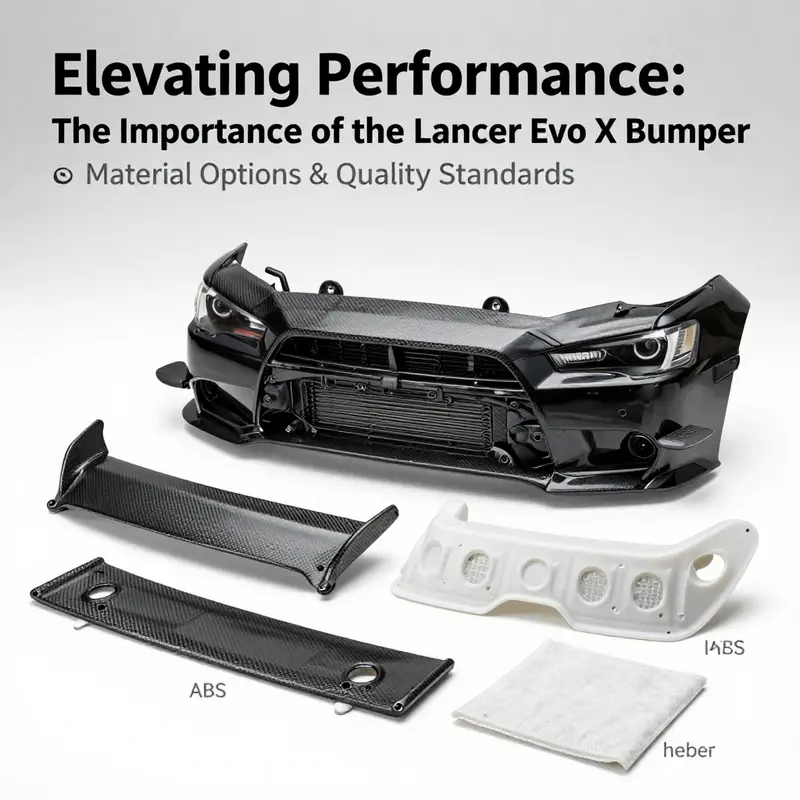
Material selection for the Evo X bumper strikes a deliberate balance between resilience and weight savings. Molded from injection-grade ABS plastic, the structure absorbs minor impacts with a degree of flex absent in more brittle composites. Internal foam energy absorbers cushion low-speed collisions, while steel reinforcements anchor to the chassis’s mounting points. This combination meets rigorous crash safety standards without adding excessive mass—a reminder that engineering foresight can blend lightness with structural integrity.
Backing plates and mounting brackets are carefully calibrated to distribute impact forces across the front rail. In the event of a collision, sections of the bumper deform in predetermined zones, preserving the integrity of more costly components behind. A simplified removal process also aids serviceability: technicians can detach trim panels and sensors without disturbing core cooling systems. This modular approach echoes the underlying philosophy of the Evo X platform—race-bred practicality married to everyday usability.
Beyond raw aerodynamics and impact resilience, the Evo X bumper embraces modern driver-assistance integration. Discrete parking sensors sit flush within the fascia, providing proximity alerts that do not compromise the bumper’s smooth surface. Radar modules required for adaptive cruise control nest behind precision-cut apertures, shielded by transparent covers that maintain sensor accuracy in all weather conditions. Even cameras used for forward collision warning tuck neatly into grille surrounds, preserving the clean, purposeful lines of the fascia.
Seamless compatibility with advanced safety systems is crucial for a vehicle as dynamic as the Evo X. Sensor housings are positioned to offer optimal field of view, while wiring harness channels are routed to prevent interference with cooling ducts. The design ensures that neither performance nor technology integration is sacrificed; rather, each feature reinforces the others. The bumper becomes a multifunctional platform, supporting high-speed aerodynamics, impact mitigation, and state-of-the-art assistance systems in one cohesive package.
Visually, the Evo X bumper extends the car’s design language into a unified aerodynamic suite. It transitions smoothly into side skirts that channel air along the rocker panels, and it prepares airflow for rear diffusers by minimizing turbulence at the front corners. When paired with the rear bumper’s integrated underbody channels, the front fascia initiates an airflow path that keeps the car planted at speed. This orchestrated approach to air management highlights the Evo X’s identity as a holistic, purpose-built performance sedan.
Diffusers and splitter elements work in harmony with the bumper’s lower lip. While the lip reduces front-end lift by redirecting airflow upward, the diffusers taper underbody air pressure peaks, creating a mild suction effect. The connection between front and rear aerodynamic components is so finely tuned that the Evo X can deliver race-car downforce characteristics without relying on oversized wings. The bumper’s substantial vents and splitters balance form and function, projecting prowess on both street and track.
Aesthetic aggression is more than visual bravado; it signals functional intent. Bold angles around the headlamp housings and cheekbones accentuate air channel entrances. Sharp creases guide air toward crucial cooling zones, while negative volume pockets add a sense of depth that hints at concealed engineering mechanisms. The interwoven surfaces evoke precision—and that precision is no accident but the result of wind-tunnel refinement and computer-aided fluid dynamics studies.
Manufacturing precision plays a pivotal role in delivering consistent performance. Injection molding tools are machined to tight tolerances, ensuring each bumper matches design specifications within fractions of a millimeter. Post-mold trimming and finishing processes remove any vestiges of tooling seams, while primer and paint adhesion treatments protect the ABS substrate from environmental wear. The end result is a component whose fit and finish rival factory standards, supporting both visual flair and aerodynamic accuracy.
While many owners choose to retain the original equipment bumper, a robust aftermarket ecosystem also exists for those seeking customization. Carbon fiber versions reduce weight further and present visible weaves that emphasize the vehicle’s track-oriented pedigree. High-density polyurethane alternatives offer enhanced impact resilience, though at the expense of some rigidity. Regardless of choice, quality control remains paramount: reputable suppliers adhere to the same design dimensions and mounting specifications as the OEM component.
For those sourcing authentic replacements, a reliable channel is the genuine CZ4A Evo X front bumper, which ensures proper fit on 2008–2015 models and preserves the precise aerodynamic profiles engineered by factory designers. Many distributors provide part verification and fitment guides to help owners avoid common pitfalls associated with ill-fitting replicas. This focus on exacting compatibility keeps cooling ducts aligned and sensor mounts accurately positioned, safeguarding both performance and safety.
Customization often extends to surface treatments. Some enthusiasts opt for semi-gloss black accents within vent inlets, while others add color-matched splitters to amplify contrast. High-temperature-resistant coatings can also protect inner duct walls from heat-induced discoloration. Each aesthetic choice can complement the bumper’s inherent function, whether by highlighting airflow paths or reinforcing the aggressive character through contrasting finishes.
The Evo X bumper works in concert with other performance components. A carbon fiber hood with functional vents accelerates heat extraction, while a front splitter augments the lip’s downforce. Upgraded intercooler cores nest neatly behind larger grille openings, making the bumper’s vent layout ideal for increased airflow demands. Even under extreme track conditions, the front fascia maintains stability, regulating pressures ahead of the vehicle to support consistent handling behavior.
Real-world testing confirms the bumper’s impact on driving dynamics. At highway speeds, drivers report a noticeable reduction in front-end lift, translating to steadier steering feedback. On the track, lap times benefit from cooler brake temperatures as airflow is directed precisely to caliper vents. These gains are not theoretical—they are quantifiable improvements that underscore the Evo X’s engineering pedigree and racing heritage. For detailed specifications and performance breakdowns, see Autocar – Mitsubishi Lancer Evolution X.
Driver feedback often highlights the bumper’s dual role as a styling statement and functional asset. Its commanding shape lends visual aggression, while its engineering ensures that form serves measurable performance advantages. This synthesis of art and science reflects the Evo X’s broader mission: to fuse everyday drivability with track-capable prowess in a single, cohesive design. Every inlet, edge, and bracket contributes to that mission, shaping airflow with purpose-driven intent.
Whether tackling mountain roads or daily commutes, the Evo X front bumper remains a vital component in the vehicle’s overall performance arsenal. Its combination of aerodynamic finesse, impact resilience, and technological integration exemplifies Mitsubishi’s commitment to a genuine sports sedan experience. This balance of form and function positions the Evo X front bumper as a key component in the vehicle’s enduring performance narrative.
null
null
Navigating Global Supply for High-Performance Evo X Front Bumpers

Sourcing the right front bumper for a performance sedan demands attention. The Evo X front bumper serves both aerodynamic and aesthetic roles. Owners must weigh availability, cost, and quality. A robust market allows enthusiasts to choose between OEM replacements, track-ready designs, and fully custom solutions. Each choice affects airflow management, weight distribution, and visual impact. Understanding the global supply landscape reveals how regional hubs and online platforms shape availability. Buyers can optimize ordering by grasping manufacturing lead times and carrier partnerships. This chapter explores the market landscape and sourcing strategies for Evo X front bumpers.
Guangdong province stands out as a cornerstone of automotive aftermarket production. Cities like Guangzhou host clusters of specialized workshops focused on bumpers, side skirts, and full body kits. This region leverages decades of expertise in injection molding, composite layup, and painting services. Factories here maintain certifications that align with North American, European, and Japanese quality requirements. They can fulfill both small and large orders without compromising material consistency. Proximity to major seaports at Nansha and Shekou ensures expedited export processes. For overseas buyers, shorter transit routes translate to lower shipping fees and predictable delivery schedules.
Material diversity caters to various performance needs and budgets. Production lines often include ABS and polypropylene composites known for impact resistance. Polyurethane bumpers remain popular in warmer climates due to superior heat tolerance and flexibility. Where weight reduction is paramount, carbon fiber alternatives cut mass by nearly a third compared to heavier fiberglass shells. Yet each material demands specific tooling and quality checks. Factories equipped with precision molds produce tightly fitting components, making installation straightforward. Consumers can choose textured or smooth surfaces, matte or high gloss finishes, depending on styling aims.
Beyond molding, finishing processes heavily influence durability. Paint shops adjacent to bumper factories optimize color matching and clear coat application. Buyers can request custom color codes or rely on pre-primed bumpers ready for final spraying. Control measures include adhesion testing and environmental resistance assessments mandated by export standards. Infrastructure investments in climate-controlled curing chambers and automated paint robots help reduce variation. For wholesalers, this translates into consistent bumper quality across successive orders. Retail distributors value defect rates under strict thresholds.
Global wholesale platforms offer gateways for distributors and small shops. These marketplaces highlight supplier profiles, minimum order quantities, and shipping options. Some listings include door-to-door logistics while others rely on freight forwarders. Buyers should compare total landed costs rather than unit prices alone. Platforms often display customer reviews and transaction histories to assist sourcing decisions. Additionally, many sellers offer flexible packaging—ranging from reinforced wooden crates to protective foam cores—ensuring bumpers arrive intact. Explore competitive pricing and flexible MOQs on an international marketplace: Alibaba listing.
While online platforms excel in reach, building direct supplier relationships unlocks further benefits. Regular buyers may negotiate lower pricing, customized production runs, and priority manufacturing slots. Visiting factories or attending regional trade fairs in Guangzhou fosters trust and technical understanding. Suppliers can demonstrate mold samples, outline production flow, and detail quality control protocols. This firsthand exposure clarifies material options and reveals potential lead times. Repeat orders often receive accelerated turnaround and extended payment terms once rapport is established.
Assessing a supplier’s technical capabilities remains vital. Buyers should examine material certificates, tensile strength test reports, and thermal deformation data. For ABS bumpers, impact resistance tests at varied temperatures guarantee compliance with market regulations. Polyurethane components undergo flexural fatigue testing to ensure resilience under road vibrations. Viewing these documents reduces the risk of receiving nonconforming parts. Many reputable factories welcome third-party inspections if buyers require additional validation. This practice safeguards both investment and brand reputation.
Order quantities and lead times directly impact sourcing decisions. High-performance shops may require small batches of specialized bumpers, while larger distributors often place bulk orders exceeding MOQs by hundreds of units. Typical minimums vary by material and complexity—ABS shells might begin at 20 pieces, whereas carbon fiber items could require 50 due to mold costs. Production cycles oscillate between two and eight weeks depending on current factory load and finishing processes. Buyers can often expedite orders for an extra fee if timing is critical.
Logistics considerations include shipping method, insurance, and customs clearance. Sea freight offers cost efficiency for large volumes, though transit can reach several weeks. Air freight accelerates delivery but increases expenses. Many suppliers provide FOB (Free On Board) and CIF (Cost, Insurance, Freight) pricing, allowing buyers to choose responsibilities. Harbor infrastructure at Nansha and Shekou enables consolidated shipments and streamlined export documentation. Freight forwarders familiar with automotive parts simplify customs procedures, especially for markets with stringent import regulations.
Customization extends beyond paint and material choice. Several factories offer bolt-on aero features, integrated vents, and removable mesh panels. Enthusiasts aiming to fine-tune airflow can request enlarged lower grilles or additional vents for brake cooling. Some workshops collaborate with performance engineers to test wind tunnel enhancements before full production. These bespoke options often incur design fees and higher MOQs but deliver unique functional gains. For street or track use, such customized bumpers enhance vehicle stability and cooling under heavy loads.
Choosing the best front bumper requires balancing cost, performance, and reliability. Online marketplaces provide access to a broad supplier base and product variants at competitive prices. Yet engaging directly with manufacturers yields deeper technical insights and potential cost savings for repeat orders. Buyers should verify supplier credentials, examine sample parts, and confirm material certifications. Factoring in logistics timelines and packaging methods avoids unexpected delays. When combined, these steps ensure front bumpers arrive ready for installation and deliver the intended aerodynamic and visual benefits.
For those seeking an OEM-style upgrade, genuine front bumpers for the Evo X chassis remain available through specialized channels. This authentic replacement component ensures factory-fit precision and preserves the original appearance. Distributors can find these items via dedicated listings where pre-drilled mounting points and reinforced support structures come standard. Learn more about sourcing a genuine front bumper for assured compatibility and build integrity.
The global market for Evo X front bumpers continues to thrive thanks to robust manufacturing clusters and digital distribution channels. Guangdong’s workshops combine material expertise, fast tooling, and sophisticated finishing to serve enthusiasts worldwide. Whether owners choose raw ABS shells for self-painting or high-end carbon fiber for track days, sourcing pathways adapt to diverse needs. Online platforms offer convenience, while direct partnerships yield deeper collaboration. Careful evaluation of technical data, supplier practices, and logistics ensures bumpers meet performance criteria and aesthetic goals. This ever-expanding ecosystem empowers Evo X owners to upgrade with confidence and precision.
Aero, Weight, and Edge: Upgrading the Lancer Evo X Front Bumper for Performance and Presence

The front bumper of the Mitsubishi Lancer Evolution X is more than a face for the car. It is a carefully engineered control surface that shapes the car’s aerodynamics, temperatures, and even its perceived aggression on the street. In the Evo X, the bumper design is not simply about shielding the engine bay; it is about managing air as it wraps around the chassis at speed. The original bumper, with its integrated air intakes and the distinctive aero apex profile, was conceived to minimize lift, direct cooling air where it matters, and present a silhouette that signals both performance intent and precision engineering. When enthusiasts consider upgrades, they are not choosing a cosmetic accessory alone. They are selecting a system that can alter how the car breathes, how sticky the tires feel at high velocity, and how quickly the engine can shed heat during track sessions or spirited mountain runs. The decision to upgrade a bumper therefore becomes a convergence of aesthetics, aerodynamics, and thermal management, all tied to the core dynamics that define the Evo X’s character on the road and on the strip.
Carbon fiber emerges as the flagship material in this narrative for those chasing maximal performance without compromise. The allure is not purely cosmetic; the weight savings translate into tangible handling benefits. A carbon fiber front bumper canards, for instance, are designed with an aerodynamically optimized curvature that reduces drag and increases downforce where the car needs it most. In practice, weight reductions of up to about 30 percent compared with traditional fiberglass or ABS components are achievable, and the stiffness of automotive-grade carbon fiber helps preserve the integrity of the aerodynamic shape under load. This is an important consideration because a lighter structure does not just reduce inertia; it also preserves the precise flow of air across the bumper’s surfaces, which helps to maintain stability during high-speed cornering and straight-line acceleration. The aerodynamic package is completed by careful integration of canards, vents, and lip elements that channel air toward or away from critical zones, balancing the need for engine cooling with the desire to minimize drag.
Material choice, however, is not one-size-fits-all. ABS plastic and PP plastics offer a robust, economical path to OEM-style replacements or broader body-kit concepts. These materials provide impact resistance and ease of production, making them practical for daily drivers and for owners who want to merge aggressive styling with reliability. Fiberglass, while still in circulation in some builds, tends to be heavier and can exhibit less strength-to-weight efficiency, particularly when exposed to tracking heat cycles and road debris. The choice among carbon fiber, fiberglass, and ABS/PP is often a trade between weight, cost, and intended use. For a street-to-track transition, a hybrid approach is not unusual: carbon fiber can be reserved for critical weight-saving zones or cosmetic elements, while a reinforced ABS or PP bumper maintains durability under daily wear and tear. What matters is not just the material in isolation but how it works in concert with the bumper’s geometry and the rest of the aero kit.
Aerodynamics are not a single metric but a set of interacting currents that influence performance across speed bands. The Evo X bumper upgrades commonly emphasize a curved, aerodynamically optimized profile that reduces drag by measurable margins while maintaining or increasing downforce at high speeds. The game is to push air to where it stabilizes the car rather than where it creates turbulence. Large, well-shaped intake openings must feed the radiator and intercooler efficiently while guiding air through ducts that avoid creating stagnation zones. In addition, the bumper’s geometry can affect under-vehicle flow, which has downstream consequences for lift and for the vehicle’s overall aerodynamic balance. The idea is not to chase a single percentage gain but to harmonize the front-end aerodynamics with the car’s overall configuration, including the front splitter, side skirts, and rear diffuser. In a properly matched setup, the bumper becomes a keystone that supports the chassis’s stability at speed and the driver’s confidence in high-G cornering.
Thermal management is another central pillar of front-bumper upgrades. The Evo X relies on air channels and large intakes to feed the cooling system, especially when the engine and turbocharged components are operating at elevated temperatures during track time or aggressive street driving. Aftermarket bumpers often include redesigned channels and more open intake surfaces to maximize cooling airflow. The result can be a noticeable improvement in cooling efficiency—on the order of several percentage points—during sustained high-load driving. When temperature management improves, engine timing and turbo response remain in a more optimal range, reducing the risk of heat soak that can erode performance. It is not just about keeping the water and oil cool; it is about ensuring the intercooler airflow is unimpeded, the radiator can shed heat quickly, and the engine bay remains within its thermal envelope.
A crucial dimension of modern Evo X bumper upgrades is modularity and integration with a broader body-kit ecosystem. Many aftermarket bumpers are designed with compatibility in mind, allowing seamless coupling with widebody fenders, side skirts, and rear aero pieces. This modular approach enables a cohesive and aggressive styling language that does not feel piecemeal. The rear of the wheel arches can be extended with widebody elements, and the bumper can be paired with a front lip or canard kit to tune the vehicle’s aerodynamic balance. For enthusiasts pursuing a race-ready stance, the bumper becomes the anchor of a holistic aero narrative that begins at the front, travels across the body, and ends with a tuned rear deployment. The allure of modular designs is not merely about looks; it is about enabling reliable, repeatable fabrication and consistent fitment across a range of models and years, given the Evo X’s production window from 2008 through 2015. A well-executed bumper upgrade aligns with the car’s engineering philosophy: lightweight, strong, and aerodynamically efficient without compromising street usability or ongoing maintenance.
Sourcing and manufacturing realities underpin the practical feasibility of these upgrades. The global aftermarket for Evo X front bumpers remains robust, driven by the vehicle’s enduring popularity among performance enthusiasts. A dense ecosystem exists in parts manufacturing hubs, with a notable concentration in parts-rich regions that can deliver quick turnarounds. In particular, a major manufacturing cluster in Guangdong Province, China, including Guangzhou, provides a tightly integrated network for injection molding, fiberglass fabrication, painting, and tooling. This proximity fosters shorter lead times and cost efficiencies, while the availability of suppliers with OEM-spec certifications helps bridge the gap between aftermarket performance parts and factory standards for reliability and safety. B2B buyers and distributors are advised to conduct thorough supplier evaluations that scrutinize material composition, structural integrity, and quality assurance processes. It is essential to verify that a bumper can withstand the pressures of high-speed runs and the rigors of track environments, where minor misalignments can lead to aerodynamic inefficiencies or even safety concerns.
This sourcing landscape also means choices extend beyond raw materials to the provider’s governance. Reputable manufacturers often conform to automotive safety and durability benchmarks, ensuring compatibility with Mitsubishi’s safety standards and performance expectations. The sourcing story is not merely about the part itself but about the service ecosystem that surrounds it: coating, painting, and finishing steps, as well as the precision of fit to the Evo X’s dimensions and mounting points. The end user benefits from a more predictable fit, fewer installation surprises, and a more reliable upgrade experience, especially for the collector or the track enthusiast who wants consistent results with every service interval. The ecosystem is further enriched by online marketplaces that connect buyers with both new and pre-owned parts. For instance, a pre-owned white Aero Apex front bumper for 08–15 Evo X models has appeared on popular sale platforms, illustrating how the community negotiates value across the lifecycle of a component. The takeaway for buyers is clear: understand your goals, assess the return on weight savings and aero gains, and source through channels that offer clear material disclosures, robust return policies, and verified fitment data.
For those who want a tangible example of a genuine, OEM-adjacent option, one compelling path is to explore dedicated front bumper options that align with the CZ4A Lancer Evolution X, a configuration widely recognized in enthusiast circles. A genuine bumper in this family can serve as a reliable baseline for a high-precision aero package, especially when the rest of the kit is tuned to maintain a coherent flow. You can explore a representative option in this category at the linked resource that highlights a genuine front bumper tailored for the Evo X. This example underscores the value of selecting components that maintain a close match to the car’s original design intent while still offering the performance-informed refinements that modern aero kits deliver. Mitsubishi CZ4A Lancer Evolution X front bumper—genuine (https://mitsubishiautopartsshop.com/mitsubishi-cz4a-lancer-evolution-x-front-bumper-genuine/).
In conversations about upgrades, the broader question is not simply “which bumper looks best?” but “which bumper, with its materials and geometry, will most faithfully complement my driving context?” A track-focused Evo X owner will weigh weight savings against durability, heat management, and the bumper’s seam integrity under endurance conditions. A street-focused owner may prioritize the balance between aggressive styling and everyday reliability, seeking a kit that holds up to curb impacts, road debris, and the routine maintenance cycle. A restoration-minded owner might value a pre-owned or OEM-aligned bumper that preserves a period-correct appearance while still offering improved airflow and cooling. Across these scenarios, the Evo X bumper functions as a strategic starting point for a broader performance narrative, a canvas that invites experimentation with geometry, materials, and finish. The best upgrades respect the car’s existing design language while expanding its capabilities in a coherent, measurable way.
As you plan the upgrade, consider how you will install and tune the new bumper within the vehicle’s overall aero and thermal framework. The process is as much about precision and fitment as it is about selection. A bumper that is light but poorly aligned will fail to deliver expected gains; one that is too rigid or mismatched can transfer stress to mounting points and even affect suspension geometry at high speeds. A careful approach involves verifying mounting points, ensuring clearances for intercooler piping and radiator hoses, and confirming that the bumper’s edges and lips align with other aerodynamic components. When done correctly, the result is a cohesive system in which the bumper’s air channels complement the radiator and intercooler performance, the lip and canards generate the intended downforce, and the side air intakes feed cooling air efficiently without introducing trim gaps that capture unwanted air or debris. The Evo X responds to these upgrades with a more planted feel at speed, a crisper turn-in, and an increased sense of purpose that is both visual and mechanical.
In continuing through the broader article, this chapter ties the performance-focused philosophy of the Evo X bumper into a broader conversation about how modern enthusiasts balance technology, aesthetics, and reliability. The bumper is a gateway to an entire aero narrative—one that is as much about the driver’s intent as it is about the car’s engineering. From the earliest aero experiments to today’s carbon-intensive, aero-optimized front ends, the Evo X remains a compelling platform for those who want their car to communicate speed through form and function. The journey from stock to upgraded bumper is more than a swap; it is a recalibration of airflow, weight, and cooling, all performed in a way that respects the Evo X’s lineage while pushing its capabilities forward. With careful part selection, diligent sourcing, and thoughtful integration with existing body-kit elements, the Lancer Evolution X front bumper can transform a sedan into a more capable, more confident machine—ready for the track, ready for the street, and ready to express the driver’s vision with a bold, aerodynamic stance. External resource: https://www.alibaba.com/product-detail/Upgrade-Your-Mitsubishi-EVO-X-Front-Bumper_1600549582484.html
Final thoughts
The Mitsubishi Lancer Evo X bumper represents a fusion of aesthetic enhancement and performance function that can significantly influence customer choices in the automotive aftermarket. By understanding the intricate details of design, material options, market accessibility, and customization potential, business owners can better cater to the evolving demands of automotive enthusiasts. This knowledge not only fosters trust and loyalty but also encourages further exploration into innovative aftermarket solutions to enhance vehicle performance and style.