
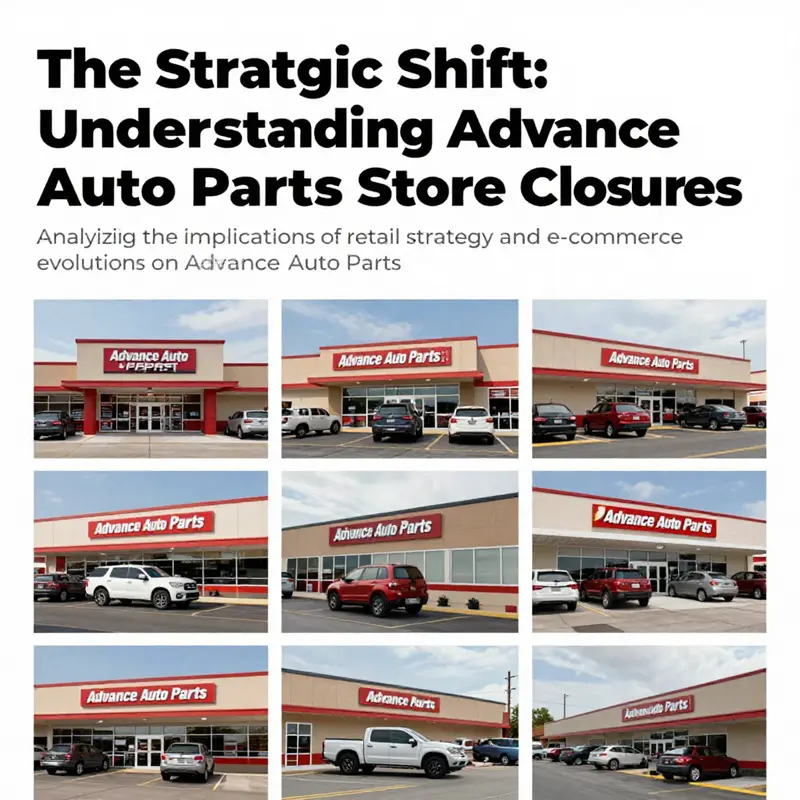
Advance Auto Parts is undergoing a significant transformation that involves closing many of its stores as a strategic response to new market dynamics. This restructuring aims to improve profitability and adapt to the evolving consumer landscape that increasingly favors e-commerce over brick-and-mortar shopping. Business owners need to understand how these closures not only affect Advance Auto Parts but also potentially signal broader trends in retail strategy. In the chapters that follow, we will explore the impact of these closures on retail strategy, how consumer behavior is shifting, the financial implications of closing stores, the growing role of e-commerce, and the overall future outlook for Advance Auto Parts as it navigates these changes.
How Store Closures Reshape Advance Auto Parts’ Retail Strategy and Future Footprint

Advance Auto Parts’ decision to close a significant number of stores marks a deliberate shift from a scale-driven retail model to a precision-focused network that prioritizes profitability and customer access. This chapter follows that shift closely, showing how closures fit into a broader strategic realignment. It examines the financial signals, operational moves, and changing customer behavior that together justify shrinking the physical footprint while supporting growth in digital and distribution capabilities.
The company’s closures are not random cutbacks. Over a defined restructuring period it targeted underperforming outlets, partner locations, and redundancies created by overlapping trade areas. Closing more than five hundred stores reduced the total footprint by more than ten percent. That reduction was paired with other moves: selling non-core businesses, consolidating inventory, and investing in logistics. The net effect was to free capital and managerial attention for areas with higher return on investment. Where a store consistently failed to meet sales or volume thresholds, keeping it open would have tied up working capital and added operating drag. Closing such locations allowed redeploying funds into online platforms and a smaller number of strategically located distribution centers.
Financially, the closures produced a nuanced picture. Revenues dipped modestly in the short term as stores closed and sales consolidated. Yet profitability metrics began to improve after those initial costs. A narrow quarterly profit contrasted sharply with the prior year’s loss, and adjusted earnings exceeded market expectations. Gross margin expanded as inventory carrying costs fell and fewer markdowns were required to clear slow-moving SKUs. These improvements illustrate a core truth of retail strategy: higher margins and healthier cash flow can matter more than raw top-line expansion when the operating environment is changing.
The outlook the company set for itself clarifies the plan. Management has signaled a deliberate trade-off: accept modest near-term revenue contraction in exchange for a durable margin profile. The target adjusted operating margin is ambitious, and it reflects a choice to prioritize efficiency and sustainable returns. Investors responded positively to the initial results, rewarding the stock as confidence grew that the restructuring would create long-term value. That investor response matters because access to capital and the company’s cost of capital will shape future investments in technology and supply chain. Thus, the closures operate simultaneously as a tactical cost-saving measure and as a strategic repositioning to unlock future growth.
Consumer behavior underlies much of this strategy. Foot traffic in many physical stores has declined as more customers choose digital ordering. Younger car owners, in particular, are less inclined to perform DIY repairs for complex modern vehicles. Modern vehicles increasingly rely on software, sensors, and integrated systems that make simple parts swaps less common than they once were. That shift reduces demand for small-ticket, walk-in purchases and increases the value of fast, reliable online fulfillment. The company’s response has been to accelerate its digital channels, integrating online storefronts with inventory data and improving fulfillment from centralized distribution hubs. The goal is to make purchasing faster and more reliable for both DIY customers and professional service providers who now order online and expect same- or next-day delivery.
Logistics plays a central role in the new strategy. Closing lower-performing stores allowed management to consolidate inventories into larger, more efficient distribution centers. These centers enable better inventory turns and shorter lead times for high-demand items. Investment in technology to forecast demand by region and vehicle type became more viable when fewer, larger nodes manage stock. Distribution efficiency improves fill rates and reduces lost sales from out-of-stock situations. It also reduces the number of inventory touchpoints, lowering handling costs and shrinkage. The company complemented these moves with targeted investments in replenishment algorithms and data integration to align assortments with local demand, even as the number of physical stores fell.
Workforce and community impacts were front and center during the closures. Store-level employees and managers faced relocations or job losses in some markets. The company mitigated some of these effects through severance packages, internal transfer programs, and retraining for e-commerce or distribution roles. Still, closures had noticeable effects on local service availability in certain communities. For professional customers who relied on a nearby branch for quick parts access, a reduced physical network meant adjusting ordering and delivery patterns. Management emphasized that the restructuring aimed to maintain or improve service levels despite fewer locations, leveraging faster delivery from regional hubs and improved online tools for ordering and part selection.
The role of data and analytics became a recurring theme. Decisions to close stores were driven by clear, measurable thresholds. Sales volume, margin contribution, traffic patterns, and overlap with nearby stores were analyzed to determine which locations to shutter. Data also guided where to invest: which regions needed distribution capacity, which SKUs required deeper stocking, and which channels deserved marketing spend. This analytic backbone allowed the company to avoid gut-driven closures and instead execute a plan tied to measurable financial and customer outcomes. It also supports continued optimization; as online sales grow, the company can iterate on its network footprint with the same disciplined metrics.
Customer experience remains a strategic focus. While the physical footprint shrank, the company invested in digital tools to make shopping intuitive. Improved search, better mobile experiences, and clearer part-finding tools reduce friction for consumers who no longer want to visit a store. Integration of online ordering with in-store pickup at select locations and rapid delivery from distribution centers aimed to preserve convenience. For professional installers and fleet customers, the strategy emphasized reliability: accurate inventory visibility, predictable delivery windows, and streamlined account ordering. By concentrating physical presence in fewer, higher-performing locations, the company can offer better-trained staff and more comprehensive service at those remaining stores.
The move away from scale also changed product assortment strategy. Rather than stocking every part in every store, assortments became tailored by location and channel. Stores in dense metropolitan areas or near clusters of repair shops retained broader inventories. Smaller or rural locations focused on fast-moving essential items. Online channels carried deeper assortments for more obscure or specialty parts. This approach reduced carrying costs while keeping a long tail of parts available through online fulfillment. It also reduced the incidence of slow-moving inventory sitting on store shelves, which had previously forced markdowns and margin erosion.
Closing stores also allowed the company to sharpen its corporate focus. Divesting non-core businesses freed management bandwidth to concentrate on retail and the aftermarket customer. The resulting capital and organizational clarity supported investments in IT, logistics, and customer-facing tools. These investments became the engine of the new strategy: digital-first customer journeys supported by fewer, smarter physical touchpoints and a lean, responsive distribution footprint.
The strategic narrative around these closures matters for stakeholders. When framed as fiscal responsibility and network optimization, closures become part of a plan to preserve long-term service viability. When framed as reactive downsizing, they risk damaging reputation and employee morale. The company sought to manage both messages with transparent communications about why certain stores were closed and how customers could continue to access parts and services. That clarity helped retain professional relationships and reassured investors that closures were part of a sustainable roadmap, not a retreat.
Looking forward, the plan balances continued digital expansion with selective physical presence. The company forecasts modest same-store sales growth and aims for a material improvement in operating margins. The success of this strategy depends on executing fast, reliable digital fulfillment and maintaining service levels for professional customers. It also relies on refining demand forecasting and keeping inventories matched to local needs. If executed well, the reduced footprint should translate into a leaner, more profitable enterprise capable of competing in a market where parts distribution must be both fast and intelligent.
An example of the market’s evolution can be seen in niche online listings for specialty parts, which reflect changing buyer behavior and the rise of online discovery and purchase. For context, consider an illustrative aftermarket listing that shows how customers now find and buy specific components online: brand-new original carbon fiber bonnet listing. That kind of availability, paired with efficient fulfillment, reduces the need for broad physical assortments in every store.
The interplay of closures, digital investment, and logistics redesign thus represents a coherent retail strategy, not a short-term retrenchment. It reduces cost, improves margins, and aligns the company with how modern customers research, select, and receive automotive parts. The next phases will test whether improved digital experiences and more efficient distribution can offset the lost convenience of widespread storefronts and deliver sustainable growth.
How Shopper Habits Reshaped Advance Auto Parts’ Store Footprint

How shifting shopper habits reshaped a store network
Consumer choices have become the catalyst for a large-scale rethink of how the automotive parts retailer serves the market. Shoppers now put convenience and immediate access at the top of their decision lists. They expect broad selection, fast fulfillment, and competitive prices. When these expectations intersect with digital native alternatives, many physical stores see steady declines in walk-in traffic and transaction volume. That decline exposes fixed costs that once made sense for a dense retail footprint.
Advance Auto Parts responded by pruning locations that no longer covered their operating expenses. The company targeted low-performing sites, especially those in oversaturated trade areas. Closing a store is rarely a simple arithmetic decision. It follows detailed sales trend analysis, local market studies, and scenario planning. When a location consistently misses volume thresholds, closing becomes a defensible business decision aimed at preserving margins and redirecting capital.
The closures announced since late 2024 reflect more than cost-cutting. They represent a strategic shift to meet customers where they increasingly shop. Many routine purchases can now be done online. Shoppers compare options on their phones and expect fast shipping or immediate pickup. For standardized parts and common maintenance items, online catalogs often show deeper inventories, and logistics networks can deliver within hours or a few days. That reality reduces the urgency to visit a store for many consumers.
Yet the story is nuanced. Not every shopper behaves the same. Independent mechanics and some DIY customers value instant access to parts and experienced in-store advice. These users still rely on brick-and-mortar locations for rapid turnaround jobs or complex repairs. The retailer must therefore balance two priorities: maintain enough physical presence to serve time-sensitive, locally concentrated demand, and scale its digital and distribution capabilities to serve the broader, convenience-driven market.
To achieve that balance, the company has pursued a mix of actions. It closed hundreds of underperforming corporate and partner stores while investing in online capabilities and selective distribution infrastructure. The announced closures included a large number of partner locations and company-owned sites, alongside a few distribution centers. By April 2025, the net store count had fallen noticeably, reflecting both completed closures and the broader reconfiguration plan.
Those closures follow a data-first approach. Retail planners model catchment areas and customer overlap. They simulate alternative fulfillment scenarios, weighing same-day pickup against delivery from regional warehouses. Where a closed store leaves a gap, the company often evaluates faster shipping solutions, locker pickup, or partnerships with local service providers to preserve customer access. The idea is to shrink physical footprint without eroding service levels.
This rebalancing also affects inventory strategy. With fewer small, walk-in stores to stock, assortments become more centralized. The company can consolidate slow-moving SKUs and concentrate fast sellers near hubs of demand. That approach reduces carrying costs and improves inventory turns. It also simplifies replenishment algorithms and frees up working capital for tech investments. But it requires exceptional logistics coordination. Faster replenishment from distribution centers to remaining stores, and to direct-to-customer channels, becomes crucial.
Closures also shift the company’s cost structure. Leases and payroll make up a large portion of fixed retail expenses. Closing underperforming leased sites cuts rent obligations over time. It also reduces local staffing needs, though the company often offers transfers or other adjustments where possible. The goal is to lower the breakeven sales level for the remaining stores, allowing them to be more profitable and better staffed.
From the customer’s eye, the changes can feel abrupt. A once-familiar neighborhood store suddenly disappears. For frequent shoppers, that can create friction. The company must manage that churn carefully. Communication matters: warning customers about closures, offering online alternatives, and highlighting nearby stores or delivery options. Loyalty programs and digital touchpoints become more important in retaining customers displaced by closures.
The market reaction to the restructuring has been mixed but informative. Short-term financials often dip because of one-time closure costs and write-offs. But the longer-term logic is clear: a leaner network with stronger-performing locations and better online fulfillment should yield higher margins. The company’s financials began to show this effect. After a period of significant losses, a return to profitability in a later quarter suggested the strategy might be working. Investors responded positively, viewing the consolidation as decisive management action aligned with modern retail dynamics.
Store closures also change competitive dynamics in local markets. When a location closes, competitors may see a temporary uptick in foot traffic. Yet the structural trend toward online purchase means that many displaced customers do not simply shift to the nearest store. Instead, they often explore faster digital options. That magnifies the importance of the retailer’s omnichannel capability: an integrated web, app, and store experience that makes buying easy, regardless of the physical footprint.
For professional customers, the company must preserve rapid-response capabilities. Mechanics and service shops prize immediacy. The retailer has tried to keep strategically placed distribution nodes and high-velocity stores to ensure those customers still have fast access. At the same time, investments in same-day delivery and next-day shipments from regional centers create redundancy. Effectively, the company aims to convert some closed retail sites into fulfillment capacity through alternate means.
Community impact is another facet. Store closures affect local employment and the small-business ecosystem. Vendors, contractors, and local landlords feel the change. The company often works through these effects by following legal obligations and seeking to mitigate hardship via internal redeployment where feasible. Public perception matters, and handling closures respectfully helps maintain brand goodwill.
The decision to close physical locations aligns with broader industry forces. Consumer preferences have shifted and will likely continue evolving. Retailers that adapt their footprints can reallocate capital into areas that improve service and margin. For this company, part of that reallocation included divesting a noncore business to focus on the retail aftermarket. It also included opening targeted distribution capacity to bolster resilience after severe weather events. These moves signal an intent to be logistics-first while maintaining key retail touchpoints.
Importantly, closures are not final judgments on the future of in-person retail. Instead, they are a realignment. Successful retailers will maintain a network of well-performing stores that act as customer service centers, local fulfillment points, and brand showcases. Stores will be fewer, but often more productive and better integrated into digital ecosystems. The accelerated closure program is painful in the short term. Over time, it should enable the company to operate more efficiently and better meet how customers prefer to shop.
Ultimately, the underlying driver is simple: consumers voted with their wallets and their clicks. The retailer had to follow where demand moved. By trimming underperforming locations, investing in digital channels, and strengthening logistics, the company aims to match service levels to modern preferences while restoring profitability. How well that strategy succeeds depends on execution—inventory precision, delivery speed, and customer retention through clear communication.
For customers looking for niche or high-touch services, the remaining network needs to offer expertise and immediacy. For those who prize low friction and speed, centralized fulfillment and reliable online tools must deliver. The balance between these needs will dictate future store counts and formats.
For deeper reporting on the closure wave and its financial implications, see this detailed article: https://www.wsj.com/business/retail/advance-auto-parts-store-closures-profit-2026
If you need parts or accessories related to performance and restoration projects, consider browsing a specialist listing for a carbon fiber bonnet for Lancer Evo X to understand how niche supply channels operate and remain accessible even as mainstream retail footprints change: carbon fiber bonnet for Lancer Evo X.
Turning the Footprint: How Store Closures Reframe Profitability at Advance Auto Parts
Advances in a retailer’s fortunes often hinge on the brutal math of its footprint. For Advance Auto Parts, the strategic decision to shrink the physical network is not a retreat but a deliberate recalibration designed to convert scale into sustainable profitability. The store-closure component of the company’s broader turnaround began in earnest in late 2024 and stretched into 2026, a multi-year effort that seeks to replace headcount-intensive, underperforming real estate with a leaner, smarter, and more data-driven platform. The facts that accompany this evolution are stark: by early 2025 the company had already closed hundreds of locations, including a large portion of its own banners and a swath of partner stores. This consolidation shaved more than 10 percent off the pre-restructuring store count, reducing total locations from roughly 4,788 at year-end 2024 to about 4,285, while also signaling a willingness to let underperformers go in favor of healthier clusters that can deliver reliable cash flow. This isn’t a gloss on a short-term problem; it is a structural repositioning intended to raise margins and cash generation even as it curtails near-term revenue, a trade-off management argues is essential to long-run health.
The immediate financial portrait of closures is unmistakable. The top-line impact is the most visible consequence of shrinking the physical footprint. In the first quarter of 2025, the closure wave contributed to a revenue decline of 6.8 percent year over year, with reported revenue around $258 million. The fourth quarter of 2025 offered a contrasting narrative: despite a profit of $6 million and an adjusted earnings per share of 86 cents, revenue still declined by 1.2 percent to about $1.97 billion. Translating the closures into hard numbers, management noted that roughly $74 million of that quarter’s revenue stemmed from sales associated with stores closed as part of the 2024 restructuring plan. In other words, a portion of the reported sales reflects activity from locations the company had begun to unwind in the prior year, underscoring the near-term drag closures place on the top line.
Yet the same period that exposed revenue softness also illuminated the longer arc toward improved profitability. The third quarter of 2025 marked the strongest quarterly performance in more than two years, with comparable sales growth driven by both professional installers and do-it-yourself customers. More notably, gross margin expanded meaningfully, rising to about 43 percent for that quarter—a substantial improvement from the roughly 37.5 percent gross margin recorded in 2024. The management team projected roughly 200 basis points of annual margin expansion in the first year of the turnaround, a target tied directly to the operating leverage unlocked by shedding underperforming real estate and concentrating capital on higher-return assets and processes. In this framework, the closure program is not merely a belt-tightening exercise but a catalyst for a more disciplined, margin-centric operating model. The company’s longer-term objective—an adjusted operating margin of 7 percent by 2027—rests on the premise that a leaner footprint will reduce fixed costs while preserving or growing high-margin revenue streams in the DIY and professional installer channels.
Strategically, closures are part of a broader transformation that repositions the business around core strengths and higher-return activities. One of the most deflating sources of capital drag—the wholesale side of the operation—came into sharper focus as management completed the exit of its wholesale operation for proceeds reported as substantial, providing liquidity that reoriented the company’s balance sheet. The sale provided a sizable liquidity infusion that, coupled with a robust cash position, created the capacity to reinvest in three critical areas: supply chain efficiency, customer service enhancements, and data-driven operating systems. With approximately five billion dollars in available funds after the Worldpac-related transaction, the company possesses the financial flexibility to pursue a more precise, technology-enabled approach to managing inventory, replenishment, and store-level execution. The strategic implication is clear: closures free capital that can be redirected toward investments with a higher probability of sustaining growth and improving profitability, rather than simply expanding the footprint for scale’s sake.
The operational implications of a leaner network extend well beyond abstract calculations. A reimagined distribution backbone—the company opened a new distribution center in Houston during the recovery period after a major weather event—illustrates the push to remove friction from the supply chain and to shorten the time between customer demand and fulfillment. In tandem with the footprint reductions, this repositioning encourages a more responsive, networked logistics model. It is no small feat to shift from a broad, store-heavy network to a more concentrated layout that supports faster restocking, improved cycle times, and higher in-stock levels at the remnant locations. In practical terms, this translates into a customer experience that, while less anchored to a sprawling store network, can be more reliable and efficient where it matters most. The combination of a streamlined store base, a stronger balance sheet, and a modernized distribution architecture forms the backbone of the company’s case for a durable turnaround.
The market’s reaction during the period of transition offers a useful signal about how investors weighed the near-term pain against the longer-term gains. After the fourth-quarter results in 2025, despite the reported revenue headwinds, the stock price rallied, reflecting investor confidence in management’s execution and the plausibility of the 7 percent margin target by 2027. The investor narrative centered on a disciplined approach to capital deployment: shedding non-core or underperforming locations to free up capital for margin-focused improvements, supply chain enhancements, and technology-enabled operations. It is a narrative that treats closures not as a betrayal of the business’s traditional model but as a method of restoring discipline to a retail network shaped by evolving consumer behavior. The shift is consistent with a broader market refrain: in an era of accelerating e-commerce and changing in-store dynamics, a retailer’s value increasingly hinges on the efficiency of its core platform and the quality of its service proposition, not simply the size of its footprint.
An equally important dimension of the financial story is the way closures interact with the company’s profitability profile beyond the top line. The reduced footprint lowers fixed operating costs, including occupancy, utilities, and underutilized labor, while the company seeks to protect, or even enhance, gross margins through tighter sourcing, better inventory management, and more precise pricing. The margin trajectory is not guaranteed to be linear; the short-run effect of closing stores is often a temporary drag on revenue and a concentrated period of transition costs, but the long-run effect—once the network is optimized and the new capital plan is fully deployed—can be a meaningful step up in operating efficiency. This is particularly true given the company’s emphasis on improving the professional installer channel as well as the DIY segment, allowing the business to capture higher-value demand with more predictable demand patterns than a dispersed, underperforming portfolio might yield.
An additional facet of the financial calculus is liquidity management and balance sheet resilience. The cash cushion created by the asset-light pivot and the sale of the wholesale unit provides a degree of insulation from ongoing macro volatility. This liquidity supports not only ongoing capital expenditures aimed at process improvements but also potential strategic opportunities, whether in the form of selective acquisitions, technology upgrades, or further optimization efforts in the network. In an environment where funding is a critical constraint for growth, this liquidity makes it easier for the company to navigate revenue volatility while maintaining commitments to customers and employees. The net impression is that the closures, while costly in the near term, are part of a disciplined plan to build a more profitable, cash-generative enterprise capable of withstanding cyclical shocks and secular shifts in consumer shopping behavior.
Of course, the path is not without risk. The durability of the margin expansion depends on a number of factors outside the control of any retailer: the pace of online adoption, price sensitivity among both DIY and professional customers, competition from digital-first players, and the ability to sustain in-stock performance across a smaller, more concentrated store network. The company’s strategy hinges on successfully reinvesting freed capital into supply chain muscle, data analytics, and customer-centric operations that can deliver higher sales per square foot and a more reliable shopping experience. In this sense, the closing of stores becomes a means to an end—the end being a leaner, more precise enterprise where every remaining location contributes meaningfully to profitability and where the balance sheet supports continued, prudent investment in core capabilities.
From a holistic perspective, the question of whether Advance Auto Parts is closing stores is answered with a confident yes, but the reasoning is more nuanced than a simple reduction in footprint. The closures are the visible edge of a longer transformation aimed at profitability, resilience, and sustainable growth in a retail landscape dominated by online competition and shifting consumer priorities. The outcome investors care about is less about the number of doors and more about the cash generating power, the efficiency of the supply chain, and the ability to convert channel mix into reliable, higher-margin performance over time. In this light, the company’s narrative reads as a disciplined, if painful, narrowing of focus—an investment in a future in which the remaining stores operate more efficiently, the distribution network moves more product with less friction, and capital is deployed toward the levers most likely to lift profitability in a durable way.
External resource: For readers seeking broader perspectives on how retailers optimize portfolios in the face of growth shifts and demand volatility, industry analyses discuss the trade-offs involved in closing underperforming locations and reallocating capital toward core capabilities. https://www.mckinsey.com/industries/retail/our-insights
The E-Commerce Pivot: Online Demand Reshapes Advance Auto Parts’ Store Closures and the Path to a Leaner, More Resilient Network

Across the auto parts ecosystem, the surge of digital shopping is a contemporary reality that redraws the map of where and how consumers buy. For Advance Auto Parts, the decision to close a portion of its physical footprint is a deliberate recalibration aimed at aligning the company’s retail network with a market that increasingly values speed, convenience, and seamless omnichannel experiences. The closures, tied to a broader restructuring begun toward the end of 2024, illustrate a core tenet of modern retail strategy: stores must deliver strong unit economics in an era where digital channels can amplify reach and optimize fulfillment. In this light, e-commerce is not simply an alternative sales channel; it is the strategic engine that determines which doors stay open and which doors pivot toward new roles in the customer journey.
The market signals driving this pivot are unmistakable. The global shift toward online shopping has intensified as consumers seek broader selection, real-time price transparency, and the convenience of home delivery or rapid in-store pickup. Industry analyses emphasize that the ease of comparison and breadth of options online compress the time customers spend wandering aisles, making underperforming physical locations increasingly unsustainable. For automotive parts, where product breadth matters, the digital channel serves not just as a storefront but as a decision-support tool that can guide a customer through complex selections. The implications for Advance Auto Parts are profound: if a store cannot meet volume thresholds in a digital-first market, its role in the network should shift toward a more centralized, online-enabled model.
Corporate disclosures in late 2024 and 2025 triangulate this logic with concrete financial signals. The company disclosed that fourth-quarter 2024 net sales included roughly $74 million from stores closed in the first quarter of 2025 as part of a strategic optimization initiative. In practical terms, closures are about reallocating resources to channels and formats that better capture demand. The results of this recalibration became visible in the subsequent period through a leaner store base and a sharpened focus on omnichannel execution, inventory analytics, and fulfillment efficiency. The scale of the closure program—encompassing hundreds of locations and the withdrawal of some distribution assets—speaks to a deliberate approach aimed at aligning the physical footprint with an online-enabled, customer-centric operating model.
The closure strategy does not imply a retreat from retail. Instead, it marks a strategic reallocation of capital toward capabilities that will support the next phase of growth: omnichannel services, such as online ordering with in-store pickup and home delivery, become essential differentiators in a competitive landscape. In this context, closures are a form of fiscal discipline, reallocating scarce resources toward higher-margin activities and more productive locations. The interdependence of stores and digital capabilities becomes clearer as the company shifts toward a network designed to serve customers wherever they choose to shop, with stores acting as hubs in a connected fulfillment ecosystem.
Rethinking the Footprint: How Store Closures Are Steering Advance Auto Parts Toward Profitability

Across the broader automotive aftermarket, the speed of change has accelerated as shoppers migrate to digital channels and as retailers reassess the economics of every storefront. In this context, Advance Auto Parts has embarked on a deliberate, data-driven transformation of its retail footprint. Since late 2024 the company has been consolidating its network to align location density with current demand, channel mix, and operating discipline. By the middle of 2025, the company disclosed it had closed approximately 503 stores—466 Advance Auto Parts locations and 47 CARQUEST stores—resulting in a net reduction of more than 10% in its total store count, from about 4,788 at the end of 2024 to roughly 4,285. The closures span a mix of company-owned and partner locations, with 523 partner stores and 204 company-owned stores exiting the portfolio, supplemented by the shuttering of four distribution centers. Management signaled that this plan would continue through 2026 as part of a broader strategy to optimize the network, sharpen unit economics, and improve long-term profitability in an evolving market where online shopping and price transparency have reshaped how customers source maintenance and repair supplies. In this framework, the closures are not a retreat but a repositioning, intended to free capital, reduce friction, and focus resources on higher-potential markets and channels.
The narrative around these changes is not merely about losing doors; it is about recalibrating the business to sustain competitiveness amid a broader shift in consumer behavior. A veteran retail observer summarizes the logic: when a store isn’t meeting volume thresholds, closure isn’t a sign of failure—it’s fiscal responsibility. The reality for Advance Auto Parts, as for many peers, rests on the tension between preserving near-term revenue and delivering durable, margin-rich growth over the long run. The company’s recent quarterly performance provides a snapshot of how this balancing act can evolve. In the fourth quarter of 2025, Advance Auto Parts reported a modest quarterly profit of $6 million, or about 10 cents per share, a notable improvement from the prior year’s sizable loss. Although seasonality and restructuring costs can confound quarterly rhythm, the result was a signal that the path through the closures is beginning to yield positive operating leverage. Adjusted earnings per share surpassed analyst expectations, signaling that the market’s focus on profitability and cash generation was shifting from near-term top-line volatility to mid-cycle margin restoration. The stock’s movement in response reflected investor confidence that the restructuring is not just cost-cutting but a catalyst for a stronger, more predictable earnings trajectory. In parallel, the company completed the strategic sale of its Worldpac subsidiary to reduce complexity and sharpen focus on its core retail network, an action designed to strengthen the balance sheet and concentrate resources where the company intends to win in the future.
The strategic rationale is reinforced by operational milestones tied to the network transformation. A new distribution center in Houston was opened to support recovery efforts and supply chain resilience in the wake of natural disruptions, underscoring the emphasis on logistics as a lever for service improvement and cost containment. These steps—together with ongoing investments in inventory systems, supplier relationships, and efficiency-driven integrations—are intended to create a leaner, more responsive footprint. As management connects the dots, the company is aiming to turn the combination of reduced variable costs and smarter pricing into a durable uplift in earnings power. The restructuring is not happening in a vacuum; it is coupled with a broader ambition to accelerate growth where it remains most defensible.
Looking ahead, the company has laid out a multi-year plan that envisions a measured yet meaningful recovery in profitability as it completes the transition. For 2026, management articulated a set of targets that aim to translate the network optimization into a sustainable earnings framework. Same-store sales are projected to grow around 1% to 2%, a trajectory that sits within the range of analyst expectations, which point to roughly 2% year-over-year growth on the same basis. Revenue is guided to a range of about $8.49 billion to $8.58 billion, while adjusted earnings per share are anticipated to land between $2.40 and $3.10. These numbers represent more than a normalization after a period of aggressive consolidation; they reflect the impact of a more disciplined pricing approach, a more integrated supply chain, and a sharper focus on higher-performing locations. Crucially, the market is watching for a return of positive free cash flow, a factor that lagged during the restructuring as cash flowed into non-operating expenses and working-capital adjustments related to network optimization. Management has targeted roughly $100 million in free cash flow for 2026, translating the earlier negative cash flow of about $298 million in 2025 into a more favorable movement toward self-sustaining liquidity.
A central pillar of the 2026 blueprint is margin improvement. Industry observers and credit ratings agencies have highlighted a meaningful uplift in EBITDA margins as the network is refined and costs are brought into closer alignment with realized volumes. From a 2024 adjusted EBITDA margin of about 3.7%, the trajectory envisions a return to roughly 10% in 2025 and further expansion toward the mid-teens by 2026. This margin expansion is not purely the result of headcount reductions or store closures; it reflects a systemic push to lift operating efficiency, better leverage fixed costs, and achieve a more favorable mix of higher-margin services and consumables in the core retail network. The plan also banks on continued improvements in supply chain integration, more effective pricing models, and the productivity gains derived from technology-enabled demand forecasting and inventory optimization. In other words, the path to higher margins is designed to be a holistic one, built on data-driven decisions and a governance framework that rewards disciplined execution and cost discipline.
Beyond the financials, the growth agenda includes selective expansion that could sustain a renewed growth arc even as the footprint contracts. For 2026 the company anticipates opening about 40 to 45 new stores, reinforcing the belief that physical locations still matter—but only when they are strategically positioned and economically viable. The expansion plan is complemented by an emphasis on market centers, with a target of having more than 50 by 2026. This configuration is intended to support more efficient distribution, faster restocking, and broader service reach, while also enabling a more precise localization of assortments and customer engagement. In parallel, the company is rolling out its loyalty program and pursuing private-label initiatives aimed at boosting customer retention and increasing the average value per transaction. Although the private-label line is described in broad terms here, the intent is clear: to deepen customer relationships, differentiate the value proposition, and create a more predictable revenue stream that complements core parts and accessories with higher-margin offerings.
Of course, the road ahead is not without risk. The macro backdrop remains challenging, with pressures from softening consumer spending and a more competitive landscape that includes both traditional peers and low-cost online entrants intent on changing the economics of everyday parts and maintenance. While the 2026 plan envisions a rebound in profitability, execution risk remains as the company realigns its store network, migrates to newer distribution capabilities, and integrates pricing tools that rely on machine intelligence. The potential benefits of the network optimization depend on sustaining a robust service capability in the stores that remain, ensuring trained staff, reliable inventory, and a consistent customer experience that can translate into increased visit frequency and higher basket size. Another risk lies in the cadence of capital allocation as the company balances ongoing investments in technology, logistics modernization, and brand-building with the imperative to deliver free cash flow. The balance sheet will be a critical barometer of the plan’s resilience, especially if market volatility or supply chain disruptions intersect with the post-closure environment.
Amid these dynamics, the forward-looking narrative centers on a disciplined, data-informed approach to network optimization. Management has stressed the importance of focusing on high-performing locations and channels, strengthening service delivery, and leveraging pricing and inventory analytics to improve unit economics. The strategic pivot is designed to create a more predictable earnings profile, better cash generation, and a portfolio that can adapt to evolving consumer preferences. The intention is not to abandon the physical retail channel but to make it more efficient and better aligned with how customers want to shop today. This is where the synergy between store performance, supply chain sophistication, and digital capabilities becomes decisive. As the company continues to execute, stakeholders will be watching for evidence that the combination of store rationalization, capital discipline, and growth initiatives yields a durable return to positive cash flow and sustained profitability.
For readers seeking a deeper, more granular view of the quarterly performance and the strategic rationale behind these moves, the company’s Q4 2025 earnings call transcript provides a detailed, management-sourced perspective on these outcomes and the roadmap ahead. External resources offer additional context on the timing, scope, and financial implications of the network optimization, complementing the chapter’s synthesis with concrete numbers and management commentary.
External resource: Q4 2025 Earnings Call Transcript: https://www.investors.advanceautoparts.com/financials/quarterly-results/default.aspx
Final thoughts
Advance Auto Parts’ decision to close stores is a pivotal move reflecting broader retail trends driven by market dynamics and shifting consumer preferences. While these store closures may bring short-term challenges, they also offer an opportunity for the company to streamline operations, reduce costs, and enhance e-commerce capabilities. This strategic restructuring is aimed not only at improving immediate profitability but also at positioning Advance Auto Parts for sustainable growth in the long run. Business owners can glean valuable insights from this case—recognizing the need for adaptability and strategic foresight in today’s rapidly evolving retail environment.