
Navigating the landscape of premium auto parts manufacturing is crucial for business owners in the automotive industry. Understanding where these parts are made can impact everything from supply chain decisions to branding. This article delves into the intricacies of domestic production, highlighting the locations of premium auto parts manufacturing across the USA. We’ll explore the quality standards that govern production, the market influences shaping these standards, and sourcing policies that ensure quality. With a comprehensive approach, each chapter builds towards a clearer understanding of the origin and quality of the premium auto parts that drive success in your business.
Made in the USA? Tracing the True Geography of Premium Auto Parts
Traceability sits at the heart of premium auto parts. The phrase “made in the USA” carries weight for reliability, labor standards, and supply-chain sovereignty. Yet the landscape behind that label is not uniform. Public records about a company named Premium Auto Parts, Incorporated show conflicting signals. On one hand, the entity appears registered in Utah with a street address in St. George, a location that would root it in the American market. On the other hand, some corporate listings point to a facility in Suzhou Industrial Park in Jiangsu Province, China. The discrepancy matters not just as trivia; it maps how auto part supply networks operate for many brands that serve the United States. The bottom line is that ownership and jurisdiction can be clear, while actual manufacturing footprints remain opaque without direct disclosure. For a consumer or shop manager, this means that a claim of USA production should be verified through labels, documentation, and direct inquiry rather than assuming based on a company’s registration address alone.
Within the United States, premium-grade parts are produced across a broad geographic canvas. Factories and assembly plants stretch from the industrial corridors of the Midwest to the southern manufacturing belts and into the western regions where specialized components demand high precision and advanced materials. This geography reflects the layered nature of modern supply chains. Some facilities assemble finished parts from a mix of domestically sourced components and imports, while others produce the core elements that later become part of a larger assembly. The distinction matters not only for cost and lead time but also for traceability and warranty coverage. When a shop or consumer investigates a part’s provenance, the critical questions revolve around substantial transformation, the origin of the key raw materials, and the point at which the final, functional item emerges.
The categories of premium parts that are most commonly manufactured or finished in the United States tend to align with the sectors where the domestic engineering ecosystem thrives. Sealing systems, fluid-handling components, and precision fasteners are areas with deep manufacturing roots in the country. In these domains, the U.S. manufacturing base has matured through decades of automotive evolution, with plants designed to meet exacting tolerances and quality standards. The presence of multiple facilities across different states allows for specialized labor pools, near-dedicated supply chains, and resilience against regional disruptions. It also gives brands the ability to demonstrate compliance with domestic sourcing expectations and to offer customers easier access to documentation like material sources, testing results, and quality certifications. Yet even within this favorable framework, not every part marketed as premium is produced entirely within American borders. A common pattern is to perform the final assembly or critical transformation steps in the United States, while incorporating major components that originate abroad. In practice, that can still satisfy consumer expectations for high quality and a robust warranty, provided the company offers transparent disclosure about the production stages and the origin of crucial materials.
The question of where parts originate touches more than fiscal or logistical concerns; it intersects with consumer trust and regulatory expectations. Transparency becomes essential when the topic shifts to labeling and regulatory claims. The accuracy of a “made in USA” statement often hinges on where the item is substantially transformed and where the most significant value addition occurs. For example, a product might be designed in the United States, engineered here to meet strict specifications, and then rolled into final packaging after integrating imported elements. In such cases, the label may still bear the “USA” designation, but the manufacturing journey is layered and international. This nuance is central to any educated discussion about premium auto parts, especially in a market where brands compete not only on performance but also on provenance, reliability, and the ethics of their supply chains. When buyers ask for proof, they typically seek a clear bill of materials, supplier lists, and third-party quality assurances. Those documents help establish whether the product truly reflects domestic craftsmanship or relies heavily on imported components that have undergone substantial transformation in the United States.
From the perspective of the industry, the existence of a robust U.S. manufacturing footprint has palpable value. It supports local jobs, contributes to regional economic stability, and reinforces the ability to pivot quickly in response to demand or supply shocks. At the same time, it must be weighed against the advantages of global sourcing, which can bring advanced materials, specialized machining, and cost efficiencies that might be harder to achieve within a purely domestic framework. The optimal balance often emerges as a strategic blend: critical components with tight tolerances and safety implications are produced domestically, while non-critical elements or highly specialized parts may be sourced through international partners who share rigorous quality controls. In this way, the premium-auto-parts landscape resembles a geographer’s map, with multiple nodes distributed across the country to support a nationwide network of repair shops, service centers, and retailers. For end users, that translates into a mix of accessible lead times, varied pricing, and a spectrum of documentation options that can be checked against warranty and service requirements.
This chapter’s exploration, anchored by the current public record about a Utah-based entity that may or may not own its manufacturing footprint, highlights a broader truth. The United States hosts a diverse set of manufacturers that contribute to the premium segment, ranging from those that operate end-to-end domestic production lines to those that coordinate complex, multi-site supply chains. For the consumer, the takeaways are practical. Ask where the parts are made, request a materials list and a process description, and seek certification that aligns with the intended service environment. When possible, prefer providers with transparent disclosures and clear audits of their production stages. In the long run, knowing the geography behind premium parts becomes more than a matter of curiosity—it becomes a compass for quality, accountability, and the ability to sustain performance on the road.
As brands, distributors, and repair shops navigate the labyrinth of sourcing, it helps to keep a simple yardstick in mind: what matters most is whether the part in hand has gone through verifiable, quality-controlled processes within or beyond U.S. borders, and whether the supplier can substantiate claims with reliable documentation. The best outcomes arise when domestic manufacturing capacity is coupled with open communication about sourcing and transformation. This creates a market where premium can be defined not just by price or performance but by the clarity with which origin and process are revealed. For readers seeking context on how a prominent U.S.-based parts network frames its operations and footprint, the official site offers a window into the scale and reach of domestic distribution and assembly without the ambiguity that can attach to ambiguous labeling. External resource: https://www.genuineparts.com.
From Assembly Lines to Aftermarket Frontiers: Where Premium Auto Parts Are Made in the USA
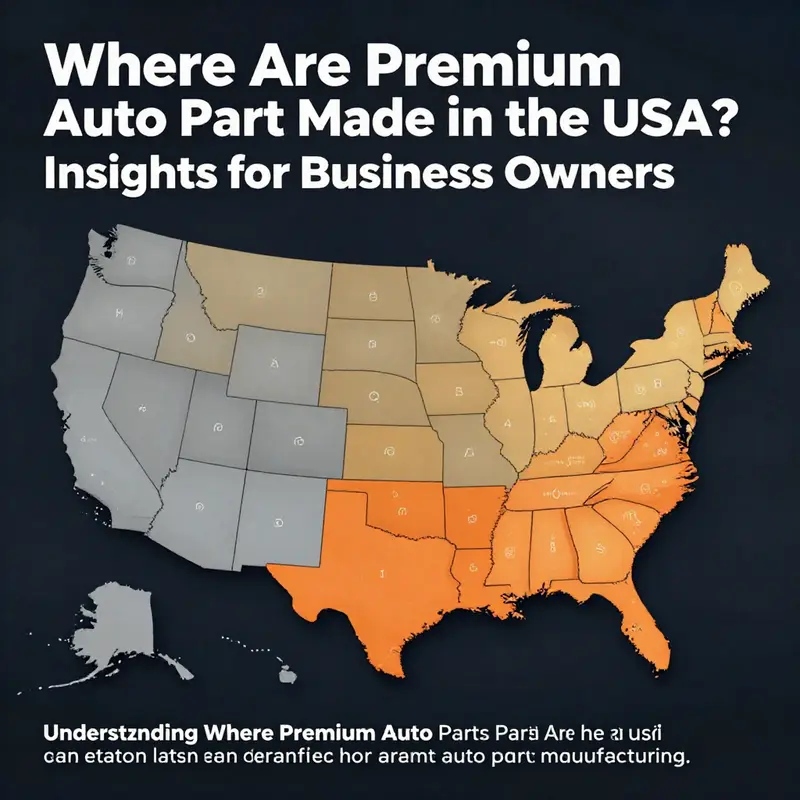
The map of where premium auto parts are made in the United States is not a single factory floor but a constellation of sites, corridors, and partnerships that together shape quality and availability. We think of premium parts as born from a fabric of materials, engineering, and skilled labor that cluster in places with established industrial ecosystems. In practice, the data shows that the corporate bases of some distributors sit in certain states, while actual manufacturing and processing occur across several regions that have long served the automotive industry. The result is a nuanced landscape where location matters for access to specialized capabilities, not merely for the sake of geography.
One domestic company is registered in Utah with a St. George address. The listing confirms that a domestic presence exists, but it does not confirm that manufacturing happens there. It may function primarily as a headquarters, a distribution hub, or a compliant staging ground for parts sourced from other regions. This distinction matters for consumers who expect a domestic origin; it also matters for supply chain resilience. A headquarters can coordinate design, compliance, and logistics while the actual production and finishing take place elsewhere, across a network of facilities designed to optimize speed, cost, and quality. That arrangement is increasingly common in premium segments, where precision and traceability take center stage.
Across the Southeast, a major distribution hub in Alabama provides a sense of how parts move from producers to retailers. This hub illustrates how premium segments rely on efficient networks to keep pace with demand. Distribution centers in strategic locations serve as nodes where orders are consolidated, inspected, and repackaged for regional markets. Even when a plant does not sit within the state line, these hubs enable rapid fulfillment, reducing lead times for shops and consumers who expect a timely return to the road. The presence of such centers underscores a broader truth: value in the premium aftermarket often travels as much through logistics as through the components themselves.
On the West Coast, California serves as a focal point for high end and specialty components. The region’s mature supply chain supports parts such as advanced body features, precision suspension components, and refined interior hardware. Proximity to ports, a dense supplier base, and a long history of advanced manufacturing reduce transit times and enable quicker iteration of design, testing, and certification for premium lines. California also benefits from a concentration of engineering talent and research facilities that feed innovation into the aftermarket, helping parts meet exacting standards for performance, fit, and durability. The result is a dynamic ecosystem where complex materials and processes can be developed and refined close to the market that consumes them.
Michigan remains central to the American auto story, with a dense web of OEMs and Tier 1 and Tier 2 suppliers. Even if a given premium part is not manufactured there, the knowledge base and tooling infrastructure in Michigan influence how parts are engineered, tested, and validated. The region’s deep manufacturing heritage makes it a natural home for innovation that drives higher performance and durability. Institutions, test rigs, and machine shops rooted in Michigan often help push premium components from concept to test bench to customer, ensuring that the parts not only fit but perform under real-world stresses. In this light, market access and technical capability reinforce one another, creating a cycle of improvement that benefits end users who demand reliability.
Texas rounds out the picture with expanding industrial capacity and a growing logistics footprint. The state benefits from access to rail and road networks, skilled labor pools, and energy resources that support advanced manufacturing. In this evolving map, Texas is increasingly a node where premium parts are assembled or finished before moving to distribution centers or retailers across the country. The geographic spread across the South and Southwest complements established hubs in the Midwest and West Coast, reinforcing the idea that premium auto parts are the product of distributed expertise rather than a single site of creation.
Taken together, these notes suggest that a premium part may be produced in one region and finished or distributed from another. Some components arrive as finished articles from outside the United States and are completed or reworked here to meet local certifications. The line between domestic production and import is not fixed, but the quality bar remains high because manufacturers and distributors rely on tightly controlled processes, supplier audits, and traceability throughout the chain. Premium segments demand consistency across a supply network that spans continents and disciplines—materials science, precision machining, surface finishing, and assembly know-how—that collectively determine how a part behaves under heat, vibration, and load.
For consumers seeking to understand origin, product labels, supplier disclosures, and third party certifications can help. Check packaging for country of origin statements and request documentation from sellers if origin claims matter to you. In a market that prizes performance and reliability, the place where a part is made is part of its story, but the ultimate measure remains how it performs on the road and under load. The traceability of a component—from raw material origin through processing steps and final inspection—forms the backbone of confidence in premium aftermarket products. This is not merely a matter of pride in domestic manufacturing; it is about consistency, safety, and the long-term value that comes from knowing a part can endure the conditions of real-world driving.
The map of American production is also a map of capability. It reflects a suite of competencies that sustain advanced materials, complex forming, and meticulous finishing. Regions with a long history of automotive manufacturing tend to host the most diverse labor pools, robust toolmaking traditions, and access to supporting industries such as molding, casting, and coatings. In practice, a premium part might rely on a multi-supplier network, a regional processing center, and a finishing line that brings the product to market within the required performance envelope. The story is not fixed in one city or state; it moves with the demands of design, the evolution of materials, and the pace of globalization. That is what makes the question of where premium auto parts are made in the USA both practical and dynamic.
For a broader overview of how the United States builds its auto parts supply, see the Motor Vehicle Parts Manufacturing section of the Bureau of Labor Statistics. https://www.bls.gov/iag/tgs/iag336.htm
Made in the USA: Tracing the Geography, Standards, and Resilience of Premium Auto Parts

When consumers ask where premium auto parts are made, the instinct is to assume a straightforward answer: a factory somewhere in the United States. The reality is more nuanced. A company like Premium Auto Parts, Incorporated is registered in Utah and operates from a U.S. address, yet the available data does not clearly confirm whether its components are designed, manufactured, and finished domestically or imported and rebranded for the U.S. market. This ambiguity matters. For buyers—whether they are fleet managers, aftermarket specialists, or enthusiasts weighing OEM compatibility against performance gains—knowing where parts originate is a proxy for evaluating quality, traceability, and resilience in the supply chain. In the current automotive landscape, the location of production shapes not only the engineering ethos behind a part but also the speed with which a supplier can respond to evolving standards, feedback from vehicle manufacturers, and shifts in trade policy.
Quality standards in the United States are not decorative. They are anchored in a dense regulatory and standards ecosystem that governs safety, emissions, and environmental stewardship. Parts destined for road use must align with federal safety guidelines administered by agencies such as the Department of Transportation, as well as environmental requirements enforced by the Environmental Protection Agency. Beyond compliance, premium parts are expected to deliver durability, precision, and reliability across a vehicle’s life cycle. The American manufacturing environment emphasizes disciplined quality management, rigorous testing, and continuous improvement. When a part is made in the USA, it often benefits from a framework that allows tighter integration with vehicle manufacturers and clearer accountability for performance, which reassures buyers who depend on predictable behavior under stress, long operating hours, and diverse climate conditions.
The domestic advantage stretches beyond compliance. Production in the United States tends to support tighter supply-chain control. When components and assemblies are fabricated closer to end markets or near automotive hubs, fabs and suppliers can respond faster to production hiccups, design changes, or shifts in demand. This proximity translates into shorter lead times, easier collaboration with OEMs and Tier 1 partners, and a more agile development cycle. It also supports more transparent feedback loops from the field, enabling refinements that improve fit, function, and longevity. In discussions of lead times, industry observers frequently point to the geographic clustering of automotive activity in certain regions—Michigan, Illinois, and California in particular—as a factor that reduces cycle times and bolsters the alignment between design intent and manufacturing execution. In such a system, a premium part engineered for high performance may begin as a concept in a design studio, pass through a digital twin and CAE validation, and move into a production line that benefits from established tooling, calibrated metrology, and skilled technicians nearby. The result is a part whose manufacturing narrative can be traced with confidence from raw material input to finished product in a way that supports consistent quality.
It is important to acknowledge a broader context: global trade and the ongoing scrutiny over imports. A 337 investigation by the U.S. International Trade Commission into imported auto parts—driven in part by concerns from major OEMs about IP and compliance—highlights the stakes around where parts come from and how they are sourced. The emphasis in such discussions is not merely protectionist rhetoric; it is a reminder that domestic manufacturing integrity contributes to legal compliance, IP protection, and the avoidance of supply-chain vulnerabilities. When parts are produced in the United States, suppliers can demonstrate traceability, document internal quality controls, and more readily address any IP or regulatory concerns. This is not about privileging one sourcing approach over another; it is about recognizing the system’s emphasis on verifiable, high-integrity sourcing practices that keep vehicles safe and compliant across a broad spectrum of use cases.
Beyond the regulatory and logistical dimensions, the ecosystem of B2B sourcing platforms illustrates how buyers navigate the premium parts space in an era of global sourcing. A comprehensive resource that curates verified B2B partners aligned with U.S. manufacturing standards reminds buyers that premium parts are underpinned by transparent supplier relationships, clear labeling, and rigorous supplier vetting. For consumers and businesses alike, such platforms offer a means to assess supplier capabilities, production controls, and post-sale support. The presence of a credible domestic-production narrative within this ecosystem reinforces the perception that premium, safety-conscious parts can be sourced from U.S.-based facilities or from suppliers who adhere to equally stringent standards abroad.
The question of origin is not merely a matter of pride or policy; it ties directly to product design philosophy. When a part is manufactured in the United States, design teams often benefit from direct access to measurement data, testing rigs, and field feedback from the domestic market. This proximity can accelerate iterative improvements and ensure that the part’s tolerances, materials, and finishes meet the exacting expectations of U.S. OEMs and discerning aftermarket customers. Conversely, parts produced overseas may offer cost advantages and access to specialized production techniques that are hard to replicate domestically. The balance, therefore, is not a simple binary choice but a strategic decision about how to pair engineering rigor with practical production capabilities, supplier partnerships, and end-user requirements.
Within this strategic terrain, a practical touchpoint for readers is the notion of a transparent, well-documented sourcing path. Consumers increasingly seek visibility into the supply chain, including material composition, certification of processes, and the ability to trace a component back to its origin. This is where domestic production can serve as a reassuring signal. It implies a framework in which quality control is not outsourced to distant contractors but is embedded in the plant floor, audited by internal and external teams, and aligned with the expectations of safety regulators and customers alike. It also supports the possibility of rapid problem resolution; when a part is manufactured close to home, supplier and customer-side teams can collaborate in real time to diagnose and address issues—reducing downtime and preserving vehicle performance.
For readers who want a concrete, navigable example of premium-part procurement that does not rely on naming a specific brand, consider the idea of an OEM-grade component listing. An OEM-referenced catalog entry—placed within a domestic or domestically aligned supply chain—illustrates how premium parts are positioned within a system that values precise fit, verified materials, and documented manufacturing steps. This kind of listing is less about flashy branding and more about a traceable lineage: design intent, material specification, manufacturing process controls, and post-production verification. The implication for buyers is simple: when a part’s provenance can be traced and verified against a framework of domestic standards and collaborative supplier relationships, confidence in performance follows. Such confidence is especially important when parts are destined for high-stress applications, where marginal gains in tolerance, surface finish, or alloy composition can translate into meaningful gains in safety and durability over the life of a vehicle.
Ultimately, the question of where premium auto parts are made in the United States returns to a larger narrative about trust, resilience, and accountability in modern manufacturing. It is a narrative that recognizes the value of domestic capability while acknowledging the realities of a global supply network. The chapter-to-chapter thread is clear: if a supplier can demonstrate compliant, traceable, and high-integrity sourcing—whether through explicit U.S.-based production or through tightly governed domestic-aligned manufacturing partners—the premium part becomes more than a component. It becomes a tangible signal of reliability in a world where vehicle performance depends on centuries of engineering, rigorous standards, and a robust, transparent supply chain. For readers who want a quick reference to a real-world catalog example without naming particular brands, the following link points to an OEM-relevant listing format used in premium part markets: OEM rear bumper listing.
External resources continue to shape how buyers understand domestic manufacturing in the premium-auto-parts space. One widely cited external resource offers a snapshot of the broader U.S. supplier landscape for high-end automotive components, illustrating how regional hubs, supplier capabilities, and certification programs interact in practice. This external reference helps ground the discussion in real-world market dynamics and regulatory expectations. Understanding the U.S. Supplier Landscape for Audi-Compatible Products.
null

null
Homegrown Precision: Tracing the Path of Premium Auto Parts Made in the USA
The question of where premium auto parts come from in the United States invites a deeper look at how modern supply chains are designed to deliver performance, reliability, and accountability. Data shows a Utah-based registration and a street address in St. George, but it does not confirm where each part is manufactured or sourced. This ambiguity is common in an industry where the production footprint is distributed across multiple facilities. The broader ecosystem of premium parts in the United States operates within a tapestry of regional manufacturing hubs, rigorous quality controls, and policy frameworks designed to keep critical components domestically produced when possible. This chapter examines those dynamics, weaving together the strategic logic behind domestic production, regional clustering, and sourcing practices that meet OEM-like specifications while supporting national resilience.
In the United States, high-end automotive components cluster around key vehicle regions. The Midwest’s historical manufacturing infrastructure and the Southeast’s growing industrial base serve as anchors for premium parts such as suspension modules, drivetrain elements, and engine-related components. Proximity to assembly plants matters beyond convenience: it enables just-in-time delivery and tighter inventories, which OEMs and tier suppliers rely on for consistent performance. Suppliers in the Midwest benefit from close geographic ties to major automotive programs, translating into faster feedback loops and clearer traceability. In the Southeast, expanding automotive manufacturing supports a parallel ecosystem of specialized suppliers that can respond quickly to shifting demand while maintaining rigorous standards.
These regional advantages feed a broader commitment to domestic sourcing and governance. Domestic procurement is a practical approach to regulatory compliance, environmental stewardship, and supply chain resilience. By emphasizing U.S.-based production lines and supplier networks, companies aim to align with DOT and EPA standards, ensure traceability across materials and processes, and maintain a controllable ecosystem where testing regimes and filings remain coherent across the supply chain. The result is a more transparent chain of custody for components such as high-strength suspension elements, engine mounts, and drivetrain parts, which must perform under a wide range of real-road conditions. Domestic production also supports clearer communication with OEMs, enabling quicker iterations when specifications shift or when new guidelines emerge.
Quality control in U.S.-based operations often extends beyond baseline quality management systems. Premium auto parts makers invest in rigorous testing that mirrors stresses of actual driving: road simulations, fatigue analyses, and compatibility checks with current vehicle ECUs are increasingly standard. In premium segments, customers expect long-lasting performance and precise fit, so manufacturers must demonstrate real-world performance data and durability under simulated conditions. This dual demand—precision plus durability—drives a culture of testing and verification centered in U.S. facilities with established quality systems and traceable records.
The sourcing logic behind premium parts rests on robust governance. Domestic manufacturers commonly adopt traceable supplier networks, clear certification regimes, and documented production capabilities that reassure OEMs and aftermarket customers. Such traceability supports warranty programs and performance transparency, especially when aftermarket components claim compatibility with various platforms. A supply chain designed around domestic procurement tends to be more responsive to order changes and quality feedback, enabling pivots if a component deviates from expectations. Dual-track production lines—one for OEM contracts and another for certified aftermarket replacements—illustrate a practical model used by some players to maintain strict dimensional accuracy, material specs, and durability criteria across a broad market.
For buyers evaluating origin, the practical takeaway is the importance of supplier credibility. Certifications matter, but they are strongest when paired with evidence of production capabilities and real-world performance data. The most trustworthy suppliers demonstrate that their parts have been vetted in environments resembling the rigors of everyday driving and extreme conditions. They show that operations are integrated into a broader JIT ecosystem, enabling timely fulfillment without sacrificing quality. In this context, domestic manufacturing is not a blanket guarantee of superiority but a credible signal of local accountability, rapid problem resolution, and transparent communication with OEMs and aftermarket customers. The convergence of quality, timing, and regulatory compliance creates a coherent value proposition for customers who require premium performance with traceability and responsibility.
The broader aftermarket landscape reflects a similar logic, where the domestic footprint is celebrated for performance validation and the economic and strategic benefits of keeping critical components within national borders. Nurturing a domestic manufacturing heartbeat reduces reliance on distant suppliers and foreign production cycles that can complicate lead times and regulatory compliance. This does not imply every premium part is produced in the United States; rather, it highlights a trend toward localization where feasible and strategic when evaluating total cost of ownership, supply stability, and consistent OEM-aligned performance. In practice, buyers weigh nearshoring against global sourcing, selecting partners who can provide robust documentation, reproducible results, and transparent execution.
Within this framework, practical examples from the broader aftermarket ecosystem can illustrate how a domestic supplier can maintain a dual-track production capability, a defined quality control program, and a track record of meeting exacting dimensional and material specifications. The goal is to deliver components that fit precisely and sustain performance across a vehicle’s lifecycle. For enthusiasts and professionals who demand reliable performance from premium parts, domestic manufacturing provides visibility into processes, facilitates improvements, and supports rapid communication with OEMs and aftermarket customers. The result is a more adaptive supply network that serves original equipment and aftermarket markets while upholding safety and environmental standards. For readers seeking a broader perspective on evaluating U.S. suppliers, external resources on supplier evaluation can offer practical guidance on due diligence and best practices in the domestic supplier landscape.
Final thoughts
In summary, understanding where premium auto parts are made in the USA is critical for business owners in the automotive industry. The chapters highlighted key production locations, quality standards, and market influences that shape this sector. With insight into sourcing policies, you can make informed decisions that enhance your business’s credibility and efficiency. Knowledge of the manufacturing landscape will not only guide your supply chain strategies but also empower you to maintain the highest product standards in an ever-evolving market.