
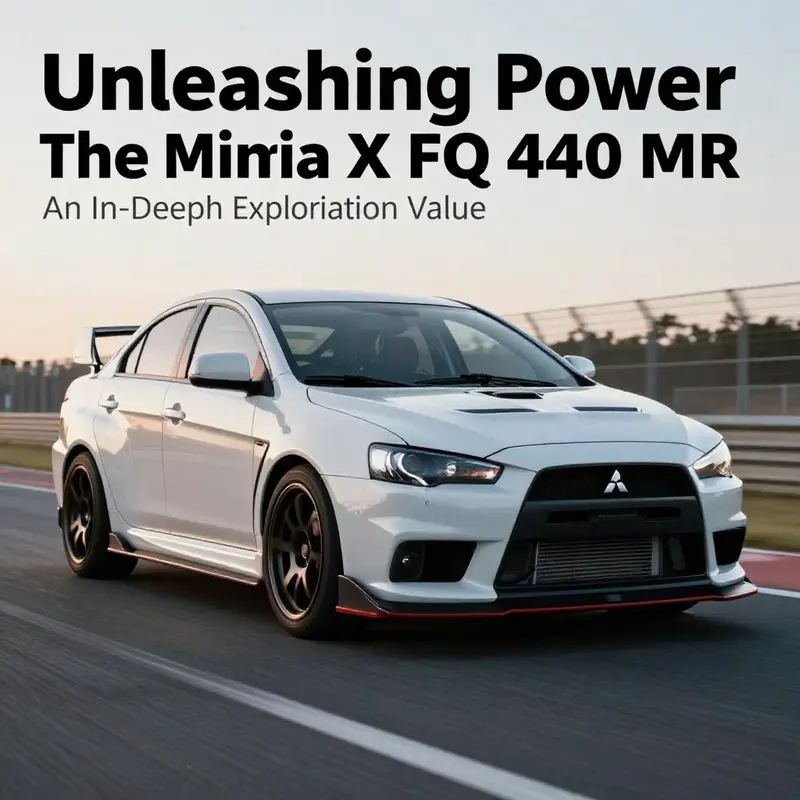
The Mitsubishi Evo X FQ 440 MR stands as a testament to precision engineering and driving dynamics, making it a worthy focus for business owners and automotive enthusiasts alike. As one of the most celebrated vehicles in the Lancer Evolution series, its remarkable performance metrics not only exceed expectations but also captivate a niche audience in high-performance automotive circles. Each chapter of this article explores the intricacies of the FQ 440 MR’s performance, the engineering accomplishments that enable its power, and its market success and desirability among collectors.
Harnessing the Fury: How the Evo X FQ-440 MR Turns a 2.0L Engine into Supercar-Level Performance
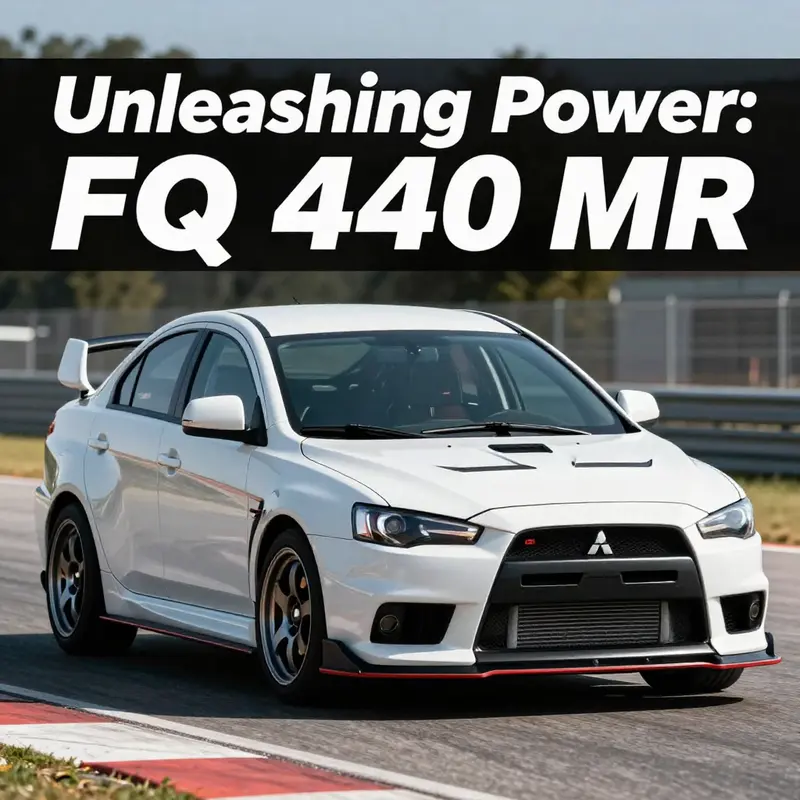
The FQ-440 MR stands as the raw, measured answer to a single question: how far can a compact, turbocharged 2.0-liter four-cylinder be pushed while remaining usable on the road? The answer lies not in a single upgrade, but in the careful orchestration of power, delivery, and control. This chapter examines that orchestration, detailing how engine modifications, drivetrain choices, suspension upgrades, cooling strategies, and stopping systems work together to transform a familiar platform into one of the most ferocious production four-cylinder cars ever made.
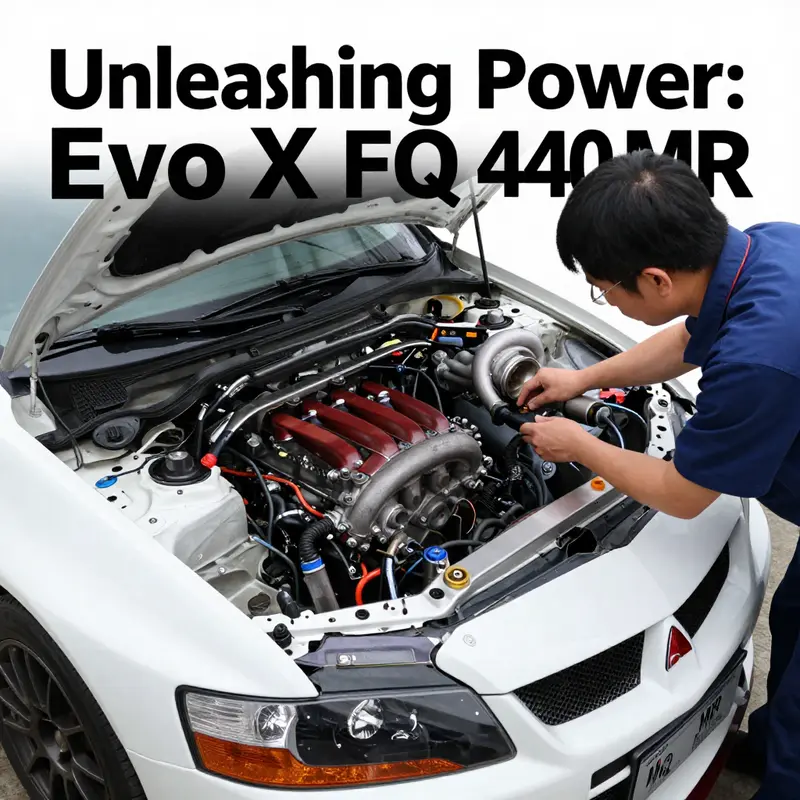
At the heart of the project is the 2.0-liter turbocharged inline-four, an engine with an architecture designed for balance and responsiveness. Rather than bolt on a single large component and call it a day, engineers pursued a holistic path. The turbocharger was upsized and recharacterized to respond quickly across the rev range while sustaining higher boost pressures without excessive thermal stress. Intake plumbing was enlarged and smoothed to reduce flow resistance. High-flow fuel injectors were selected to ensure the correct air-fuel mixture at every operating point. On the exhaust side, a less restrictive system was fitted to minimize backpressure and extract energy from the spent gases more efficiently. Each of these changes improved power, but they also raised temperatures and stress levels. To keep the engine within safe operating windows, the cooling system was substantially enhanced, with larger radiators, improved intercooling, and better oil cooling. The result was a unit that reliably produced 440 horsepower at higher revs, with a broad torque curve peaking early enough to feel explosive off the line yet controllable through corners.
Power figures alone can be misleading. What matters to drivers is how that power is delivered. To that end, the car’s electronic control systems were recalibrated. The engine control unit received a bespoke mapping that tuned boost dynamics, ignition timing, and fuel delivery to work in concert. Attention to throttle response reduced lag and made the car feel decisive. Torque management strategies in the AWD system were adapted to cope with the increased output. These calibrations are crucial; raw pump numbers are ephemeral without predictable, repeatable delivery. The FQ-440 MR’s calibrations aim for an immediate initial response, followed by a linear surge that drivers can modulate with the throttle pedal.
Transmission choice is a decisive factor. The six-speed dual-clutch gearbox provides near-instant shifts and keeps the engine in its sweet band. Compared with older manuals or slower automatics, a fast-shifting dual-clutch maintains momentum and delivers consistent times under repeated acceleration. The gearbox is tuned to hold gears longer when demanded, and to execute crisp upshifts that minimize torque interruption. For spirited driving, this translates to sharper exits from corners and a more connected feel through consecutive shifts.
The AWD system had to be strengthened to handle the dramatic jump in torque. Reinforcements to differentials and driveshafts reduce flex and heat buildup under load. Beyond brute strength, recalibrated torque split logic and clutch pack behavior optimize traction. The system favors a controlled, rear-biased distribution when needed, improving rotation without sacrificing grip. The net effect is confidence: the car can launch aggressively without overwhelming the front tires, and it can be coaxed through high-speed transitions without abrupt weight transfer surprises.
Acceleration is the headline figure for many enthusiasts. While an official 0–100 km/h time might not be published, independent testing and logical extrapolation from drivetrain characteristics put the car in supercar territory in the low-to-mid three-second range. Importantly, this acceleration is repeatable under real-world conditions because cooling and drivetrain durability were addressed during development. Short, hard bursts are one thing; sustained performance over multiple runs requires thermal management and component resilience. The FQ-440 MR was built with both single-lap fury and extended-session consistency in mind.
Handling upgrades are equally important. Lowering the center of gravity by dropping the front and rear ride heights by roughly 35 mm and 30 mm respectively was not purely aesthetic. It reduced body roll and improved turn-in precision. However, reduction in ride height alone can create new challenges: unwanted camber shifts, increased bump steer, and harsher ride quality. The engineers balanced these effects with revised spring rates, dampers, and anti-roll bars. Stiffer springs control pitch and dive, while carefully valved dampers maintain compliance over imperfect surfaces. Anti-roll bars reduce lateral body movement without compromising independent wheel articulation. The unsprung mass was minimized where possible, and wheel and tire choices were selected to deliver consistent grip and feedback.
Wheels and tires provide the critical contact patch between design and reality. Forged 18-inch wheels, paired with sticky, high-performance tires, were chosen to balance inertia and grip. Forged hoops save rotational mass and withstand high cornering loads. Tire compound and construction emphasize consistent grip under rising temperatures. Wheel width and offset were selected to widen the track subtly, improving mechanical grip and stability. For owners seeking authentic replacement or upgrade components, there are dedicated R18 wheel options tailored for this model.
Braking capability needed to meet or exceed the car’s acceleration. Large, multi-piston calipers clamping substantial rotors arrest rotation quickly and resist fade during repeated hard stops. The braking system was matched to pedal feel as much as stopping power. A precise, progressive pedal allows drivers to modulate braking force with confidence. High-performance pads, vented rotors, and improved brake cooling ensure consistent performance even during track days or spirited mountain runs. This balance keeps the car composed under deceleration and gives drivers trust entering tight braking zones.
Chassis rigidity and reinforcement are often the unsung heroes of high-performance conversions. Torsional stiffness improves predictability, allowing the suspension to do its job with more clarity. Reinforcement points in the unibody reduce flex under cornering loads. Strut brace additions and carefully placed gussets refine the structure without adding excessive weight. The net result is sharper steering response and crisper feedback from the tires. When combined with suspension tuning, the car becomes willing to rotate and eager to change direction.
Thermal management touches nearly every performance subsystem. More boost means more heat in the intake charge. Higher combustion pressures raise oil and coolant temperatures. The development program extended the cooling envelope with larger radiators, upgraded intercooler cores, and more efficient oil coolers. Heat shielding and purposeful airflow routes maintain a stable operating environment. These measures existed to prevent progressive power loss, commonly known as heat soak. With them, the car holds peak performance across multiple runs, rather than delivering a single brilliant blow followed by steady decline.
Sound and sensory feedback were addressed as part of the package. The exhaust system was designed to free flow while producing a tone that matches the car’s character. It amplifies turbo spool and the engine’s top-end urgency without becoming intrusive at cruising speeds. Inside, the driver receives information through a direct steering feel, a firm pedal, and a tactile shift quality. Together, these cues create a satisfying dialogue between man and machine.
Weight distribution and mass management were also considered. While absolute weight increases are sometimes unavoidable due to larger components and reinforcements, careful placement of heavier items kept balance near the original target. Battery location, brake system layout, and ancillary component placement sought to minimize polar moment and keep rotational inertia favorable. The interplay of lowered center of gravity, strengthened chassis, and well-managed mass contributes to quicker transitional responses and improved cornering stability.
Electronics and driver aids received meticulous attention. Traction control and stability systems were retuned to complement mechanical upgrades. Instead of simply allowing more slip, these systems provide a wider, more predictable intervention envelope. Experienced drivers can dial back assistance to enjoy greater wheel slip and oversteer tendencies, while less seasoned drivers can rely on progressive intervention to maintain safety. The goal was neither total electronic domination nor complete absence of aids, but harmony between hardware and software that improves lap times and road manners.
Durability and serviceability matter for a high-strung machine. Components subject to higher loads were chosen for longevity: reinforced driveshafts, improved clutch packs in differentials, and upgraded engine internals where necessary. Routine maintenance intervals were adapted to reflect the higher stress environment. These decisions ensure the car not only performs at peak but remains dependable for owners who drive it often.
Finally, the character of the car remains rooted in usability. Even with extreme numbers and track-capable bits, it preserves a level of civility for daily use. Throttle mapping includes smoother responses at lower pedal openings. Transmission logic allows relaxed shifts for commuting. Climate control and noise suppression maintain comfort on longer journeys. The FQ-440 MR is therefore not a single-minded track tool; it is a high-performance road car that accepts aggressive driving without demanding it.
Every upgrade carried a trade-off. The larger turbo improved top-end power but demanded better thermal systems. Lowered suspension sharpened handling but required precise valving to avoid a choppy ride. Bigger brakes add unsprung mass and cost, but they keep stopping distances short and fade at bay. The genius of the build lies in resolving these trade-offs through integrated engineering. Power, grip, control, and reliability were tuned together rather than in isolation.
One practical note for owners: while the core improvements are robust, supporting systems and consumables must be matched to the car’s capabilities. High-performance tires must be maintained at correct pressures. Brake fluid should be flushed with a high-temperature fluid at recommended intervals. Cooling system integrity must be preserved, and engine oil chosen for high thermal stability. Treating these systems as integral parts of a performance ecosystem preserves the exhilarating attributes of the car over time.
In sum, the FQ-440 MR demonstrates that exceptional performance is the product of systems thinking. A large turbo alone does not make a great car. Instead, delivering 440 horsepower in a usable, repeatable, and thrilling package requires matched upgrades in transmission, driveline, brakes, suspension, cooling, and electronics. The result is a compact performance car capable of matching larger, more complex engines in acceleration and handling. It proves a potent lesson: when engineering is comprehensive and purposeful, a high-revving 2.0-liter engine can deliver supercar-level excitement without sacrificing everyday usability.
For owners considering wheel upgrades that preserve the car’s balance and character, options exist such as original BBS R18 rims for Lancer sedans, which mirror the forged, lightweight ethos that suits this platform. For a broader technical read and testing impressions, see the detailed review at Motor Trend.
External reference: https://www.motortrend.com/cars/mitsubishi-lancer-evolution-x-fq-440-mr-review/
Crowning a Rally-Bred Benchmark: The UK-Exclusive Performance Edition That Stood at the Summit
A chapter about a high-performance milestone begins with a silhouette and ends with a pulse. In this case, the silhouette is a compact four-door sedan whose rally lineage is clear, and the pulse comes from a carefully tuned heartbeat: a powertrain and chassis package that makes a production platform behave like a prepared race car. This chapter follows the arc of a UK exclusive, limited-run edition celebrated for pushing a turbocharged four into the realm of high-performance road machines, while maintaining daily usability and reliability. It stands not merely as a curiosity of the era but as a benchmark in disciplined engineering, where improvements in aerodynamics, intake, exhaust, and control logic converge with a reinforced chassis to deliver a coherent driving experience that rewards precision and patience.
The core of this achievement lies in the heart of the car: a 2.0-liter four-cylinder turbo engine. In this edition, a high-performance turbocharger from a respected tuner replaced the stock unit, setting the tone for a cascade of improvements. The new turbo raised both intake capacity and boost potential, widening the envelope of what the engine could absorb and convert into usable power. But a turbo is not standalone; it exists within a broader ecosystem of induction, exhaust, and fueling that must work together to sustain reliability at high stress. The induction system received a comprehensive upgrade: high-flow filters, upgraded intercoolers, and redesigned intake ducts aimed at delivering cooler, denser air with minimal resistance. This matters not only for peak numbers but for consistency across a broad rev range, where a rally-honed temperament appears as a stable, usable torque curve rather than a brief spike.
Fuel delivery was tuned to support persistent performance. High-flow injectors maintained a strong air-fuel mixture even as boost rose and the intake faced heat and backpressure. The engine control unit was reprogrammed to manage the new air-fuel ratio and ignition timing, with a goal beyond chasing raw numbers: reliability at the edge of capability. A reimagined exhaust system completed the core package: manifold, downpipe, and catalytic path were chosen to reduce backpressure and improve flow, allowing the engine to breathe more efficiently at high load. In a package like this, small gains in exhaust flow translate into meaningful improvements in response and power delivery, especially when the turbo operates near its optimum efficiency island.
The performance results followed logically from these targeted changes. The power output rose beyond the conventional four-cylinder baseline, while torque arrived early enough to provide a strong, usable surge without requiring the engine to stay at the limiter. The numbers translated into real-world acceleration characteristics that could rival engines with larger displacement. The engine’s peak occurred in a rev band that rewarded rapid shifts and precise throttle modulation, yielding a coherent blend of linearity and bite that let the driver sense the mechanical orchestra at work behind the scenes. The torque figure, appearing early in its range and sustaining into the mid‑rev zone, provided a broad, usable middle for cornering and mid‑corner pace.
Power, of course, is only part of the story. The drivetrain and chassis were tuned to harness the surge with confidence. A dual‑clutch automated transmission sent power to all four wheels, enabling rapid gear changes that maintain momentum. The chassis was strengthened with reinforced structures to handle the increased torque, while suspension geometry and ride height were carefully dialed in to sharpen turn-in and curb pitch sensitivity. Front ride height was reduced by a measured amount, and the rear by a comparable amount, with the aim of lowering the center of gravity, reducing body roll, and improving steering response at the limit. The result was a chassis that felt planted, predictable, and communicative through the most demanding corners.
Brakes, aero, and handling were upgraded in concert. The car received high‑performance brakes with larger rotors and calipers designed for repeated stops at speed, paired with a chassis balance and aero tools that kept nose dive in check and preserved front grip during late braking. The suspension tuning balanced trek comfort and precision, producing a compliant ride on the road and firm control on the track. In terms of design, the limited run retained the compact, purposeful silhouette of its lineage while adding subtle cues that signaled its exclusivity. Inside, the cabin offered a driver-centric environment with supportive seats, bold controls, and materials that conveyed a sense of purpose without unnecessary ornamentation.
The story of exclusivity adds a crucial layer to this chapter. Production was scarce, with only a small handful of units allocated to a single market. The rarity created a provenance that continues to captivate enthusiasts and collectors alike. It is not just the numbers that make the car special, but the way a factory and a tuning house collaborated to coax extraordinary performance from a familiar platform. The combination of a dedicated development effort, a carefully chosen upgrade path, and a limited distribution plan elevates what might have been a standard performance enhancement into a collectible legend.
From a broader perspective, this edition demonstrates the power of a focused, well-integrated modification program. The turbo, induction, fuel system, ECU, exhaust, and chassis all operate as instruments in a chamber orchestra. Each component must perform in harmony with the others; otherwise, gains become marginal. When tuning and chassis alignment are harmonized, the result is a car that behaves with the ease of a well-mated pair of shoes—comfortable in everyday driving, yet razor-sharp when pushed to the limits. This is the essence of engineering discipline in a performance project: not merely to extract horsepower, but to translate that horsepower into controllable, repeatable, and engaging behavior that rewards precision and restraint from the driver.
For readers seeking context beyond the numbers, the story highlights the value of strategic collaboration between an automaker and a specialist partner. A well-executed milestone within a production framework shows how focused upgrades can elevate a car’s character without sacrificing daily usability. It also underscores how rarity can amplify appreciation and influence in the collector market, turning a limited edition into a lasting benchmark for what disciplined engineering paired with targeted preparation can achieve.
Pinnacle of a Limited Legend: Market Impact and Collectibility of the Evo X FQ-440 MR
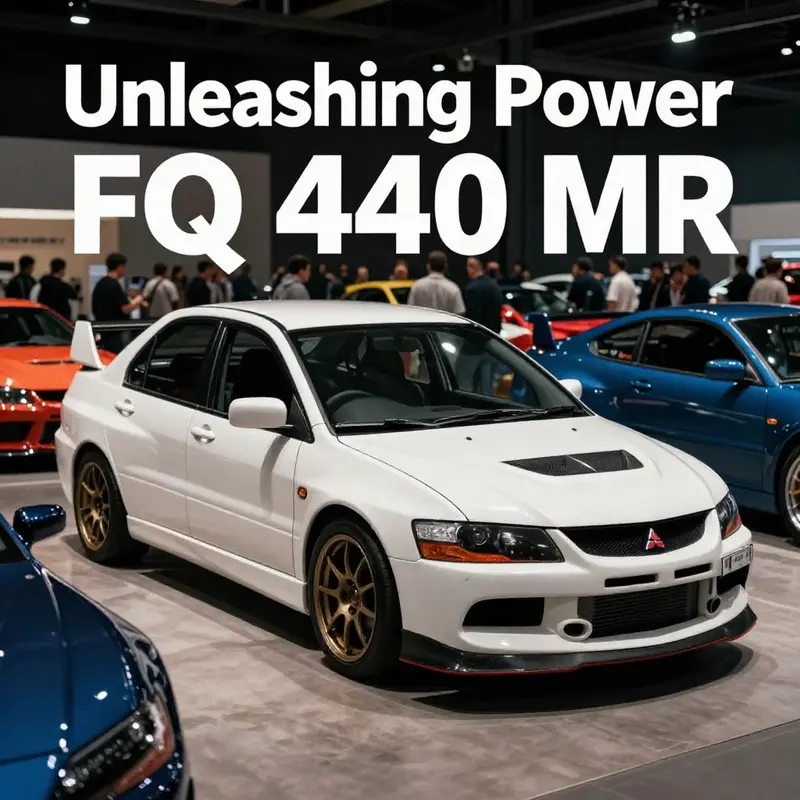
In the annals of modern performance, few cars manage to balance intrinsic speed with a narrative that elevates them beyond mere transportation. The Mitsubishi Lancer Evolution X FQ-440 MR did exactly that when it emerged as a celebration of Mitsubishi’s UK anniversary, a limited-run model whose very existence spoke to a philosophy: you can extract astonishing pace from a compact, four-cylinder package when the engineering is disciplined, the chassis is honed, and the intent is pure track-to-road performance. With only 40 units produced and all of them reserved for the UK market, the FQ-440 MR did more than accelerate; it crystallized a benchmark for what a small-displacement turbo can achieve under factory stewardship. The result was not just a faster Evo but a modern legend that sits at the crossroads of engineering achievement, scarcity, and collector appeal. The engine at the heart of this legend—the heavily reworked 2.0-liter 4B11T—exemplifies a broader engineering ambition: squeeze every drop of capability from a compact powerplant while preserving the package’s everyday practicality and reliability. By replacing the stock HKS twin-scroll turbo with a tuned configuration, optimizing intake and exhaust paths, strengthening the cooling system, and reprogramming the ECU, Mitsubishi created a car whose official numbers echoed the aspirations of much larger, more burdensome powerplants. It delivered a resonant signal to enthusiasts: raw horsepower is not the sole measure of greatness; the confidence with which a car harnesses its power, its durability under track strain, and its ability to deliver a cohesive driving experience under real-world demands count just as much. In the FQ-440 MR, those elements align in a way that makes the car a benchmark for the segment and a touchstone for the idea that performance can be engineered, curated, and sold in limited numbers without losing coherence or purpose.
Market impact, then, extends beyond the baseline performance figures. It centers on a broader narrative: that a potent four-cylinder can redefine expectations for a compact sports hatch. The Evo X platform already carried a reputation for agile dynamics, linked to Mitsubishi’s long history of rally-informed chassis work and a drivetrain that rewarded momentum and precise inputs. The FQ-440 MR did not merely tick the boxes for peak output; it amplified the message that limited-edition editions can redefine what a brand’s modern heritage stands for. In this sense, the car became a reference point for engineering ambition within an increasingly crowded market segment. It highlighted how engineering choices—such as a tuned turbo, refined intake plumbing, and a strengthened cooling loop—translate into a tangible edge on the road and the track. It also demonstrated how a single model can embody a brand’s performance zeitgeist at a time when automakers were balancing emissions, efficiency targets, and the desire for adrenaline-fueled driving experiences. The FQ-440 MR’s performance package, including the 6-speed SST dual-clutch automatic transmission and the Alcon braking system with six-piston front and four-piston rear calipers, reinforced a philosophy: speed requires controlled, repeatable stopping power and a transmission that can exploit the engine’s narrow-band torque in real world conditions. As combinations go, it was a careful orchestration rather than a brute-force sprint.
From a market standpoint, scarcity is the unmistakable driver. The decision to sell exclusively in the UK, and to cap the model at a mere 40 units, amplified demand in ways that a more widely distributed model seldom achieves. In today’s collector culture, rarity is more than a statistic; it is a narrative asset. The FQ-440 MR’s exclusivity makes it a focal point for conversations about provenance, originality, and condition, all of which feed into valuation and long-term desirability. The car’s white body, BBS forged wheels, Recaro seats, and the premium Rockford Fosgate audio system became part of its identity beyond the horsepower and straight-line acceleration. These features, while aesthetically distinctive, also serve as markers of a specific era of tuning philosophy—one that valued coherent integration of performance parts and interior ergonomics with the overall driving experience. This is not to say that the FQ-440 MR’s appeal rests solely on looks; rather, its distinctive cues contribute to a holistic perception of it as a factory-tuned, track-ready icon.
The numbers themselves—440 horsepower and approximately 559 Nm of torque—told a compelling story. Even though Mitsubishi did not publish official timing for 0–100 km/h, the consensus among enthusiasts places it in the vicinity of 3.5 seconds, with a top speed around 250 km/h. Those figures, paired with a compact footprint and a chassis tuned to offer precise feedback at the limit, ensured that the FQ-440 MR could compete with, and in some cases outpace, larger displacement rivals. The six-speed SST automated transmission played a crucial role in translating the engine’s punch into sprinting potential, while the Alcon brakes provided the confidence needed to exploit that performance on demanding surfaces. The result was more than speed; it was a coherent driving experience that rewarded sophistication, discipline, and consistent lap times as much as it did straight-line acceleration. In this light, the FQ-440 MR demonstrates a broader truth about the market: when a limited edition couples raw capability with a carefully curated hardware suite, its appeal extends beyond enthusiasts to collectors who value engineering intent, historical significance, and the story that accompanies a car’s life in the wild.
The financial arc of the FQ-440 MR illustrates a modern collector-car dynamic. The model’s original price—about £49,999 at launch—was steep for a compact hatch, even with its performance credentials. Yet scarcity and the Evo X’s enduring popularity have driven values upward in the secondary market. By 2024, well-preserved examples were trading in the £75,000 to £100,000 range, a substantial premium that reflects not only the car’s performance pedigree but also its provenance and the emotional appeal of a limited UK-only run. The valuation narrative here is instructive: supply is intentionally capped, but demand is amplified by a combination of nostalgia, rally heritage, and the allure of owning a modern performance icon with a unique place in Mitsubishi’s history. Auction results and private sales, while not always consistent, show a recognizably upward trajectory that aligns with broader market trends for modern classics that crossed the threshold from enthusiast curiosity to investable asset.
One of the enduring questions for collectors and investors alike concerns how to calibrate value when the car sits at the intersection of rare collector appeal and the ever-shifting tastes of enthusiasts. The FQ-440 MR’s lure rests on several interlocking pillars. First, its rarity and UK exclusivity ensure the model stands out in any showroom lineup or auction room. Second, its status as the most powerful variant of the Evo X lineage—something that electric and hybrid-driven performance can’t easily replace in the eyes of many purists—adds a layer of historical significance. Third, the car’s performance package embodies a precise engineering philosophy: limited-scope tuning that preserves the essence of the original platform while pushing the envelope of what a four-cylinder can deliver when the factory tunes are optimized for high-repetition endurance rather than one-off novelty. The combination of these factors creates an aura that is as much about storytelling as it is about engine displacement or track times.
The cultural imprint of the FQ-440 MR extends into the tuning community and the broader automotive enthusiast culture. Its example has influenced conversations about what constitutes a “modern classic” in a world where five- and six-figure performance cars are often the norm for limited editions. The presence of the car in magazines, online forums, and social media discussions helps perpetuate its legend, which, in turn, sustains market interest. Enthusiasts debate how original a car needs to be to maintain value—whether a fresh battery of period-correct components is essential or whether tasteful, era-appropriate upgrades can coexist with provenance. In the Evo X’s case, the FQ-440 MR is frequently cited as a benchmark for what a carefully curated limited-run model can achieve in terms of driving experience and lasting appeal. Its influence extends beyond the prestige of ownership; it shapes how the subsequent generation of collectors thinks about what makes a production car worthy of preservation, display, and careful investment.
For potential buyers and curators, the question is not just about a price tag or a performance spreadsheet. It is about long-term stewardship—ensuring that the car remains as authentic and as well-documented as possible. Provenance is critical: the complete service history, evidence of original parts, and the car’s documented evolution from concept to showroom stratum all contribute to a credible and robust market position. The FQ-440 MR’s narrative—built around a limited production run, exclusive UK distribution, and a combination of performance hardware that was tailored to a track-ready mindset—serves as a blueprint for how future limited editions might be valued. It signals to manufacturers and collectors alike that scarcity, when paired with a coherent performance package and a clear historical context, can yield a durable, multi-generational appeal. This dynamic invites a broader appreciation for other limited-edition efforts that recognize the importance of engineering integrity, the role of period-correct components, and the psychological resonance of owning a car that stands as a snapshot of a particular moment in performance history.
In the end, the Evo X FQ-440 MR’s market and collectibility story is a case study in the pricing and preservation of limited-run performance machines. It demonstrates how a small, purposeful batch can become a catalyst for lasting interest, how performance can be inseparable from heritage, and how exclusivity, properly managed, can translate into enduring financial and cultural value. For readers seeking a tangible anchor to these ideas, a look at the current availability of well-preserved, low-mile examples provides context for what it means to own a car that was engineered to be a track instrument and a showroom curio at the same time. A practical reference point for current and prospective owners can be found here: Low-mile Mitsubishi Evo X FQ-440 MR for sale. The combination of compelling performance, scarce supply, and a coherent historical narrative continues to yield a potent mix that keeps this Evo at the center of conversations about modern automotive collectibles.
For readers who want a broader external frame of reference on how collector values are tracked and understood in markets like this, look to established industry resources that compile and analyze values over time. A well-regarded reference is Hagerty, which documents shifts in value for modern classics and limited editions as market conditions evolve. https://www.hagerty.com/
Final thoughts
The Mitsubishi Evo X FQ 440 MR epitomizes high performance and engineering excellence, making it a significant player in the automotive landscape and a prized possession for collectors. Through its remarkable achievements in performance, innovative engineering features, and limited production numbers, this vehicle proves its value not just on the road but also in the marketplace. Understanding its impact enriches one’s appreciation of automotive artistry and reinforces why investing in such vehicles may be a rewarding venture.