

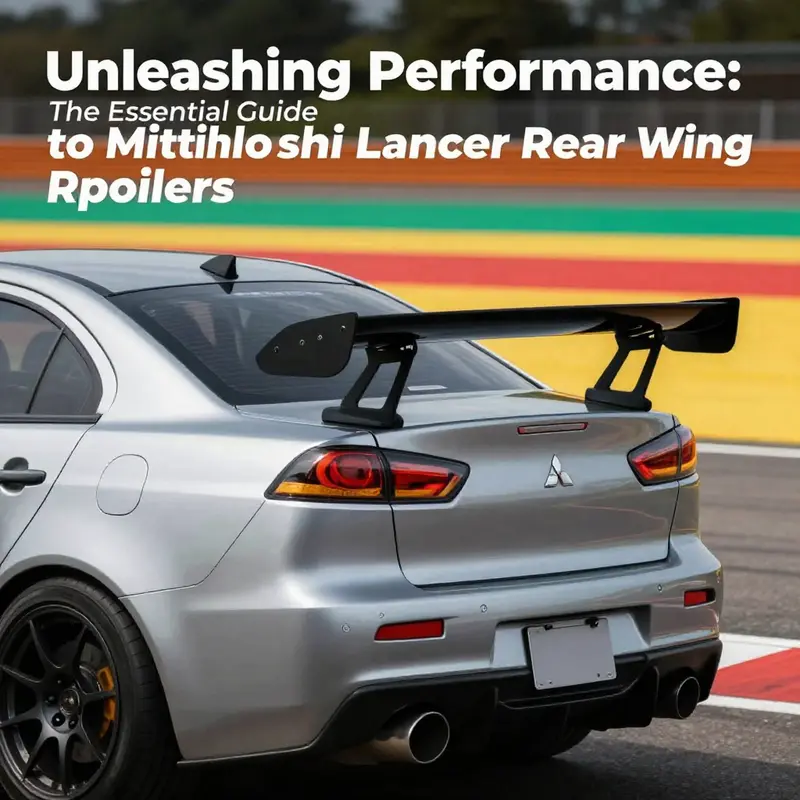
The Mitsubishi Lancer rear wing spoiler serves as a pivotal aftermarket modification for automotive enthusiasts and professionals alike, who seek to optimize vehicle performance at high speeds. Beyond aesthetic appeal, these spoilers significantly enhance aerodynamic stability and downforce, which drastically improves driving dynamics. In this guide, we will delve into the intricate designs and aerodynamic principles behind these spoilers, analyze the various material choices available in the market today, discuss their performance benefits, and finally, explore the market availability of these essential components.
null
null
Choosing the Right Material: How a Mitsubishi Lancer Rear Wing Balances Weight, Strength, and Style
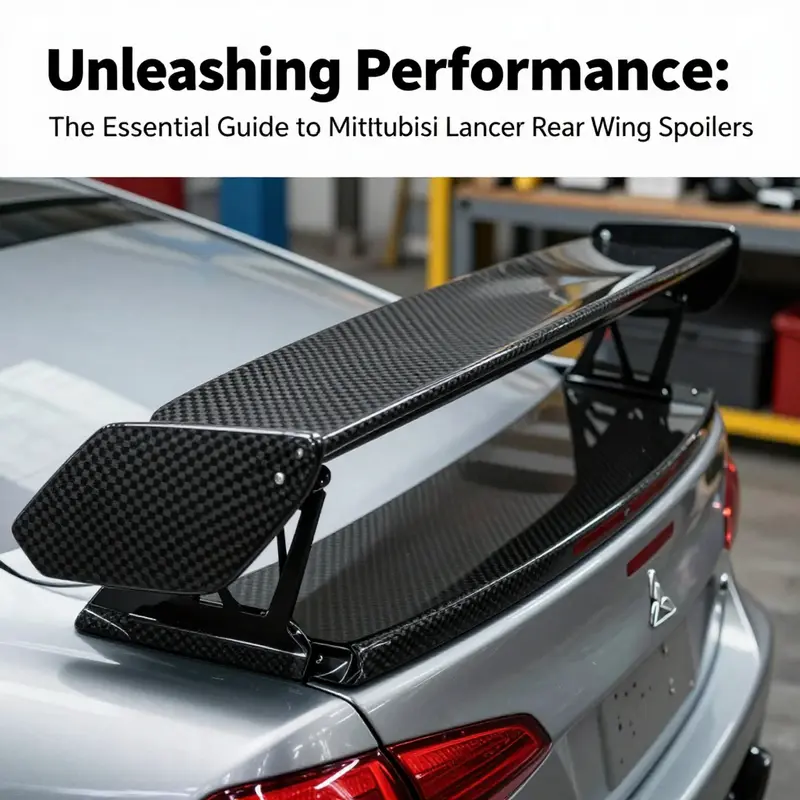
Material matters for a Mitsubishi Lancer rear wing. The material you choose determines weight, stiffness, durability, cost, and appearance. Each choice shifts the balance between performance and practicality. For Lancer owners who care about both function and form, understanding material trade-offs is essential. This chapter walks through the four common options, and explains how each one behaves on the road, at speed, and over years of use.
The most common material is ABS plastic. ABS is affordable, easy to shape, and impact-resistant. Manufacturers often use it for original-equipment and budget aftermarket spoilers. Its greatest advantages are cost and formability: complex curves and OEM-style contours are straightforward to mold. For owners who want a clean factory look without a high bill, ABS is the pragmatic choice. It handles everyday stress and light track use reliably. However, ABS is heavier and less rigid than more advanced composites. Under extreme aerodynamic forces, ABS can flex more. Repeated stress or a hard impact can lead to cracks. Cosmetic damage is also more visible when paint chips or UV exposure dulls the finish. For those prioritizing low cost and a factory match, ABS is usually adequate.
Polyurethane, or PU, sits between ABS and higher-end composites. It brings notable flexibility and outstanding impact resistance. That flexibility makes PU spoilers resilient against minor scrapes. A PU wing will bend rather than break when it meets a curb or a stray object. This property is especially useful for street-driven Lancers that sometimes see rough parking lots or occasional track days. PU parts can return to shape after moderate impacts, reducing repair costs. They are often favored by owners who want a sporty look but who drive regularly on imperfect roads.
Polyurethane is more expensive and trickier to install than ABS. Its flexibility means alignment during mounting must be precise to avoid vibration. In some cases, specialized adhesive or fasteners are needed. PU can also be heavier than composite options, so its benefits are mostly durability and toughness rather than weight savings. For daily-driven Lancers that need a robust spoiler, PU often represents a sensible compromise between performance and resilience.
Fiberglass is a classic choice for performance and customization. It offers a favorable strength-to-weight ratio and excellent stiffness. Fiberglass parts are commonly used on track-focused cars and by custom shops. They resist aerodynamic loads without much flex, which helps maintain consistent downforce at high speeds. For owners modifying bodywork or fitting non-standard wings, fiberglass is easy to repair and reshape. Cracks can be patched, sanded, and refinished without replacing the entire piece.
That said, fiberglass has trade-offs. It is more brittle than polyurethane, so a strong impact can fracture it. Surface finish and fitment quality vary by manufacturer, so a fiberglass spoiler can require professional trimming and adjustment. Additionally, fiberglass parts may need careful painting and sealing to prevent moisture intrusion. For performance-minded Lancer drivers who want a lighter, stiffer wing and who are comfortable with occasional repairs, fiberglass offers clear benefits.
Carbon fiber represents the premium end of the spectrum. It is prized for exceptional stiffness and minimal weight. A carbon fiber rear wing reduces mass at the back of the car, improving dynamic response and reducing rotational inertia. On a track, that lighter tail can improve turn-in and overall handling. Carbon fiber also has a high strength-to-weight ratio, resisting deformation at speed and maintaining predictable aerodynamic behavior.
The visual appeal of carbon fiber is another major draw. The woven pattern and glossy finish signal high-performance intent. For many Lancer enthusiasts, a carbon fiber wing enhances both aesthetics and resale value. Yet, carbon comes with downsides. Cost is considerably higher than ABS, PU, or fiberglass. Carbon fiber can also be brittle if not designed with proper layups. Impacts can cause delamination or hidden internal fractures. Repairs are possible but often expensive and require specialist skills.
Beyond cost, installation and maintenance demand attention. Carbon components should be handled carefully to avoid chipping the finish. Mounting points need reinforcement because carbon wings transmit aerodynamic loads directly to the trunk. Without proper reinforcement, even a strong carbon wing can cause damage to the mounting area. For owners who seek top-tier weight savings and stiffness, carbon fiber is the go-to material. It suits those prepared to accept the cost and maintenance demands.
Choosing between these materials depends on use-case and priorities. If budget and a factory look matter most, ABS will usually satisfy. If daily durability and resistance to scrapes is the goal, PU is favored. For track use and custom installations, fiberglass balances lightness and repairability. For maximum performance and visual cachet, carbon fiber is unmatched. A practical way to decide is to list priorities in order: cost, durability, weight, stiffness, and appearance. Then match the material that best aligns with that ranking.
Fitment and manufacturing quality matter as much as material. A well-designed ABS spoiler can outperform a poorly made carbon piece. Check panel gaps, mounting hole alignment, and the quality of paint or clear coat. For carbon wings, confirm that the weave and resin finish are consistent. For PU and fiberglass, inspect for pinholes, rough seams, or uneven thickness. A quality spoiler should sit flush and secure on the trunk lid without undue force.
Installation considerations are material-specific. ABS and fiberglass often bolt directly to predrilled holes or use supplied brackets. PU requires careful clamping during curing, and adhesives may need time to set. Carbon components typically require reinforced mounting points and sometimes a backing plate to spread loads. Improper installation can create vibrations, rattles, or worse—damage to the trunk lid. Additionally, trunk operation can be affected. Some larger wings interfere with trunk lid clearance. Always test trunk travel before finalizing fitment.
Environmental resistance varies too. ABS and PU handle temperature changes reasonably well, though prolonged UV exposure can fade their finishes. Fiberglass and carbon fiber, when properly painted and clear-coated, resist UV better. Salt and road grime can accelerate finish degradation. Regular washing and waxing preserve surface integrity. Small chips in ABS or PU are relatively straightforward to repair. Fiberglass and carbon require resin work to restore properly.
Cost and resale are practical concerns. ABS parts are cheap to replace. PU and fiberglass sit in a mid-range price bracket. Carbon fiber commands a premium. However, carbon pieces can add perceived value when selling a modified Lancer. Buyers interested in performance often pay more for authentic carbon components. That said, aftermarket carbon without proper certification may raise questions during resale. Documenting purchase and installation details helps maintain value.
Safety and legality should not be overlooked. Extremely large or poorly designed wings can catch crosswinds in tight conditions. Local laws sometimes restrict modifications that affect vehicle width or visibility. Mounting that alters the trunk structure can affect crash dynamics. Choose parts that do not compromise safety. Favor products that match vehicle specifications and come with mounting instructions or reinforcement kits.
Finally, verify supplier credibility. Even within the same material category, quality varies widely. Look for parts that list material composition and provide installation guidance. Where possible, inspect examples in person or request high-resolution photos. For owners considering carbon upgrades across the car, compare wing options with other carbon pieces. A relevant reference for carbon bodywork can be found in the shop’s listing for a brand-new original carbon fiber bonnet for Mitsubishi Lancer Evo X, which illustrates typical carbon finish and fitment expectations: brand-new-original-carbon-fiber-bonnet-for-mitsubishi-lancer-evo-x.
For detailed buying guidance, certification notes, and a checklist to choose the right spoiler, consult an expert guide that walks through selection steps and fitment concerns: https://www.carinterior.com/how-to-choose-the-right-mitsubishi-lancer-spoiler/
By matching material characteristics to real-world needs, Lancer owners can select a rear wing that genuinely improves stability and style. The right material ensures the wing delivers predictable aerodynamic benefits. It also reduces long-term ownership friction. Whether the priority is budget, impact resistance, or peak performance, the material choice sets the tone for the entire modification.
The Wind, the Grip, and the Turn: Understanding the Performance Benefits of a Mitsubishi Lancer Rear Wing Spoiler
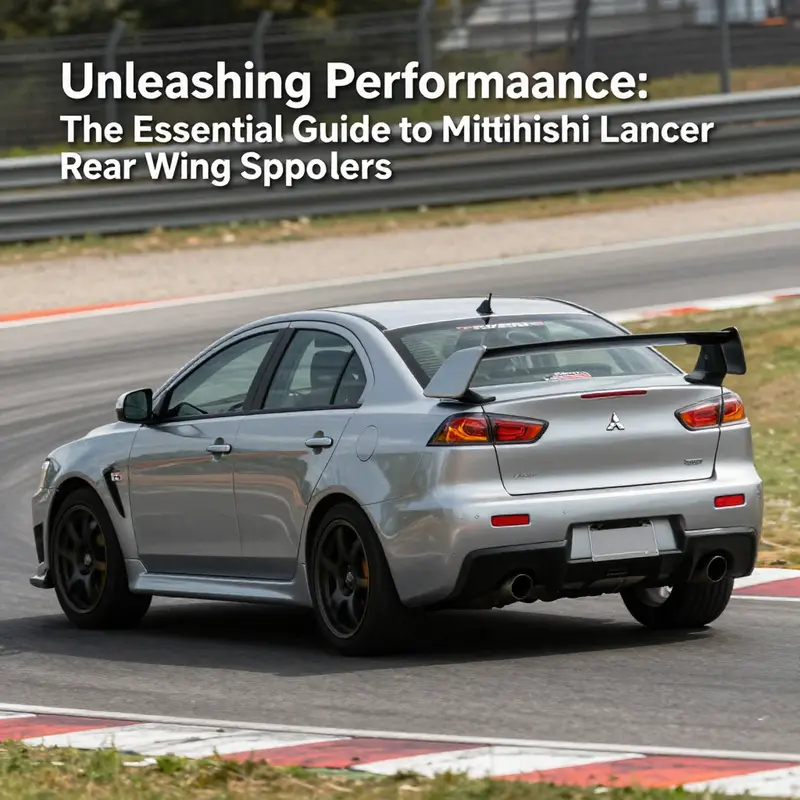
Across the spectrum of car culture, aero upgrades carry a specific promise: more control when speed presses against the chassis and more confidence when the road demands precision. For the Mitsubishi Lancer, the rear wing spoiler sits at the crossroads of this promise. It is not a decoration, nor a mere visual statement. It is a deliberately engineered device that reshapes how air interacts with the car’s rear end, and in doing so, it reshapes how the car behaves when the pace increases. To understand its value, it helps to translate the physics into everyday driving sensations—the way a highway stretch can become a proving ground and how a winding road can become a place to test the balance between grip and steering input. The spoiler’s effect begins where air meets the car’s tail, and its reach extends into corner entry, exit, and even the stability a driver feels during high-speed lane changes. When mounted correctly, a rear wing does more than push air downward; it guides air to help the rear tires maintain their bite as velocity climbs, helping the Lancer remain planted rather than allowed to wander at the limit. The result is not just a faster car, but a more predictable one—one that communicates its limits clearly and lends the driver a higher degree of precision and assurance in moments when the line between control and instability is razor-thin.
The physics behind this effect are approachable. A properly designed rear wing spoiler generates downforce at the rear by directing the air in a way that increases pressure on the top surface and, crucially, maintains a downward pressure through the rear axle as speeds rise. This downward force is not a simple downbeat of the nose; it is a carefully distributed action that stabilizes the tail, helps the rear tires maintain contact with the road, and reduces the likelihood of sudden lift when a car is loaded into a corner or when the throttle is pressed aggressively on exit. On a Lancer, where the silhouette and rear geometry create a distinct wake, the wing’s job is to shape that wake so the rear end behaves in a familiar, communicative way rather than in an unpredictable one. It is this predictability, especially under stress, that many drivers associate with real-world performance gains rather than theoretical improvements.
There is a practical continuum to consider: there are simpler rear spoilers that manage airflow mainly at the bumper, and there are wings engineered to be a more complete aerodynamic package. A lip or small duckbill might refine the exit flow and reduce some rear disturbance, but a dedicated rear wing aims to optimize air pressure distribution across the entire rear end. The wing’s arch and endplates tune how the air wraps around, how it re-energizes the wake behind the car, and how it contributes to the balance of downforce between the front and rear axles. This balance matters because the chassis responds to cornering loads as a packaged system. If the rear wing is too aggressive for a given setup, it can rob the front end of some balance, potentially increasing understeer in certain conditions. If it is too tame, the driver may not perceive the intended stability or confidence at speed. The art is in a well-matched combination that respects the Lancer’s wheelbase, suspension geometry, and drivetrain layout, so the wing’s effects complement the car’s natural tendencies rather than fight them.
Materials play a role in how these ideas play out on the road. ABS plastic wings offer practical advantages: they resist impact well enough for street driving, are relatively affordable, and are straightforward to shape for a fit that looks natural on the tail. Carbon fiber wings reduce weight and often feel stiffer under load, which can translate into crisper aerodynamic behavior at high speeds and sharper response to load changes in corners. Yet the trade-offs are real. Lighter weight and higher stiffness come at a premium price and sometimes a more involved installation process. The choice between these materials should align with how the car will be used. A daily-driven Lancer that sees occasional track sessions may benefit from a well-chosen ABS wing that is finished to look like OEM but with the performance intent intact, while a weekend warrior who spends long days on track might justify the investment in carbon fiber for the added stiffness and weight savings. The broader lesson is that the materials do more than alter cost; they influence how the wing behaves as the car enters and leaves corners, how it handles gusts on the straight, and how durable the setup remains after repeated high-load cycles.
From the driver’s seat, the gains manifest most clearly when cruising at highway speeds and dialing into a long sweep of road where lines demand composure. At these speeds, the rear wing begins to operate in earnest. The added downforce contributes to a steadier platform, which translates into more confident lane changes, more linear steering response, and a reduced tendency for the tail to break away under sudden throttle applications. This is not a sweeping claim about a miraculous performance leap; rather, it is a statement about consistency. The car feels consistent as air pressures rise and fall with shifts in throttle position, wind, and road irregularities. The velocity window where these benefits feel most tangible is the range you would expect on aggressive highway driving or track sessions with sustained high speeds. At low city speeds, the wing’s influence is far less dramatic. That is not a flaw, but a characteristic of aero design: the asymmetry between low-speed practicality and high-speed advantage means the wing’s value is best realized when speed is a friend rather than a foe.
Narrative and data converge here. Car enthusiasts who have studied the wing’s effect on handling describe improved rear traction and more stable high-speed cornering as direct outcomes of a properly tuned aero element. The added downforce at the rear helps maintain line, reduces chassis yaw, and lends a feeling of unity between steering input and vehicle response. This is particularly noticeable when the Lancer is pushed into faster bends where the balance between grip and rotation becomes critical. A well-matched wing does not erase the car’s natural limits; it lengthens the window of controllable behavior, making the moment of transition from straight to corner more predictable and the exit from the corner more assured. In that sense, the rear wing is a tool for communicating the car’s intent to the driver with even more clarity.
The practical considerations surrounding fitment are essential. The rear wing’s advantage depends on a robust mounting system that preserves trunk integrity, respects the hatch’s opening mechanism, and minimizes adverse wind leaks around fasteners. If the wing is installed with gaps, misalignment, or improperly sealed joints, the expected aerodynamic gains can be compromised by wind noise, vibrations, or even leakage that spoils the seal around the trunk edge. A guided approach—selecting a wing that is designed for the Lancer’s rear geometry, ensuring proper mounting hardware, and confirming compatibility with the specific model year—helps avoid these pitfalls. The goal is a clean, cohesive look that sits flush with the car’s lines while the wing applies its forces to the air in a respectful, predictable manner. This is where OEM-compatible or certified aftermarket options are valuable, not merely for aesthetics but for the confidence that the installation will stay true to the chassis under stress.
Discerning enthusiasts often weigh the effect on daily usability. A wing of substantial size can influence trunk clearance and the ease with which the hatch opens. If the wing sits too tall or translates to a rear end heavy with mass, the added load can subtly shift the car’s weight distribution and the way the tail behaves when the trunk is opened or closed. The cautious path emphasizes a balance between performance goals and practical use. In a well-considered build, the wing integrates with the car’s lines and with the suspension setup so that performance is not achieved at the expense of daily livability. The driver experiences a heightened confidence at speed without introducing new compromises in traffic or parking scenarios. That balance is rarely accidental; it is achieved through careful specification and precise installation.
Visual impact often accompanies performance, and that impact can influence a buyer’s perception of value. A rear wing aligns the car’s exterior with its driving demeanor. When chosen with an eye toward harmony with the Lancer’s silhouette and its aero cues, the wing communicates purpose, and that communication can resonate with others who share a passion for driving dynamics. But the aesthetic payoff should never override the engineering logic that underpins stability and control. The ideal upgrade respects the car’s identity while elevating the performance envelope—creating a coherent story rather than a collection of disparate appearances.
In sum, the rear wing spoiler for a Lancer becomes a meaningful performance tool when it is selected and installed with a clear understanding of how air, chassis, and driver interact. The gains in rear downforce at speed translate into more stable handling, improved cornering consistency, and a more communicative chassis overall. The wing’s true value reveals itself not in a single dramatic moment but in the car’s ability to carry momentum through fast sections and to reveal its intentions with steady, predictable feedback. The effectiveness of the upgrade rests on fitment quality, material choice, and alignment with the car’s overall performance aims. A well-executed install preserves daily practicality while unlocking a higher ceiling for speed and control, which is exactly the kind of upgrade that transforms a street Lancer into a more confident partner on the road and a more capable machine on the track.
To connect this discussion to a practical path, consider how compatibility matters in real-world aftermarket planning. A reference point for fitment and integration can be found in the rear-end component catalog for the Lancer Evolution X, which demonstrates how careful design choices translate into a coherent aero strategy rather than a compilation of mismatched parts. rear bumpers for Mitsubishi Lancer Evo X (2008-2015). This example underscores the importance of aligning new aero components with the car’s existing geometry and the surrounding bodywork to preserve both function and form. By treating the rear wing as part of an integrated approach to aero balance, drivers can maximize the benefits without sacrificing reliability or daily usability.
External resource: For a broader perspective on the speed-focused considerations behind spoilers and their selection, see the CarInterior guide on Mitsubishi Lancer spoiler speed buying guide. https://www.carinterior.com/mitsubishi-lancer-spoiler-speed-buying-guide
null

null
Final thoughts
In conclusion, the Mitsubishi Lancer rear wing spoiler is more than just a cosmetic upgrade; it’s an essential component that enhances vehicle performance through expertly crafted aerodynamic designs and high-quality materials. Selecting the right spoiler can significantly improve your Lancer’s stability and handling, particularly during high-speed maneuvers. The variety in designs and materials also ensures that there is an ideal choice for any enthusiast, whether for everyday driving or competitive racing. Investing in a reliable rear wing spoiler can elevate your vehicle’s performance, making it a key consideration for anyone serious about automotive enhancements.