
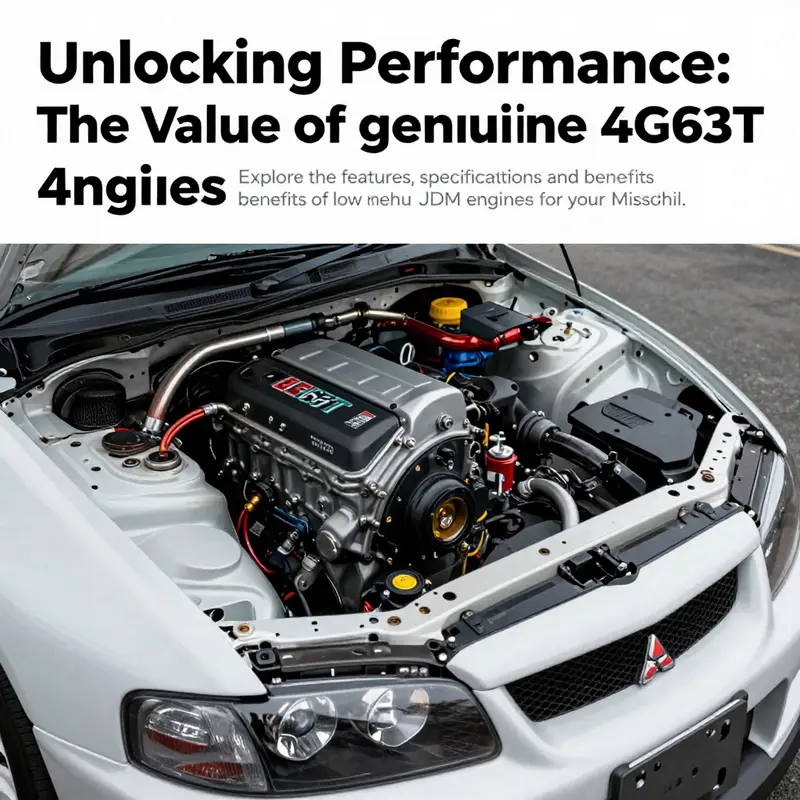
The 1995-1999 JDM Mitsubishi 4G63T 2.0L DOHC Turbo engine is a hallmark of performance and reliability, making it a sought-after component for enthusiasts and business owners alike. As the heart of popular models such as the Evo VII, Eclipse, and Talon, understanding its applications and specifications is crucial for anyone involved in automotive sales or performance enhancements. This article will delve into the technical aspects of the 4G63T engine, highlight the importance of acquiring low-mileage examples, discuss compatibility and installation considerations relevant to AWD systems, and clarify the essential role of the ECU. Each chapter builds a comprehensive understanding of why investing in these engines is not only about performance but also about securing value in today’s automotive market.
From JDM Roots to Street Legend: The 1995–1999 4G63T and Its Legacy in Evo, Eclipse, and Talon
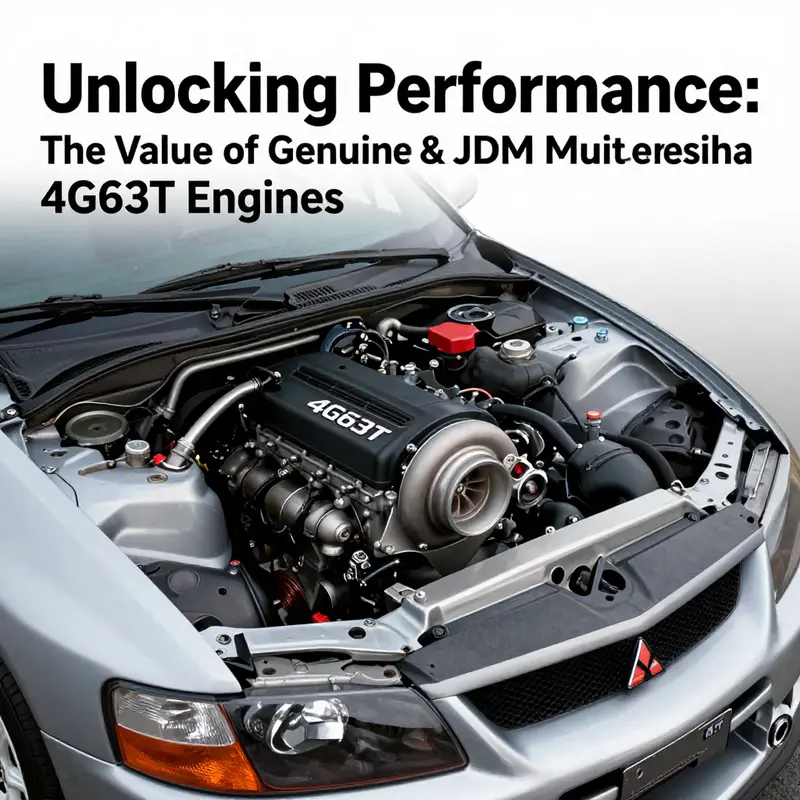
To understand the genuine JDM engines of the mid-to-late 1990s, one must hear the quiet thunder of a 2.0-liter turbocharged four that powered Mitsubishi’s best-remembered performance platforms. The 1995–1999 window marks a pinnacle when the 4G63T became a cultural benchmark. This was not merely a powerplant; it was a compact, balanced unit designed to deliver turbo surge with usable torque, translating into the Evo’s rally-spirited vigor and the Eclipse GSX’s street-ready aggression. In Japan, enthusiasts prized durability and predictable boost response; in North America, drivers found a machine that felt precise, responsive, and surprisingly approachable. The idea of a genuine JDM low-mileage engine attached to its original ECU is more than a selling point. It is a lens on a period when performance and reliability were designed to coexist. The chapter that follows traces how the 4G63T shaped three iconic chassis families and why authenticity—especially low mileage with factory electronics—still commands attention today.
At its core, the 1,997 cc engine married an iron block with a dual overhead cam design and sixteen valves, all feeding a turbocharged heartbeat. The block’s durability, along with forged internals in higher-spec variants, gave the 4G63T a large margin for boost and longevity. The factory ECU managed air, fuel, timing, and boost in a way that balanced performance with emissions. This foundation was not brittle; it tolerated upgrades and tuned maps that many enthusiasts explored in the street and on the strip. The turbocharger worked in concert with intercoolers that kept charge temperatures manageable, preserving throttle response and preventing heat soak. Taken together, the core architecture offered a rare blend of robustness and adaptability. It is this blend that explains why the engine remains a favorite among builders who want a genuine, tunable powerplant that can be trusted under demanding driving conditions, whether in an Evolution or in a street-oriented Eclipse or Talon.
In the Evolution lineup, the 4G63T became the heart of a machine engineered for sweeping grip and rally-like composure. Evo IV through Evo VI demonstrated how the package could deliver both high-end performance and track-ready reliability. By late in that cycle, calibrations and hardware upgrades converged to push the official output toward Japan’s 280 horsepower limit, with torque peaking in a way that rewarded a disciplined driving style. The engine’s strength lay not only in peak numbers but in the way torque arrived—early enough to pull cleanly off boost, yet generous enough to support confident mid-range acceleration. The AWD system, carefully matched gearing, and a robust drivetrain made these cars feel composed on rough roads and eager on smooth asphalt. This synergy fed a powerful aftermarket ecosystem that supplied upgraded intercoolers, fuel hardware, and ECU maps, all aimed at extracting more from the same robust core. The result was a platform that remained a benchmark for both street use and performance tuning, and that kept the 4G63T in the spotlight long after its initial introduction.
Across the Atlantic, the Eclipse GS-T and Eagle Talon XTI brought the 4G63T into a different light. These cars paired the turbocharged power with a compact chassis and, in many cases, an all-wheel-drive framework that broadened grip and stability. The engine’s management and exhaust flow were tuned to balance everyday usability with brisk acceleration, whether in city traffic or on open roads. Factory configurations included intercoolers and ECU recalibrations that improved throttle response and reduced heat buildup under hard use. In practical terms, owners could expect a solid 200-plus horsepower in well-sorted examples, with torque curves that delivered strong mid-range punch. The engine remained approachable for enthusiasts who preferred bolt-on upgrades rather than a wholesale rebuild. The ECU’s role as a central coordinator—managing fuel, ignition, boost, and sensor feedback—meant that even modest modifications could yield meaningful gains without destabilizing engine behavior. The Eclipse GSX and Talon thus helped democratize turbocharged performance, offering a pathway from showroom spec to street-legal thrill with a confidence that came from Mitsubishi’s engineering discipline.
The allure of a genuine JDM engine with low mileage goes beyond nostalgia. It stands at the intersection of provenance, condition, and future usability. For collectors and builders, the appeal is the chance to preserve the engine’s original calibration, hardware, and feel, while still integrating it into contemporary restorations or modernized builds. In practice, that means seeking a block and head that carry their original casting marks, a turbo that hasn’t seen excessive wear, and a factory ECU whose maps still reflect the period’s design philosophy. A low-mileage package reduces the risk of varnish in the turbo, contaminated oil passages, or worn timing components that can hinder reliability. It also makes installation easier when compatibility with the rest of the drivetrain—whether in a straight Eclipse GSX or in a chassis adapted for an Evo-style drive—needs to be considered. For those who approach these engines with reverence and patience, the payoff is a sound that remains unmistakably period-correct yet incredibly capable when matched with sensible supporting modifications. The result is a car that feels connected to its heritage rather than detached from it.
Within the hobby, the practical aspects of ownership are as important as the thrill of the first turbo rush. The 4G63T can be paired with several transmission options, but the most satisfying experiences come with a drivetrain that preserves alignment and drivetrain integrity. In the context of an Evolution-inspired build or a faithful Eclipse/GXS restoration, the right transmission, a solid transfer case, and well-chosen gearing matter as much as the engine itself. An authentic ECU, kept with the engine, becomes a living record of how Mitsubishi balanced performance and reliability in the factory era. Maintaining that synergy means routine checks of the turbo seals, intercooler integrity, and fuel-injection timing, as well as ensuring that the cooling system can handle sustained boost. These steps help retain the engine’s smooth response and prevent overheating, which is especially important in high-boost configurations. In short, the engine demands disciplined care to remain a trustworthy partner in a vintage performance package.
To illustrate market realities, consider a real-world listing that underscores the value of provenance. A 1998 Eclipse GSX example, advertised with an Original JDM Engine and Low Mileage, comes with the original ECU and the mounting hardware that makes installation straightforward for a restoration or a retro-fit project. The listing emphasizes authenticity and mileage history as defining features, illustrating how genuine JDM detail influences value far beyond raw horsepower. See this listing for a concrete example of market demand for exact configurations—a reminder that the engine’s status as a genuine JDM unit with low mileage carries concrete implications for price, install ease, and long-term reliability. 1998 Mitsubishi Eclipse GSX 4G63T DOHC Turbo AWD for Sale. The broader discourse around these engines also benefits from technical reference that explains how the 4G63T’s architecture can be understood and appreciated in a modern restoration context. For a deeper technical dive into the 4G63T’s design and potential, see this external resource: Mitsubishi 4G63T Engine Guide: Performance, Properties, and Types for Industrial Applications.
Preserving a Legend: The Genuine JDM 4G63T 2.0L DOHC Turbo Engine in 1995–1999 Eclipse, Evo VII, and Talon AWD
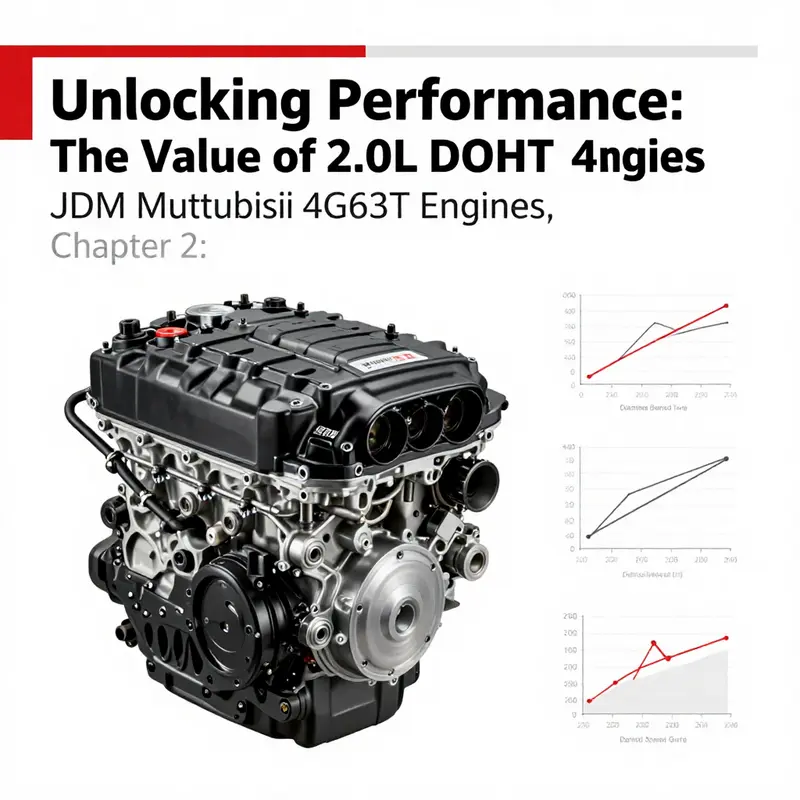
The 4G63T engine has long carried the aura of a compact powerhouse, a compact 2.0-liter that punches well above its size when paired with a turbo. In the late 1990s, Mitsubishi offered this powerplant in a family of performance machines that enthusiasts still chase today: the Lancer Evolution lineup, the Eclipse GSX, and the Talon AWD. When the engine is genuine JDM and paired with low mileage, it becomes more than a set of numbers on a spec sheet. It is a living link to a period when turbocharged I4s defined immersive, accessible performance. The appeal rests not just in the potential horsepower, but in the quiet resilience of a design that has endured through decades of spirited use. A low-mileage, original JDM example carries a sense of ready-to-run reliability, a rare condition in a market where miles and modifications accumulate like rings on a tree trunk. The engine’s true value, in this sense, lies in its condition, its original calibrations, and the integrity of its accompanying hardware, especially when it arrives with the factory ECU still attached. In this chapter, we probe what makes the 4G63T technically distinctive, why its low-mileage JDM iteration matters, and how the combination of engine, transmission, and electronics can influence the way such a powerplant performs when dropped into an Evo VII- or Eclipse-tuned context.
At its core, the 4G63T is an inline-four, a compact architecture that Mitsubishi designed for efficiency without sacrificing torque and throttle response. The displacement clocks in at roughly 1,997 cubic centimeters, just about two liters, a figure that has become a shorthand for enthusiasts when they discuss this engine’s balance of performance and drivability. The engine uses a Dual Overhead Camshaft (DOHC) configuration with 16 valves, a setup that optimizes airflow and valve timing, particularly important when a turbocharger introduces boost pressure into the combustion chamber. The block is cast iron, a choice that reinforces durability under higher cylinder pressures and elevated heat. The combination of a sturdy bottom end and a turbocharged top-end is what underpins the engine’s reputation for handling more aggressive tuning, while still remaining robust enough for street use with proper care.
What the 4G63T delivers in raw numbers often matters less than how those numbers translate into everyday driving. Stock configurations typically place the engine in a horsepower band that ranges widely by market and model year, but the engine’s real strength is its tuning potential. With the right upgrades—a suitable turbo, an intercooler sized to match the boost, an upgraded fuel system, and careful ECU work—the 4G63T has repeatedly proven capable of four-figure horsepower figures in competition and high-performance street builds. The engine’s robust internals, particularly the forged crankshaft and connecting rods that many variants employ, help it endure the increased stress of forced induction, especially when boosted to meet demanding performance targets. It is a powerplant that invites, rather than resists, modification, and its aftermarket ecosystem is among the most comprehensive in the industry. That ecosystem, combined with the engine’s inherent strength, makes it an enduring favorite for enthusiasts who want to maximize performance without sacrificing a measure of everyday usability.
The 4G63T’s performance narrative also hinges on how it breathes and how it’s supported by the rest of the drivetrain. The turbocharged nature means there can be noticeable turbo lag in stock configurations, particularly in older setups that haven’t been matched to a modern, well-tuned turbo system. However, this lag can be mitigated by selecting a turbo and intercooler pairing that aligns with the engine’s displacement and fuel delivery capabilities, along with a controller that can map boost delivery across the rev range. The engine’s throttle response is enhanced by the DOHC architecture, which allows refined valve timing and improved air flow at higher RPMs, enabling the engine to sustain power as boost climbs and RPMs rise. The result is a powerplant that rewards a thoughtful blend of mechanical upgrades and precise calibration rather than brute-force changes alone.
A genuine JDM engine with low mileage carries additional advantages beyond potential performance gains. Worn seals, carbon buildup, and general wear accumulate over time, and even well-maintained engines benefit from the absence of heavy usage. A low-mileage unit tends to exhibit cleaner internals, smoother turbine wear, and a turbo that hasn’t endured the full spectrum of heat cycles that come with long, hard service. When the ECU remains attached to the engine, that means the original fueling maps, boost control logic, and knock protection are preserved in their intended configuration. For buyers and builders who prize authenticity, the presence of the original ECU attached to a low-mileage JDM engine provides peace of mind that you haven’t inherited a mismatched pairing from a different market or a heavily altered calibration. The ECU acts as the nerve center, coordinating fuel delivery, ignition timing, boost targets, and transmission logic when applicable, ensuring that the engine’s basic behavior remains faithful to its provenance.
Within the broader ecosystem, the compatibility of this engine with the AWD systems found in Evos and Talons matters. The 4G63T’s broad success across all-wheel-drive platforms owes much to its ability to sustain boost while distributing traction to all corners, a feature that has shaped the driving experience in both rally-inspired and street-oriented builds. When a complete package is retained—engine, wiring, ECU, and the appropriate drivetrain components—the result can feel remarkably cohesive. In the context of a genuine JDM engine sourced from the 1995–1999 window, this integrity translates to consistent throttle response, predictable torque delivery, and a sense of unity between engine and chassis that is hard to emulate with later or heavily modified powerplants. A low-mileage example, curated with attention to matching components, becomes a reference point for what the 4G63T can deliver when it stays true to its original configuration.
To give a concrete sense of what collectors and builders seek, consider a widely cited example that aligns with these criteria: a 1998 Mitsubishi Eclipse GSX listed with an Original JDM 4G63T engine and low miles, paired with AWD and the factory ECU intact. While listings vary, the emphasis remains the same—genuine JDM provenance, low mileage, intact original ECU, and confirmation that the engine was installed in a way that preserves factory calibration points. Such a package is not just about raw horsepower; it is about the balance of durability, precise throttle and boost control, and the sense that the engine is operating within its designed envelope rather than beyond it. For those who want a tangible starting point in their search, a complete, correctly documented 4G63 engine package can be found via specialist listings that emphasize authentic hardware and market-specific configurations. For example, a complete 4G63 engine package aligned with Evo VII/GSX-era layouts can be explored here: Mitsubishi Evolution Evo-4-9 complete 4G63 engine listing.
Even with a strong technical foundation, care and verification remain essential. The AWD drivetrain and the ECU’s role in boost management mean that a genuine JDM engine should be checked for proper sensor operation, correct boost control, and a clean history of maintenance. With a low-mileage engine, it becomes feasible to evaluate the quality of seals, turbocharger health, and oiling pathways with greater confidence. While the engine’s potential is widely celebrated in the enthusiast community, the practical reality is that longevity rests on meticulous maintenance, especially around cooling efficiency, oil pressure stability, and fuel delivery consistency. Turbocharged engines, even those with forged components and robust internals, require careful attention to heat management and lubrication to deliver reliable performance over the long haul. This is where the value of a genuine JDM powerplant truly shines: if kept within its intended operating envelope and paired with a well-matched intake, intercooler, exhaust, and ECU strategy, the 4G63T can remain responsive and durable across a broad spectrum of driving scenarios.
The narrative surrounding the 4G63T is not simply one of peak horsepower. It is a story about an engine that invites careful curation, a willingness to respect its boosted nature, and a recognition that the car, the ECU, and the drivetrain form a synchronized system. When everything is aligned—engine, ECU, transmission, and all-wheel-drive components—the result is a driving experience that captures the essence of late-1990s Japanese performance: compact, eager, and capable of rewarding disciplined tuning. The genuine JDM 4G63T in a low-mileage package offers a rare combination of authenticity and potential, a combination that continues to attract collectors, enthusiasts, and builders who want a living link to a pivotal era in performance engineering. It is the sort of engine that, when properly documented and maintained, preserves a chapter of automotive history while still delivering day-to-day usability for those who simply want to enjoy a spirited drive.
For a broader, official context on the engine’s technical underpinnings, authoritative details can be found in Mitsubishi Motors’ documentation and global resources. These sources provide the framework within which enthusiasts understand the 4G63T’s capabilities, limitations, and evolution over time. For an official overview, see the Mitsubishi Motors Global Website: Mitsubishi Motors Global Website.
null
null
Preserving the OEM Pulse: The Genuine JDM 4G63T, AWD, and Low-Mileage Promise in 1995–1999 Mitsubishi Platforms
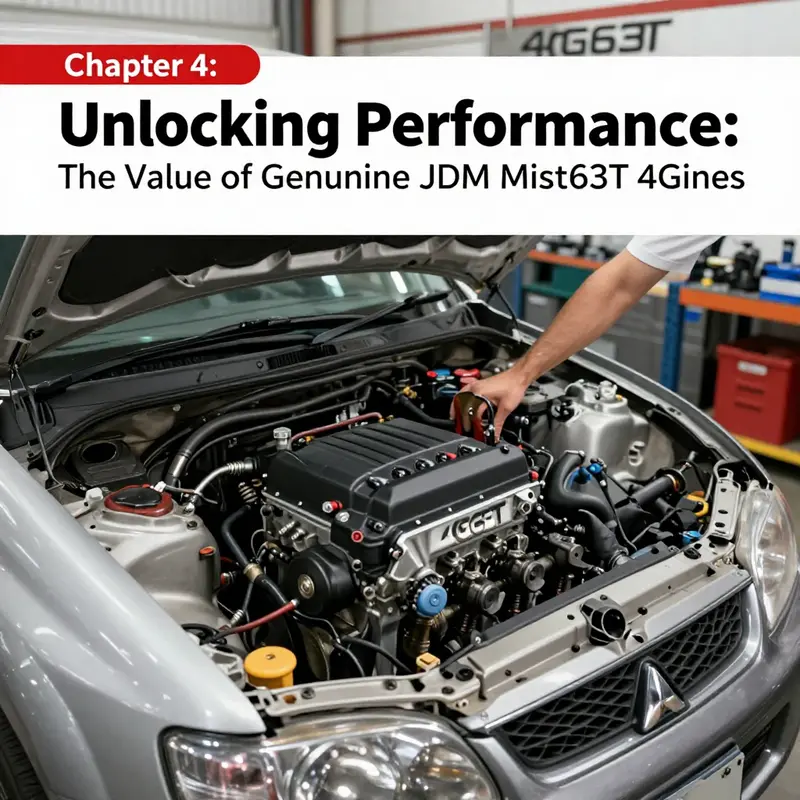
The draw of a genuine Japanese market 4G63T engine from the mid to late 1990s is not merely about power on paper. It is about preserving a lineage—a compact, high-revving, turbocharged heartbeat that paired with all-wheel drive and a factory ECU to deliver a distinct, immediate response at the pedal. In the waning years of the 1990s, Mitsubishi built a reputation for turbocharged sophistication, and the 4G63T became a benchmark for reliability when the setup remained within a factory architecture. This chapter centers on the realities and rewards of pursuing a low-mileage, original JDM 4G63T, complete with its ECU, in a configuration that emphasizes authentic drivetrain integration and the nuanced compatibility required to keep the experience faithful to the era’s engineering. It also threads a practical thread through the modern appetite for originality—how a truly stock, low-mileage engine can shape both performance and value, and what that means for someone who wants to preserve history while driving it today.
A genuine JDM 4G63T is more than a high-output engine; it is a product of a complete drivetrain philosophy. The powertrain did not exist in isolation. It was designed to work in concert with a full-time all-wheel-drive system, a robust transmission housing, and an ECU that managed boost, timing, and fuel delivery in a tightly orchestrated loop. When a buyer surveys listings for engines described as “Original JDM” and “Low Mileage,” what matters most is a chain of trust that extends beyond the engine block to the harness, the ECU, and the way the engine communicates with the car’s other systems. A recent listing on a major classic car platform highlights this precisely: the engine is described as a genuine JDM unit with low mileage and comes with the original ECU. That combination is not mere rarity; it is a signal that the installation, if pursued, will require rigorous attention to OEM specifications and to the way the engine interacts with the AWD drivetrain in your chassis. This reference point underscores a practical truth: real authenticity does not exist in isolation. It is a systemful proposition that requires careful matching across engine, electronics, and transmission.
To understand what a genuine JDM 4G63T demands, one must begin with the AWD backbone. The engine’s most successful home is in a platform engineered to handle its torque with confidence. The integrated AWD system in these cars features a limited-slip center differential, balanced front and rear differentials, and a reinforced case designed to tolerate elevated torque levels. In other words, the engine’s potential is fully realized only when the rest of the drivetrain is prepared to translate torque into controllable, repeatable grip. Transplanting the 4G63T into a non-AWD chassis—an idea sometimes entertained by enthusiasts seeking raw weight savings or a different chassis balance—soon encounters structural and dynamic mismatches. The engine bay geometry, firewall mounting points, and the transmission tunnel are tailored to a specific layout. Even with a solid fabrication effort, the result can be a compromise between fit, stiffness, and torque management. The prudent path, if one’s goal is to honor authenticity, is to work within the donor’s AWD framework or, at minimum, to choose a donor vehicle that shares similar architecture and control philosophy. In this context, a low-mileage JDM engine paired with its original AWD system yields the most faithful replication of the era’s driving character and reliability.
From a mechanical perspective, the 4G63T’s installation is as much about support systems as about the engine itself. One cannot merely drop in the block and expect flawless operation. The feed and return lines for oil and cooling must be aligned with the turbocharger’s demands, the turbo oil feed and drain must be correctly routed, and the turbo’s pressure control must communicate with the ECU in a way that mirrors factory calibration. The engine’s intake manifold, intercooler routing, and sensor placement are part of a comprehensive package that was designed to work as a complete system. Even small deviations—such as altered hose lengths, different mounting points, or a misaligned turbo shield—can cascade into boost instability or heat-soak issues under load. The ethos of authenticity, therefore, also carries a practical caution: preserve as much of the original layout as possible, and any deviations should be made with a clear understanding of their consequences on air/fuel timing, boost behavior, and long-term reliability.
Another layer of complexity lies in the electronic integration. The original ECU was calibrated to the engine’s exact sensor set, turbo parameters, and the AWD system’s torque distribution logic. In a modern restoration or restomod context, some builders opt for a dedicated standalone engine management approach to preserve driveability while offering room for refinement. Yet, adopting an alternate control strategy should not erode the sense of period-correct behavior. The best path, if the goal is a vehicle that truly reflects its late-1990s DNA, is to maintain the stock ECU with its matching engine and to ensure the harness, sensors, and electronics are pristine and correctly integrated. If the project involves combining the engine with a different transmission or AWD setup, expect calibration work that respects the original’s mapping logic, including how wastegates, boost targets, and knock detection interact with throttle response at various temperatures and altitudes.
The value proposition of a low-mileage, original JDM engine also extends into ownership history and the conditions that preserve performance. A low mileage in this context suggests less wear in critical areas: the rotating assembly, valve train, and turbo. However, mileage alone is not a guarantor of reliability. Storage, humidity, and maintenance history all influence the engine’s long-term health. A thorough assessment should include compression tests across cylinders, leak-down checks, a scrutiny of the timing components, and a close look at the turbocharger’s condition and the sealing surfaces of the turbo-to-manifold interface. A genuine JDM unit deserves a provenance check that confirms not only the engine’s height in kilometers but also its service history, head gasket integrity, and evidence of proper oil changes. It is through this lens that Mileage becomes a meaningful marker. It signals potential longevity, not just a number. The combination of genuine JDM provenance, low mileage, and an intact OEM ECU is a rare trifecta that can deliver a satisfying blend of performance, consistency, and historical integrity for a project car, even as the car itself ages.
For anyone contemplating a build that honors the period’s engineering ethos, a concrete example helps frame the path forward. A practical reference point is a listing that emphasized an Original JDM Engine paired with Low Mileage and the original ECU, illustrating how authenticity is documented and valued in today’s market. In parallel, consider the technical feasibility and the required alignment work as you plan the integration. The alignment is not merely about engine installation; it encompasses the entire drive train relationship—the mounting points, the drive shafts, and the center diff’s behavior under load. If your aim is to preserve the core experience—the way the car communicates throttle input, turbo spool, and cornering balance—you’ll want to respect the AWD architecture and engine management scheme that the manufacturer designed. In short, the best path toward an authentic result is a deliberate, methodical approach that treats the engine, ECU, transmission, and drivetrain as an integrated system rather than as separate components stacked together.
As you evaluate potential purchases, keep in mind how the engine’s history translates into real driving characteristics. A genuine JDM 4G63T with its original ECU and a documented low mileage offers not only a performance baseline but also a tangible link to the late-1990s Mitsubishi engineering language. It promises a more faithful reproduction of the vehicle’s intended dynamics, from how the turbo responds to throttle input to how the AWD system distributes torque in corners. The practical takeaway is clear: authenticity compounds value and driving feel when the engine, electronics, and drivetrain remain in close alignment with their original design. The result is a car that speaks with a genuine, period-correct voice—one that enthusiasts seek when they chase a true JDM experience, rather than a modernized reinterpretation.
For readers seeking a concrete technical reference on similar AWD architectures and installation challenges, a detailed external discussion on the subject provides valuable context about the broader implications of AWD integration. See the resource here: https://www.autohome.com.cn/tech/20140212/189577.html. And for those curious about a related internal resource that aligns with the engine’s broader ecosystem, you can explore a detailed note on a project that highlights a complete 4G63-based setup through the link evo-4-9-shock-block-short-motor-engine-complete-4g63-1000b075. This combination of external context and internal reference helps frame the challenge and reward of maintaining a genuine JDM powertrain within the era’s AWD architecture, rather than pursuing a shortcut that departs from the original engineering intent.
Ultimately, the pursuit of a genuine JDM 4G63T with low mileage and the original ECU is about more than horsepower numbers. It is about preserving an era’s drivetrain philosophy—how Mitsubishi harmonized turbocharged performance, AWD traction, and electronic control to deliver a distinctive driving experience. It is a choice that values mechanical fidelity and historical context as much as it does speed. In that sense, the true reward is not just the thrill of acceleration, but the moment you hear the turbo wind up and recognize that the machine you’re piloting still speaks the language its designers intended.
The Engine’s Brain: ECU Tuning for the Genuine JDM 4G63T in the 1995-1999 Mitsubishi Performance Line
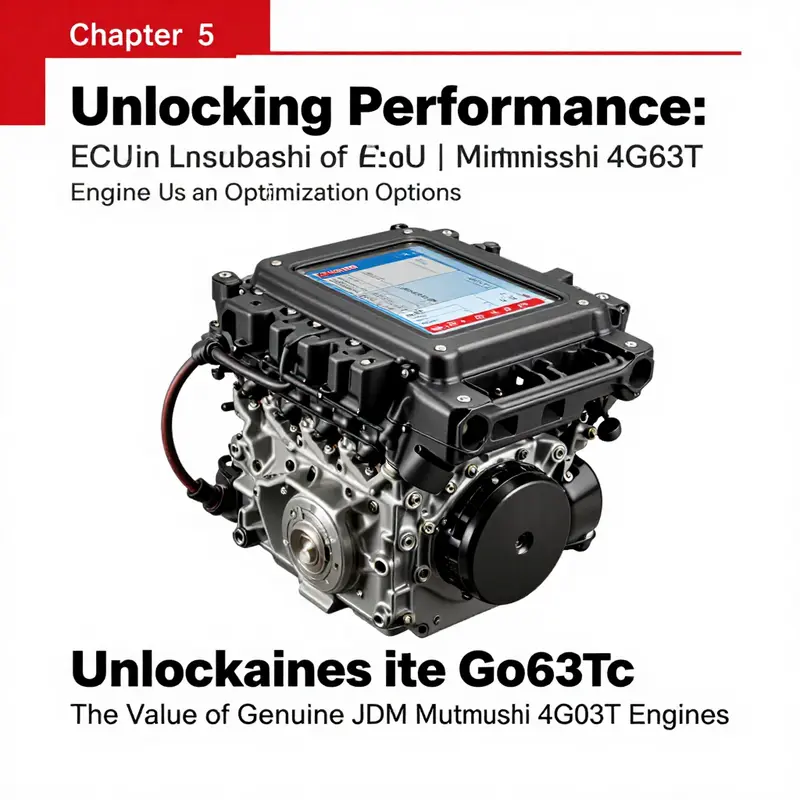
The Engine Control Unit (ECU) sits at the center of the Mitsubishi 4G63T’s performance story, especially for a genuine JDM 4G63T engine tucked into a late 90s Eclipse, Talon, or Evo VII with all-wheel-drive confidence. It is the engine’s brain, orchestrating a complex ballet of fuel delivery, ignition timing, and turbo response to deliver a predictable mix of power, efficiency, and reliability. In a stock configuration, the ECU is calibrated to maximize drivability and longevity. It negotiates emissions, cold starts, and varying fuel qualities, all while keeping the engine within safe limits. The result is a drivetrain that feels robust and approachable in daily driving, even as it holds back the upper reaches of the engine’s potential with conservative maps that favor durability over peak horsepower.\n\nWhat the stock ECU actually does is a disciplined act of balance. It continuously reads data from a network of sensors: the mass air flow, intake air temperature, engine temperature, oxygen sensors, and pressure signals from the boost system. It uses this information to time when fuel is injected and how much is squirted into the cylinders, when spark should fire, and how aggressively the turbocharger should spool under different conditions. The goal is to maintain a safe air-fuel ratio, prevent detonation, and keep emissions within regulatory bounds, all while delivering a smooth power delivery that accommodates everything from highway cruising to spirited backroad bursts. The result is a predictable engine character that rewards careful, measured tuning with both performance and durability.\n\nYet the same data-rich, closed-loop system that yields a reliable daily driver also hides a door to true performance. The 4G63T’s well-regarded mechanical architecture – robust iron block, efficient turbocharging, and a drivetrain that can handle a broad torque range – pairs exceptionally well with electronic tuning. If you peel back the factory maps, you find opportunities to re-map fuel, ignition, and boost control in ways that expand usable horsepower while respecting the engine’s limits. This is where the ECU’s role shifts from guardian of reliability to enabler of performance. An aftermarket or standalone control strategy can replace or augment the original maps, offering the tuner a precise tool to rewrite how the engine breathes, when it breathes more air, and how it manages combustion across the entire rpm band.\n\nThe essence of effective ECU tuning rests on a few foundational ideas. First, increasing boost is not merely a matter of telling the turbo to spin harder. It requires a parallel refinement of fuel delivery and ignition timing to maintain a safe air-fuel ratio across all operating points. Without appropriate fuel maps, higher boost can invite detonation, which is the enemy of reliability. A tuned ECU recalibrates the fuel curves so richer or leaner mixtures remain safe as boost rises, preserving power without inviting stress on pistons, valves, or gaskets. Second, ignition timing must be adjusted with surgical precision. Advancing timing where the engine is safe, especially at higher loads, can extract meaningful gains in power and throttle response. But too much advance, especially at high air densities, can trigger knock. The ECU’s role is to manage this timing in real time, balancing aggressive flame fronts with the engine’s thermal margins.\n\nA third pillar concerns the removal of stock-imposed limits. The factory ECU often includes programmed restrictions such as rev limits, speed governors, or limp-home behaviors that preserve engine integrity under worst-case scenarios. In performance contexts, these safeguards can become boundaries. A tuned ECU or a standalone system can relax or remove these constraints in a controlled, data-informed manner. This unlocks more usable power, but it also shifts the responsibility to the tuner to ensure that the engine, transmission, cooling, and fuel system stay in harmony under elevated demand.\n\nThe 4G63T is especially forgiving for electronic modification, not because it is fragile, but because its combination of a strong bottom end and a straightforward turbocharged breathing path invites predictable, tunable responses. In practice, this means a well-planned ECU strategy can deliver meaningful gains without resorting to radical hardware changes. It is not unusual for enthusiasts to aim for substantial, track-capable improvements through careful calibration and modest supporting upgrades. The objective is often not just peak horsepower, but a broader, more usable power band—more torque at midrange for real-world acceleration and more linear response in corners where the car’s AWD system can translate a boost of grip into momentum.\n\nThe discussion, however, cannot ignore the mechanical and logistical realities that come with the engine’s original pairing to an automatic transmission and an AWD layout. The ECU does not operate in a vacuum; it communicates with the transmission controllers and torque management systems. When tuning the entire drivetrain, the interplay between engine torque delivery and shift logic, transmission damping, and clutch or torque converter behavior becomes part of the tuning puzzle. A skilled approach treats torque management not as a blunt limiter but as a dynamic tool that helps the car put down power cleanly on twisty surfaces or under rapid acceleration out of corners. In practice, this means tuning strategies that consider shift points, ramp rates, and torque transfer to the wheels so that the added horsepower translates into real, usable speed rather than just a higher peak number.\n\nOf course, every performance journey begins with a solid baseline, and low-mileage, original-market 4G63T engines offer a particularly appealing starting point. A fresh, pristine ECU baselines the car in a condition that makes the subsequent tuning work more predictable. The sensors still reflect near-new tolerances, and the engine’s thermal and mechanical behavior remains close to the intended design. This makes it easier to map out a careful upgrade path rather than chasing issues that surface when aging components no longer respond in the same way. Yet even with a clean slate, the road from stock to a tuned performance engine is defined by discipline. Each change—whether a modest boost target, a refined fuel map, or a timing adjustment—demands validation through data and road testing. Without disciplined validation, the risk of misfire, lean conditions, or overheating rises, undermining both power and reliability.\n\nFor enthusiasts, the most satisfying aspect of ECU tuning with a genuine JDM 4G63T is the sense of harmony between the engine’s core hardware and its electronic brain. The goal isn’t to chase maximum numbers in isolation; it is to create a calibrated system where the turbo’s breath, the engine’s timing, and the car’s traction and chassis capabilities work together. When executed well, the result is a car that remains tractable in daily driving while unveiling a much more responsive and confident character when the accelerator is asked to demand more. It is a careful craft – one that respects the engine’s original engineering while extending its capabilities through thoughtful reprogramming and validation.\n\nThe practical takeaway for anyone considering a project around a genuine JDM 4G63T with low mileage is clear. Begin with a robust understanding of the factory maps and how they shape every drive. Treat the ECU as a living control system whose parameters must be tuned with respect for fuel quality, ambient conditions, and the car’s transmission behavior. Build a plan that accounts for fuel delivery, ignition, and boost as a cohesive trio rather than as isolated adjustments. And whenever you push into higher-performance territory, ensure you have a support path: upgrades for cooling, fuel capacity, and intercooling, plus careful attention to the drivetrain’s ability to handle increased torque. The ECU is, in many ways, the gateway to unlocking the engine’s potential while preserving the reliability that drew enthusiasts to these JDM machines in the first place. For readers who want to dive deeper into how electronic control strategies translate to practical, data-driven performance improvements, a broader technical exploration can be found in reputable automotive engineering resources: https://www.bitauto.com/
Final thoughts
The genuine JDM 4G63T engine is not merely a powerful turbocharged unit; its significance stretches beyond performance to aspects of reliability and value retention. For business owners, comprehending the engine’s specifications, the criticality of low mileage, and installation compatibility with AWD systems creates a competitive edge in the automotive market. Equipping yourself with the knowledge of how the ECU interacts with engine performance can lead to further optimization, ensuring a high-performance driving experience. Thus, investing in a genuine Mitsubishi 4G63T engine not only enhances vehicle performance but also fortifies your positioning in an evolving market.