

The Mitsubishi Lancer Evolution X (Evo X), produced between 2008 and 2015, is a symbol of performance and sought-after customizability among car enthusiasts. With time, as these vehicles age, the need for durable replacement parts rises, especially for crucial components like the front bumper. This article offers an in-depth exploration of Lancer Evo X front bumpers, focusing on their varied materials and construction, performance enhancements, market trends, and user preferences. Each chapter will delve into vital aspects to help business owners navigate the aftermarket landscape effectively.
Materials, Construction and Choosing the Right Lancer Evo X Front Bumper
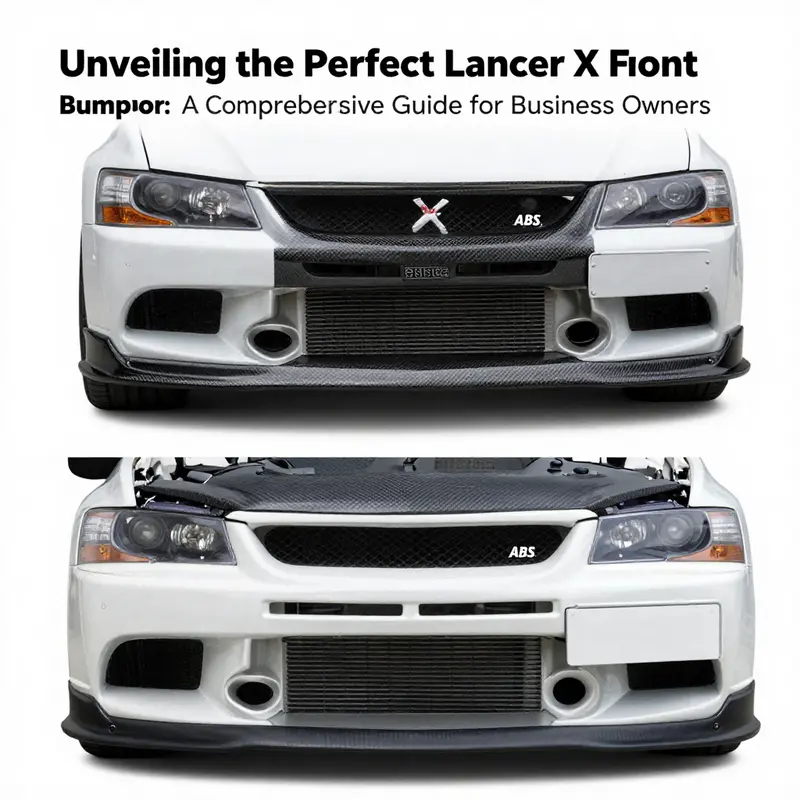
The front bumper on a Lancer Evolution X is more than a cosmetic shell. It shapes airflow, protects structures, and defines a car’s character. When owners replace or upgrade that bumper, the material and construction method determine performance, durability, and fitment. Understanding the common materials and how they are built will help you pick the right bumper for daily driving, track days, hot climates, or show builds.
Carbon fiber remains the premium choice for people who want weight savings and rigidity. A carbon fiber bumper is made by laying high-strength carbon fabric into a mold, then saturating the weave with resin and curing it. The result is a composite with a superb strength-to-weight ratio. For the Evo X, carbon bumpers can be up to roughly thirty percent lighter than traditional fiberglass pieces, which matters when reducing unsprung and frontal mass. Lighter weight improves throttle response and can slightly enhance braking and cornering balance. Properly shaped carbon parts also reduce drag and increase downforce, producing measurable handling gains at speed. Carbon resists thermal deformation, so it remains stable in extreme heat. The trade-offs are cost and fragility in low-speed impacts. Carbon will not flex like polyurethane; instead, it can crack under impact. Repairs are possible, but they require specialist skills to restore structural integrity and finish.
Fiberglass-reinforced polyester, often called FRP, occupies a middle ground between performance and cost. These bumpers are typically produced by a hand-layup process in a mold. Layers of fiberglass mat or cloth are placed and saturated with polyester resin, then allowed to cure. FRP yields a strong, rigid panel that holds complex shapes well. For the Evo X, FRP bumpers are popular for custom body kits because they accept elaborate vents, ducts, and contours with relative ease. They are stiffer than many thermoplastics and, compared with carbon, much more affordable. However, FRP is heavier than carbon and more brittle than polyurethane. Small impacts can chip or crack fiberglass; but damage is often straightforward to repair with resin and filler. For owners who seek a convincingly aggressive look without the premium price, FRP is a sensible option.
Thermoplastic urethane (TPU) and polyurethane blends offer a different set of strengths. These materials are engineered to flex and return to shape after minor collisions. A TPU bumper can absorb scrapes, parking bumps, and curb encounters without cracking into pieces. That resilience makes TPU common in road-focused bumper lips, canards, and modular kit pieces. Polyurethane also tolerates higher temperatures than some cheaper plastics, which is useful in hot regions. The downside is weight and fitment precision: TPU parts can be heavier and sometimes require professional alignment to avoid squeaks or binding. They also often need careful painting, because surface preparation differs from that of composite materials.
ABS plastic remains the go-to for many OEM-style replacements and universal widebody conversions. ABS is molded via injection for consistent fit and repeatability. It offers good impact resistance and is cost-effective for large-scale production. For daily drivers, ABS provides reliable performance with minimal fuss. It handles environmental stress well, tolerates heat, and resists minor impacts without major damage. Universally styled widebody bumpers often use ABS to balance cost and fitment across many chassis. While ABS won’t match carbon’s weight savings or polyurethane’s flexibility, it reliably restores the Evo X’s original function and appearance at an affordable price.
Polycarbonate is less common as an entire bumper material but finds a role in regions where heat and impact resistance are critical. It provides excellent toughness and tolerates thermal cycling without becoming brittle. In very hot climates, polycarbonate-based bumpers and components resist warping and maintain dimensional stability. This attribute makes them attractive where environmental conditions are severe and frequent.
Construction technique matters as much as material. Injection molding is the dominant method for thermoplastics like ABS and some urethane blends. The process yields parts with consistent thickness, predictable tolerances, and precise mounting points. For owners looking for a bumper that snaps into place and aligns well with factory mounting points, injection-molded ABS is hard to beat. Hand-laid composites, whether carbon or FRP, allow for more bespoke shapes. Hand-laying is flexible for low-volume production and custom lines, enabling deep vents, intricate lips, and molded canard integration. However, hand-laid parts may show more variability in surface finish and thickness unless produced by experienced shops following tight quality controls.
Modular designs combine materials and methods to get the best of both worlds. A common approach pairs a rigid FRP or carbon main bumper with flexible TPU or polyurethane lips and splitters. This hybrid construction lets the central structure provide accurate mounting and shape while the replaceable lower pieces absorb contact and protect the main shell. Such systems are increasingly common in the Evo X aftermarket because they allow targeted repairs and aesthetic swaps without replacing the entire bumper.
Choosing the right material depends on intended use. For track-focused drivers, carbon fiber often yields the best performance return. Weight savings and improved aerodynamics matter at speed, and carbon keeps its shape under heat from brakes and engine bay airflow. For those in hot climates who still want durability, polyurethane or polycarbonate hybrids make sense. They resist cracking and maintain fitment despite thermal cycling. Daily drivers who want a balance of cost and longevity typically opt for ABS. Enthusiasts after deep custom styling but not ready to pay carbon prices usually accept FRP, knowing repairability and cost are both manageable.
Fitment and finish are equally critical. Genuine-style bumpers made to factory dimensions ensure that mounting tabs line up and ancillary components fit without extensive modification. If you prefer a custom or widebody look, expect trimming, reinforcing, or additional brackets to achieve perfect alignment. The best aftermarket manufacturers test their molds for multiple cars and supply reinforcement plates where necessary. For reference on factory replacement options and verified fitment, consider looking at a genuine CZ4A Evo X front bumper to see how OEM-style parts align with the car’s original points and hardware. genuine CZ4A Evo X front bumper
Durability and repairability are practical concerns. Carbon repairs require resin infusion or patchwork with matching fibers and sometimes autoclave curing for high-grade restoration. FRP repairs can be completed with polyester resin, fiberglass cloth, and filler compounds. Polyurethane patches need adhesives that remain flexible; otherwise, rigid fillers will fail. ABS repairs are feasible using plastic welding and specialized adhesives. When evaluating used bumpers, inspect mounting tabs, inner reinforcement rails, and key contact points. Superficial scrapes can be fixed easily, but cracked mounting bosses or broken inner rails often require extra fabrication or replacement.
Manufacturing origin influences quality and lead time. A major production hub for Evo X bumpers is the Guangdong region of China. Manufacturers there frequently provide integrated services, including injection molding, composite layup, painting, and tooling. Buying from established suppliers with clear quality documentation reduces the risk of dimensional errors and poor paint finishing. For B2B buyers, confirming certifications, tooling accuracy, and logistical reliability is essential. Smaller shops may offer lower prices but lack the consistency of seasoned manufacturers.
A few installation and maintenance pointers tie the discussion together. If you install a rigid composite bumper, reinforce the mounting points with steel or aluminum plates to prevent stress cracks. For flexible bumpers, add anti-squeak washers or soft mounts where panels interface. Always trial-fit before painting; minor sanding and filler work are easier when you can see how parts meet at seams. For painted components, use high-quality automotive primers and paint systems, and consider ceramic or clearcoat layers to protect against stone chips and UV fade. Regular inspection after winter or spirited driving will identify loose tabs and early damage before it worsens.
Finally, think about integration with other aerodynamic pieces. The front bumper does not work alone. Splitters, canards, diffusers, and side skirts create a cohesive aero package. Materials should match or at least be compatible. Rigid carbon front lips pair well with carbon splitters and diffusers. Polyurethane lips and canards can cushion impacts and protect carbon mains. Ensure mount points and hardware match across parts to avoid stress concentration and misalignment.
Selecting the right front bumper for an Evo X is a practical balance of performance, cost, and context. Carbon brings weight reduction and high-end aesthetics. FRP delivers shape flexibility at reasonable cost. Polyurethane and TPU add resilience and thermal durability. ABS offers consistent OEM-level fit and value. Consider how you drive, where you live, and how much fabrication work you want to accept. A well-chosen bumper enhances both the car’s presence and its function. For deeper reading on composite behavior and carbon material properties, the following resource provides technical context: https://en.wikipedia.org/wiki/Carbonfiberreinforced_polymer
Aerodynamic Precision and Material Mastery: Evo X Front Bumper Design, Materials, and Performance

The Evo X front bumper is more than a visual shell; it is a programmable aero gateway that moderates air, heat, and loads to sustain high-speed stability and confident handling. Designed to channel air toward the intercooler and radiator, it also hosts vents and openings that influence boundary layer behavior and underbody flow, while integrating with a splitter and canards to tune downforce where it matters most. In the performance ecosystem, the bumper helps keep the engine and brakes cooler, preserves sensor integrity, and supports the overall aero narrative that keeps the car planted through rapid weight transfer and corner exit.
Material choices underpin this balance between efficiency, durability, and cost. ABS plastic remains common for OEM-inspired bumpers, offering predictable molding, solid impact resistance, and reliable alignment with sensors and lighting. Carbon fiber bumpers bring a different category of performance—reduced weight and exceptional stiffness that lower unsprung mass and enable more precise suspension response and steering feedback. In many builds, carbon fiber is paired with a complete aero kit to maximize aero efficiency while maintaining structural safety. Polyurethane offers resilience in hot climates, with good impact tolerance and an ability to endure repeated thermal cycling; however, its surface finish can require careful painting and sealant work to prevent cosmetic wear and paint cracking. Across materials, the bumper must retain geometry for sensors and lighting while contributing to the car’s aero package as a coherent whole, not a standalone feature.
The Evo X bumper’s effectiveness emerges from its integration with other aero elements. Integrated air intakes feed cooling air to the intercooler and radiator, while strategically placed vents manage flow around the wheel arches and reduce pressure buildup that can spoil cornering behavior. When paired with a front splitter and canards, the bumper helps generate meaningful downforce and stabilizes the front end during high-speed maneuvers. The mechanical and thermal benefits extend to track performance, where improved air management translates to more consistent brake cooling and steadier temperature profiles, supporting sustained laps and predictable grip. In daily use, the same design prioritizes safety and reliability, ensuring that sensors stay calibrated and the crash structure remains intact.
From a practical standpoint, fitment and compatibility drive many purchasing decisions. Modern Evo X bumpers are engineered to preserve sensor function, fog lights, and mounting points, so aftermarket upgrades do not automatically compromise safety or warranty expectations. Weight considerations are also a factor: lighter bumpers can improve handling response by reducing inertia, but must not sacrifice safety or alignment with the crash structure. The supply landscape for bumpers is global, with manufacturers offering a range of materials and finishes, certifications, and batch-to-batch consistency. When selecting a bumper, buyers should weigh weight, durability, and compatibility with existing safety equipment, as well as the intended application—street driving, track days, or show builds—and seek a cohesive balance that respects the Evo X’s overall aero strategy. The end goal is a front end that looks purposeful and delivers measurable gains in airflow, cooling, and cornering confidence without compromising daily usability.
Edge in Motion: Market Currents and the Global Sourcing of Lancer Evo X Front Bumpers

The front bumper of the Mitsubishi Lancer Evolution X is more than a cosmetic panel; it is a carefully engineered interface between the car and its environment. In the Evo X, the bumper governs how air is captured, how heat is managed, and how the vehicle sits on the road at speed. Its role becomes even more pronounced when owners push the car beyond stock parameters, chasing improved cooling under track conditions or a sharper, more aggressive stance on the street. As a result, the front bumper has emerged as a focal point for enthusiasts who want both performance and visual impact, and the market that supplies these parts has evolved in tandem with that demand. In 2026, the Evo X bumper market reflects a broader shift in how performance components are sourced, manufactured, and distributed, driven by a combination of aging OEM inventories, the pull of advanced materials, and the geographic concentration of manufacturing capabilities that can deliver rapidly without compromising fit or safety.
At the heart of the material conversation are three pathways that buyers often weigh when choosing a bumper: ABS plastic, carbon fiber, and polyurethane. ABS plastic stands as the workhorse choice for many OEM replacements and a wide array of aftermarket offerings. It provides dependable impact resistance, predictable molding for complex shapes, and a price point that makes it accessible to a broad base of buyers. For daily drivers and show cars that still demand reliability, ABS bumpers offer a practical balance of durability and economy, with the added benefit of straightforward paint compatibility. Carbon fiber, by contrast, enters the conversation when performance metrics take center stage. Carbon fiber bumpers deliver substantial weight savings and remarkable rigidity, which translates to improved handling feel and a more immediate response to steering input. In high-velocity contexts, carbon fiber contributes to reduced rotational inertia and can assist in maintaining a more consistent aero profile across a range of speeds. The trade-off is cost and resilience to certain kinds of impact; while carbon fiber can be incredibly strong, it can also be more brittle in certain minor-impact scenarios, and care must be taken to ensure proper repair procedures after a collision.
Polyurethane, meanwhile, has risen as a preferred option in hot climates and for enthusiasts who value resilience and flexibility. In regions where heat can accelerate material fatigue, polyurethane’s elastic properties help parts absorb minor shocks and return to shape with less risk of crack formation. It also offers durability against ultraviolet exposure when properly formulated with UV stabilizers, which is a practical concern for sun-drenched environments or road trips that expose the bumper to long hours of sunlight. However, polyurethane can introduce its own maintenance considerations, including the need for careful painting to maintain a uniform finish and the potential for slight squeak if mounting hardware shifts over time. These material characteristics shape not only how a bumper performs on the car but how buyers deliberate over long-term ownership costs, repair options, and even the warranty implications of non-OEM parts.
From a performance and safety perspective, modern Evo X front bumpers are engineered to do more than merely clamp a nose to the chassis. They are designed to absorb impact energy in the event of a collision, distributing that energy in ways that mitigate damage to critical components behind the bumper cover. Aerodynamically, the front end is tuned to reduce drag while guiding air toward radiators, intercoolers, and brake cooling ducts. This not only improves cooling efficiency but also supports steadier high-speed handling by limiting lift at the vehicle’s front end. The integration with other body-kit components, such as splitters, canards, and side skirts, is a reminder that the bumper is part of a broader aerodynamic ecosystem where every piece influences airflow patterns, downforce, and ultimately the car’s balance through corners and straights alike.
The market for Evo X front bumpers has come into sharper relief as OEM parts become scarcer or more expensive to source. Buyers increasingly look to a global network that can deliver parts that fit factory specifications while offering options that enhance performance without jeopardizing warranty status. This is where suppliers anchored in the Guangdong Province, particularly within Guangzhou’s industrial clusters, have become pivotal. The Guangdong ecosystem—home to injection molding, fiberglass fabrication, painting facilities, and tooling expertise—has built a tightly integrated supply chain that shortens lead times and reduces the complexity of coordinating multiple specialized processes. The effect on the buyer is tangible: faster fulfillment times, often in the 15–25 day range, and a consistent level of process maturity that supports repeatable, scalable sourcing for both small shops and larger distributing operations. Proximity to major ports such as Nansha and Shekou further lowers transit costs and accelerates international logistics, which matters when a shop needs to replenish inventory or respond to a sudden spike in demand.
Beyond Guangdong, Zhejiang and Jiangsu provide complementary strengths that round out the production map. Zhejiang’s precision CNC machining and alloy fabrication capabilities feed into high-performance internal components and enhancements around the bumper area that require exact tolerances or specialized hardware. Jiangsu’s expertise in die-casting and sheet-metal forming translates into durable structural elements and backing components that reinforce the bumper’s mounting points and sensor housing interfaces. The result is a two-pronged supply strategy for B2B buyers: a robust, regionally distributed network capable of delivering factory-aligned, OEM-replacement bumpers when needed, and a more diverse lineup of aftermarket variants that offer customization and weight-targeted performance improvements. The market has matured to a point where due diligence and technical evaluation are essential. Buyers increasingly demand ISO certifications and evidence of compliance with global quality standards, not only to protect vehicle warranties but also to ensure consistent performance across batches and models.
In practice, the decision matrix for buyers often starts with fitment and alignment. The Evo X family includes models that share a common architecture, but even small deviations in bumper mounting points or sensor housings can ripple into the need for adapters or minor modifications. This is especially critical where fog lights, camera systems, or proximity sensors are integrated into the bumper. A bumper sourced from a well-documented supplier with alignment-tested fitment and clear documentation reduces the risk of misalignment that could trigger warning lights or require dealer-level reprogramming. For buyers who are planning long-term ownership or export-oriented distribution, the reliability of the supplier’s quality assurance processes is equally important. In Guangdong and its neighboring provinces, the best-known manufacturers have built reputations for transparent testing, batch traceability, and robust after-sales support that can guide buyers through replacement or upgrade cycles without surprises.
The market also respects the range of use cases that Evo X owners pursue. Show car builders seek aggressive aesthetics and high-end materials that turn heads at car shows, where carbon fiber bumpers or polyurethane kits provide dramatic visual impact and a sense of personalization. Daily drivers, in contrast, benefit from ABS plastic bumpers that offer sturdy everyday usability at a lower total cost of ownership. For enthusiasts in hot climates such as the UAE, polyurethane’s heat resistance and flexibility become a decisive advantage, providing resilience under sun exposure and temperature swings without cracking. Track-focused enthusiasts often favor carbon fiber for its weight savings and aero advantages, accepting the higher price point as part of the performance equation. In each scenario, the choice of bumper interacts with the rest of the vehicle’s platform—intercooler ducting, radiator sizing, sensor placement, and even the calibration of steering feel that can be subtly influenced by front-end weight distribution.
Even as the market celebrates the breadth of options, a quiet but important tension remains: the balance between price and performance, between the immediacy of supply and the long-term reliability of the product. This tension is most visible in the procurement decisions B2B buyers face when negotiating with suppliers who promise OEM-replacement accuracy versus those offering higher-grade composites or tailored finishes. In this landscape, technical specifications become the currency of trust. Material data sheets, UV exposure ratings, color match capabilities, and finish durability under regional climates all inform which bumper becomes the best-fit choice for a given project. Buyers increasingly demand evidence of consistent material performance, especially for carbon fiber composites, where resin systems and layup quality directly affect long-term rigidity and damage tolerance. Likewise, polyurethane formulations must demonstrate weathering performance across seasonal cycles, as sun, heat, and humidity can subtly shift surface texture and color over time.
The role of documentation cannot be overstated. When suppliers can provide a clear, verifiable trail—from raw materials to finished product and through final paint processes—the risk of misfit or suboptimal performance drops noticeably. The Guangdong cluster’s competitive advantage has grown in part from this culture of process maturity, where tooling integrity, mold maintenance, and paint shop consistency are tracked with the same rigor applied to automotive OEMs. For buyers, this translates into faster onboarding, less need for post-shipment modifications, and more predictable planning for installation, warranty coverage, and service life. It also means that a well-supported supplier can offer consistent batch-to-batch color matching, which is essential for a vehicle that will be judged on its aesthetics as much as its engineering.
To illustrate how this market operates in practice, consider the path a shop might take when sourcing a bumper for a client project. The process begins with a specification review, where fitment charts and sensor interface diagrams are checked against the client’s Evo X variant. If a premium, OEM-grade option is chosen, the buyer leans on suppliers known for factory alignment and exactness in mold geometry, often resting on the assurance of ISO-compliant processes and traceable quality records. If performance goals call for weight reduction or enhanced airflow, carbon fiber or reinforced polyurethane options may be selected, with the understanding that installation may require specialized painting, clear coats, and careful mounting to avoid vibrations or rubbing against adjacent components. Either path benefits from the Guangdong ecosystem’s speed, but the risk calculus shifts. Premium options demand tight quality control and consistent resin systems for carbon fiber, while polyurethane routes hinge on precise chemical formulations and cure processes that prevent warping or surface imperfections.
As with all major aftermarket ecosystems, the question of durability against UV exposure and environmental stress is never far from the surface. The most durable solutions in hot, sunny climates incorporate UV stabilizers and anti-yellowing coatings that maintain color fidelity and surface gloss. For owners who value resale value and long-term aesthetics, this becomes a practical consideration that shapes the total cost of ownership. While some aftermarket bumpers may not perfectly replicate every aspect of an OEM part, the best-in-class options offer factory-like fitment, compatibility with sensors and fog lights, and a paint-ready surface that minimizes the time to install and the risk of gaps or misalignment after installation.
For readers who are curious about specific sourcing pathways or want to verify a particular bumper option that aligns with factory standards, there is a wealth of information available through dedicated product pages and supplier hubs. One example, which demonstrates how a genuine, factory-aligned option is presented to buyers, can be explored here: CZ4A Lancer Evolution X front bumper, genuine. This page exemplifies how a supplier communicates compatibility, finishes, and installation considerations in a way that reduces ambiguity and supports confident procurement decisions.
Looking ahead, the Evo X bumper market is likely to continue benefiting from ongoing improvements in material science and process engineering. Advances in carbon fiber layup, resin infusion techniques, and recycled-content formulations could influence both performance and sustainability profiles. The Guangdong cluster will probably maintain its lead through continued investment in automation, digital traceability, and collaboration across supply chains, making it possible for shops to plan around shorter lead times and tighter inventory controls. Buyers who adopt a data-driven approach—assessing material properties, team capabilities, and supplier certifications—will be best positioned to navigate the evolving landscape and secure high-quality bumpers that meet exacting standards of fit, finish, and performance. In this environment, the front bumper becomes not only a shield and a canvas for style but a critical component that embodies the intersection of engineering precision, global trade, and the shared passion that keeps the Evo X’s presence on the road and on the track unmistakable.
External resource: https://www.example.com/evox-bumper-supplier-guide-2026
Front Bumpers Reimagined: How Lancer Evo X Front Bumpers Align With Daily Driving, Show, and Track Ambitions

The front bumper on a Mitsubishi Lancer Evolution X is more than a weathered piece of plastic or carbon fiber glued to a frame. It is a living negotiation between safety, aerodynamics, aesthetics, and the everyday realities of ownership. For enthusiasts, the bumper is where intent meets execution: a way to keep the car safe in traffic, to squeeze out a little more performance on a windy road, and to make a bold statement at a show or on the street. In the Evo X ecosystem, the choices are shaped by how the car is used. A daily driver, a weekend show car, or a track weekend warrior all reveal different priorities—fitment accuracy, material durability, and the visual impact that a bumper can deliver. The result is a spectrum of options that reflects the car’s versatile identity, with the bumper acting as the keystone of a larger upgrade program rather than a stand-alone swap.
In the broader aftermarket landscape, three materials dominate the Evo X front bumper conversation: ABS plastic, carbon fiber, and polyurethane. Each has its core strengths and trade-offs, aligning with distinct goals and budgets. ABS plastic sits at the pragmatic center. It is durable, resistant to minor dings, easy to repair, and relatively straightforward to paint. For daily-driving Evo Xs, ABS bumpers offer a reliable path to a sportier silhouette without inflating the ownership cost. They fit into the routine of a car that must navigate city commutes, weekend errands, and occasional canyon runs with predictable, low-stress maintenance. The reach of ABS is global, thanks to established molding processes that allow for a wide range of aftermarket designs that maintain a reasonable price point. This makes ABS bumpers a popular choice for drivers who value consistency and ease of service as part of a car that is meant to be driven rather than kept pristine in a showroom.
Carbon fiber represents the other end of the spectrum—lightweight, stiff, and visually striking. A carbon fiber bumper can shave weight, reduce inertia, and sharpen the car’s response at speed. On track-focused builds, carbon fiber is often the preferred option because every gram counts when handling, braking, and cornering are tested at higher speeds. The material’s rigidity supports refined aero performance, and its finish carries a performance aura that many owners associate with true racing lineage. Yet carbon fiber also demands meticulous attention to manufacturing quality and installation. Flaws in layup, resin thickness, or finish can translate into weaker impact behavior or cosmetic inconsistencies. Moreover, the initial outlay is higher, and any crash or repair may require specialized services. For show cars and performance-driven street builds, carbon fiber delivers a compelling combination of weight savings, rigidity, and a dramatic visual statement that aligns with the Evo X’s heritage of cutting-edge engineering.
Polyurethane occupies a practical middle ground that resonates strongly in hot climates and harsh operating environments. In regions where heat and sun can accelerate material fatigue, polyurethane’s flexibility helps resist cracking and maintains impact absorption properties even after exposure to high temperatures. This makes it a favored choice for body-kit enthusiasts in environments known for heat and sun, such as hot climates where a rigid, brittle bumper would be less forgiving. Polyurethane’s resilience under heat also means a bumper can endure the kind of minor, everyday bumps that are common in daily driving without suffering the cosmetic consequences. On the downside, polyurethane can be less forgiving if misaligned during installation and may require professional painting and careful handling to avoid squeaks as parts shift under load. Still, for those seeking a balance between heat resistance, cost, and spray-applied color customization, polyurethane provides a sturdy, adaptable option that performs well in diverse road conditions.
Beyond raw materials, the Evo X bumper landscape is defined by fit, integration with other aero elements, and the realities of installation. Aerodynamic efficiency is not merely about big intakes or aggressive lines; it is about how the bumper channels air to cool the engine bay, intercooler, and radiator, while maintaining stability at speed. Modern designs often include optimized ducting, integrated fog-light housings, and canards or splitter compatibility to create a cohesive aero package. When the bumper is part of a broader kit, the objective is to avoid conflicting airflow paths and to ensure that the front end remains controllable at high speeds. In practice, this means attention to mounting points, brace fitment, and the compatibility of the bumper with the Evo X’s factory systems, such as washer nozzles and hood supports. Enthusiasts who push their cars onto the track will encounter a few practical realities during upgrades. For carbon fiber or polyurethane front bumpers, common adjustments can include relocating the washer nozzle hoses and, in some cases, modifying or removing the factory hood prop rod. These are not show-stoppers, but they are the kinds of details that separate a seamless installation from a fitment headache. The goal is to preserve or enhance safety features and to maintain reliable operation of auxiliary systems while achieving the intended look and performance.
The marketplace mirrors these technical distinctions with a regional and process-driven reality. Guangdong’s Guangzhou region stands out as a global hub for Evo X aftermarket parts, a consequence of dense manufacturing clusters that provide integrated capabilities—from injection molding and fabrication to painting and tooling. For buyers in business-to-business contexts, evaluating technical specifications, material data, and quality certifications becomes essential. The ability to source a bumper that matches OEM tolerances while offering a meaningful upgrade is not just about appearance. It is about consistency in fit across generations of the Evo X, along with predictable lead times and the reliability of logistics networks. In practice, the best buys are those that align technical credibility with transparent production and robust after-sales support. This is particularly relevant for show cars and track cars alike, where a misfit or delayed delivery can derail a build timeline and the overall project’s momentum.
If the Evo X is being prepared for daily use, the priority tends to be a straight-forward, plug-and-play replacement that respects the vehicle’s original safety calculations and mounting geometry. For many owners, an OEM-style replacement offers a clean fit that preserves warranty and reduces the risk of intangible issues—such as misaligned mounting points or incompatible air channels—that could affect engine cooling and intercooler performance. In this scenario, the bumper is chosen not only for its visual appeal but for the assurance that it will integrate with the stock layout and operating systems without introducing new concerns. The aftermarket ecosystem does this well, delivering variants that mimic the factory lines while offering the enhanced edge that a sportier silhouette conveys. On the other hand, for those who view the Evo X as a weekend racer or a focal point of a show, the emphasis shifts toward high-fidelity styling that communicates a message of speed and precision. The bumper becomes a canvas for aggressive styling cues—larger upper grilles, sculpted side intake housings, and clean lines that echo the car’s performance roots. In these builds, the aesthetic impact is inseparable from the performance narrative, and the bumper plays a critical role in achieving both dramatic visual presence and functional cooling dynamics.
A practical lens on common uses helps to illuminate user preferences. Daily-driven cars tend to favor ABS bumpers for their durability and repairability, coupled with easy color-matching options during routine maintenance. Track-focused builds gravitate toward carbon fiber or polyurethane for their weight savings and improved airflow management, even if this choice requires more careful handling and higher costs. In the show and styling segment, buyers chase aggressive aesthetics with well-integrated cooling ducts and modern, Evo-inspired styling cues that signal performance while maintaining daily drivability. These choices are not merely about the bumper in isolation; they reflect a broader plan that integrates with the car’s entire aero strategy, cooling needs, and the owner’s tolerance for investment and risk.
Across all use cases, fitment accuracy remains a top priority. The Evo X’s front end is not a single, static surface; it is a modular ecosystem that must align with fenders, canards, splitters, and the hood. A bumper that fits poorly will undermine even the best aerodynamic intent, just as a bumper that is too stiff for a vehicle’s mounting points can transmit vibrations and degrade ride quality. In markets emphasizing daily reliability, the emphasis on exact fit and straightforward installation tends to favor OEM-like or OEM-grade aftermarket designs. For enthusiasts chasing track performance or show-ready aesthetics, fitment still matters, but there is a higher tolerance for professional installation and minor adjustments when the payoff is a lighter, more aggressive front end or a more dramatic visual impact. The decision often comes down to what the owner values most: a warranty-friendly, plug-and-play upgrade or a customized, high-performance configuration that pushes the Evo X’s capabilities and appearance toward a personal vision.
The used-parts market also reflects these preferences. Pre-owned Evo X front bumpers can offer practical value for someone restoring a car or building a project on a tighter budget. Worn but functional bumpers carry the narrative of a car that has lived many miles and still carries a sense of purpose. Buyers in this space must assess structural integrity, impact history, and whether the bumper’s mounting points are intact. Even in the used market, the same triad of considerations—fitment, material durability, and aesthetic impact—drives decision-making. If the goal is a straightforward, affordable upgrade, a solid ABS option with a clean exterior and proper mounting points can deliver the desired blend of look and reliability without introducing new risks.
The social and cultural dimension of bumper choice should not be overlooked. Show cars are not just about spectacular lines; they are about a narrative—the story of a machine that has been tuned, wrapped, and refined to express a performance heritage. The Evo X’s identity in the enthusiast community is intimately tied to the front end’s silhouette, the relationship between air intakes and cooling, and the way the bumper interacts with other body kit elements. When owners choose a more aggressive or more refined front end, they’re making a statement about how they see driving: as a daily joy, as a display of craft at a concours, or as a disciplined test of speed on a track. The bumper becomes a tangible marker of that identity, bridging practical safety and aerodynamic efficiency with the expressive language of design.
The right choice, then, reflects a blend of goals: practical reliability and ease of maintenance for daily use; precise, performance-focused design for track days; and bold, eye-catching styling for shows. OEM replacements hold value for those who want plug-and-play compatibility and warranty confidence, while aftermarket options dominate for customization and performance gains. For many in the Evo X community, the decision is not about privileging one goal over all others; it is about crafting a front-end package that harmonizes with the car’s entire character, from engine cooling and aero balance to the visual statement it makes on the road or on the track. The diversity of options ensures that whether the car is pressed into daily service, tuned to a track-ready edge, or prepared for a stand-out appearance, the Evo X front bumper remains a central instrument in shaping the vehicle’s behavior, presence, and identity.
For readers who want to explore a concrete example of a well-considered option that aligns with the show-and-tlex trend yet preserves structural integrity and authenticity, there is a resource that maps these choices to market realities and supplier capabilities. genuine front bumper for CZ4A Evo X provides a glimpse into how OEM-inspired designs are positioned within the broader aftermarket ecosystem. It demonstrates how a genuine option might fit within a build that seeks factory-level alignment while still offering the styling cues that enthusiasts crave. This kind of reference helps bridge the gap between the desire for an authentic silhouette and the practical demands of performance upgrading, painting a realistic picture of how a bumper aligns with the car’s technology, safety systems, and aero ambitions.
In sum, the common applications and user preferences for Mitsubishi Lancer Evo X front bumpers reflect a car that is inherently versatile. The bumper is a practical part of the operating equation for daily drivers, a performance-focused component for track-day enthusiasts, and a dramatic styling feature for show cars. The material choice—ABS for practicality, carbon fiber for performance and weight savings, polyurethane for heat resilience—mirrors the varied climates and driving realities of Evo X ownership. Fitment and integration with other aero elements anchor these choices in engineering reality, while regional supply dynamics—particularly in manufacturing hubs like Guangdong—shape availability, cost, and lead times. By embracing this spectrum of options, Evo X builders can craft front-end configurations that respect the car’s legacy while pushing its capabilities forward. The bumper thus serves as a lens through which the entire project is imagined, evaluated, and realized, tying together the car’s safety skeleton, aerodynamic ambitions, and bold visual language in a single, cohesive statement.
External resource: https://www.supplierguide.com/mitsubishi-evo-x-bumper-supply-chain
Final thoughts
Understanding the landscape of Lancer Evo X front bumpers empowers business owners to make informed decisions in the aftermarket. The choice of materials—whether ABS plastic for daily functionality, carbon fiber for performance, or polyurethane for heat resistance—affects not only the aesthetics and performance of the vehicle but also impacts consumer preferences and market dynamics. By staying updated on these insights, businesses can effectively meet the demands of a diverse customer base, ultimately driving growth in this competitive sector.