
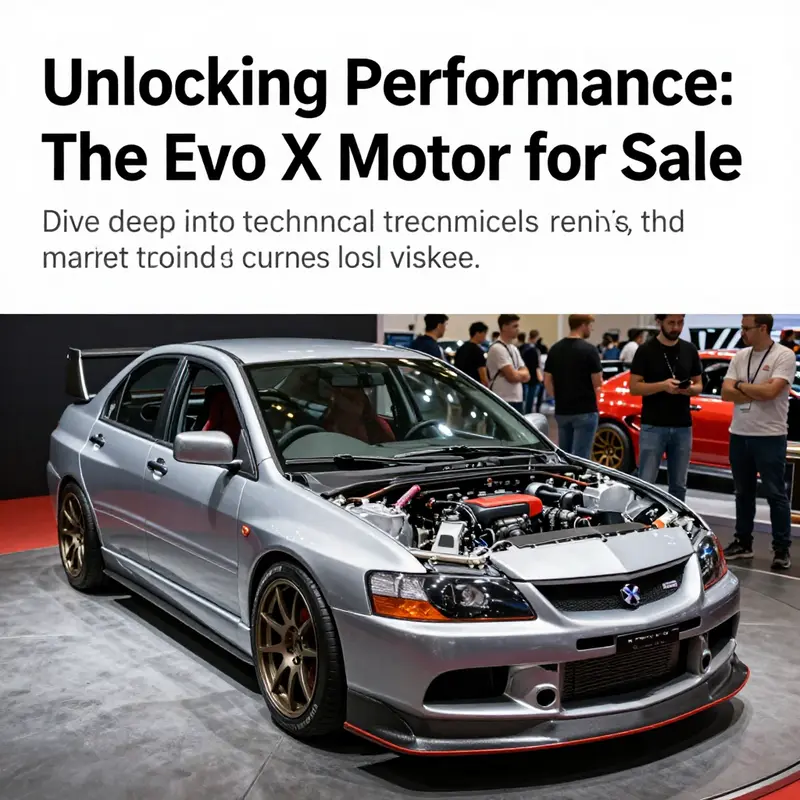
The Mitsubishi Lancer Evolution X, known for its performance prowess and tuning potential, has made its mark in car enthusiast circles and motorsports alike. For business owners in the automotive sector, understanding the availability and dynamics of Evo X motors is crucial. This article will explore current listings, delve into the technical specifics of the Evo X motor, and analyze market dynamics and pricing trends. Each chapter contributes to a comprehensive understanding of how the Evo X motor can be a valuable asset for businesses catering to automotive enthusiasts and professionals alike.
Unearthing the Perfect Evo X Short Block: Today’s Top Listings and Value Insights
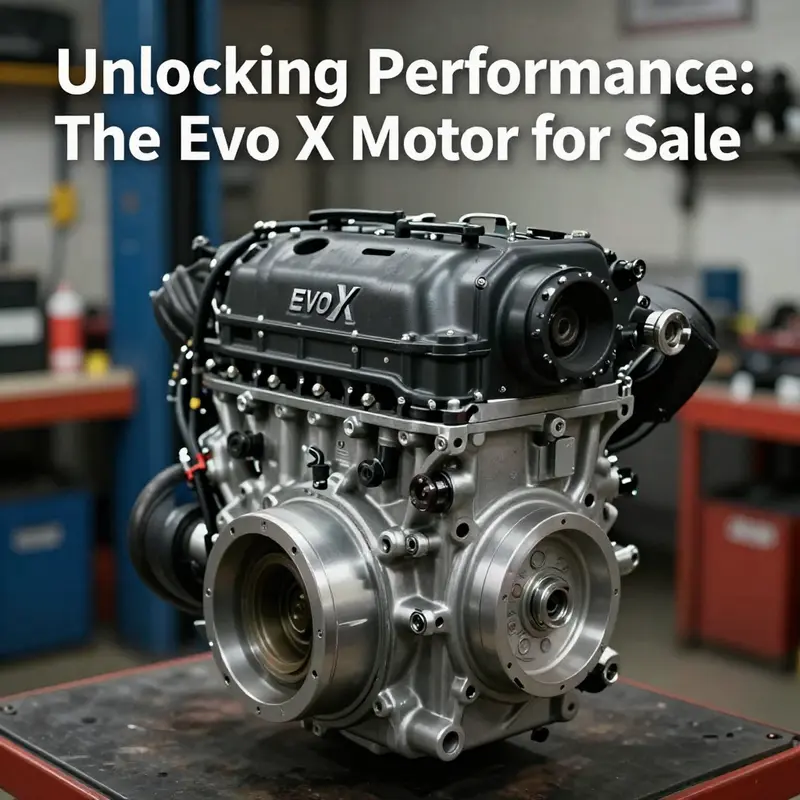
When hunting for a replacement or upgrade engine for a Mitsubishi Lancer Evolution X the market often centers on the 4B11 turbocharged short block. Enthusiasts favor it for OEM pedigree and power potential.
Current highlighted listing: a used Evo X short block with 51,000 miles, listed at $1,999. It is sold as “short block only”—no turbochargers, alternator, fuel rails, or peripheral hardware. That lowers upfront cost compared with long blocks but requires sourcing compatible components, machining, and installation.
Pricing: with a flat $499 shipping fee the all-in pre-tax cost reaches approximately $2,498. For DIY mechanics this is a manageable route to an OEM foundation; for small shops the margin remains attractive after add-ons and labor.
Condition and inspection: request compression and leak-down numbers, photos of bores and decks, and documentation of any machine work. Uniform cylinder wear is ideal. If you spot bore scoring or evidence of coolant seepage, plan for a machine-shop inspection and possible reconditioning.
Shipping and receipt: insist on reinforced crating, insurance, and a documented inspection upon arrival. Check crate condition, remove protectors, and verify bore alignment and crank journals before finalizing payment.
Aftermarket outlook: the 4B11 short block is versatile — from 350+ whp bolt-on builds to fully forged race engines. Builders often combine it with aftermarket turbos, upgraded oil pumps, strengthened rods/pistons, and tailored tuning strategies.
Sourcing notes: genuine Evo X short blocks are less common than complete engines, which raises demand. Listings under $2,500 shipped move quickly; monitor auction pages and Buy-It-Now options for real-time availability.
Next steps: confirm desired compression ratio and head gasket thickness, budget for parts and labor, and line up a reputable machine shop and tuner before purchase. Realistic planning prevents costly rework after assembly.
External resource: https://ebay.com
Under the Hood: In-Depth Look at the Evo X’s 4B11T Powerplant
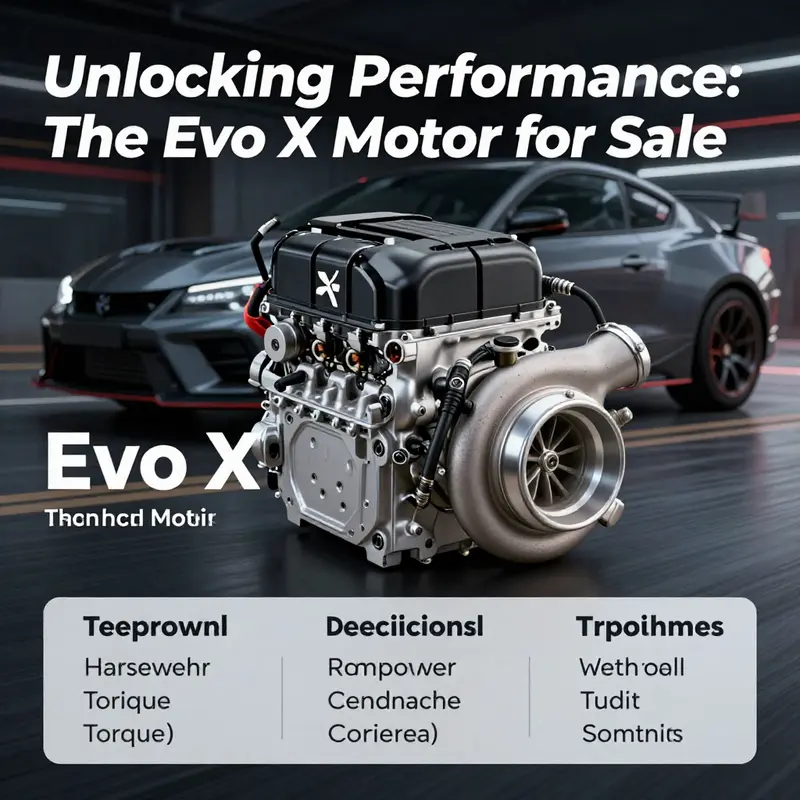
When prospective buyers search for an Evo X motor for sale, understanding the heart of the Lancer Evolution X—its 4B11T engine—becomes essential. This turbocharged 2.0-liter inline-four powerplant earned its reputation by blending remarkable performance with everyday reliability. As enthusiasts and technicians examine a used short block listing, they must appreciate how the engine’s aluminum die-cast block and head deliver both weight savings and efficient heat management. These features translate to quicker throttle response and more consistent power delivery, whether on street or track.
Beneath its compact exterior, the 4B11T employs Mitsubishi’s MIVEC (Mitsubishi Innovative Valve timing Electronic Control) system. By adjusting valve timing on the fly, MIVEC optimizes torque at low rpm and horsepower at higher engine speeds, marrying spirited acceleration with respectable fuel economy. This dual nature makes the Evo X motor for sale particularly appealing to those who demand a thrilling driving experience without sacrificing drivability during daily commutes or spirited canyon runs.
At its core, the 4B11T is a DOHC (Dual Overhead Camshaft) design with 16 valves, coaxing more airflow into and exhaust gases out of the combustion chambers. That efficiency, mated to a single twin-scroll turbocharger and front-mounted intercooler, yields a factory output of roughly 217 kW (295 hp) at 6,500 rpm and 366 Nm (270 lb-ft) of torque at 3,500 rpm. For buyers weighing a short block-only purchase, these figures underscore the motor’s capacity for further tuning: stronger internals, a larger turbo, or refined engine management can push outputs well beyond stock, while the core block remains stout enough to absorb increased boost.
Fuel delivery is handled through a precise electronic fuel injection (EFI) system, calibrated at the factory to balance performance and emissions. The injectors and rail must be in top shape, so anyone acquiring a used short block should budget for a full inspection of fuel rails, injectors, and associated sensors once the engine arrives. A slight deviation in fuel pressure or a clogged injector can compromise both output and drivability, making early preventative maintenance a wise investment.
Transmission compatibility adds an extra layer of complexity when sourcing an Evo X motor for sale. The GSR variant typically mates the 4B11T to a five-speed manual gearbox praised for its direct feel and robust synchronizers. In contrast, the MR (Mitsubishi Racing) and rare Final Edition trims incorporate a six-speed TC-SST (Twin Clutch Sportronic Sequential Transmission), offering lightning-fast gear changes and launch control features. Buyers of a short block must ensure the replacement powerplant aligns precisely with their transmission of choice, as minor differences in engine mounts, wiring harness connectors, or flywheel patterns can complicate installation and necessitate custom adapters.
Those chasing the peak of street-legal performance will recall that the Final Edition Evo X, introduced in 2015, arrived factory-tuned to 303 hp—an increase of more than 25 hp over standard models. Although the block remains the same 4B11T foundation, Mitsubishi engineers refined turbocharger vanes, revised engine mapping, and knocked in stronger engine internals. If your goal is to extract similar figures from a used short block, be prepared to source higher-flow injectors, an upgraded wastegate, and bespoke tuning strategies to replicate that final factory spec.
A defining attribute of every Evo X is its Super All-Wheel Control (S-AWC) drivetrain. Integrating Active Center Differential (ACD), Active Yaw Control (AYC), Active Stability Control (ASC), and ABS, this system dynamically distributes torque to each wheel for razor-sharp handling and traction. Although a short block-only purchase excludes the transmission and transfer case, potential owners should verify the condition of differential oil and seals in the rest of the drivetrain once the engine is installed. Neglecting the S-AWC components can undermine the Evo’s legendary cornering prowess.
Braking performance forms the other half of the Evo X’s dynamic equation. From the factory, Brembo four-piston calipers grip ventilated discs up front, while two-piston units handle the rear. These components are engineered to work in harmony with the engine’s power curve. When fitting a used motor, inspect mounting points and lines for corrosion or fatigue, and ensure calipers move freely. A fresh set of high-performance pads and stainless-steel braided lines will maintain braking consistency under repeated track abuse.
Rolling on 18-inch forged BBS alloy wheels wrapped in 245/40 R18 tires, the Evo X balances grip and agility. Those rims contribute to unsprung weight reduction, enhancing suspension response and ride quality. While the short block listing may not include wheels, understanding the interplay between wheel design, tire width, and engine torque output will inform decisions on gearing and final drive ratios during a rebuild. An ill-chosen tire can send more force through the contact patch than the block can handle, leading to wheel hop or drivetrain shock.
Dimensions further underline the Evo X’s purpose-built nature. With a length of 4,510 mm, width of 1,810 mm, and height of 1,480 mm on a 2,650 mm wheelbase, the chassis was tuned for nimble turn-in and high-speed stability. The engine bay’s packaging accommodates both the intercooler plumbing and intake piping while maintaining easy access to routine service points. When contemplating installation of a used motor, plan for correct routing of coolant hoses, oil lines, and turbo plumbing. Misrouted lines can cause overheating or intercooler pressure losses, robbing you of both horsepower and reliability.
A used short block often arrives missing vital peripheral components: turbocharger assembly, alternator, starter, and intake manifold. Calculating the true cost of an Evo X motor for sale requires factoring in these additional items. A single twin-scroll turbocharger can retail for over a thousand dollars, while a genuine intake manifold and throttle body carry a premium due to their critical role in airflow management. Budget for a new gasket kit, thermostat housing, and timing belt kit—neglecting these parts can lead to leaks or catastrophic failure once the engine is fired up.
Shipping costs significantly impact the overall investment. This particular listing quotes $1,999 for the short block and $499 for freight within the continental United States. That brings the initial outlay close to $2,500 before taxes, duties, or handling fees. For buyers in remote areas or outside the contiguous U.S., rates may climb further. It’s prudent to confirm that the engine is insured during transit and to track it from dispatch to delivery. Any damage incurred en route must be documented immediately to claim against the carrier.
Purchasing a used engine from an online marketplace demands due diligence. Ask the seller for compression and leak-down test results, ideally recorded at operating temperature. Request clear, date-stamped photographs of the block surfaces, bolt holes, and bearing caps to rule out cracks, corrosion, or signs of improper torqueing. If possible, secure a video of the engine spinning freely on a stand to verify there are no hidden knock-sensor triggers or bearing noises. Only then can you confidently arrange for installation, knowing the short block’s internal health meets your performance goals.
Authentic OEM components preserve the Evo X’s DNA, and aftermarket alternatives rarely match the factory’s metallurgy or tolerances. When you’re rebuilding a 4B11T, consider sourcing an OEM billet crankshaft, forged pistons, and upgraded conrods. A credible source for high-quality engine blocks is the 4B11T billet block listing available through our parts catalog. By starting with a proven foundation, you reduce the risk of crankwalk, piston slap, or premature bearing wear—conditions that plague engines rebuilt on inferior cores.
Once the short block is in place and peripheral systems reconnected, calibration of the ECU becomes paramount. A professional tune, optimized for your intake, exhaust, and turbo setup, unlocks the Evo X’s latent potential. It compensates for any variances introduced during the rebuild and ensures safe air–fuel ratios across the rev range. After tuning, a dyno session verifies that the power curve aligns with expectations and alerts you to any anomalies before track or street use.
Owning an Evo X motor for sale extends beyond the purchase price. Regular maintenance—oil changes with high-zinc, low-ash oils; periodic intercooler cleaning; and turbocharger inspection—safeguards your investment. When driven responsibly, the 4B11T long block can exceed 200,000 miles, offering decades of spirited performance. By approaching each step—from initial purchase and shipping to teardown, inspection, and final calibration—with meticulous care, you preserve the Evo X’s reputation as one of the most exhilarating and versatile performance platforms ever produced.
Behind the Price Tag: Navigating Evo X Motor Market Dynamics

The market for Evo X motors has evolved into a finely tuned ecosystem where condition, provenance, and rarity converge to shape pricing and availability. From online auction platforms in North America to auction halls and classifieds in Asia, each marketplace reflects the same underlying forces: enthusiast demand, parts scarcity, and the enduring reputation of the Mitsubishi Lancer Evolution X’s 4B11 turbocharged powerplant.
At the heart of this landscape lies the distinction between complete engines and short blocks. A popular listing on an international auction site highlights a 2008–2015 Evo X Ralliart short block priced at $1,999.00, with an additional $499.00 for shipping—a total commitment of roughly $2,498.00 before any local taxes. This figure undercuts many fully assembled crate engines, but it also carries implicit costs: sourcing a compatible turbocharger, oil pump, alternator, wiring harness, and ancillary components separately. Still, for tuners and rebuild shops, the short block option delivers the authentic 4B11 iron block and forged crankshaft at a fraction of a complete assembly’s outlay.
In China’s robust used-car market, the Lancer Evolution X itself commands strong resale values that feed directly into parts pricing. Early 2026 data shows well-kept Evo X sedans trading hands between 270,000 and 320,000 RMB. Examples with under 50,000 km on the odometer or minor performance enhancements push into the 350,000–450,000 RMB bracket, while limited editions or near-new collector cars can leap to 600,000–1,000,000 RMB in private deals or specialized auctions. This premium for rarity and near-factory originality creates a parallel halo around donor engines: fewer salvage titles, lower mileage blocks, and documented service histories command higher bids when dismantled for parts.
Demand from motorsports teams and street tuners alike keeps prices buoyant even years after the Evo X’s final production in 2016. The five-speed manual GS-T and the advanced twin-clutch SST variants both spawn unique engine swap inquiries—drivers chasing the tactile engagement of a stick shift or the cutting-edge launch control of a dual-clutch setup. Rebuilders leverage OEM block cores to craft high-performance builds, often prioritizing genuine Mitsubishi components over aftermarket castings. As these cores shrink in availability, the auction floors and classifieds fill rapidly, driving short-block prices upward.
North American buyers face additional considerations. Shipping costs from overseas can double the base price of a used block, while import duties and compliance checks for EPA or CARB regulations further hike the final figure. This reality nudges many enthusiasts toward domestic sellers offering half-cut assemblies, complete with wiring, subframes, and drivetrain attachments. For those weighing the extra expense against installation convenience, exploring Evo X half-cut engines can reveal bundled deals that simplify logistics—even if the headline price exceeds that of a bare short block.
Condition metrics play a decisive role. Blocks with visual casting marks, minimal corrosion, and comprehensive service records maintain a 15–30% price premium over similar cores with unknown histories. Confirmation of a clean bore surface and crack-free deck by professional inspection can transform a listing from an intriguing gamble into a worthwhile investment. In many cases, sellers will offer fresh machining services—bore hone and deck resurfacing—for a modest fee, protecting buyers from unforeseen rebuild expenses down the road.
Regional supply chains further shape pricing trends. In Europe, where Evo X sales never matched the volumes seen in Japan or North America, authentic Mitsubishi short blocks are rarer still. Importers often bundle engine shipments with other high-demand Evo X parts—turbos, transmissions, ECU units—to achieve economies of scale on freight costs. The added convenience can justify a 10–20% markup when compared with U.S.-based single-item auctions.
Enthusiast forums and social media groups amplify awareness of these price fluctuations in real time. When a well-preserved Evo X shell hits a salvage yard in the Midwest or Shanxi province, word spreads quickly. Buyers prepare to strike the moment a block enters an online marketplace. This collective vigilance maintains a dynamic pricing band—blocks may appear at bargain rates briefly, but strong demand ensures they disappear just as fast.
Ultimately, acquiring an Evo X motor is a calculated exercise in balancing budget, project scope, and timeline. Whether sourcing a bare short block for a high-output build or opting for a full half-cut assembly to slash labor time, the principles remain constant: verify block provenance, compare shipping and import fees, and align the purchase with the intended application—street, track, or show. By understanding how condition, rarity, and logistics affect price, enthusiasts can navigate the market with confidence and secure the heart of one of modern rallying’s most celebrated machines.
For current listings and detailed historical pricing data on used Evo X vehicles and engines, refer to Autohome’s comprehensive marketplace.
External Resource: Autohome
Final thoughts
As the automotive market continues to evolve, the Mitsubishi Lancer Evolution X remains a prominent choice for performance enthusiasts. For business owners tapping into this niche, staying informed on current listings, technical specifications, and market trends is essential. The Evo X motor represents not just a component but an opportunity to connect with a passionate community of car lovers. Equipping oneself with knowledge about these motors can significantly enhance business strategies and service offerings.