

The Mitsubishi Lancer Evolution X (Evo X) is celebrated for its performance and design, with its fenders playing a critical role in the overall functionality and aesthetics. In the automotive industry, understanding the significance of these components goes beyond mere appearance; it relates to aerodynamics, structural integrity, and personal customization options. This article delves into the landscape of Evo X fenders, comparing Original Equipment Manufacturer (OEM) parts to aftermarket alternatives, the importance of proper maintenance to prevent corrosion, the advantages of lightweight materials for performance enhancements, and a practical buying guide to ensure you make the best choice for your business needs. Each chapter integrates insights into the value of Evo X fenders within broader automotive considerations, helping business owners make informed decisions for their clientele.
Front Fenders on Evo X: OEM Precision vs Aftermarket Potential
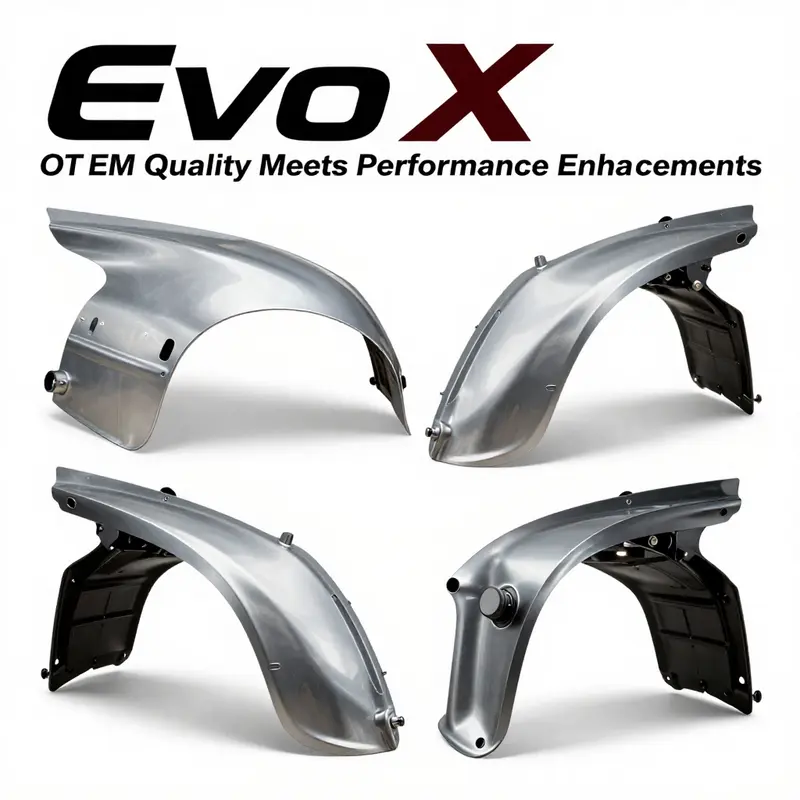
A Mitsubishi Lancer Evolution X communicates with the road through more than its engine. The front fenders directly influence alignment, aerodynamics, and the car’s visual stance. This chapter examines two paths: OEM fenders that preserve factory fitment and behavior, and aftermarket fenders that offer wider arches and altered airflow. The choice affects headlights, mounting points, and even how brakes dissipate heat.
OEM fenders are engineered to exact specifications, providing predictable fit, finish, and warranty alignment. They simplify maintenance and preserve resale value. However, corrosion resistance and repainting can be considerations for older cars.
Aftermarket fenders expand width, allow larger tires, and can improve air management around the wheels. They often require careful fitment, possible trimming, and attention to sealing. Material options range from carbon fiber to fiberglass, with trade-offs in stiffness and weight.
Practical guidance: define the intended use, check compatibility with suspension and wheels, and plan for professional installation. Maintenance remains essential regardless of choice, including cleaning mounting points and inspecting seals to prevent leaks or rust.
Bottom line: OEM preserves the car’s original recipe, while aftermarket offerings let you steer its appearance and performance toward your goals. Both paths demand diligence in fitment, paint, and warranty implications.
How Evo X Fenders Shape Performance: Aerodynamics, Structure, and Safe Upgrades

The fenders on a Mitsubishi Lancer Evolution X do far more than dress the wheel arches. They are an engineered component that balances appearance, airflow management, and chassis strength. On the Evo X, front fenders are integrated with the bumper, rocker and quarter panels, and mounting points that tie into the vehicle’s crash structures. That integration lets the fender contribute to torsional rigidity and to how loads move through the body during spirited driving. A properly fitted factory fender helps keep handling sharp and predictable by preserving intended load paths and preventing unwanted flex under cornering or heavy braking.
The geometry of the front fender is subtle but deliberate. Its contours guide air around the wheel openings and along the body sides. That guidance reduces turbulent wakes from the rotating tires. It also affects pressure distribution across the front end and underbody. With less turbulence, drag drops and high-speed stability improves. The fender’s flare and inner liners work together with the bumper and side skirts to control how much air spills into the wheel well versus how much is channeled along the car. That balance influences how the front end generates downforce, and how effectively the undertray and diffuser can operate.
Factory front fenders are typically stamped from high-strength steel and finished to match the original body panels. Their material and fitment are chosen to maintain crash performance and meet safety standards. When a front fender is struck in a minor collision, its mounting points and seams can shift. Even small misalignments change panel gaps and can introduce new stress points where corrosion or fatigue will start. For these reasons, replacing a damaged fender with a correctly aligned, OEM-spec unit keeps both fit and structural integrity intact. After any collision repair, alignment checks of adjacent panels and suspension mounting points are essential to restore the chassis to its engineered state.
Beyond crash and fitment considerations, long-term durability is a practical concern. Steel fenders resist impact and retain body strength, but they are vulnerable to corrosion if road grime and salt accumulate. Regular cleaning of wheel arches and seams, along with prompt rust treatment when coatings are damaged, prolongs service life. For owners who preserve originality, maintaining the OEM finish and protective layers is a cost-effective way to keep the fenders functioning as intended.
Performance-minded owners often look to lighter alternatives, and here carbon fiber and composite fenders are common choices. Well-engineered aftermarket fenders can reduce unsprung mass and lower overall vehicle weight. This creates measurable gains in acceleration, braking, and transient steering response. But the gains depend on more than the weight of the panel. The substitute fender must replicate the original mounting geometry, stiffness characteristics, and aerodynamic profile. If it does not, handling balance can shift unpredictably. A lighter, more flexible fender that deforms under load can change the airflow pattern at speed. That change may reduce front downforce or increase drag, negating the expected benefits.
Fitment quality separates useful upgrades from risky modifications. High-end aftermarket manufacturers design fenders to retain structural attachment points or supply reinforcement brackets that tie back into the chassis. They also test profiles in wind tunnels or with CFD to ensure airflow continuity. When a carbon or composite fender is a direct bolt-on with matching rivet locations and tolerated gaps, it is far more likely to maintain the Evo X’s engineered behaviors. Conversely, low-cost panels that require cutting, filler, or creative brackets can void that assurance. Improperly fitted panels can fatigue mounting points, allow water ingress into seams, and interfere with suspension geometry checks.
Airflow around the wheel is one area where subtle differences have large consequences. The rotating tire creates a low-pressure wake that wants to pull air into the wheel well. Stock fender shapes direct part of that flow out through small vents or controlled gaps, preventing build-up of turbulent pockets that can buffet the front end. On track cars, vented fenders or wider arches are often paired with brake cooling ducts and controlled vent exits to reduce lift at the front axle. But widening the arches changes the local pressure field. Unless the full aerodynamic package—bumpers, splitters, side skirts, and diffusers—works together, the net effect may be neutral or negative. That is why purposeful kits are engineered holistically, not as isolated parts.
Practical installation matters as much as design. Even an excellent replacement must be aligned, sealed, and fastened to factory tolerances. Bolt torque, seam sealer application, and liner refitment influence both noise and structural behavior. During replacement, technicians should check adjacent parts—headlight mounts, hood lip, and bumper supports—to ensure panel gaps are consistent. Misalignments not only look poor but also disturb aerodynamic transitions that were designed to be smooth.
Owners considering visual and performance upgrades can take a staged approach. Begin with panels that preserve mounting geometry. Add aerodynamic pieces that have been validated for the Evo X’s platform. If weight is the priority, inspect reinforcement methods and ensure the replacement maintains or improves stiffness where the OEM part contributed to load paths. For a track-focused build, coordinate wide fenders with front splitter adjustments and underbody changes to reclaim lost downforce.
Finally, sourcing parts requires attention to compatibility. Verify left and right orientation, model years, and any variant-specific differences. Some widebody or race-spec fenders are designed for particular builds and will not match stock bumpers or lights. When in doubt, consult design information and seller documentation.
If you want to explore aftermarket wide fender options that are designed specifically for the Evo X, consider researching manufacturer-specific offerings such as Group A wide front fenders that are tailored for the platform: Group A Evo X wide front fenders.
Additional technical guidance and sourcing notes on choosing lightweight composite front fenders are available in a detailed supplier article: https://www.alibaba.com/product-detail/How-To-Choose-The-Best-Evo-X-Carbon-Fiber-Fenders_1600547238475.html
Keeping Evo X Fenders Rust-Free: Practical Strategies for Longevity and Performance
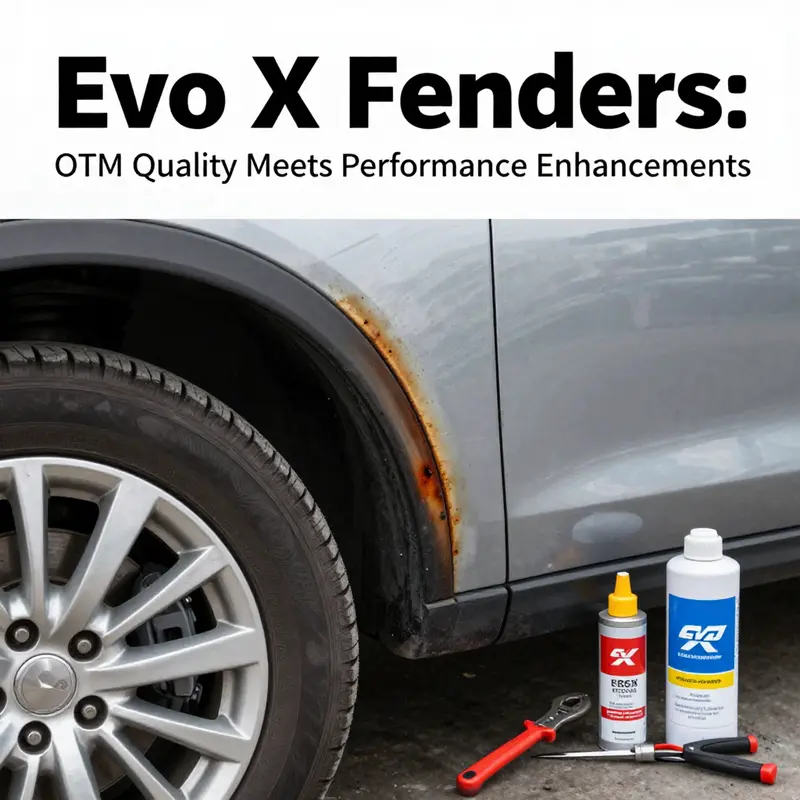
Fender corrosion is a slow problem that becomes sudden when ignored. On the Evo X, factory front fenders are high-tensile steel. They resist impacts well but will rust if moisture and contaminants collect. Corrosion often starts in the places you rarely see: behind the liner, along weld seams, at drainage holes and around the wheel arch edges. Road salt, grit, mud and coastal humidity all accelerate the process. Left unchecked, what begins as surface pitting will eat into structure, change panel fitment, and compromise safety margins around mounting points.
A practical approach treats corrosion as an ongoing maintenance item, not a one-time fix. Regular cleaning is the baseline. Rinse the wheel wells and under-fender areas after salty or muddy drives. Use a pressure washer at moderate distance to dislodge road salt and fine grit. Focus on seams and crevices where water pools. Removing debris reduces trapped moisture and prevents the slow chemical attack that turns steel flaky and weak.
Inspect frequently, especially after winter. Remove the fender liner and check the backside of the panel. Look for bubbling paint or brownish discoloration around seams. Small chips in the finish are critical to address. They let water contact bare metal immediately. Sand down any rusted spots to bare metal, apply a corrosion inhibitor, prime and repaint. This stops progression and preserves the factory panel’s fit and finish.
Undercoating and professional rustproofing add durable protection. Products applied to the inner fender, rocker and wheel well form a barrier against salt and stones. Choose a service that cleans surfaces first, then applies seam sealer and a rubberized undercoat. These treatments extend service life, but require periodic inspection. Undercoating can hide trouble spots if not checked; peel-back and look under the coating annually.
Drainage matters. The Evo X design includes factory drainage holes and paths. Make sure those stay clear. Mud and leaves can plug channels and force water into seams. Flush drain paths with a hose and remove blockages during seasonal checks. Keeping liners correctly seated is part of this; a shifted liner lets water splash behind the fender and pool where corrosion starts.
For owners in coastal or snow-belt regions, consider material choices when replacing panels. Aluminum fenders resist rust entirely and cut weight. That weight reduction helps handling and transient response. Aluminum costs more and needs special repair techniques, but the trade-off often justifies the investment where salt exposure is constant. Carbon fiber options exist too, offering greater weight savings and a distinct look. Those options demand careful fitment and paint work to maintain aerodynamic lines.
If you keep the OEM steel panels, focus on painting and seam integrity. Factory paint systems are robust. When repairing, match the original layers: primer, base, clearcoat. Proper curing and blending around edges prevent future lift and moisture ingress. Where weld seams are present, inspect for cracks. Small seam cracks let rust begin under the paint. Re-apply seam sealer to any suspect joint after rust removal and before painting.
Damage control after an impact matters more than immediate aesthetics. A seemingly small bend near the mounting flange can open a gap and trap moisture. Realign panels to factory tolerances. If you repair at home, tighten bolts evenly and check panel gaps against the opposing side for symmetry. Poor alignment creates stress points that accelerate paint failure and rust formation.
For drivers who track their Evo X or drive aggressively, salt and moisture are not the only enemies. Brake dust and high heat change corrosion behavior. Brake dust is abrasive and chemically active. Clean wheel wells more often after track days. Use high-temperature-compatible coatings near the brake area. If you install wider fenders or aftermarket widebody panels, remember the new geometry can change where water and debris accumulate. Reassess drain paths and liner fitment after any body modifications. A useful reference for wide fender options and fitment approaches is the Group A Evo X spec-V wide front fenders listing for guidance on how aftermarket lines alter fit and maintenance needs: Group A Evo X spec-V wide front fenders.
When rust has progressed beyond surface scale, evaluate replacement versus repair. Small areas can be cut out and welded, then treated and painted. Larger corrosion around mounting points or the inner structure warrants full-panel replacement. Replacement preserves crash behavior and mounting precision. If you choose a replacement, verify it meets factory mounting points and aligns with hood, bumper and light openings. Poorly fitting panels cause wind noise and lead to concentrated weather exposure in unexpected areas.
Repair techniques influence longevity. Use proper rust converters on pitted steel to neutralize remaining oxides. After neutralization, apply epoxy-based primers before filler and topcoat. Avoid thin, single-stage touch-ups unless wrapped by protective clearcoat. For welded repairs, treat weld heat-affected zones with anti-corrosion primer. Refinish seams with seam sealer to restore the original barrier.
Maintenance routines are inexpensive and effective. Wash fenders and wheel wells monthly in winter, quarterly in mild climates. Remove the liner and inspect twice a year. Touch up chips immediately. Reapply undercoating every few years as needed. Keep drain holes clear and liners properly fastened. If you live near the coast or travel on salted roads regularly, increase inspection frequency. These habits prevent minor surface flaws from becoming structural failures.
Finally, choose technicians who understand the Evo X body structure. Proper panel alignment, seam sealer application and paint matching require experience. Ask for service notes on seam treatment and undercoating steps. Request photos of hidden areas before and after work when possible, to ensure nothing gets overlooked.
Maintaining Evo X fenders is about routine attention and smart material choices. With consistent cleaning, timely touch-ups, and considered upgrades where needed, you keep panels strong, look factory-fresh, and protect the car’s structural integrity. For technical guidance on factory maintenance procedures and service intervals, consult the official Evo X service documentation below.
Reference: Mitsubishi Lancer Evolution X: Maintenance Guide – Official Service Manual (2026) (https://www.mitsubishicars.com/owners/manuals/lancer-evolution-x-2026-service-guide.pdf)
The Edge of Grip: Lightweight Evo X Front Fenders and the Subtle Science of Handling

Front fenders are more than a visual cue on a Mitsubishi Lancer Evolution X. They sit at the edge of the wheel arches, where air meets the tire, where mass meets inertia, and where a few design decisions can ripple through the car’s behavior in meaningful ways. In Evolution X builds that see track duty or spirited weekend drives, rotating mass and aerodynamics become live variables rather than fixed constants. The OEM front fenders, crafted from high strength steel, are matched to the car’s original silhouette and mounting points with precision. They preserve alignment with the headlights, the indicators, the suspension mounts, and the overall balance of the body. Yet even with factory accuracy, the fender is a component whose influence extends beyond cosmetic harmony. It participates in load transfer during cornering, helps manage airflow around the wheel, and forms part of the path that air follows as it exits the wheel well. When owners consider upgrades, they often weigh the comforts of originality against the performance gains that lighter, more aerodynamically tuned panels can offer. The decision, at its core, is a negotiation between weight, rigidity, and the way the car communicates with the road at speed.
Weight is the most obvious lever. Replacing a traditional steel fender with a lighter alternative reduces unsprung weight, which lies at the heart of how a car responds to bumps, ruts, and curbs. A lighter fender surrounding the wheel reduces the mass that the suspension must control, allowing the tires to maintain contact with the pavement more effectively over irregular surfaces. The improvement is not simply about shaved grams; it translates into crisper steering response and quicker adjustments when the track demands a quick correction. The difference is most noticeable in rapid transitions, where every fraction of a second and every ounce of inertia matter. At a certain threshold, the suspension can react more efficiently, grip can be preserved under midcorner throttle changes, and the car can feel more willing to swap direction with minimal steering input. For Evo X drivers who push toward the limits, the payoff comes as a more forgiving transition from straight line to corner entry and a more predictable rear end as tire temperatures rise and aero forces build.
The materials choice compounds that benefit. Fiberglass and carbon fiber fenders—common in the aftermarket scene—strip weight while offering stiffness profiles that can be tuned for the kind of driving the car is intended for. In the end, the goal is to maintain sufficient rigidity to keep the fender aligned with the body, the headlight assembly, and the wheel during aggressive cornering, while shedding weight to free the suspension. Carbon fiber brings a further edge with its high stiffness-to-weight ratio, though it comes with a price premium and different repair considerations. Fiberglass, while more affordable, trades some rigidity and long term fatigue resistance for cost savings and ease of repair. Either path alters how the front end interacts with air, and when paired with proper alignment and tire choice, it helps the car sit a touch lower on the nose and bite a touch more cleanly into corners.
Airflow around the front wheel wells also shifts with lighter, purpose-built fenders. Aftermarket designs are often engineered with improved aerodynamics in mind, guiding air more efficiently around the front wheels and toward the radiators and brake cooling intakes. The result can be a modest reduction in drag at speed and a more stable boundary layer near the wheel arches. In track conditions where downforce begins to matter at higher speeds, the combination of reduced weight and more favorable air separation can translate into a slight, but tangible, uptick in high speed stability and cornering confidence. It is not a single dramatic change, but a cascade of small improvements that together raise the car’s overall track readiness. Aesthetics follow closely behind. A well executed lightweight fender not only reduces weight and improves aero behavior but also sharpens the car’s stance, inviting a more aggressive line through corners and a cleaner silhouette when viewed from the side. The Evo X benefits from that dual impact: performance gains in cornering shrink and response, paired with a look that communicates readiness for a more committed drive.
There is, of course, a practical side to this upgrade. Aligning a new fender with the rest of the car requires care. The fender must mate precisely with the mounting points, and if the chosen panel does not maintain correct geometry, the alignment of the headlights, indicators, and even the fender liners can drift. For a driver who uses the Evo X on daily roads, the concern is not just track readiness; it is street reliability, wash routines, and the way occasional road debris interacts with a lighter panel. Professional installation is wise, especially when the fenders require minor tweaks to fit around a slightly altered wheel or tire package. In areas with rust or corrosion, OEM steel remains robust, but the aftermarket fenders must also consider mounting hardware integration and the potential for differential movement under load. Owners who pursue this route should plan for a full inspection after installation, checking for any rub points that could wear through paint or liners, as well as ensuring that the front fascia and bumper modules remain in harmonious contact with the fenders.
From a value and maintenance perspective, the choice between OEM and aftermarket is a balance sheet as well as a chassis one. Original parts provide a known fit and finish, a dependable rework path after minor collisions, and a straightforward repaint process when care is needed. They also come with the caveat of corrosion if the protective measures lapse in winter climates or damp environments. Aftermarket fenders, while offering weight advantages and a customized aesthetic, can entail higher servicing costs if damage occurs. There may be more frequent or complex repairs needed if a fender experiences impact, particularly with a carbon fiber option whose repair can be more specialized. For those who track their Evo X with some regularity, the question often shifts toward how much the weight reduction costs in repairability and how much aero tuning pays off in lap time. The reality is nuanced: a well-chosen lightweight fender can yield measurable gains in grip and response, but the engineering balance must be respected to keep the front end coherent with the rest of the suspension geometry, steering effort, and brake cooling layout.
In this context, the Evo X owner who wants a clear upgrade path tends to look for options that align with the car’s era and drivetrain. A common approach is to select a lightweight front fender kit designed to fit Evos from 2008 through 2017. Such kits typically include front fenders that integrate cleanly with the front lips, align with the fender lines of the bumper, and offer a tightened contour that suits the wider tire packages common to modern Evo X builds. They can be ordered as part of a broader body kit or as standalone panels, depending on how far the owner wants to push visual aggression versus raw lightness. In practice, the selection often centers on a balance between weight savings, ease of installation, and the practicality of upkeep for daily driving. The right choice also considers wheel offset and tire width, because a fender that’s too tight or too generous can complicate rubbing and heat management around the brakes.
For Evo X enthusiasts who want to explore an aftermarket pathway without sacrificing the classic lines, there is value in examining a reputable option that is widely compatible with the 08–15 Evo X front fenders family. The intent is not merely to replace but to upgrade in a way that preserves or improves the vehicle’s balance. To make that process more concrete, consider a group of front fenders that are engineered for the 08–15 Evo X chassis and designed to accommodate a broader stance while maintaining reliable alignment with the car’s overall geometry. These front fenders offer a practical route for upgrading the front end with a modern, performance-focused silhouette. For readers who want to explore this path, you can learn more about the Group A Evo X front fenders at this page: Group A Evo X front fenders (08–15)
As with any significant modification, the financial and logistical costs must be weighed. The upfront price of a lightweight fender set can be higher than stock replacements, and installation may require alignment checks, possible suspension tweaks, and brake cooling considerations. Yet the payoff is reflected in the car’s on-road and on-track demeanor: quicker turn-in, more precise steering feedback through the front wheels, and an overall impression of a more eager, planted front end. For some drivers, the improvements are enough to justify the extra effort, while for others the priority remains maintaining a pristine, OEM-style appearance with the added assurance of rust resistance and factory fitment. The Evo X remains a platform that rewards thoughtful choices—where the front fender becomes a small but meaningful lever in the broader, dynamic equation of handling, aero efficiency, and driver confidence on every curve.
External references provide a broader perspective on the trade-offs involved in this class of upgrades. A widely used resource catalogs a range of aftermarket lighter front fenders and discusses the balance between weight savings, structural integrity, and ease of repair. This external reference offers practical guidance on evaluating fitment for the Evo X and the implications for alignment and tire clearance. For those seeking a deeper dive into lightweight fender options and their performance implications, refer to this external resource: https://www.ebay.com/itm/154968749343
Evo X Front Fenders: Fit, Finish, and the Subtle Art of a Balanced Stance
The front fenders on the Evo X are more than cosmetic shields for the wheel wells. They are a small yet crucial piece of a broader journey toward balance between aero efficiency, structural integrity, and the emotional appeal of a car that can feel one with the road. When a car’s silhouette is so closely tied to its performance character, the choice of front fenders becomes less about fashion and more about how the body communicates with the air, the tires, and the chassis. OEM front fenders, crafted to match the line of the headlights, the wheel arches, and the underbody geometry, carry a quiet promise of perfect compatibility. They align with the factory install points, accommodate the lamp housings, and leave space for essential components like the suspension and steering rack without requiring invasive modification. For owners seeking a faithful restoration or a shop-level repair, OEM fenders restore the original sense of symmetry that the Evo X relies on to project stability when crossing a windy highway or a twisting back road. In a field dominated by aftermarket options, that fidelity matters as much as the raw material or the paint’s gloss level.
Yet the Evo X is also a gateway to customization. The aftermarket landscape offers a spectrum from lightweight fiberglass to high-end carbon fiber, each with its own logic about weight, stiffness, and look. Fiberglass fenders present a practical path for enthusiasts who want a mid-range weight reduction or a more open-ended surface for bodywork alignment. They are robust enough for street thrills and occasional track days, yet forgiving enough for weekend projects where a dent repair is part of the narrative rather than the end of the world. Carbon fiber fenders, by contrast, promise a more immediate reduction in unsprung weight and a finish that exudes a premium, race-bred aesthetic. The sheen of woven fibers under clear coat and the whisper of weight savings when the car accelerates out of a corner can be instant mood changes for a driver who tunes the car to feel lighter, swifter, and more willing to ride the edge. In that sense, the choice between fiberglass and carbon is not only about cost; it is about the kind of feedback the driver wants at the end of a long straight and at the apex of a serpentine pass.
Compatibility is the first question. The Evo X wears its bodywork with a certain era-specific rhythm, and model years can introduce subtle changes that ripple into fitment. When shopping for fenders, the rule of thumb is straightforward: verify that the fenders are designed for the Evo X’s model years, and confirm the orientation—left-hand drive versus right-hand drive—because mounting points and inner fender clearance can shift with the dashboard geometry and the wheel offset. For a car that may have aftermarket wheels or altered suspension geometry, fitment becomes an ongoing evaluation rather than a one-and-done purchase. The conversation around fitment then broadens to the architecture beneath the fender line—the fender liner, the fender bolts, and the way the panel meets the quarter panel without gapping or rubbing against the tire during full steering lock or suspension travel. In practice, this means checking whether the fender kit offers pre-drilled holes that align with factory bolts, or if it requires a set of extended hardware and some trimming on the inner edge. Some kits include all necessary mounting hardware and detailed instructions to simplify installation, but the reality is often more nuanced: a responsible fit might demand a mix of carefully placed shims, minor trimming, and a patient test fit before spray, mask, and clear coat.
An important thread in the purchase decision concerns material choices and their implications for the car’s behavior. Fiberglass fenders can be shaped to mimic OEM lines closely, but their resin content and layering determine how they respond to heat and impact. In a collision scenario, a fiberglass panel may crack in a way that is repairable but can also require more frequent maintenance if the underlying mounting points sustain deformation. Carbon fiber, while offering prized stiffness and lightness, trades some resilience for its high strength-to-weight ratio. It can resist flex under load and deliver crisp steering cues, yet it demands careful inspection after heavy impacts. The finish is another gauge of quality. A well-made aftermarket carbon fiber or fiberglass fender should present a consistent weave or a uniform gel coat, with edges that align flush to the chassis line and a paint-ready surface that reduces prep time. OEM fenders, by contrast, carry factory-sourced paint preparation that often means fewer steps before color coat. For restorers who want a factory feel, the OEM route remains the most straightforward path to repeatable results, especially if the goal includes preserving the car’s original show-ready appearance.
Beyond raw fit and material, the practicalities of installation and maintenance live at the intersection of user experience and long-term ownership. Prepped and primed fenders arrive with their own expectations for garage work. Some owners prefer the path of least resistance: swap the old panel and bolt down the new one using factory points, then send the car to paint. Others choose a more involved route, removing adjacent components to gain clear access, or adding new weather seals to maintain cabin dryness and road noise performance. In all cases, rust prevention and corrosion protection cannot be treated as a last-step after thought. Steel OEM panels can resist the elements only with consistent maintenance of seam sealer, underbody coatings, and proper washing to stave off the corrosion that hides beneath the paint. When corrosion does take hold, the fender’s structural integrity and alignment can be compromised, encouraging misalignment in adjacent panels or accelerated wear of the wheel well and suspension mounts. A proactive approach—regularly cleaning the wheel well, inspecting for rust, and reapplying protective coatings as needed—helps maintain the Evo X’s signature stance and the precise aero balance that a well-tuned fender line supports.
Aesthetic choices, too, weave into the decision. The visual impact of a fender lines up with the vehicle’s overall stance. A flush, well-fitted fender can create a table-flat line from the hood to the wheel arch, underscoring a sense of calm but ready performance. A slightly more aggressive profile, achieved with widened or vented fenders, can shift the car’s silhouette into a more forceful stance, signaling intent to onlookers and inviting a more direct sense of speed. In this sense, the fender becomes a dialogue between the car and the road: a minimal escalation toward aerodynamic efficiency or a leap toward a track-ready, show-ready aesthetic. The chapter of the Evo X’s journey is never just about replacing metal with metal. It is about choosing a front-end narrative that matches how the owner intends to drive, care for, and present the vehicle over time.
For buyers who want to ground their decision in real-world options, it helps to consider price ranges, the available ecosystem of related parts, and the steps of the purchase journey. An example in the marketplace can reveal how the market prices OEM-style front fenders and what buyers should expect in terms of condition, compatibility notes, and included hardware. When buying second-hand OEM front fenders, buyers should confirm wheel arch dimensions, the year range, the specific side (left or right), and whether the part includes mounting brackets or requires transfer of hardware from the existing panel. It is also prudent to verify that the seller describes the panel’s condition with care—any signs of rust at the edge or pinholes near attachment points can forecast an extended repair itinerary. Conversely, new or reproduction fenders from reputable suppliers should offer clear compatibility notes and a consistent paint finish. The decision to go OEM or aftermarket, carbon fiber or fiberglass, rests on the owner’s tolerance for cost, repair complexity, and the desired balance of weight, stiffness, and aesthetics.
For those who want to explore more concrete options while keeping the conversation grounded in practical terms, one navigates to a few well-curated sources that discuss fitment guidelines, material comparisons, and installation considerations. A notable reference point in this space highlights the relevance of a model-year-specific approach to fender fitment, and shows how different front fender designs interact with common wheel arches and suspension setups. The guidance emphasizes ensuring compatibility with the Evo X’s geometry, paying attention to how wheels, tires, and struts clear the fender edge during full lock and suspension travel. It also points to the value of reading customer feedback and checking warranty policies, which can offer a window into long-term ownership realities and the supplier’s reliability. In this context, an external resource that documents the nuances of fender fitment, material performance, and installation can provide additional depth to the buyer’s decision-making process. Finally, when one considers the broader ecosystem of bodywork and aero improvements, the fender is a piece of a larger puzzle that includes lips, diffusers, side skirts, and bumper assemblies. The way these elements integrate with the fender line often defines how clean the overall aero balance feels on the road and at the track.
If you want to peek at a concrete example of a wider front-fender option within the Evo X community, you can explore a dedicated category that focuses on wide front fenders for the Evo X model years 08–15. The page presents a range of styles that emphasize the broader fender profile while preserving the original stance and alignment. This specific path showcases how some owners pursue a more aggressive visual language while staying mindful of fitment realities and underbody packaging. Such a direction underscores an important principle: the Evo X is a chassis that responds to intent. Whether the goal is to retain an OEM look for resale value or to push the car toward a race-inspired silhouette, the fender choice will influence the car’s perceived and actual performance. The synergy between the fender, the wheel arch, and the suspension is a conversation that evolves with every upgrade, every test drive, and every wash of the car’s surfaces.
For readers who want to deepen their exploration, a practical route is to review a marketplace listing that represents the kind of OEM front fender option discussed here. This example demonstrates how the product is described, what details buyers should request, and how the price may reflect the part’s condition and origin. It is a reminder that while the Evo X offers a coherent path for upgrades, the path is concrete and well-marked by terms like compatibility, mounting, and corrosion prevention. The broader takeaway is that the best fender choice respects both the car’s original engineering and the owner’s driving aspirations. It honors the balance between aero performance, structural integrity, and faithful aesthetics that define the Evo X journey—where a single panel can contribute to a car that feels more planted, more predictable, and more alive when driven with purpose.
External resource: https://www.ebay.com/itm/2015-MITSUBISHI-LANCER-EVO-X-FENDER-LEFT/
Internal link for related content: group-a mitsubishi evo x 08-15 spec v wide front fenders
Final thoughts
In summation, Evo X fenders are not just decorative elements; they are vital components that enhance both the aesthetic and functional aspects of the vehicle. The choice between OEM and aftermarket options plays a significant role in a vehicle’s performance and durability. Awareness of maintenance requirements is crucial in combating potential corrosion, while performance enthusiasts may benefit greatly from upgrading to lighter materials. With a solid understanding of the essentials, business owners can guide their clients toward the best choices for Evo X fenders, ensuring both satisfaction and safety. Investing in quality fender parts ultimately reflects the commitment to excellence in the automotive market.