
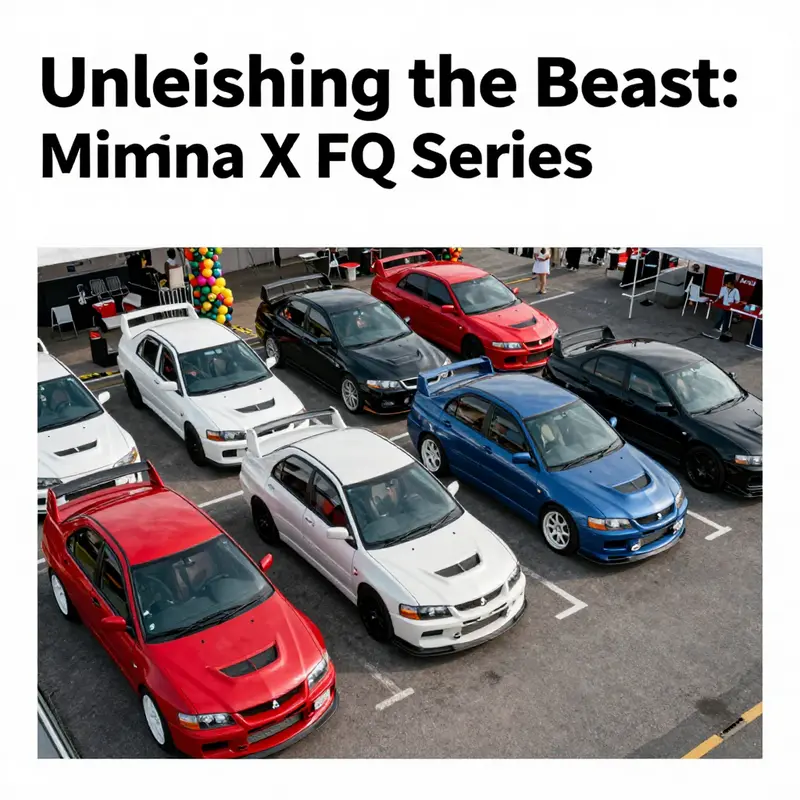
The Mitsubishi Lancer Evolution X, or Evo X, marks the culmination of a legacy built on performance and innovation. The FQ series, specifically crafted for the UK market, showcases extreme enhancements in speed, handling, and design. This article delves into three notable models within the FQ series, starting with the Evo X FQ-400, the ultimate expression of Mitsubishi’s engineering prowess. We’ll explore the FQ-440MR, a tribute to four decades of excellence, followed by the FQ-330 SST, which represents a bridge between the base model and high-performance versions. Finally, we’ll analyze the overarching legacy of the Evo X FQ series, highlighting its innovations that have impacted automotive performance standards.
The Final Act of Speed: Evo X FQ-400 and the British Pinnacle of Mitsubishi Performance
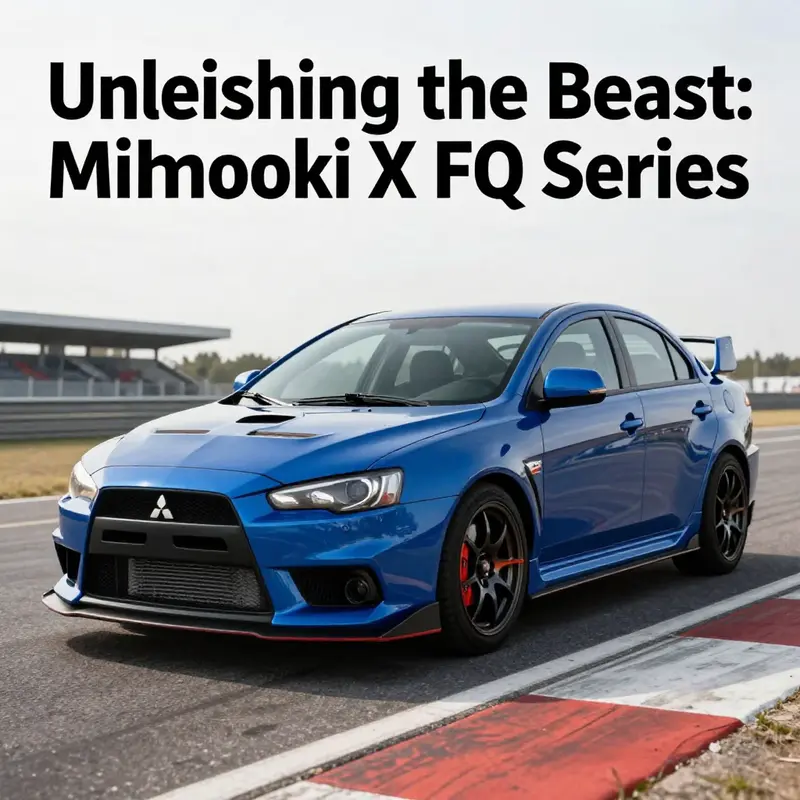
The Lancer Evolution X has long been a symbol of how far a compact four-door can be pushed when engineering culture and motorsport history collide. In the annals of this lineage, the FQ-400 stands not merely as a high-performance variant, but as a carefully tuned statement born from a collaboration that stitched together British passion for speed with Mitsubishi’s rallying DNA. The specific aim of the FQ series was to deliver an extreme, track-ready experience that could stand up to the most formidable competitors on both road and circuit, and to honor a milestone—Mitsubishi’s three-decade presence in the United Kingdom. The result is a car that wears its purpose on the outside and its capabilities more subtly in the fabric of its chassis and drivetrain. The essence of the FQ-400 is that it is not simply a faster Evo X; it is a redefinition of how a relatively small displacement engine can deliver a brutal, user-friendly experience when every system is calibrated to operate in a narrow, high-performance window. The story begins with the collaboration between Mitsubishi Motors UK and ADR Motorsport, a partnership forged to craft a version that could respond to increasing competition while still carrying the moral weight of a brand’s rally heritage. A limited run of precisely engineered examples ensured that the FQ-400 remained more than a numbered badge on the tailgate; it was a product of intent, a car built to be used as intended and not merely admired from afar. The FQ-400’s market positioning was straightforward: a lightweight, aero-focused, driver-centric interpretation of Mitsubishi’s flagship four-wheel-drive platform, tailored for enthusiastic drivers who sought a seat of power that could translate into actual pace on a tight track or a long, high-speed boulevard. This was a car built to be driven with a fierce respect for its limits, and its creators understood that the key to real performance lies as much in control as in raw output. If there is a singular thread that ties the FQ-400 to the broader Evo X story, it is the willingness to push the envelope in ways that can be experienced as a complete system rather than as a collection of individual upgrades. In the FQ-400, the powertrain, the suspension geometry, the braking hardware, and even the bodywork have been harmonized to deliver traction, stability, and feedback with a kind of ruthless clarity that enthusiasts often describe as “instant, unfiltered response.” It is this quality that helps the FQ-400 stand out among the lineage’s many celebrated variants and cements its reputation as an apex point for the Evo X era in the UK market and beyond. The powerplant—minding only for the moment that its displacement remains modest—has been extensively modified to unlock performance that was unusual for a 2.0-liter engine at the time. Through a blend of a new hybrid turbocharger, upgraded bearings, higher-flow injectors, and a redesigned engine management map, the FQ-400 could produce figures that would have seemed extraordinary a generation earlier. In a context where many rivals relied on bigger engines to achieve similar performance, the FQ-400 proved that intelligent turbo architecture and precise tuning can deliver a direct, usable surge of thrust. The result, by common consensus, sits around the neighborhood of 400 horsepower, with torque figures that push the engine toward a level of muscular response previously associated with much larger units. That blend of high-end power with linear, predictable response is what makes the FQ-400 so compelling on both road and track. Acceleration is the chapter’s most vivid scene: the seamless transition from standstill to speed, culminating in a 0–100 km/h sprint that many modern supercars would envy. In the FQ-400, that dash-to-60 or 100 is achieved with a clarity that remains surprising for a car that also wears a factory body kit and a purposeful, sensory-rich interior. The chassis upgrades carry the same message: bring the center of gravity down and tighten the compromise between ride comfort and track grip, and you gain a kind of confidence that allows a driver to lean hard into a corner with the assurance that the car will respond with composure rather than scramble. The ride height is lowered by a measurable amount, and the front and rear suspensions are recalibrated with carefully chosen springs and dampers that preserve daily usability while sharpening cornering response. The aero package adds both visual drama and measurable downforce: a carbon front splitter, aggressive side skirts, a rear diffuser, and a prominent rear wing work in concert to keep the nose planted and the rear settled as speeds climb. It is not about drama for drama’s sake; every element of the kit is aimed at one objective—predictable, linear behavior at the limit. The braking system reinforces this principle. Massive, high-performance components are not just for show; Alcon six-piston calipers bite down on the rotors with a bite that remains consistent as heat builds. The result is not only the kind of decisive stopping power needed to manage the effects of high-speed acceleration but also the kind of fade resistance that makes repeated track sessions possible without a loss of pedal feel. The wheels and tires are chosen to match this mandate for confidence. Lightweight 18-inch rims are shod with high-grip tires, and the whole package is tuned around the balance of grip, steering feel, and rotational inertia that a true performance car requires. On the inside, the driver sits in a cockpit that is both purposeful and intimate. The seats are Recaro buckets that cradle the body during hard cornering, while the shifter and dash layout reinforce a connection to the road. A dedicated S-AWC control option is part of the driver’s toolkit, allowing traction and torque distribution to be tuned to different road conditions with the flick of a switch. It is a reminder that the Evo X was always intended to be more than a rally-derived sedan; it was a platform for exploring how intelligent all-wheel-drive systems can preserve speed and composure when edges blur between asphalt and the limits of grip. The FQ-400 also pays homage to its status as a limited-edition model with a sense of exclusivity that extends beyond the numbers. Only a small fleet was produced, each one bearing the badge of its era and its country-specific pedigree. The name itself carries a bit of lore—FQ as a shorthand that fans soon understand to signify something exceptionally quick, a badge that tells you with one breath that you are looking at a machine whose purpose is to deliver speed with control. The UK market’s special edition status further colors the narrative, positioning the FQ-400 not just as a performance car but as a symbol of Mitsubishi’s ongoing commitment to a particular audience—drivers who value track capability and road manners in equal measure. In this context, the FQ-400’s legacy extends beyond the immediate thrill it offers on a circuit or a road. It represents a moment in time when a carmaker and a national distributor could converge to craft something that sat at the apex of a performance family and that could hold its own against rivals who were chasing performance with bigger budgets or more aggressive power bumps. The car’s limited production, its explicit focus on driver-driven performance, and its coherent, integrated approach to power, handling, braking, and aero have ensured that the FQ-400 remains a touchstone in discussions of the Evo X’s most coveted variants. For enthusiasts, a careful balance of figures—403 or 405 horsepower, 527 to 542 Nm of torque, 3.8 seconds to 100—serves as a reminder that the most memorable cars of this era were not simply about raw output. They were about how that output could be harnessed, controlled, and enjoyed by a driver who understood that speed is a conversation between man and machine. If one looks for a single paragraph that captures the spirit of the FQ-400, it is the one that describes its essence as a track-focused, street-leaning, road-capable machine that was built to be driven fast by people who want to feel every heartbeat of the car in real time. The omnipresent question for future generations of performance cars is whether such holistic design philosophy can be scaled to new platforms and new regions. Yet, as a historical milestone, the Evo X FQ-400 remains a benchmark for how an automaker can honor heritage while pushing the envelope of what is practically achievable on the road. One can experience a vivid sense of that ethos by exploring the kind of aero-conscious, weight-conscious engineering that defined this edition. For readers who want to see a tangible example of the parts philosophy that characterized many Evo X variants, a relevant listing showcases carbon-fiber trim pieces that illustrate the kind of material choices and design language that helped to separate the FQ-400 from more ordinary iterations of the model. carbon-fiber bonnet for Evo X. While the page itself highlights a specific piece, it embodies the broader principle that performance cars in this family often rely on purposeful, lightweight components to keep the dynamics honest and entertaining. In the grand arc of Mitsubishi’s performance timeline, the FQ-400’s brief, intense existence is a reminder that ultimate speed can be achieved without oversized engines or a parade of horsepower numbers. It is a case study in how balance—between power, grip, and driver control—delivers something far more satisfying than the sum of its figures. The FQ-400’s story is a compact, telling chapter that demonstrates why enthusiasts still return to the Evo X when they want to understand the art of pushing a small displacement engine toward the edge. The British market’s particular context—limited production, a clear performance mandate, and a connection to ADR Motorsport—provides a narrative thread about how regional enthusiasm can shape what a global company ultimately offers. In this sense, the Evo X FQ-400 is not only a car but a confluence: an engineering exercise, a commemorative gesture, and a driver’s instrument that invites ardent appreciation and careful, skilled use. It remains, in many people’s eyes, the apex of a lineage that continues to command respect for its approach to performance engineering, a disciplined, thoroughly engineered path to speed that begins with a small engine and ends with a grand, precise arc of acceleration and control. For those who seek a deeper dive into the broader Evo X FQ family, the history surrounding FQ-440MR and FQ-330 SST variants offers a complementary panorama of how Mitsubishi’s UK program experimented with weight, torque, and chassis tuning across a spectrum of market demands. The story is not merely about numbers; it is about the human experience of turning the ignition, selecting a gear, and letting the machine translate ambition into momentum. External reference for extended context: https://www.motor1.com/
Evo X FQ-440 MR: Forty Years of Velocity in the UK, and the Crown Jewel of a Legendary Evolution
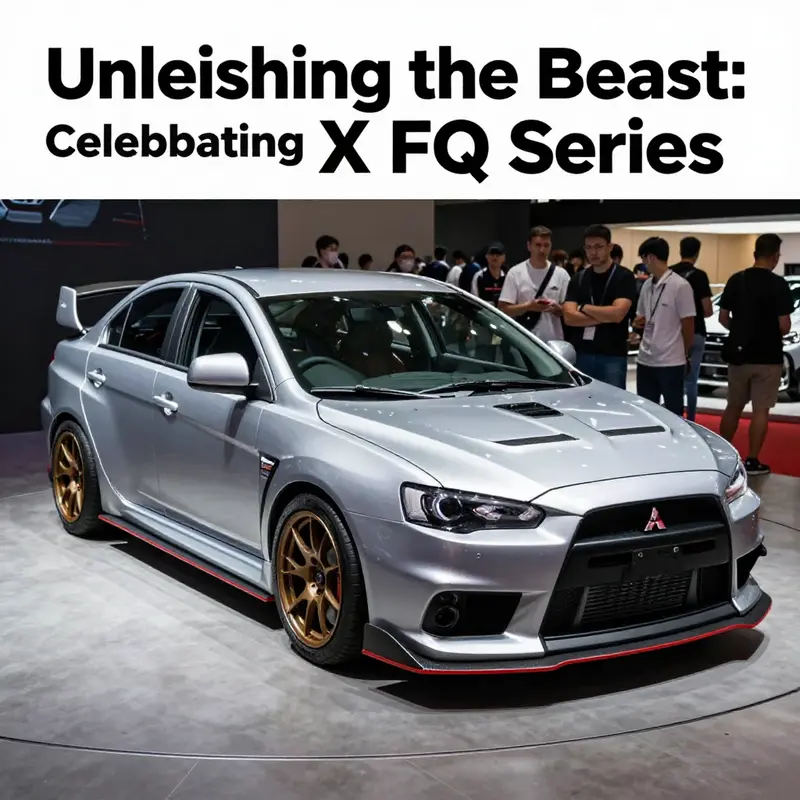
The Evolution X carried the weight of a long, multi-layered story. It arrived as the final fuel-powered chapter in a lineage that had already crossed countless rally stages and road courses. In Europe, the X chassis had matured into a platform that could translate blistering performance into everyday usability, while still inviting a race-bred mindset from the driver. Within that already charged framework, the FQ variants emerged as a dedicated response to a single market’s appetite for speed. They were not mere packages; they were statements, crafted with a sense of theater and precision that reflected the UK’s distinct appreciation for high performance with a clear, unsentimental edge. The FQ name, a blunt promise wrapped in a signature design language, signaled a chapter where power, handling, and chassis feel were not negotiable. The story was always about achieving more with the same fundamental architecture, pushing the boundaries until a track-ready street car felt almost inevitable on every road during the week and almost inevitable on a circuit by weekend.
The specific moment when the UK market embraced the most extreme extension of this philosophy came in March 2014. Mitsubishi celebrated Europe’s 40th anniversary footprint with a car that carried a heavy sense of occasion and a technical dossier to match. Forty units were allotted to a market that could translate scarcity into desirability, and the price point, hovering near the £50,000 mark, reflected a balance between exclusivity and the tangible value of the engineering upgrades underneath. The FQ-440 MR was not a crowd-pleaser by volume; it was a curated experience designed for those who measure a car’s worth by the way it turns time into velocity. The car’s existence was a reminder that performance culture can be both intimate and aspirational, a rare combination that turns ownership into a personal project and a public statement at once.
Power is the language of this edition, and its vocabulary is bold. Under the hood lay a heavily tuned version of the familiar 2.0-liter turbocharged engine family. The collaboration with a renowned tuner brought a multi-faceted upgrade: a high-performance turbo, larger fuel injectors, and a more aggressive intake and exhaust cascade. A larger intercooler ensured heat stayed in check, while a comprehensive ECU reprogramming tuned the engine’s response across rev ranges. The result was a claimed output of 440 horsepower at 6,800 rpm and torque peaking at 559 Nm around 3,100 rpm. What this meant in practice was not merely more peak numbers, but a broader, more usable surge of power that felt punchier and more linear than many high-output contemporary rivals. The car rewarded open throttle and high-gear acceleration with a sense of inevitability—a feeling that the car was always ready to extend a straight line into a wide arc of speed, regardless of the road surface or weather.
The mechanical core of the MR edition was matched by a calibrated chassis strategy. The six-speed dual-clutch transmission—abbreviated SST in Mitsubishi’s lexicon—was the conduit for the engine’s aggression. It shifted quickly, cleanly, and with a degree of immediacy that kept the momentum intact through corners and straights alike. Manual enthusiasts might miss the tactile drama of a traditional clutch, yet the SST offered a different kind of immediacy: shifts that seemed to happen with surgical precision, engineered to minimize the interruption of acceleration as you pressed into the apex. The suspension, too, was refined to embrace the car’s new vocation. Front and rear drops of about 35 mm and 30 mm respectively lowered the chassis, sharpening steering feel and enhancing turn-in response. A limited-slip differential distributed traction with a discipline that allowed the chassis to become one with the driver’s intent, whether on a damp back road or a dry track layout. The result was not only better grip but a more communicative, tactile relationship between driver and machine.
The visual language of the FQ-440 MR reinforced its purpose. The body kit, bold yet purposeful, announced its track-minded intentions without veering into flamboyance. A carbon front splitter, color-coordinated aero elements, and a carefully sculpted rear diffuser worked in concert with the car’s reduced weight to improve high-speed stability. Inside, the cabin became a sanctuary for performance: Alcantara-trimmed seats wrapped around the occupants, supportive enough to hold you in place during aggressive cornering, and exclusive badging that marked every unit as a member of a small, reverent club. The attention to detail extended to tires and brakes as well. High-performance brakes, a tuned brake figure, and purpose-built rubber completed the package, allowing the car to shed speed efficiently and reliably when confidence needed to be restored before the next corner. In short, the MR was not merely faster; it was more confident and more communicative at a higher threshold of speed.
What then did the FQ-440 MR represent within the broader Evolution X story? It stood as the apex of a carefully curated UK-only lineage, a culmination of a philosophy that valued precision engineering and a clear, quantifiable sense of belonging to a long-running performance tradition. Compared with earlier FQ editions, the MR offered a sharper suspension tune, more aggressive torque delivery, and a more connected driving experience. The FQ-330 SST had shown how a dual-clutch system could meet competition-inspired expectations, while the FQ-400 pushed the envelope on horsepower and aero, culminating in the FQ-440 MR’s insistence on a full, track-ready personality that could still operate as a refined road car when needed. This progression was not simply about speed. It was about a continuum of feedback and balance: the car telling you where it could go, and you choosing whether to go there with full confidence or not.
The social and cultural resonance of the FQ-440 MR cannot be separated from its scarcity. Only forty examples exist in the UK, a number that made every mile accrued with such a machine feel doubly valuable. The story of its resale and fan interest mirrors the uneasy romance of chasing a legend: a rare, well-preserved example becomes less a vehicle and more a time capsule, a portable demonstration of what engineers and enthusiasts believed performance could be when a market displayed unwavering devotion. The price, rarity, and the aura of exclusivity created a feedback loop where aficionados sought out these cars not only to experience their speed but to own a piece of a moment when engineering bravado was celebrated as an art form and not just a procurement decision. A well-preserved MR is as much about provenance as it is about power, and the owner becomes a custodian of a particular memory—the moment when a British market fell in love with a car that dared to blend rally ancestry with street aggression.
For readers who want to see a contemporary expression of that legend, a well-documented listing offers a vivid snapshot of what the FQ-440 MR remains today. The search for a low-mile example often starts with a straightforward inquiry into the car’s health, service history, and authenticity of the limited edition badges. A representative listing highlights a very specific narrative: a car with a clean maintenance history, preserved paint, and a well-documented lineage that can narrate its own chapter in the broader Evolution X saga. This is more than currency value; it is a story about the way enthusiasts connect with the past through a machine that was built to deliver the kind of experience most manufacturers reserve for their high-end models. If you want to glimpse a modern expression of that legend, consider the listing titled low-mile Mitsubishi Evo X FQ-440 MR for sale, where the car’s mileage and care intersect with a market that still reveres it for its singular combination of speed and rarity. low-mile Mitsubishi Evo X FQ-440 MR for sale.
The chapter closes with a broader reflection on what that final Evolution edition achieved. It did not merely push the envelope on horsepower or 0-60 times; it crystallized a philosophy. The UK-market FQ lineup showed how a niche could become a legendary identifier for performance, an emblem of a country’s willingness to embrace raw velocity with a disciplined engineering approach. In a world that increasingly depends on electronics to daisy-chain power to the road, the MR edition stands as a reminder that, at its core, speed is a dialogue between human intention and mechanical response. The result was a car that felt alive not only because of its numbers but because of the way those numbers translated into an emotional, direct, and consumable driving experience.
External reference and further reading can be found in official archives that document the launch and the market context for this model. For an authoritative overview of the MR’s introduction and its place in Mitsubishi’s European strategy, see the UK press release archive. https://www.mitsubishi-motors.co.uk/press-releases/2014/march/lancer-evolution-x-fq-440-mr-launch.html
Bridging the Margin: How the Evo X FQ-330 SST Rewrote the Balance Between Street Comfort and Track-Ready Aggression

The evolution of the Lancer Evolution X culminated in a line of limited editions that turned performance into a language spoken in the United Kingdom, where the FQ badge became a talisman for a car that could hustle with race-bred precision while still behaving on ordinary roads. The FQ-330 SST sits at a pivotal point in that story. It is not merely a step up in numbers; it is a deliberate attempt to bridge two worlds—the everyday drive and the edge-of-control thrill that only a properly calibrated all-wheel-drive system can offer. In the mind of the evo enthusiast, the FQ-330 SST is the model that demonstrates how Mitsubishi’s engineers reined in raw power to yield a car that could be both a legitimate daily performer and a ferociously capable track companion when the road turned snaky or the apex demanded a more aggressive line. The narrative of this model begins with a clear objective: make a 2.0-liter turbocharged four-banger feel alive, refined, and predictably aggressive, so that the driver could attend to the art of driving rather than wrestling with the machine.
Beneath the hood, the 2.0-liter 4B11T engine, tuned for this variant, unleashes 329 horsepower at 6,500 rpm and a stout 437 Nm of torque at 3,500 rpm. These figures establish a foundation that is not merely about peak numbers, but about a broad, usable region of power delivery. The torque curve, peaking early, ensures that left-foot coordination is rewarded with immediate response. The acceleration figure—0 to 100 km/h in about 4.4 seconds—speaks to the car’s competence in a straight line, yet what makes the SST truly compelling is how that power is managed through a six-speed Twin Clutch Sport Shift Transmission. This dual-clutch unit, which Mitsubishi shared with other high-performance variants of the era, accelerates gear changes with a speed that feels almost telepathic. The result is a car that can surge from mid-rev torque to redline with minimal interruption, an essential quality when the driver wants to place the power exactly where it belongs—on the rear wheels and through the car’s all-wheel-drive architecture.
The transmission is more than a speed changer; it is a driving philosophy. It offers Normal, Sport, and Super Sport modes, each tuning throttle response, shift speed, and into-the-green-into-the-turn timing differently. In Normal, the car behaves with a civility that suits daily driving, the throttle is progressive, and the shifts are gentle enough to preserve comfort on long commutes. In Sport, the character shifts to a more immediate response, the throttle map opens up, and the transmission holds gears longer, letting the turbo breathe and the engine sing a little more clearly. Then there is Super Sport, where the car’s personality becomes almost tactile. Up to the redline, the SST delivers blistering, nearly instantaneous shifts that reward aggressive driving with a like-for-like feel of speed and momentum. The early era of SST systems in this class carried some reliability questions, but the FQ-330 SST demonstrates how durability can be built into a system designed for frequent, intense shifts. In the UK context, where the FQ reputation rests on the quality of the engineering and the ability to sustain high-performance use, this is a crucial point that has influenced how collectors view the model today.
Driving this variant is made more precise by the chassis work that accompanies the powertrain. The suspension setup—Eibach sport springs paired with Bilstein dampers—lowers the front end by a noticeable margin, contributing to a lower center of gravity and sharper turn-in behavior. The front end appears planted without feeling overwhelmed by the car’s mass, which remains a feature of the Evo X’s design: the ability to shed understeer at the exit of a corner while maintaining a balanced, neutral character through the apex. The rear suspension receives similar attention, ensuring that the car remains predictable when the throttle is applied mid-corner. The result is a chassis that communicates effectively with the driver, providing feedback that is both honest and actionable. It is the kind of handling that translates a driver’s intent into precise, confident movements at the wheel, a critical trait when the road is undulating, slick, or cambered toward an off-camber corner.
Stopping power is another thread in the same fabric. The FQ-330 SST is equipped with a Brembo-brake setup that delivers reliable, fade-resistant stopping force under sustained pushing. Large ventilated discs and four-piston calipers work in harmony with the chassis to ensure that as the speed climbs, the braking system remains composed, providing a stable sense of control rather than a sudden, unpredictable bite. It is this harmony between engine deliverance, chassis poise, and brake feel that makes the car so inviting on road courses or winding mountain pass stretches. The tires, wrapped around 18-inch Enkei wheels, complete the circle by offering a capable contact patch with the pavement. The balance of grip and progressive slip under load allows the driver to set a confident rhythm through corners, and the car’s electronic aids—while not overbearing—permit a level of trust in the car’s ability to intercept if the driver pushes a little too hard.
Inside, the cockpit reinforces the sense of purpose that the FQ-330 SST embodies. Recaro sport seats grab the driver with a supportive hold during aggressive driving, helping to maintain posture and focus under lateral loads that come with spirited laps. The seating position, combined with a snug, precise steering feel, creates an environment where the driver’s inputs feel intentional and direct. Even as the car balances on the edge of grip, the cabin remains a place where comfort is not sacrificed for performance. The interior is not a vacuum of restraint but a cockpit designed to keep the driver connected to the road and the car’s dynamic character. In this sense, the SST’s dual nature—fast and tractable—becomes more than a performance spec. It becomes a message about how a high-performance road car can serve as a reliable partner for a weekend of aggressive driving while still performing well enough for a daily commute.
If the FQ-330 SST serves as a bridge, it bridges more than merely power and performance. It bridges the expectation that a high-performance car must sacrifice livability for speed. By marrying a tractable, road-friendly power delivery with a chassis tuned for cornering precision, Mitsubishi’s engineers created a vehicle that could ride the fence between a street car and a track tool. This wasn’t a car meant only to brag about horsepower; it was a machine designed to teach a driver how to extract speed from a combination of torque, grip, and shift timing. The FQ-330 SST, in effect, teaches the art of driving on a higher plane without requiring the driver to become a professional racer. In a market where the line between discretionary performance and everyday usability is routinely blurred by cruder machines, this car offered a more refined alternative that still carried enough drama to satisfy enthusiasts.
The broader context for this model’s significance lies in the evolution of the FQ family within the UK market. The FQ naming sequence began as a way to signal a level of performance beyond the standard Evo X, a signal that its engineers would push to the limit in subsequent iterations like the FQ-400 and FQ-440MR. The 330, though, is the one that often gets quoted as the most complete balance of the era. It is not the most powerful in the family, but it remains the most coherent—an all-in-one experience that could be enjoyed as a daily driver yet unleashed with confidence on a track. The chassis, the transmission, the braking, and the seating all work in symmetry to produce a car that feels, at any moment, ready to tackle a demanding road or a challenging circuit.
The narrative of the Evo X FQ-330 SST also intersects with the broader culture of the era—the competition from rivals who were ramping up their own performance packages, and the British market’s appetite for limited-edition machinery that offered exclusivity along with genuine performance. The FQ-330 SST is a product of that moment, a car that doesn’t simply claim to be fast; it demonstrates what it means to be fast in a way that is accessible to a discerning driver who wants to push the car hard but not at the expense of daily usability. To a collector’s eye, the 330 remains a compelling proposition because it captures the essence of the Evo X: a car that could be driven with restraint and then opened up for a more aggressive, track-oriented experience with a level of confidence that comes from engineering that respects the physics of four-wheel drive, turbocharged torque, and a well-tuned chassis.
As a nod to the era’s aesthetic and engineering details, the car’s appearance carried the subtle signals of its purpose: a purposeful, understated aggression rather than a loud, showy display. The exterior was enhanced with the kind of aero cues and functional styling that communicates speed more than flash. Inside, premium materials and performance-oriented details reinforced the sense that the FQ-330 SST was built to deliver a complete experience, from the moment the doors close to the moment the tires sing on the track. In the world of limited-edition sport sedans and compact performance coupes, the 330 SST stands out not only because it is a rare edition but because it embodies a philosophy: that speed, when guided by intelligent engineering and a well-tuned chassis, can be both thrilling and approachable.
For readers curious about the specific upgrade paths that accompanied these kinds of models, a representative example of the aftermarket imagination around Evo X is the carbon-fiber bonnet upgrade often discussed in enthusiast circles. A linking example can be found here: carbon-fiber bonnet upgrade for Evo X. This sort of component underscores the broader engineering mindset—how lightening, rigidity, and heat management are integral to pushing a car’s performance envelope without compromising daily usability.
External references can provide deeper context for how automotive press and enthusiasts perceived the FQ-330 SST in practice. For a detailed contemporary assessment, see the Motor1 UK review that covers the Evo X FQ-330 SST’s blend of speed, precision, and everyday comfort: Motor1 UK review: Mitsubishi Evolution X FQ-330 SST.
British Thunder, Final Sprint: The Evo X FQ’s Masterclass in Performance and Prestige

The Mitsubishi Lancer Evolution X, in its final petrol iteration, did more than close a chapter. It punctuated a lineage with a concentrated, UK-born force that turned a global rally heritage into a road-going legend. The Evo X FQ family—born from a collaboration between Mitsubishi UK and ADR Motorsport—was crafted not merely to celebrate enduring success in Britain, but to push the very idea of what a factory-inspired performance sedan could be. This chapter traces that apex, weaving together the engineering calculus, design philosophy, and market dynamics that gave the FQ-400 its enduring status as one of the most sought-after Evos. It is a narrative about specialization under constraint—limited production, a single market, and a clear aim: to demonstrate that a compact four-door sedan could rival the theater of supercars when tuned with purpose and resolved engineering.
The FQ label itself marks a turning point in the Evo X’s story. It stands for a candid, almost audacious promise: the machine you’re about to drive is “Fucking Quick.” That cheeky badge belies a rigorously engineered program. The series began with the FQ-330 SST, which introduced a more aggressive tuning philosophy in 2009 to counter a resurgent competitor, the STI. But the true apex would come later, when the UK team, together with ADR Motorsport, selected the best parts and tuned the powertrain and chassis to a level previously unimaginable for a production Lancer. The result was less a mere model upgrade and more a statement of intent: an Evo X meant to stand alongside the world’s hyper-fast sedans while staying true to its four-door practicality and all-weather versatility.
Under the hood of the FQ-400 lies the familiar, robust 2.0-liter turbocharged 4B11T engine—the cornerstone of the Evo X’s performance identity. What distinguishes the FQ-400 is the meticulous hand of engineers from Mitsubishi and their tuning partners. Power climbs to 405 horsepower at 6,500 rpm, with torque peaking at 53.57 kg·m (525 Nm) at a modest 3,500 rpm. These figures translate into a 0–60 mph sprint of just 3.8 seconds, a time that aligns the FQ-400 with the immediacy of modern supercars on British roads and track days alike. It is a statistic that, on paper, invites the knee-tremor of the road test hero and on real roads invites the reverberating exhale of a driver who just summoned the raw, usable speed the chassis could deliver.
The FQ-400’s handling package does not rely on more torque alone. The front suspension, reinforced with Eibach springs and Bilstein dampers, lowers the front end by 30 millimeters. The effect is more than a lower silhouette; it’s a deliberate reduction of front-end lift and an enhancement of front-end grip that sharpens steering response and cornering confidence. The rear suspension receives equal attention, with tuned geometry and damping that balance grip distribution and mid-corner stability. Braking hardware reflects the same mindset: AL CON six-piston calipers—distinctive with the brand’s red insignia—grip ventilated discs, delivering what one would call a controllable avalanche of deceleration. This is not merely strong braking; it’s peak brake management, designed to sustain high-load stops from track to mountain pass with confidence rather than drama.
Wheels and tires round out the chassis narrative. The FQ-400 rides on 18-inch lightweight alloys with a nine-spoke design, shod in high-performance Toyo Proxes R1R rubber. The choice of a performance tire with a relatively modest capital outlay in rolling resistance and grip underscores a broader philosophy: this car is not a one-trick sprint machine but a balanced performance sedan that remains at home on a daily commute while delivering the intensity of a dedicated track car when the throttle is pinned and the road demands it. The result is a chassis that speaks in a language of precision steering, measured compliance through corners, and a tactile sense of engagement that rewards the driver’s judgment rather than masking it behind electronic aids.
Aesthetics and aero are no afterthought in the FQ-400 story. The body kit is a ruthless synthesis of function and presence: widened fenders, side skirts, a bold rear diffuser, and a carbon fiber front splitter that channels air toward cooling ducts and the engine bay. The oversized front bumper apertures and brake ducts aren’t merely stylistic; they are part of a coherent thermal management system essential to maintaining consistent performance under high-load conditions. The tail bears the unmistakable FQ-400 badge, a badge that became a shorthand for enthusiasts seeking a rare, limited-run model that embodied the apex of Mitsubishi’s UK performance program. Inside, the cabin stays focused on the driver. A six-speed manual transmission anchors the drivetrain, an explicit nod to purists who value direct engagement over the inertia of a dual-clutch system when facing torque figures as aggressive as those produced in this package. The return to a manual is not retrograde; it’s a design choice that preserves the analog thrill of driving with a machine whose character relies as much on driver input as on mechanical refinement.
Yet the FQ-400 cannot be understood in isolation from its kin—the FQ-440MR and the FQ-330 SST, siblings in an evolutionary lineage that maps the Evo X’s most intense performance moments in the British market. The FQ-440MR, a 2014 celebration of ADR’s 40th anniversary in the UK, consolidates the “most aggressive 2.0L turbo” arc while increasing power to 440 horsepower and torque to 559 Nm. The turbocharger is a bespoke unit from HKS, and the chassis lowers further—down 35 mm at the front and 30 mm at the rear—creating a lower center of gravity that accentuates the car’s flinch-free turn-in behavior and mid-corner composure. The FQ-440MR abandons the manual option in favor of a six-speed SST, aligning with a modern, electronics-assisted engagement that prioritizes rapid, consistent shifts during track work. It is a model that demands a different kind of commitment from its drivers—one that rewards throttle discipline and precise line selection as much as raw speed.
The earlier FQ-330 SST, launched to counter an evolving rival, provides a crucial bridge in understanding the FQ arc. With 329 horsepower and 437 Nm of torque, it marked a meaningful uplift over the baseline Evo X models, pairing Brembo brakes, Eibach springs, and Recaro seats with the stability of the four-wheel-drive system. The SST configuration, immovable in the public eye as a single-gear-changer of choice for the more aggressive entries, signals Mitsubishi UK’s willingness to embrace dual-clutch transmission technology in the context of a high-performance platform where acceleration and throttle response could be tuned with surgical precision. The trio of FQ models represents a carefully curated ladder of performance, where power, handling, and transmission philosophy evolved in response to both market demand and the technical capabilities of the underlying Evo X platform.
The broader significance of these models lies not merely in their numbers, but in what they symbolized for enthusiasts and collectors alike. The FQ lineup was a bespoke celebration of the Evo X’s capabilities, a demonstration that a compact, four-wheel-drive sedan could, with the right engineering, stand shoulder to shoulder with performance icons from far larger manufacturers. The UK-exclusive nature of these cars added another layer of mystique. They became more than cars; they were limited-edition artifacts whose value in the collector market is tied to the narrative of a brand’s commitment to a particular market, and to the collaboration between a mainstream automaker and a specialist race engineering outfit that produced certificates of performance rather than mere marketing statements.
For those tracing the thread of value and provenance, the market offers reminders of the FQ’s singular status. A listing for a low-mile Evo X FQ-440 MR, for instance, reflects the way these cars are perceived by collectors: as rare, well-preserved specimens that epitomize the apex of a storied lineage. The internal market hint here is that these are more than occasions to buy speed; they are opportunities to acquire a piece of a broader narrative about British performance culture, and about a time when manufacturers explored the boundaries of production-car capability with serious intent. The FQ-400, with its 405 hp and 3.8-second sprint, remains the anchor—the most widely acknowledged iteration of the UK’s ultimate Evo X, a car that embodies the culmination of a performance program that valued driver connection, mechanical purity, and a disciplined approach to power delivery.
The chapter’s forward-looking resonance lies in how the FQ models reshaped expectations for a modern performance sedan. They demonstrated that the boundaries between factory sport models and bespoke race engineering could be deliberately blurred, producing a series of cars whose appeal rests on how they integrate engineering discipline with a sense of theatrical speed. The Evo X FQ family did not seek to reinvent four-wheel drive; it sought to redefine what it meant to extract trust, feedback, and pace from a relatively compact chassis through careful tuning, robust components, and a relentless gaze toward the limits of grip and balance. The result is a lineage that continues to influence contemporary discussions about how manufacturer-backed performance calibrations should be approached in an era where electrification and hybridization complicate the past’s clear lines.
In revisiting the official documentation, one sees how the FQ-400 stands as a culmination of a long, deliberate program. The British market, the ADR collaboration, and the engineering rigor produced a car that could be described, with both humor and reverence, as a remarkable synthesis of speed, control, and character. It is a reminder that, at times, the most lasting innovations in performance cars are not the most dramatic leaps. They are carefully judged increments that, together, redefine the possibility of a production machine. The FQ-400, and its siblings, sit as a testament to how a practical, well-balanced four-door performance sedan can become a benchmark not just for a generation, but for the way we measure the intersection of power, precision, and passion in high-performance road cars.
For readers who wish to explore this topic further, a practical glimpse into the current market offers a sense of continuity with the past. A listing such as the one referenced above demonstrates how the FQ models continue to circulate in enthusiast circles, preserving a living memory of what these cars achieved on the road and in the hands of skilled drivers. The lineage endures not simply as a set of specifications, but as a narrative of how a car can be tuned, personalized, and cherished across years, retaining relevance in a landscape where performance is often measured in how gracefully a machine can be driven rather than how quickly it can fling itself down a straightaway. The Evo X FQ story remains a case study in how to balance power, handling, and personality within a single, coherent vision.
Final thoughts
The Mitsubishi Evo X FQ series represents a remarkable journey of automotive excellence, from the tenacious FQ-400 to the groundbreaking FQ-440MR and the pivotal FQ-330 SST. Each model not only embodies unmatched performance but also showcases innovative design elements that resonate with enthusiasts and collectors alike. The legacy of the Evo X FQ series continues to influence the automotive landscape, reminding us of what can be achieved when engineering brilliance meets passion. As we reflect on these legendary machines, we recognize their impact and the standard they set for future performance vehicles.