
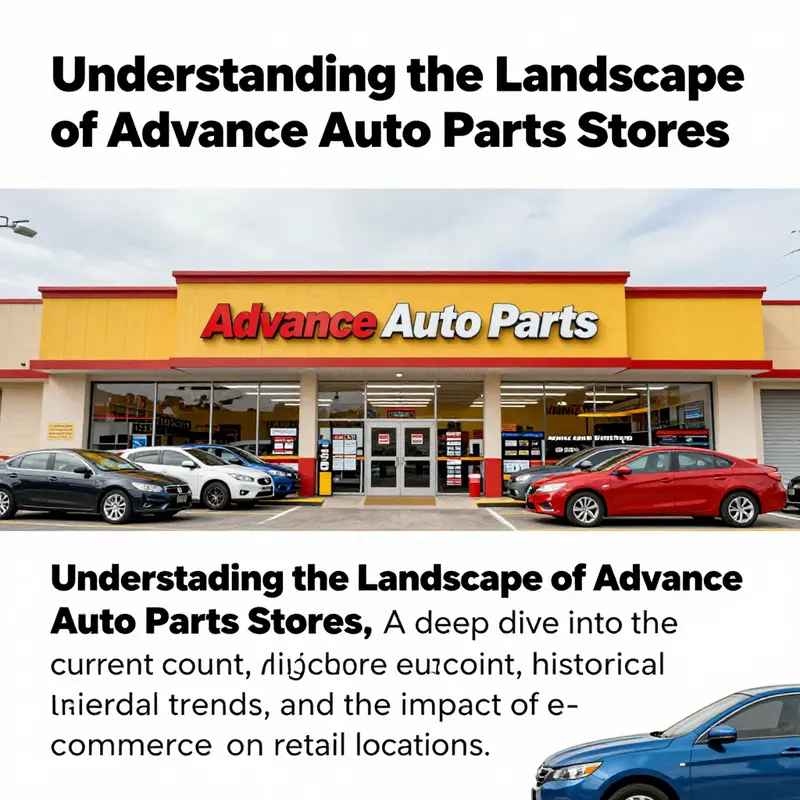
Advance Auto Parts, a mainstay in the automotive parts retail industry, has undergone significant changes in its store footprint over the years. Currently, there are 4,065 Advance Auto Parts locations in the United States, marking a notable reduction from previous years. This trend prompts a pertinent examination of the historical growth, reasons behind store closures, and the company’s strategic brand positioning. Additionally, the burgeoning influence of e-commerce has reshaped the retail landscape, affecting how many physical stores remain open. This composition will delve into each of these facets to provide a robust understanding of how many Advance Auto Parts stores are currently operational and what factors have driven these numbers.
Mapping the Present Footprint: The 4,065 Advance Auto Parts Stores Serving the U.S.
As of February 19, 2026, Advance Auto Parts maintains a tangible and significant retail presence in the United States with a total of 4,065 stores nationwide. This store count represents the latest verified snapshot of the company’s operational footprint, reflecting both its enduring role in the automotive aftermarket retail industry and its adaptation to changing economic and technological landscapes. For decades, Advance Auto Parts has been recognized as a key supplier for drivers, mechanics, and enthusiasts, offering parts, accessories, and resources for vehicle maintenance and repair. The current figure is neither static nor arbitrary—it encapsulates a dynamic balance between physical retail accessibility and the growing influence of online commerce.
Importantly, this number contrasts with the higher counts seen just a few years prior. Late 2023 and early 2024 reports placed the national store total between 4,786 and just over 4,900. The reduction to 4,065 points to deliberate restructuring. It is common in retail to see strategic location adjustments—some stores are closed due to underperformance, overlapping trade areas, or shifts in customer behavior, while other locations may be repurposed for distribution or service rather than storefront sales. This pattern aligns with broader industry trends in which legacy brick-and-mortar retailers recalibrate their networks to balance physical coverage with cost efficiency.
Advance Auto Parts’ footprint is dispersed across diverse regions, from high-density metropolitan streets to small-town main drags, ensuring coverage for both urban and rural drivers. Such widespread accessibility is vital in auto parts retail because vehicle maintenance cannot always be planned weeks in advance; drivers often need immediate solutions for breakdowns, repairs, and upgrades. The company’s operational scale also feeds into its competitive positioning—larger networks often command stronger relationships with suppliers and hold capacity for bulk ordering, which can translate into competitive pricing and consistent availability of inventory.
However, the present count of 4,065 stores should also be understood in the context of the company’s multi-brand strategy. Advance Auto Parts operates under its own flagship name but also manages Carquest and Worldpac. These brands serve different segments: Carquest often caters to professional mechanics and DIY consumers alike, while Worldpac focuses primarily on the professional installer market, offering parts for a broad spectrum of vehicle makes through an expedited supply chain model. When assessing the reach of the company, one must recognize that the Advance Auto Parts brand locations are only part of a larger network. Yet, the fresh February 2026 count specifically refers to Advance Auto Parts-branded U.S. retail stores.
The automotive aftermarket sector has been evolving rapidly due to changing technologies in vehicles themselves. Modern cars and trucks require parts that are increasingly precise, specialized, and often electronically integrated. Retailers must meet these demands with both physical inventories and robust catalog systems. Alongside this shift, e-commerce has expanded significantly, offering consumers the option to browse, compare, and purchase parts online for delivery or in-store pickup. As online purchasing grows, companies can reduce physical redundancy in store locations while enhancing fulfillment capabilities across fewer but strategically functioning stores.
Advance Auto Parts’ apparent reduction in total locations over the last few years likely coincides with internal focus on improving profitability per store rather than simply maximizing count. Operating a store involves fixed costs—rent or property ownership, staffing, utilities, and local marketing. By concentrating resources in stores that are best positioned geographically and financially, the company can aim for higher operational efficiency. This also helps maintain adequate staffing levels, ensuring customers receive knowledgeable assistance and reliable service.
Even with these shifts, for many drivers, walking into an Advance Auto Parts store remains a trusted part of vehicle care. Whether it’s sourcing OEM-equivalent brake pads, finding highly specialized components for performance upgrades, or getting advice from experienced staff, the 4,065 locations provide tangible points of contact. Regional differences also factor into which stores remain open—states with higher vehicle density, diverse weather conditions, and extensive commuter networks tend to maintain stronger store representation. In colder climates, winter-related vehicle challenges make local auto parts access essential, whereas in hotter or desert climates, cooling system maintenance takes a higher priority.
The company’s retail footprint also intersects with the automotive enthusiast community. While many patrons seek routine replacement parts, enthusiasts and tuners often visit stores for specific performance components or styling elements. In such cases, store availability can influence project timelines. For example, acquiring body panels or specialized bumpers, such as those for niche models like the Mitsubishi Lancer Evolution X, often requires careful sourcing. Sites like Lancer Evo X rear bumper options demonstrate how project-specific parts can be sought online, complementing the inventory found in local stores.
Looking beyond simple counts, the sheer presence of thousands of outlets speaks to the logistical depth involved in keeping them supplied. Advance Auto Parts orchestrates complex distribution networks to ensure each store is stocked with parts ranging from common oil filters to rare specialty items. Each location ultimately acts as both a front-line service point and a node in the greater supply chain. This role becomes increasingly important in the DIFM (Do It For Me) market segment—customers who rely on professional installation services but purchase parts through retail or via their mechanic’s preferred supplier.
Operationally, maintaining thousands of locations means managing regional warehouses, fleet logistics, inventory turnover rates, and seasonal supply adjustments. Winter driving conditions in the Midwest require pre-positioning of battery stock, antifreeze, and winter tires. Conversely, summer in the southern states may trigger demand for cooling systems, AC service kits, and exterior maintenance products suitable for prolonged sun exposure. Ensuring accurate forecasting and timely replenishment across all 4,065 stores is a feat of coordination and planning.
From a customer-experience standpoint, the store count also reflects brand visibility. Frequent encounters with the Advance Auto Parts storefront, whether en route to work or visible from a highway, embed the brand into the consumer’s awareness. The physical presence captures impulse purchases and can serve as immediate solutions for breakdowns. While online platforms serve planned purchases well, there is still an irreplaceable value in having a nearby store when an unexpected vehicle issue occurs.
In sum, the current retail network of Advance Auto Parts stands as a calculated configuration designed to offer broad coverage while aligning with operational realities of the modern automotive industry. The decline from previous counts does not necessarily signal contraction in market influence but rather illustrates the balance a retailer strikes between wide physical coverage and modern efficiency driven by e-commerce trends and supply chain optimization. This presence ensures that customers across the country—from major metropolitan hubs to smaller, vehicle-reliant communities—retain access to reliable automotive parts, expert advice, and allied support services.
For the most precise and up-to-date store information, including location-specific hours and contact details, it’s best to consult the official resource at Advance Auto Parts website.
null
null
Footprints in Flux: Counting Stores as a Strategy Shift Reshapes the Auto Parts Landscape
Every chapter in the story of automotive aftermarket retail eventually returns to a single, stubborn question: how many stores are out there, and what does that number say about the strategy behind them? By early February 2026, the United States counted a total of 4,065 Advance Auto Parts locations. That figure, while still sizable, sits atop a shifting baseline. It marks a retreat from the height of recent years, when the network stretched between roughly 4,786 and 4,935 stores in late 2023 and through 2024. The difference isn’t just a headcount delta; it signals a deliberate recalibration of how to balance brick-and-mortar presence with digital reach, centralized distribution, and customer service across the DIY and DIFM segments. The broader arc is less about shrinking for its own sake and more about focusing on unit economics, profitability, and the ability to serve both local neighborhoods and multi-channel demand with fewer, but more capable, touchpoints.
A large part of that recalibration has taken the form of store closures. The company announced the shuttering of 523 corporate-owned stores across the United States. This is not a uniform cull, but a targeted pruning of underperforming locations and markets that have become saturated or suffer from persistently low foot traffic. It is a reminder that in segments like the automotive aftermarket, sustaining hundreds of fixed locations may no longer be financially viable if those sites do not deliver consistent cash flow. The objective is not merely to reduce the number of places customers can walk into; it is to reallocate capital and resources toward the stores and networks that generate stronger margins, faster restocking cycles, and better service levels in markets where demand remains resilient.
The move sits squarely within a broader reality confronting traditional brick-and-mortar retailers in this space: a retail environment increasingly shaped by online and omnichannel options, leaner fleets, and more agile distribution models. When a shopper needs a part, the path to fulfillment is no longer a simple walk-in-and-puy scenario; it often begins with online search, digital product catalogs, and options like curbside pickup or rapid delivery from nearby hubs. In this context, the number of physical storefronts becomes an indicator of how a company balances local accessibility with supply chain efficiency. The goal shifts from sheer scale to strategic scale—where every remaining store functions as a high-velocity node or a reliable link in a distribution network that can meet demand quickly and accurately. The elimination of a sizeable minority of locations is, in this view, a way to shore up reliability and speed where it matters most to customers and to the bottom line.
The corporate strategy that accompanies these closures further complicates the conventional wisdom about growth for growth’s sake. The firm continues to operate multiple brands, which serve slightly different customer segments: the traditional retail customer who visits a storefront for a quick fix or project, and professional repair shops that rely on assembly-line parts and consistent supply. The Carquest and Worldpac brands operate alongside, but the core Advance Auto Parts retail footprint has been scaled back to support a tighter, more efficient network. In practical terms, this means reallocating investment into facilities that can better handle peak demand, optimize inventory turns, and minimize dead stock. It is a move away from counting stores as a metric of success and toward counting the units of service those stores can deliver per hour, per day, per week. In this sense, the store count becomes a lens for profitability and operational discipline, not merely a measure of reach.
The shift also mirrors a changing competitive landscape in which lower prices, broader inventories, and faster fulfillment promised by online channels erode the traditional advantages of owning a vast network of small retail sites. Without naming competitors, the reality is clear: online platforms can curate extensive assortments, offer price transparency, and deliver with speed that challenges the most convenient neighborhood storefronts. The implication is not that physical stores are obsolete, but that their role must be recast. Stores become more like strategically placed hubs that support both customer-facing service and back-end logistics. They become, in effect, curated connections between the customer, the product, and the distribution system, rather than simple points of sale. This reconfiguration places a premium on the accuracy of inventory data, the quality of staff knowledge, and the efficiency of replenishment cycles, all of which can influence whether a customer still chooses a walk-in visit or opts for digital fulfillment with a near-immediate pickup option.
To understand the ripple effects for customers and communities, it helps to step back from the headcount and look at what those closures mean on the ground. In markets where stores shutter, customers who previously relied on a local location to diagnose a problem, source a part, or obtain quick professional advice must reorient toward nearby open locations, online ordering with expedited fulfillment, or connections to distribution centers capable of same-day or next-day delivery. For some DIY customers, this is a moment to embrace more digital tools that guide purchases and assemble parts lists before even stepping into a store. For professional customers, the impact can be more nuanced. A professional might lose a convenient daily pickup point but gains access to a network of hubs designed to maintain inventory availability for a larger pool of outlets and warehouses. In this sense, the net effect is not a uniform decline in service, but a reallocation of service capacity that aims to preserve speed and reliability even as physical footprints shrink.
The numbers, then, are not just arithmetic. They reflect a reallocation of capital, labor, and real estate toward a business model that emphasizes profitability and resilience over expansion for expansion’s sake. It is a reflection of how a company negotiates the balance between local accessibility and the capital intensity of a dense storefront network. In the current climate, the cost of maintaining a storefront is measured not only by rents and utilities but by the opportunity cost of capital that could be deployed to more productive uses—upgrading distribution centers, funding more skilled staff training, or accelerating the adoption of data-driven inventory management. When the company reorients its strategy in this way, the store count becomes a lever rather than a ceiling; it is a variable that can be adjusted to meet the evolving demand curve and the needs of a modern, multi-channel customer base.
An underlying thread through this transition is the degree to which digital resources and physical spaces complement one another. The move toward fewer but more strategic locations sits alongside ongoing investments in digital infrastructure, order management, and supply chain optimization. In practice, this means that a shopper may still discover a part online, select a local pickup option, and pick up a part at a nearby hub rather than a storefront. The preference for speed and reliability pushes the business model toward a hybrid approach: a leaner network of stores operating in concert with a more capable, responsive distribution system. The net effect on the customer experience can be positive if the remaining stores are truly well-located, well-staffed, and integrated with the logistics backbone that powers rapid fulfillment.
Within this narrative, the broader industry context matters as well. The aftermarket sector has faced persistent competitive pressure from online marketplaces and catalog-based retailers that emphasize inventory breadth and price competitiveness. The closures and realignment reflect a strategic choice to double down on the parts ecosystem’s most profitable segments, while leveraging centralized capabilities to support those remaining stores. The leadership’s focus on profitability and unit economics over sheer expansion indicates a willingness to accept a smaller physical footprint if it translates into steadier cash flow, healthier margins, and more predictable capital allocation. This is not about retreat from the market; it is about recalibrating the operating model to survive and thrive amid shifting consumer expectations and a more digitized competitive arena.
For readers who want to see how catalog-style and parts-pourcing resources are shaping consumer behavior in adjacent spaces, a related example from a different corner of the auto parts ecosystem illustrates the move toward centralized information and efficient fulfillment. A catalog entry from a widely used parts resource demonstrates how digital references help customers and professionals assemble accurate parts lists before engaging with any storefront or distribution hub. See this entry for a concrete example of how catalog pages organize critical part identifiers and compatibility data: 03-06-mitsubishi-evolution-8-9-jdm-rear-bumper-oem.
As the store network tightens, the question becomes not merely how many locations exist today, but where the remaining locations sit within the evolving logistics grid and how effectively they serve local customers while plugged into a smarter, more responsive supply chain. The current count—4,065 locations—bespeaks a substantial but purposeful footprint. The 523 corporate closures target places with limited potential to contribute meaningfully to profitability, especially when weighed against the costs of maintaining, staff training, and inventory that may not move quickly enough to justify the investment. The strategic narrative is clear: a more selective footprint that emphasizes speed, reliability, and service quality over volume of storefronts. The economic logic is equally clear. Fewer stores can mean lower overhead, less capital tied up in real estate, tighter inventory, and faster turns—all factors that contribute to stronger profitability and more predictable financial performance in a market that rewards efficiency as much as it does access.
For policymakers, researchers, or analysts studying retail transitions, the Advance Auto Parts case offers a concrete example of how a traditional retailer navigates a post‑pandemic, digitally enabled economy. It shows how a company can hold on to essential market presence while shedding much of what previously seemed indispensable. It highlights the tension between serving local repair need and capitalizing on centralized capabilities that reduce per-unit costs and widen geographic reach without multiplying fixed costs. It also underscores the role of multi-brand strategies in sustaining a diversified customer base while the core retail footprint contracts. In sum, the story of store counts is not a simple tale of decline; it is a narrative about recalibrating a complex network to align with today’s demand patterns, cost structures, and strategic ambitions.
External reference for broader context on the company’s ongoing restructuring and profitability trajectory can be found in a leading business publication that covered the store-closure trajectory and its implications for turning a profit. See: https://www.wsj.com/articles/advance-auto-parts-continues-store-closures-as-it-turns-a-profit-11676482000.
Footprint in Flux: Tracing the Real-World Reach of Advance Auto Parts in a Consolidating Automative Aftermarket
The question of how many Advance Auto Parts stores exist is more than a simple tally. It is a window into the company’s strategy, the health of the broader auto parts market, and how retailers attempt to balance breadth of reach with the profitability of each location. In the United States and Puerto Rico, the Advance Auto Parts footprint has become a moving target, one that mirrors the tension between growth ambitions, capital discipline, and the shifting preferences of DIY customers versus professional service providers. As of February 10, 2026, the company reported 4,065 Advance Auto Parts locations. That figure, while precise on its face, sits amid a longer arc of expansion and retrenchment that stretches back to the middle of the previous decade and accelerates through the mid-2020s. The context matters because it helps readers understand not just how many stores exist, but why that number matters for service quality, supply chain efficiency, and the consumer experience in an industry where proximity and reliability can determine a customer’s choice of retailer.
To grasp the full picture, it is essential to trace the recent historical rhythm. By late 2023 and into early 2024, the store count hovered in a higher band—roughly between 4,786 and 4,935 locations. Those numbers suggested an aggressive expansion phase or at least a maintenance of a large retail footprint even as the market grappled with inflationary pressures, supply chain costs, and the demand cycle for automobile parts and accessories. Yet that same period also foreshadowed a strategic shift. The company, like many of its peers, began to reevaluate the optimal mix of brick-and-mortar locations versus fulfillment and distribution efficiency, culminating in a real estate optimization push announced in early 2025. The objective was not to abandon the physical footprint, but to retire underperforming stores and redeploy that capital toward higher-return locations, better-performing formats, or more efficient supply routes. In practice, that meant closures—significant in number—that would prune the network enough to lift profitability and performance metrics, even as total store count fluctuated.
The narrative did not stop with a single decision point. By April 2025, the company was still reporting well over four thousand locations, underscoring a dynamic that is common in mature retail chains: growth via openings and acquisitions, paired with rationalization that targets underperforming units or markets with diminishing returns. The company’s acquisitions—most notably the integration of Carquest and Worldpac assets in various regions—contributed to the depth of the store base and the breadth of service capabilities. Yet, the integration strategy favored a unified customer-facing identity. Acquired locations were generally rebranded to align with Advance Auto Parts branding, rather than maintained as standalone Carquest or Worldpac stores in the consumer-facing space. This consolidation under a single retail banner is not merely cosmetic; it simplifies the shopping journey for DIY customers and DIFM (do-it-for-me) professionals alike, while sharpening supply chain coordination and pricing strategy across the network.
The early months of 2025 also brought reports of more than seven hundred store closures as part of the broader real estate optimization effort. Such a figure is substantial enough to affect regional density and consumer access, yet it is also a deliberate reshaping designed to improve profitability, inventory turns, and in-store performance. In practice, closures are not arbitrary—they reflect an analytics-driven approach to store performance, where foot traffic, local demand, competitive dynamics, and facility costs are weighed against each location’s ability to contribute to the company’s financial goals. The goal behind this downsizing is not to retreat from the market, but to refine the portfolio so that the remaining locations can deliver consistent top-line sales and solid margins, complemented by a strengthened e-commerce and distribution framework. The result is a real-world footprint that remains extensive, albeit leaner, with a focus on sustaining a high level of service across the most productive markets.
Today, the aggregate figure of 4,065 stores as of February 2026 reflects both the legacy of decades of growth and the recalibration that followed in the mid-2020s. It is a snapshot at a time when the company continues to emphasize its retail core while leveraging adjacent channels to reach customers—from professional repair shops to DIY enthusiasts who want parts in-hand with speed. The United States remains the dominant stage for this footprint, with Puerto Rico also contributing to the regional mix. The geography of density matters as much as the count itself because it influences everything from inventory assortment to the availability of next-day delivery options and the ease with which customers can return or exchange parts. The strategic takeaway is not simply that a count exists; it is that the number represents a careful balance between depth (the range of parts and brands offered), breadth (the geographic spread that reduces customer travel time), and operational efficiency (the ability to stock, pick, and ship parts rapidly to customers, whether they walk in or order online).
What does this count imply for customers and for the broader aftermarket landscape? First, a large store base remains a critical asset in an industry where parts availability matters as much as price. In markets with dense store networks, customers are more likely to find the exact part they need quickly, aided by trained staff and immediate in-store pickup. A robust footprint also supports a resilient parts supply chain. When demand surges or when a regional supplier faces a disruption, a network of nearby stores can absorb some of the variability by routing orders and shoring up inventory through regional distribution. Second, the ongoing consolidation allows the company to optimize labor and fixed costs, which can translate into more competitive pricing, promotions, or higher-margin offerings in the stores that remain open. Third, the single-brand strategy—the continued focus on the Advance Auto Parts label rather than multiple distinct store identities—helps unify the customer experience. It reduces confusion for DIY customers who may have previously encountered different brand labels in the same market and it streamlines marketing, merchandising, and training programs for store staff across the footprint.
Yet the chapter on store counts cannot ignore the competitive and consumer context. The aftermarket has seen a shift toward omnichannel fulfillment, where online orders, curbside pickup, and efficient in-store pickup compete with the traditional walk-in visit. A broad store network can support same-day pickup for online purchases, which has become a differentiator in many markets. At the same time, the rise of e-commerce, third-party logistics partnerships, and enhanced distribution networks has given retailers more flexibility in how they deploy inventory. This multi-channel approach helps the company maintain visibility and accessibility even as the physical footprint contracts in some areas. In effect, the store count becomes a proxy for strategic intention: a larger footprint signals willingness to maintain broad customer access, while a tighter network signals focus on profitability, location performance, and the optimization of the real estate portfolio.
The branding story behind the footprint is equally telling. While the company historically benefited from layered brand assets under Carquest and Worldpac—each serving different customer segments—the modern retail strategy centers on a unified consumer brand. The forward path emphasizes consolidating market presence under a single label, while leveraging the strengths of acquisitions through centralized integration, inventory management, and customer loyalty initiatives. This approach reduces complexity, aligns pricing, and provides a more predictable shopping experience for customers who value reliability and consistency. It also signals to investors and partners that the business is prioritizing sustainable profitability alongside scale. In practice, any legacy brand references from earlier years are gradually replaced with the Advance Auto Parts identity, reinforcing a clear market signal: this is a single, cohesive retail experience designed to serve a diverse customer base with speed and expertise.
For readers seeking a tangible sense of how these numbers translate into a customer-facing reality, consider the everyday implications of a 4,065-store network. In regions with dense coverage, a customer can often find the exact part they need within a short drive and pick it up the same day. In less dense markets, the model supports efficient distribution and online fulfillment that compensates for lower in-store density. The balance between store count and e-commerce capability is not a trivia exercise; it is the backbone of service reliability. The company’s performance, particularly during shifts in demand or supply chain stress, depends on how well this network can move parts across the country, how quickly stores can restock, and how effectively the brand can communicate value to both DIY customers and professional technicians. The resulting store count is thus both a metric and a management tool—a snapshot of operational choices made in response to market dynamics, customer expectations, and the imperative to sustain profitability in a competitive aftermarket.
For readers who want to verify this footprint through official channels, the best source is the company’s own locator and corporate information, which provides location data and store-level details. As the landscape continues to evolve, stakeholders will watch closely how the network responds to market signals, how quickly underperformers are retired or repurposed, and how the brand continues to adapt to consumer preferences in a rapidly digitizing retail world. The overarching lesson is straightforward: a larger store count offers broad access and resilience; however, the true value lies in maintaining a network where each store contributes meaningfully to profitability, service quality, and customer trust. In that sense, the reported 4,065 locations as of February 2026 do not just reflect a number on a page. They reflect a deliberate, ongoing recalibration of accessibility, efficiency, and brand coherence in a market that prizes reliability as much as breadth.
External resource for further details: https://www.advanceautoparts.com
Footprints in Flux: Reframing the Store Network Through E-Commerce, Efficiency, and Market-Cending Strategy
The question of how many Advance Auto Parts stores exist in the United States sits at a crossroads of retail footprint analysis and a broader transformation narrative. As of February 10, 2026, the company operates about 4,065 locations in the United States. That figure tells part of the story; it marks a decline from the headcount seen in 2023 and 2024 when the tally hovered around 4,800 to 4,900 stores. Far from signaling a retreat from physical retail, the contraction reflects a deliberate recalibration: pruning underperforming sites, concentrating resources on markets with the strongest demand, and shifting capital toward initiatives that promise greater long-term efficiency and resilience. The corporate structure behind the footprint remains multifaceted, with a portfolio that includes distinct brands aimed at different customer segments. The core retail presence remains anchored under a leading flagship while ancillary brands serve complementary channels such as professional repair shops and wholesale distributors. Taken together, the numbers reveal a company that treats its store network as a flexible asset, one that must adapt to changing consumer habits without sacrificing the immediacy and accessibility that in-person service provides.\n\nThis reframing shifts the focus from raw size to network effect: how the stores, distribution hubs, and digital touchpoints combine to deliver fast, reliable access to parts. The count is a moving target, but the objective is stable: a seamless customer journey that blends in-store pickup, local inventory, and efficient fulfillment from Market Centers. The company operates under multiple brands, including Carquest and Worldpac, which extend reach to different customer groups while preserving a cohesive corporate strategy. The evolving approach signals a broader industry trend: success now hinges on orchestrating physical presence and online convenience, not simply on the number of doors.\n\nThe e-commerce impulse has redefined expectations across the sector, and the Advance Auto Parts model illustrates how a traditional, store-centric business can metamorphose into a hybrid system. The digital shift goes beyond adding an online storefront; it embeds online capabilities into day-to-day operations of every location. Digital infrastructure, data analytics, and customer engagement tools are deployed to improve efficiency and service. In 2025, Digital Commerce 360 projected that the company’s online sales would reach about $1.1 billion, signaling growing reliance on digital channels to drive revenue and in-store traffic. Loyalty programs, such as Advance Rewards, are designed to deepen connections, while AI tools assist pricing, promotions, and inventory allocation. This triad—loyalty, AI-driven pricing, and an adaptable footprint—forms the backbone of a modern retail strategy that values speed, personalization, and efficiency.\n\nLooking ahead, the company has signaled openings and closures aligned with market potential and capital discipline. The footprint is being optimized by balancing selective openings with strategic closures, and by strengthening Market Center infrastructure to shorten fulfillment times and expand the reach of digital orders. Returns and exchanges can be processed through the same integrated system, reducing friction and creating a more predictable experience for both consumers and professionals. The result is not merely fewer doors but smarter doors—places that connect customers to a broader, more responsive network.\n\nExternal resource: For a detailed look at recent performance and guidance, see Advance Auto Parts Reports First Quarter 2025 Results and Reaffirms Full Year Guidance (https://www.advancedautoparts.com/ir/news-releases/2025/advance-auto-parts-reports-first-quarter-2025-results-and-reaffirms-full-year-guidance).
Final thoughts
The evolution of Advance Auto Parts, with its current count at 4,065 locations, symbolizes both the challenges faced in the traditional retail model and the shifting dynamics toward a more diverse shopping experience. Understanding the historical context, reasons for closures, brand strategies across different labels, and the rising importance of e-commerce provides valuable insights for business owners in the automotive parts industry. The landscape of retail is changing, and companies must adapt to these new trends to thrive in an increasingly digital economy.