
Introduction: Why Winter Stops Cold-Start Hydraulics
Every winter, construction and agricultural machinery grinds to a halt. Excavators, backhoes, tractors, and loaders refuse to move, cylinders jerk and chatter, and pumps groan under load. For operators and maintenance crews, these cold-start hydraulics problems are a familiar recurring headache that costs time, money, and patience.
The instinct is usually to blame the hardware. A worn pump, a sticking valve, or a hardened seal gets pulled and replaced. In most cases, though, the equipment itself is not the culprit: when temperatures drop, the fluid changes behavior long before any metal part fails.
Most cold-start failures trace back to hydraulic oil selection rather than hardware defects. The wrong viscosity grade, poor cold-flow properties, or contaminated fluid can starve a pump at startup and trigger the very damage operators attribute to defective components. Winter troubleshooting therefore starts at the oil, not the parts counter.
Table: Matching ISO hydraulic oil viscosity grades to ambient temperature and cold-start behavior
| ISO Grade | Ideal Ambient Temp Range | Typical Viscosity Index | Cold-Start Behavior Notes |
|---|---|---|---|
| ISO VG 15 | -30°C to -10°C (-22°F to 14°F) | 100-150 | Thinnest of the common grades. Flows through suction lines and filters almost immediately after a cold soak, so the pump picks up oil fast and cavitation risk is low. Downside: it thins out badly once temperatures climb, causing internal leakage and sluggish cylinder response in warm weather. |
| ISO VG 22 | -20°C to +10°C (-4°F to 50°F) | 100-150 | Good winter fluidity with more film strength than VG 15. Suits machines that see shoulder-season temperature swings. Watch for oil running too thin once daytime ambient passes roughly 15°C (59°F). |
| ISO VG 32 | -10°C to +30°C (14°F to 86°F) | 100-150 | The common all-season grade on construction and ag machines. Still pumpable at cold dawn temperatures, especially with a block or pan heater, and stable through mild summer heat. Works when you cannot justify two seasonal oils. |
| ISO VG 46 | 0°C to +40°C (32°F to 104°F) | 95-150 | Standard mainline and summer grade. Below freezing the pump can starve on the suction side until the oil warms up, so a heater or extended warm-up idle is strongly advised for cold starts. |
| ISO VG 68 | +10°C to +45°C (50°F to 113°F) | 95-150 | High-viscosity grade for hot climates and heavy-duty cycles. Poor cold-start performance: at low temperatures it can stall the pump, blow seals, or collapse a filter element. Avoid in cold climates unless heating is provided. |
Tip: Grades with a higher viscosity index (VI) resist thickening at cold temperatures and thinning at hot temperatures, giving you a wider usable operating window than a straight mineral oil of the same ISO number.
Viscosity Index and Pour Point: The Two Numbers That Decide Your Winter
Most operators pick hydraulic oil by brand or by whatever is on the shelf. In cold weather, that shortcut backfires. Two specs matter when the temperature drops: viscosity index and pour point.
What Is Viscosity Index?
Viscosity index (VI) measures how much an oil’s thickness changes as temperature shifts. Every oil gets thinner when hot and thicker when cold; a high VI means the oil resists that change and holds a more stable consistency across the range.
A low VI oil turns near-sludge on a frosty morning and thins dangerously once the machine warms up. A high-VI oil flows freely at startup and still protects hot components hours later.
What Is Pour Point?
The pour point is the lowest temperature at which oil will still flow. Below it, the oil stops moving like a liquid and behaves more like gel. If the pour point sits above the morning temperature, the pump is trying to circulate something closer to candle wax than lubrication.
Why This Matters on Cold-Start Hydraulic Systems
Construction and agricultural machinery often sits overnight in unheated yards, fields, and lots. On a freezing morning, a cold-start hydraulic oil faces its toughest test:
- Thick oil starves the pump. High viscosity restricts flow, so the pump runs dry for the first critical seconds.
- Pressure spikes on startup. Restricted flow creates cavitation and pressure surges that hammer seals and valves.
- Slow response means unsafe operation. Loaders, booms, and steering react sluggishly when oil cannot move.
High-VI, low-pour-point oils address all three. They stay fluid enough to reach the pump immediately, hold pressure steady during warm-up, and keep their protective film once everything reaches operating temperature.
The Bottom Line
When choosing oil for winter, don’t just check the weight. Check the viscosity index and the pour point, match both to your coldest expected operating temperature, and the hydraulics will start faster with fewer breakdowns.
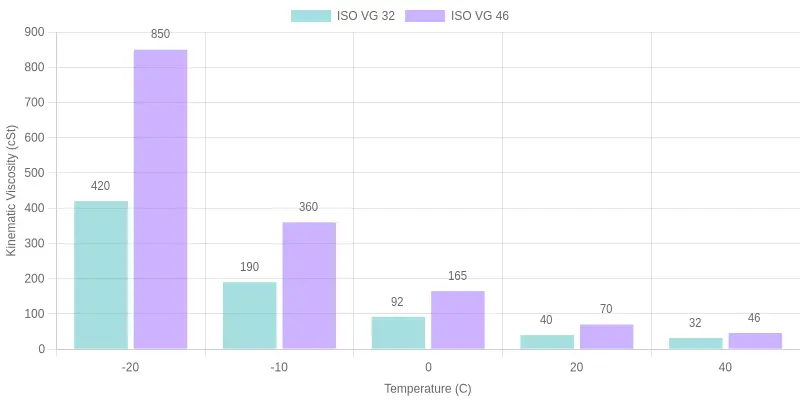
The two bars pull apart as the temperature drops. At 40°C both grades flow freely, but at -20°C, ISO VG 46 thickens to roughly 850 cSt versus 420 cSt for ISO VG 32. That viscosity surge starves the pump on a cold start, causing cavitation, slow response, and wear. Choosing the right grade keeps viscosity in the pump’s safe operating window.
Common Winter Failure Modes
Cold mornings expose weaknesses that warm weather hides. These are the failures to check for first on construction and agricultural equipment.
-
Pump cavitation. Thick, cold oil starves the pump inlet, so the pump pulls a vacuum and forms vapor bubbles that collapse violently against metal surfaces. Over time the pitting erodes the pump and produces the whine operators hear on the first startup of the day.
-
Seal and hose damage. Cold temperatures make rubber seals and hose walls stiff and brittle, so they lose the flexibility needed to absorb pressure spikes. The result is weeping seals, cracked hose covers, and blowouts once the system reaches operating pressure.
-
Valve sticking. High-viscosity oil slows spool movement inside directional and relief valves, and moisture frozen in the bore can lock a valve open or shut. Sticking valves cause erratic circuit behavior and can deadhead the pump before the oil warms.
-
Sluggish actuation. Even when nothing is broken, cold oil resists flow, so cylinders creep and motors lag behind the operator’s command. This delay feels like a fault and often pushes operators to over-throttle, which only increases wear.
-
Filter bypass or collapse. Cold oil struggles to pass through a clogged or overly fine filter element, forcing fluid through the bypass valve or, in severe cases, collapsing the element inward. Either way, unfiltered oil – or a ruptured filter – travels through the system.
In every case the oil’s low-temperature behavior is the trigger. A fluid with the right viscosity index, correct filtration, and a sensible warm-up routine prevents the physical damage cold starts inflict. Operators who treat oil selection as a real winter maintenance decision, rather than an afterthought, keep their machines working instead of parked in the yard.
Warning Signs of the Wrong Cold-Weather Hydraulic Oil
Cold mornings punish marginal fluid choices, and the symptoms show up fast. When a machine is sluggish or noisy on a frosty start, the fluid is usually fighting the temperature instead of doing its job. Watch for these before a hard failure lands the machine in the shop.
- Slow cylinder response – rods that creep, hesitate, or stall on the first lift of the day, then smooth out once the oil warms.
- Whining or groaning pumps – a high-pitched cavitation whine at startup that quiets after the machine runs a while.
- High pressure spikes – relief valves cracking early, jumpy gauge readings, and hoses flexing harder than they should on the first cycle.
- Overheating after warm-up – fluid running hotter than normal because a wrong-viscosity oil cannot shed heat or lubricate efficiently under load.
- Foaming or aerated oil – milky, bubbly fluid in the sight glass, with soft brakes, drifting cylinders, and spongy controls from trapped air.
- Frequent filter clogging – filters loading up far too quickly as waxes and additives drop out of a fluid that is out of spec for the seasonal temperature.
When to Act
Do not wait for a full breakdown. If even two of these signs appear on consecutive cold starts, stop the machine, sample the oil, and confirm whether the current fluid matches the manufacturer’s winter viscosity grade. Fixing the oil early is far cheaper than replacing a scored pump, a burned motor, or a full set of seals.
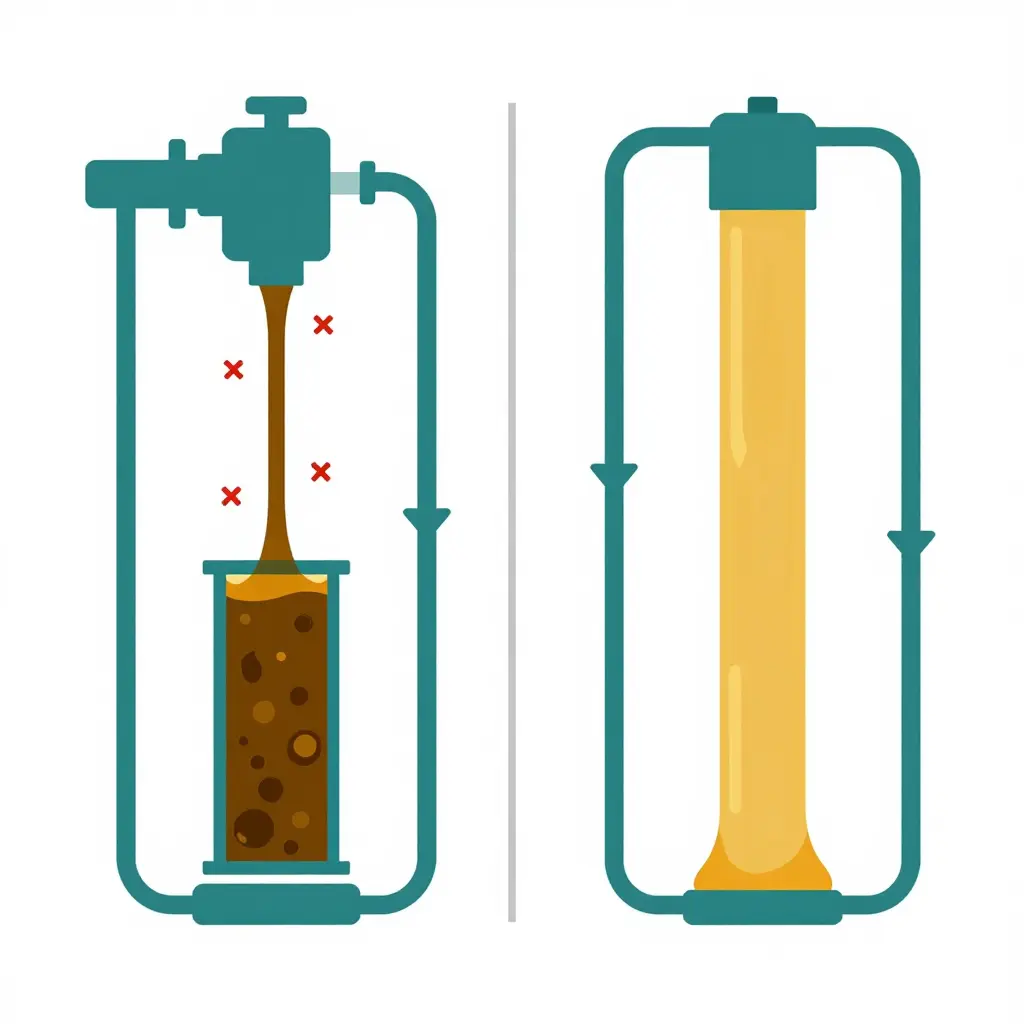
Two identical hydraulic circuits sit side by side. On the left, cold, thick oil struggles through narrow passages – dense droplets, pinched bottlenecks, and short arrows that stall mid-pipe. On the right, the correct low-temperature oil moves through wide, open pipes with long, continuous arrows from pump to cylinder. Same hardware, different behavior, depending on how the oil flows when the temperature drops.
Cold-Start Hydraulic Oil FAQ
Winter raises questions that don’t come up in July. These are the ones operators and maintenance crews ask most often once temperatures drop and machines start refusing to move.
Can you mix different hydraulic oils in winter?
Mixing oils with different base stocks or additive packages can create unpredictable viscosity, foaming, and sludge. In an emergency top-up, use a compatible fluid, but never blend brands as routine practice. When the season ends, drain the system and refill with the correct winter-grade oil rather than leaving the mixture in place.
Does synthetic oil really improve cold starts?
Yes. Synthetic hydraulic fluids hold a more stable viscosity index, so they stay fluid at low temperatures instead of thickening into a gel. That means faster pressure buildup, quicker response at the joystick, and less strain on the pump during the first cold minutes. For machinery that runs in freezing conditions, the wider operating window is usually worth the higher price.
How often should I verify viscosity?
Check viscosity at every seasonal change and any time you suspect contamination or water ingress. If you operate year-round, test quarterly and compare results against the oil’s spec sheet. A quick lab analysis costs far less than a failed pump or a blown seal.
Does warm-up idling actually help?
Only partly. Idling circulates oil and warms it slowly, but a long idle at freezing temperatures burns fuel and barely raises fluid temperature. Cycle the cylinders gently under low load for a few minutes instead, so fresh fluid moves through the entire system before you demand full pressure.
What should I do after a cold-start hydraulic failure?
Shut down immediately, let the system warm before reopening it, and inspect for cavitation damage, aeration, or a collapsed filter. Replace contaminated fluid and the filter before restarting, and source quality replacement engine components if the pump or motor is beyond repair. Document every failure so you can refine your oil selection before the next deep freeze.
The takeaway
Most winter breakdowns trace back to one decision made months earlier: the oil you poured in. Match viscosity to your real operating temperatures, keep testing honest, and the machines will start on the coldest mornings.