
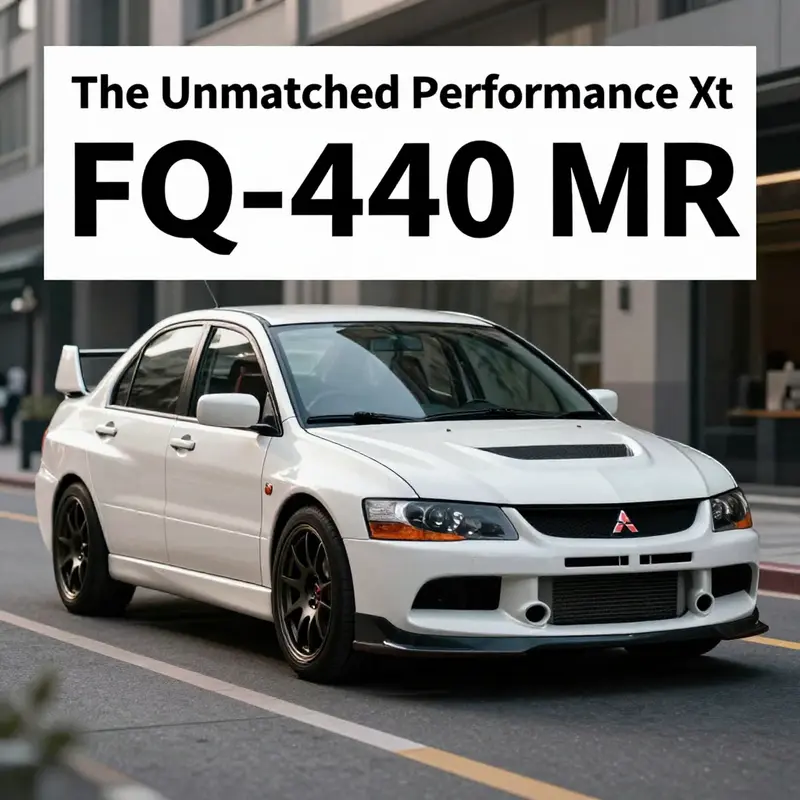
The Mitsubishi Evolution X FQ-440 MR stands as an emblem of automotive excellence and performance engineering. This extraordinary vehicle, acclaimed as the most potent version of the tenth-generation EVO lineup, blends powerful specifications with a limited production model that enhances its desirability among collectors and enthusiasts alike. In this exploration, we will delve into the technical prowess and innovative engineering of this legendary sedan, assess its limited production and market valuation, and celebrate its storied legacy in motorsport. Each chapter will unravel unique aspects of the FQ-440 MR, shedding light on why it captivates car aficionados globally.
null
null
The Final Act of Speed: Unpacking the Evolution X FQ-440 MR’s Limited Run and Lasting Market Value

In the pantheon of Mitsubishi’s performance lineage, the Evolution X FQ-440 MR stands as a ceremonial close to a storied chapter. It is not merely a car with extraordinary numbers; it is a carefully curated manifesto of what the Lancer Evolution era explored and achieved. Born from a desire to celebrate an anniversary and to push the engineering envelope one final time, this model emerged as a clarion call to enthusiasts who understood that rarity is as much a measure of value as horsepower. Its identity rests on a unique confluence of restricted production, European market emphasis, and a specification sheet that reads like a compact manual on high-performance tuning. The result is a vehicle that feels at once like a collectable sculpture and a true high-performance machine, a combination that explains why it continues to command attention and a premium in today’s market.
The essence of the FQ-440 MR is found in its calibrated ambition. The engine remains a 2.0-liter turbocharged four, but the tune carries the essence of a racing mindset. The factory rating of 440 horsepower, unleashed at 6800 rpm, coupled with a torque peak of 559 newton-meters, is not merely about top-end speed. It is about the orchestration of boost, response, and throttle feel that makes every drive a concentrated session of focus. The engine breathing through a larger HKS turbocharger, an upgraded intercooler, and a reprogrammed ECU tells a story of maximal efficiency under the stress of real-world road and track conditions. Each component has been selected and tuned to work in harmony, so the car behaves with a measured ferocity rather than a blunt instrument. The MR designation, standing for Mitsubishi Racing, signals not just limited production but a narrative of track-tuned intent that carries the silhouette of a rally heritage into a road-going environment.
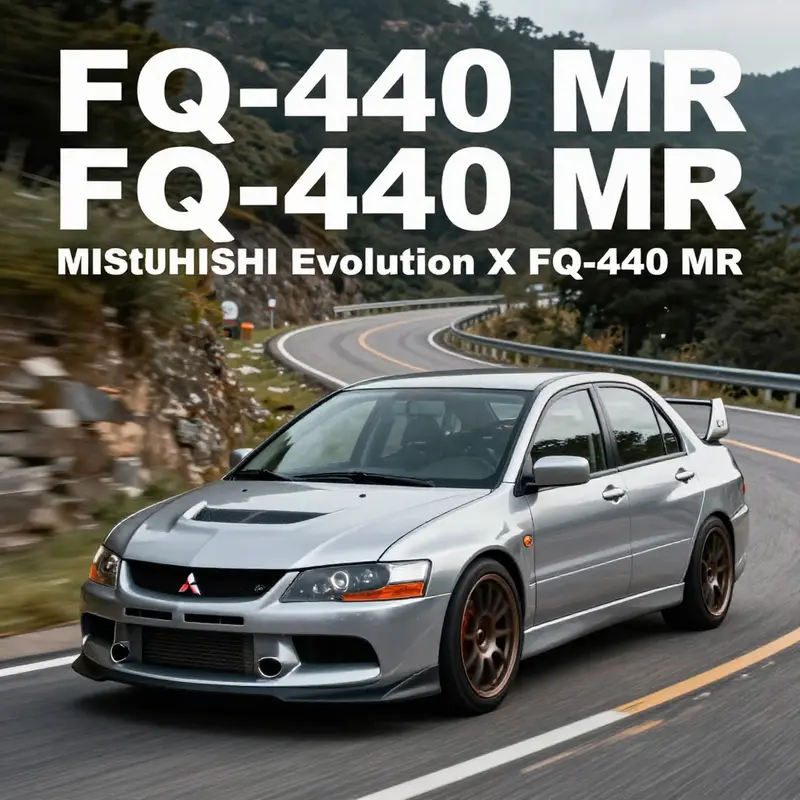
To those who have studied the Evolution lineage, the FQ-440 MR is less about chasing raw numbers than about the integration of performance with the car’s chassis dynamics. The suspension, prepared by Eibach, sits in a mode that combines supple compliance with firm, track-ready precision. The brakes, supplied by Alcon, are described in the collective memory as bite-first and unflinching, capable of repeated hard stops without the fade that would plague lesser machines when pushed toward the edge. When wrapped around the factory 18-inch forged aluminum BBS wheels, the chassis delivers a level of grip and stability that feels almost surgical. The result is a driving experience that can be both forgiving on a fast road and demanding in a time-attack scenario, a duality that has become a hallmark of the Evolution’s broader reputation.
The exterior design—often rendered in Frost White and accented by xenon lighting—speaks to a restrained, disciplined aesthetic. It does not chase flamboyance; it elevates refinement with a measured, almost austere, air of competition. This is a car that does not require loud graphics or theatrical wings to announce its purpose. The visual vocabulary remains coherent with the performance blueprint: a body that breathes cleanly, an air intake that annuls heat and pressure, and a silhouette that communicates aerodynamic purpose rather than mere speed. The interior follows suit with a driver-centric environment where the instrumentation aligns with the tactile realities of high-performance driving. The seating, the layout, the texture of materials—all contribute to a cockpit that rewards precise inputs and sustained focus. In many examples, owners report a sense of intimacy with the car, a feeling that you are not merely piloting a machine but having a meaningful dialogue with a finely calibrated instrument.
One facet that often surfaces in discussions around the FQ-440 MR is the degree of modification that can be found in the wider Evolution ecosystem. Some early-tuned variants pushed horsepower to levels near or above 480, a testament to the car’s robust base architecture and the willingness of aftermarket developers to explore the outer edges of performance. In these contexts, the FQ-440 MR is sometimes cited as a benchmark—a baseline of purity from which further enhancements could be measured. Yet the stock configuration, with its integrated Alcon braking and Eibach suspension, already speaks to a balanced philosophy: you do not need to chase the last few horsepower to experience a car that feels focused, purposeful, and emotionally honest behind the wheel.
From a market perspective, the rarity of the Evolution X FQ-440 MR is the element that anchors its lasting value. Only 40 units were produced, a number that instantly nudges the model into the realm of highly sought-after collectibles. Rarity is not merely about scarcity; it is about a confluence of provenance, originality, and condition that investors and enthusiasts weigh with careful consideration. In recent years, well-preserved examples have achieved substantial price levels, often ranging from mid to high six figures in USD terms, depending on factors such as mileage, documented maintenance, originality of components, and the presence of original parts and documentation. The market recognizes that there is a finite window in which such a car can be acquired in a condition that would later be deemed truly “as-delivered,” and those who secure a car in a near-perfect state are often rewarded by not just performance nostalgia but the possibility of a meaningful appreciation in value over time.
The historical significance of this limited run extends beyond price alone. It is widely acknowledged in collector circles that the Evolution X FQ-440 MR represents the culmination of Mitsubishi’s rally-informed engineering philosophy at a moment in time when the brand was consolidating its performance identity on Europe’s roads and circuits. The European market, in particular, is a focal point in the model’s narrative; the edition was crafted and marketed with the context of a 40-year commemoration in mind, underscoring a milestone not just for the car itself but for the relationship between a manufacturer and a vibrant, performance-seeking audience. This connection to a concrete anniversary elevates the model beyond mere performance to a story about heritage and memory, about a car that embodies a closing note to a long, successful chapter in Mitsubishi’s performance saga. In that sense, the FQ-440 MR is more than a high-powered commuter with a race-bred heart; it is a symbol of an era’s end and a ceremony for enthusiasts who value both engineering discipline and the romance of limited-edition collectibility.
For collectors and historians, the valuation conversation often includes a consideration of provenance. A well-documented history—showing care records, service stamps from reputable workshops, and a compelling lineage of ownership—can elevate a car from an excellent example to a storied artifact. The FQ-440 MR is particularly sensitive to these aspects because its rarity means that every background detail can meaningfully influence perceived authenticity and desirability. Enthusiasts frequently seek cars with close to or under-30,000 miles, complete with two things: a clear maintenance history and a coherent chain of ownership that can be traced back to the original importer or the European market introduction. When such documentation accompanies the car, it enhances the narrative value of the vehicle, making it not only an object of desire but a credible ambassador of Mitsubishi’s technical ethos during the era of the Evolution’s peak performance.
Within the broader story of the Evolution lineup, the X variant sits at a crossroads. It is not merely the latest in a long line; it is a deliberate, almost ceremonial capstone that respects the model’s rally roots while acknowledging the evolving safety, emissions, and market expectations of a changing automotive world. The result is a vehicle that, even as it represents a highly specialized form of speed, remains remarkably usable on a daily basis. The idea of a car that can serve as both a weekend track weapon and a practical road car for someone who wants a highly capable, exclusive machine makes it particularly appealing for those who want a tangible link to a celebrated era of performance engineering.
In terms of consumer perception, the FQ-440 MR occupies a space similar to other ultra-limited editions from the same period: coveted, sometimes misunderstood in terms of day-to-day practicality, yet unmistakably authentic upon closer inspection. The car’s technical sophistication—an evolved turbocharged engine, reinforced intake and exhaust pathways, and electronics that are tuned to extract maximum potential without compromising reliability—speaks to a buyer who values engineering honesty. The chassis work—reflecting a balance of grip and feedback that translates into confidence for both the road and the track—speaks to drivers who want to feel connected to the process of speed rather than simply experiencing it as an abstract concept.
As the automotive market continues to mature, the chapter closed by the Evolution X FQ-440 MR gains new meaning. It is not just a rare model with impressive numbers; it is a narrative device that helps explain why limited editions hold their value, how provenance and condition converge to shape perception, and why the discipline of engineering can become a form of artistic expression. The car’s value is not a static figure but a story path—one that traverses the original engineering intent, the period’s market dynamics, and the evolving appreciation that collectors bring to the table as we move further away from the era that birthed the familiar sound of a turbocharged four on a winding road. This is the essence of its appeal: a vehicle that carries weighty history in its doors, performs with restraint and precision on the road, and remains a living reminder of the performance culture that defined a generation.
For readers who want to explore the current market landscape and perhaps locate a low-mile example that preserves the integrity of the original build, a practical starting point is the availability of preserved units advertised for sale. Such listings offer a glimpse into the present-day demand and the kind of buyer who sees the FQ-440 MR not only as a car but as a heritage asset. When examining these opportunities, it is useful to consider the condition of key components, the extent of any non-factory modifications, and the thoroughness of the accompanying provenance paperwork. Each of these factors contributes to the overall narrative of the car and its potential as both a driver and an investment, a dual role that makes the FQ-440 MR a unique phenomenon in the contemporary collector market.
In closing, the Evolution X FQ-440 MR stands as a rare paradox: a car that is simultaneously a weapon of performance and a museum-piece of engineering heritage. Its limited production run, targeted European heritage, and a tuned specification that begs meticulous respect have solidified its status as a milestone in automotive history. The model’s enduring appeal lies in the way it crystallizes a moment when speed and craftsmanship intersected with scarcity, creating a vehicle that is as much about the story of a performance era as it is about the thrill of driving. This is the final act of speed in Mitsubishi’s Evolution narrative—a performance-oriented tribute that remains compelling, collectible, and fundamentally human in its pursuit of refinement through controlled, purposeful power. For enthusiasts and scholars alike, the FQ-440 MR offers a compact, credible lens through which to view the evolution of high-performance homologation and the emotional resonance that limited-edition machines can evoke.
Internal link: for a glimpse into the current availability and a sense of how these cars are presented to collectors today, see the listing described as low-mile Evo X FQ-440 MR for sale. This example or its peers provide a practical snapshot of how the market translates rarity into opportunity while preserving the car’s original character: low-mile Evo X FQ-440 MR for sale.
External reference for authoritative details on the model’s specifications and archivial context can be found here: https://www.mitsubishimotors.eu/evolution-x-fq-440-mr
Mitsubishi Evolution X FQ-440 MR: Rally-Bred Precision on a Limited Stage
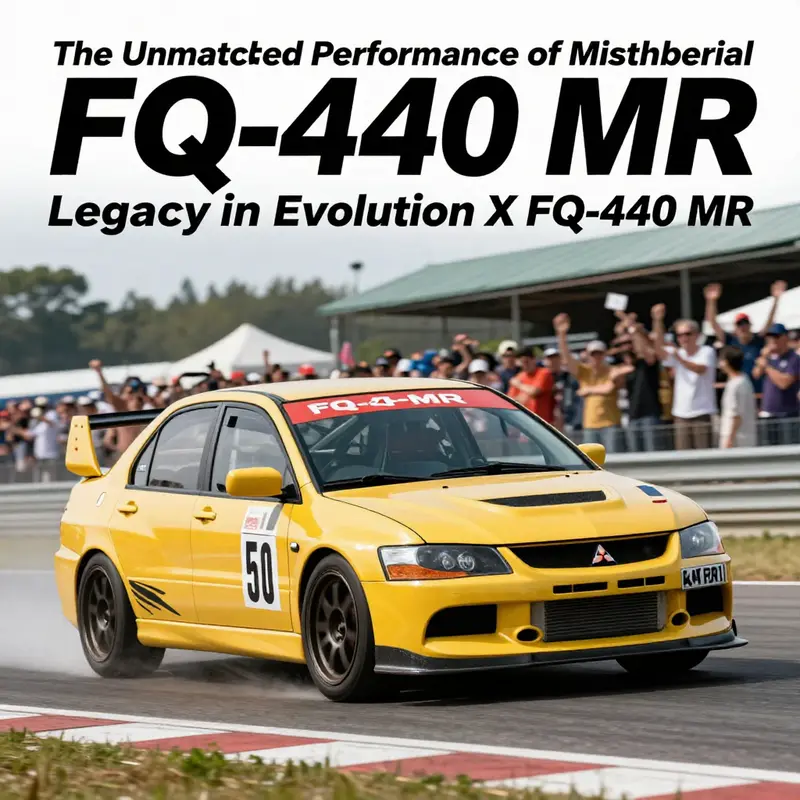
The Evolution X FQ-440 MR is Mitsubishi’s rally heritage distilled into a road car. A 2.0-liter twin-turbo inline-four sits at the heart of the machine, delivering a controlled surge that rewards smooth inputs and precise line work. The MR designation signals a weight-saving program: carbon fiber panels, a stiffer chassis, and a suspension tune that favors agility over opulence. All-wheel drive and a calibrated torque split keep the front wheels faithful to the steering while the rear helps the car rotate through corners with a confident balance. Braking is matched by an Alcon setup, and forged wheels with a light contact patch keep unsprung mass down for sharper response. The result is a car that feels purpose-built for stages yet comfortable on public roads. Collectors prize its scarcity and the sense that owning one preserves a moment when Mitsubishi translated rally DNA into a limited, track-ready street machine.
Final thoughts
The Mitsubishi Evolution X FQ-440 MR is more than just a car; it represents the pinnacle of performance engineering, limited availability, and a rich legacy in motorsport. For business owners and enthusiasts alike, this remarkable sedan serves as a testament to Mitsubishi’s commitment to innovation and excellence. As such, investing in this vehicle may not only provide unparalleled driving experiences but also significant market value retention. The FQ-440 MR stands as a shining example of what high-performance automobiles can achieve, blending rarity and performance into an exquisite package.