

The Mitsubishi Lancer Evolution X, or Evo X, is not just a car; it’s a powerful statement in automotive engineering. At the heart of this iconic vehicle lies the 4B11T engine, a turbocharged powerhouse that sets new standards for performance, reliability, and advanced technology. Understanding the intricate features, specifications, and maintenance of the Evo X’s engine is essential for any business owner looking to optimize performance or invest wisely in automotive engineering. In the chapters that follow, we will explore the performance features of the Mitsubishi Lancer Evolution engine, delve into its technical specifications, and provide essential insights on maintaining it using genuine OEM parts.
Turbocharged Heritage: From the 4G63T Legend to the 4B11T Powertrain in the Lancer Evolution

The Mitsubishi Lancer Evolution has always been more than a compact sedan with a high-performance badge. It is a living chronicle of engineering decisions made under pressure, tuned to rally stages, race circuits, and everyday roads where the driver expects instant response and unshakable reliability. At the heart of that chronicle lies the engine—the fiery core that translated Mitsubishi’s racing know-how into a production car that could be trusted at the limit. Across generations, the Evolution’s powertrain tells a story of evolution itself: a lineage that began with the 4G63T’s turbocharged roar and evolved into the 4B11T’s modern sprint, all while maintaining the same core passion for high revs, precise control, and durable construction. This chapter looks at that journey, tracing the performance features that defined each era and showing how the engine became the driving force behind the Evo’s rally persona and its street cred alike.
The early chapters of the Evolution story are inseparable from the 4G63T engine family. In the EVO III, introduced in the mid-1990s, Mitsubishi raised the bar with a larger TD05H-16G6-7 turbocharger. The result was an impressive leap in boost and airflow, pushing power outputs to around 270 horsepower (273 PS) and delivering substantial torque early—about 31.5 kg·m (309 Nm) at 3,000 rpm. This was more than a simple upgrade; it represented a strategic shift toward a more aggressive, race-ready character. To cope with the elevated cylinder pressures generated by forced induction, internal refinements followed closely. Forged pistons and an increased compression ratio of 9.0:1 were adopted to optimize the combustion process, balancing peak performance with reliability under sustained high-RPM operation. In that era, the chassis and the drivetrain were already being pushed toward the edge, and the engine’s robustness laid the foundation for a machine that could be driven hard on long events and still survive.
The 4G63T’s enduring legacy rests not only in its boosted power, but in the holistic engineering that supported it. The cast-iron block, paired with an aluminum cylinder head in many variants, offered a robust base capable of withstanding the heat and stress of rally duty. This combination proved to be a winning formula for durability and heat dissipation, enabling consecutive generations of Evos to be pushed to the limit. A crucial part of that durability was the drivetrain’s tuning philosophy—an approach that emphasized a strong torque band, smooth throttle response, and predictable behavior as boost rose and the engine came on cam. The result was a highly adjustable platform that tuners could refine with fuel delivery, ignition timing, and boost management to unlock additional performance without sacrificing reliability.
Even then, the Evo’s engine was not static. Performance engineering gradually introduced technologies designed to extend power across the rev range. MIVEC, Mitsubishi’s variable valve timing system, would become one of the more transformative technologies in the Evolution family, arriving with the Evo VII. MIVEC allows the engine to shift its valve timing electronically, extending useful torque at low and mid RPM while preserving top-end power at higher revs. The net effect is a broader, more controllable torque curve—one that makes the car feel lively from a standstill and eager to surge toward redline when the driver asks for it. Throttle response improves, feel remains linear, and the engine seems to harness more of the turbo’s energy without the harshness that sometimes accompanies aggressive boost. The presence of MIVEC on the later generations also underscores a broader engineering philosophy: that peak power alone does not define performance, but the way the engine breathes across the entire RPM spectrum does.
All the while, the Evo’s powertrain remained a finely tuned balance between forced induction, mechanical strength, and electronic control. Drivers could exploit a flexible, high-boost setup while knowing the fundamental parts—pistons, connecting rods, and the crankshaft—were engineered to work in concert with the turbo, the intercooler, and the fuel and ignition systems. This synergy is what allowed the Evolution to excel on gravel and tarmac alike. It also explains why Mitsubishi placed such emphasis on durability when the era of aftermarket tuning surged forward. The engine’s core design invited modification, yet it insisted on reliability for daily use and race-day discipline. The Evolution’s fans learned early that success meant more than peak horsepower; it meant a well-rounded package where the engine’s performance was matched by chassis balance, drivetrain sophistication, and the ability to recover quickly from a momentary misstep.
Those early experiences laid the groundwork for the modern engine that would define the Evo X era: the 4B11T. Moving to a 2.0-liter liquid-cooled, inline-four, the newer architecture retained the turbocharged impulse that drove the Evolution line but adapted it to a different set of performance objectives. The 4B11T employs a single, compact turbocharger—traditionally a Garrett unit with a robust intercooler—that feeds a modern intake and exhaust flow path designed to deliver strong response at lower RPM while preserving top-end momentum. The displacement remains close to two liters at 1998 cc, maintaining a tight balance between performance and efficiency, and the DOHC, 16-valve configuration continues to favor a high-revving character that enthusiasts came to expect from Mitsubishi’s turbocharged four-cylinder strategy.
What sets the 4B11T apart within the Evo X’s architecture is not merely the numbers, but how the engine integrates with the car as a total performance system. The 4B11T’s power output sits in the neighborhood of 291 horsepower (217 kW) at 6,500 rpm, with torque peaking near 3,500 rpm at about 295 lb-ft (400 Nm). Those figures reflect a modern tuning approach that favors an efficient, broad torque band rather than a single peak. The fuel system’s sequential multi-port injection ensures precise metering across operating conditions, while the MIVEC system continues to enable flexible valve timing. The result is a powertrain that can deliver explosive acceleration when the boost comes on, yet remains tractable during street driving or fast highway cruising. Importantly, the engine’s high-rev potential is preserved, enabling the Evo X to stay responsive as the tachometer climbs toward its redline and the turbocharger continues to spool under load.
In this modern chapter, the engine’s durability remains a central virtue. Mitsubishi designed the 4B11T to handle the sustained boosts and high RPMs demanded by rallying and track days while also accommodating a broad spectrum of driving styles. That durability is underwritten by components engineered to tolerances that ensure reliability when subjects like high boost pressures and rapid, repeated throttle changes test the engine’s mettle. Forged or enhanced internals, reinforced crankshaft materials, and precision-built connecting rods all contribute to a powertrain that can tolerate the rigors of high-performance operation. In practice, owners who participate in spirited driving or competitive events often seek OEM parts or carefully selected high-grade components to maintain exact factory specifications while pushing the engine closer to its mechanical limits. In the long run, maintaining that precise balance between performance and reliability depends on treating the engine as a complete system, not a collection of isolated performance pieces.
One of the practical considerations that underpins the Evo X’s engine viability is its compatibility with an advanced all-wheel-drive system and sophisticated control architectures. The Super All-Wheel Control (S-AWC) setup coordinates torque distribution, stability control, and braking intervention to keep the car planted during cornering and on variable surfaces. In that sense, the engine’s output is not an isolated attribute; it is the core input to a dynamic drivetrain that actively manages power delivery. The 4B11T’s torque curve, its responsiveness to throttle input, and the turbo’s response all feed into a system that can adapt to different driving modes and surface conditions. For enthusiasts who want to push the engine further, there is a continuity of engineering thought that links the block, the heads, and the turbo with the sensors, actuators, and electronic control units that govern everything from boost pressure to valve timing.
For those who are curious about strengthening the lower end to support higher boost or more aggressive tuning, options exist to upgrade the engine’s structure without compromising its design philosophy. A practical example is the availability of specialized engine blocks and related components designed to withstand increased stress from boosted operation. A representative example in the community is the 4B11T billet block development, which illustrates how a modern engine platform can maintain a factory feel while offering an extra margin of rigidity for demanding applications. The idea is not to replace the entire architecture but to reinforce critical areas where stress concentrates during high-load operation. In discussions with engineers and enthusiasts, the emphasis is always on preserving the precise tolerances and fitment that ensure reliable operation with the car’s electronics and the AWD system. When coupled with careful calibration of fuel delivery and ignition timing, the result is a package that preserves the Evo’s character while enabling more aggressive performance for track work or competitive events.
The evolution from the 4G63T to the 4B11T also tells us something about how the engine’s design priorities shifted over time. The earlier engines leaned on robust mechanical strength and a high-revving nature to deliver performance through a multi-faceted approach: turbocharged airflow, forged internals, and a defined peak power range. The 4B11T, by contrast, integrates more advanced electronic control, refined valve timing via MIVEC, and a modern fuel-injection strategy to achieve a broad, usable power band and a drivetrain that can exploit that power with confidence. It is not a single tech breakthrough; it is a continuity of Mitsubishi’s engineering ethos—one that values precision, balance, and a willingness to evolve in step with turbocharger technology, intercooling efficiency, and electronic control capabilities.
The engine’s performance features—turbocharged power delivery, high-compression discipline in earlier generations, and the later integration of MIVEC—combine to produce a living performance character. The 4G63T offered a raw, visceral response with a strong midrange and a willingness to rev, traits that rally drivers prized for tempo and momentum. The 4B11T continues that legacy by delivering rapid throttle response and robust torque across a broad RPM band, accompanied by electronic tuning that makes the engine more adaptable to different driving contexts. In both cases, the engine’s essence is its ability to feel alive at the edge. The turbo spools with a characteristic whine, the intercooler cools the intake charge, and the pistons, rods, and crank handle the mechanical demands with a balance that has earned the Evolution its reputation for reliability at speed.
From a technical standpoint, the evolution of the engine also reveals a broader shift in automotive engineering: the move from a purely mechanical performance model to a system that integrates mechanical prowess with electronic finesse. The early Evo generations demonstrated what a robust turbocharged four could do when the mechanicals were well conceived and the boost well managed. Later generations showed how electronic control could extend that performance envelope without sacrificing driveability. The result is a family of engines that, while different in architecture, share a common goal: to empower a chassis that can exploit power with balance, precision, and control. That balance has made the Lancer Evolution a benchmark for performance compact sedans and a source of enduring fascination for engineers and drivers alike.
In practical terms, owners who want to keep pace with the Evo’s reputation understand the importance of matching maintenance and upgrades to the engine’s design philosophy. Genuine OEM parts help preserve the calibration between engine management, fuel delivery, and the all-wheel-drive system. They ensure that sensors, actuators, and control units remain aligned with how the engine breathes, how boost is delivered, and how the ECU interprets load and throttle input. In a performance context, where every twist of the throttle is weighed against the car’s response, reliability is not a luxury—it is a prerequisite for confidence on the track and in the street. Keeping the engine tuned to factory specifications, or carefully upgrading with components that are designed to work within those specifications, helps ensure that the Evo’s performance remains consistent over time, preserving the car’s reputation for both speed and durability.
For readers who want to explore more about the specific hardware that underpins the 4B11T’s capabilities, a practical avenue is to examine the billet-block options that have emerged as part of the engine’s evolution. These components, engineered for greater rigidity and improved resistance to boost-induced stress, offer a tangible way to raise the performance ceiling without changing the fundamental architecture. In the context of responsible modification, such options are best pursued with a clear understanding of how the revised block interacts with the rest of the engine’s ecosystem—fuel, ignition, turbocharger, intercooler, and the ECU—so that the engine’s timing and fueling remain harmonized with the revised structural characteristics. The interplay between hardware and calibration remains at the heart of successful upgrades, and it is a reminder that the Evolution engine, over its long arc, is a study in precise balance as much as raw power.
As the Evo lineage continues to be celebrated by enthusiasts and collectors, the engine remains a central thread tying the cars’ history to their future. The 4G63T’s roaring performance and the 4B11T’s modern, refined powertrain both illustrate Mitsubishi’s commitment to building engines that are equally capable on a rally stage and a city street. The chapter of the Evolution engine is not simply about horsepower numbers; it is about how those numbers are earned through a combination of turbocharged airflow, resilient internals, and electronic control that makes the car feel instantaneous, confident, and alive when the driver asks for more. In this light, the engine emerges not merely as a component but as the living heart of a car that has become a legend in its own right—a symbol of engineering courage, relentless refinement, and a relentless pursuit of speed that remains relevant to this day.
Further reading and deeper technical context can be found in official engine technology resources that map the evolution of the Lancer Evolution’s powerplants and explain how modern control strategies interact with high-performance hardware. For those who want to see how engine technology for the Evo family has matured, the external overview provides a broader look at how such advancements fit into the larger story of Mitsubishi’s engineering approach. If you’re curious about even more technical insights, the linked external resource offers a concise, authoritative foundation for understanding the engine’s development and its impact on performance and reliability across generations. Additionally, for enthusiasts seeking a concrete upgrade path or a deeper dive into component-level strengthening, the 4B11T billet block offers a tangible example of how modern performance tuning can push the boundaries while staying faithful to the platform’s core design principles. The engine’s history, with its blend of turbocharging, valve timing innovations, and robust construction, remains one of the most compelling narratives in performance engineering.
Internal link: For enthusiasts curious about reinforcing the 4B11T block and pursuing higher boost tolerance with a billet solution, explore the 4B11T billet block offering here: 4B11T billet block.
External resource for further technical context: Mitsubishi Engine Tech Overview.
Heart of the Rally: The Engine That Forged the Mitsubishi Lancer Evolution Legend

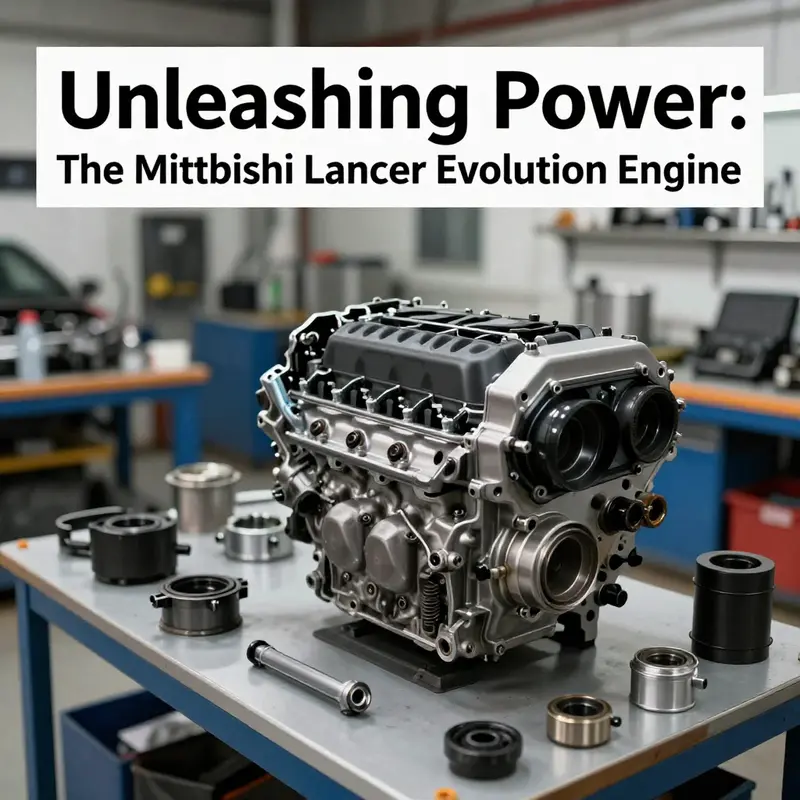
Power, revs, and reliability have long defined the Evolution’s engine. The heart is a compact, turbocharged inline-four that blends high rpm capability with durability to survive rally sampling and track duty. From the early 2.0-liter 4G63-derived units to modern variants, the engine family emphasizes a strong bottom end, efficient turbocharging, and precise engine management. Each generation refined cooling, fueling, and valvetrain control to deliver a broad torque curve and responsive throttle. The result is a powerplant that can sprint on demand yet remain tractable during long endurance events, with a synergy between engine performance and the all wheel drive system that keeps grip predictable. In short, the Evolution engine is the rally bloodline that makes every corner a test and every straight a possibility.
null
null
Final thoughts
Understanding the Mitsubishi Lancer Evolution X engine is crucial for maximizing its potential, whether for business use or personal enjoyment. With a focus on performance features, precise technical specifications, and the importance of using OEM parts for maintenance, business owners can appreciate the engineering excellence that drives this iconic vehicle. Such insights not only aid in making informed decisions regarding investments and repairs but also contribute to the longevity and performance of the Evo X. Investing in quality solutions ensures that the powerful drive of the Lancer Evolution continues to impress on the road and track alike.