
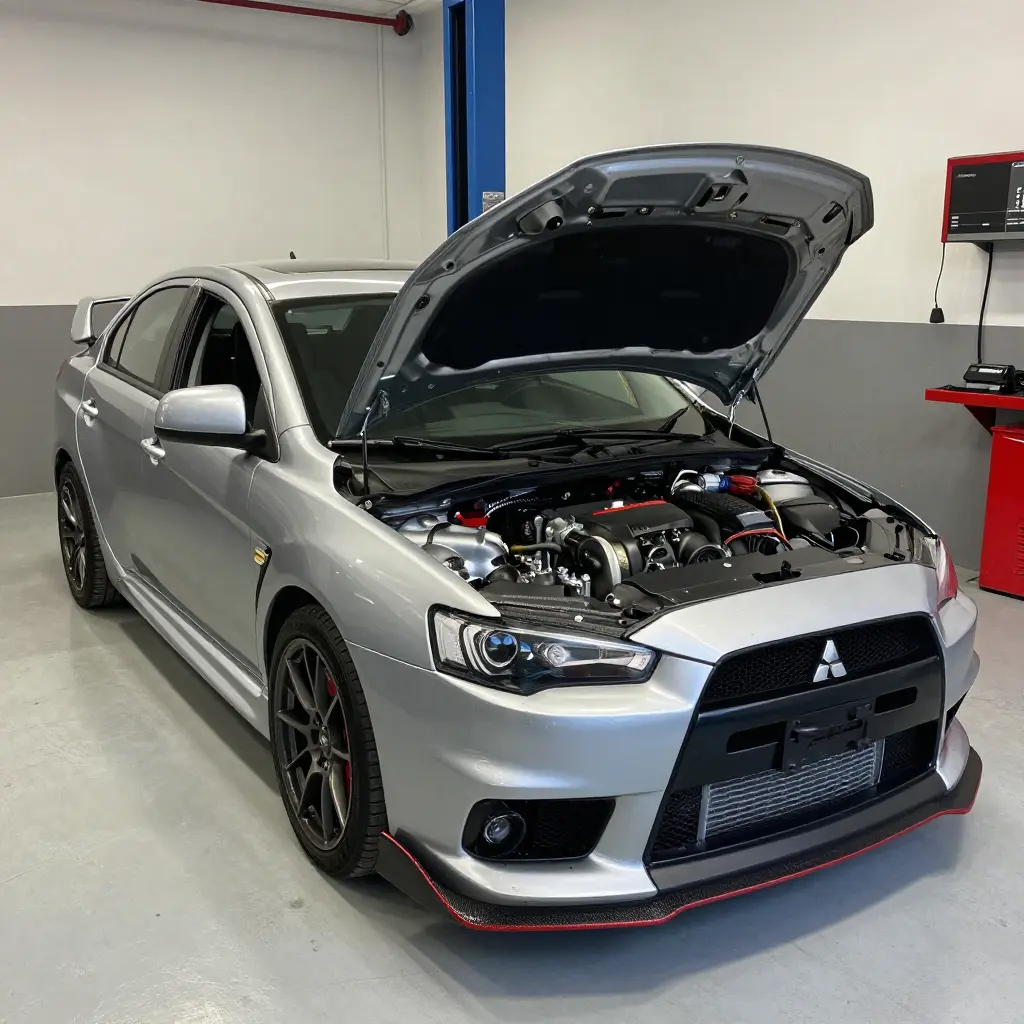
Why a 25,000-Mile Evo X GSR Rewards Maintenance-First Thinking
The 2015 Lancer Evolution X GSR was the last of Mitsubishi’s turbocharged all-wheel-drive cars, and even a garage-kept example with just 25,000 miles needs more than occasional oil changes to stay healthy. Under the hood sits a turbocharged 2.0-liter inline-four, the 4B11T, bolted to a five-speed manual transmission and feeding the S-AWC (Super All-Wheel Control) system. Those parts are what make the GSR what it is, and they also decide where the maintenance money goes.
On a low-mileage Evo X GSR, S-AWC fluid condition and clutch wear matter more to long-term reliability than the turbo does. The 4B11T is durable when it gets clean oil and sane boost levels, so it rarely becomes the problem. The all-wheel-drive hardware is what ages: the rear differential clutches, the AYC pump, and the transfer case all live or die by fluid discipline, and heat cycles and stop-and-go driving take a toll. Treat the 25,000-mile Lancer Evolution X GSR as a complete system rather than an engine, and the ownership math changes.
The S-AWC System: Where the Evo X’s Advantage Comes From
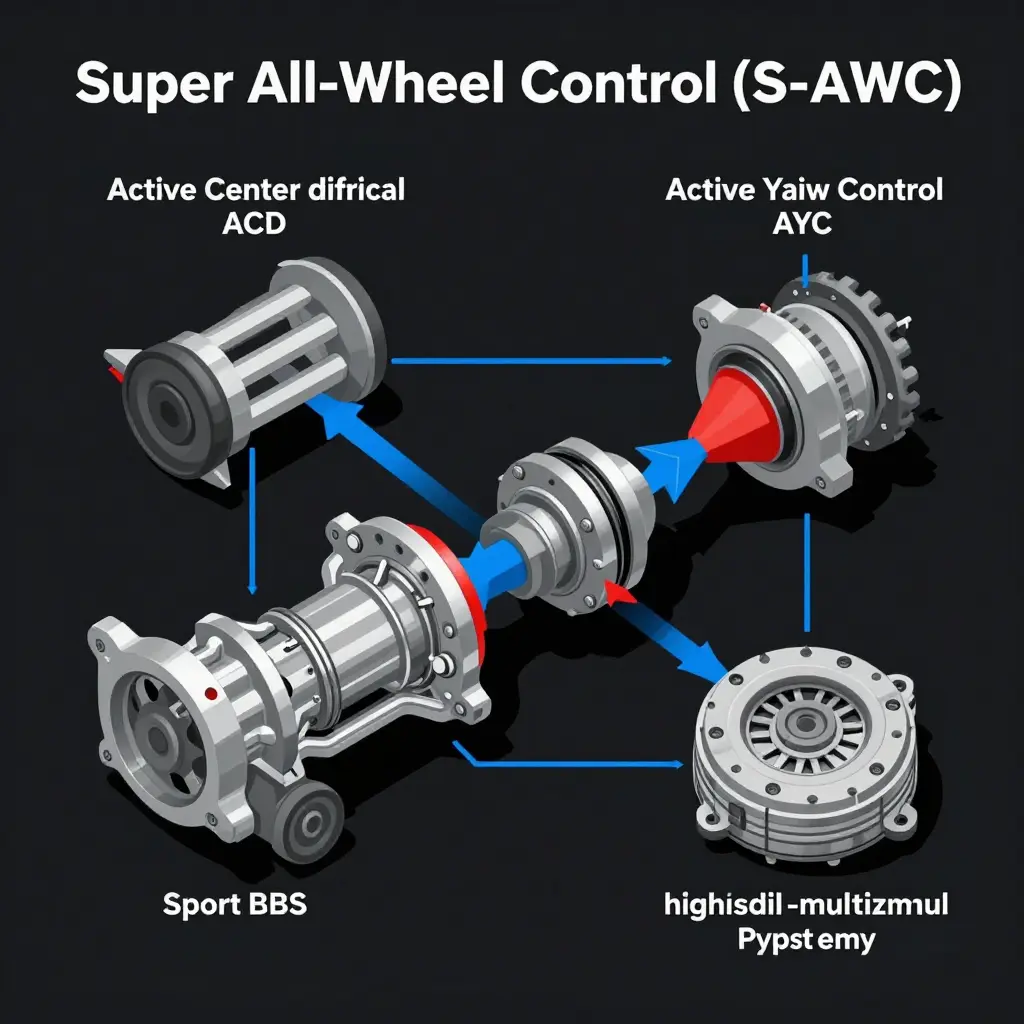
Open the hood of an Evo X and your eye goes straight to the turbo. That is the wrong place to look. What separates the car from other 291-hp sport sedans of its era is the Super All-Wheel Control (S-AWC) system, a drivetrain that decides where torque should go, wheel by wheel.
Four Systems, One Brain
S-AWC is not one part. It is several subsystems that talk to each other constantly:
- Active Center Differential (ACD) – an electronically controlled multi-plate clutch that varies how much torque flows front to rear instead of locking to a fixed split.
- Active Yaw Control (AYC) – the rear torque-vectoring unit, using a hydraulic multi-plate clutch pack to shuffle torque between the left and right rear wheels and rotate the car into a corner.
- Sport ABS – an aggressive anti-lock calibration that can brake individual wheels and sharpen turn-in.
- Hydraulic multi-plate clutch packs – the mechanical parts that actually execute every ACD and AYC command.
The Trade-Off: Constant Torque Distribution Costs Something
Continuous torque distribution to all four wheels helps grip, but it costs something. Those clutch packs slip and shear on every mile, and they need clean, correctly specified S-AWC fluid to move torque without chatter or heat buildup. The harder you drive, the faster the fluid breaks down and the clutch material wears.
Why Fluid and Clutch Health Beat Raw Boost
A tired turbo makes less power. A tired S-AWC system makes the car unpredictable. Degraded fluid means lazy Active Yaw Control response, hunting ACD behavior, and a car that suddenly pushes wide or snaps where it once felt telepathic. For drivability and safety, a proper fluid service and fresh clutch packs matter more than another 30 horsepower.
If you own one of these cars, understanding the S-AWC-equipped Evo X GSR platform is the first step toward keeping that behavior intact.
S-AWC Fluid Degradation and Service: The Wear Item Nobody Tracks
Evo X conversations drift to the turbo, the 4B11T, the boost threshold. The part that costs owners real money is under the car: the fluid that makes Super All-Wheel Control work. It is not a glamorous service item, but on a 25,000-mile 2015 Lancer Evolution X GSR it is the most time-sensitive fluid on the car. It degrades with heat, mileage, and time, and the damage it does when ignored shows up as ACD and AYC repairs.
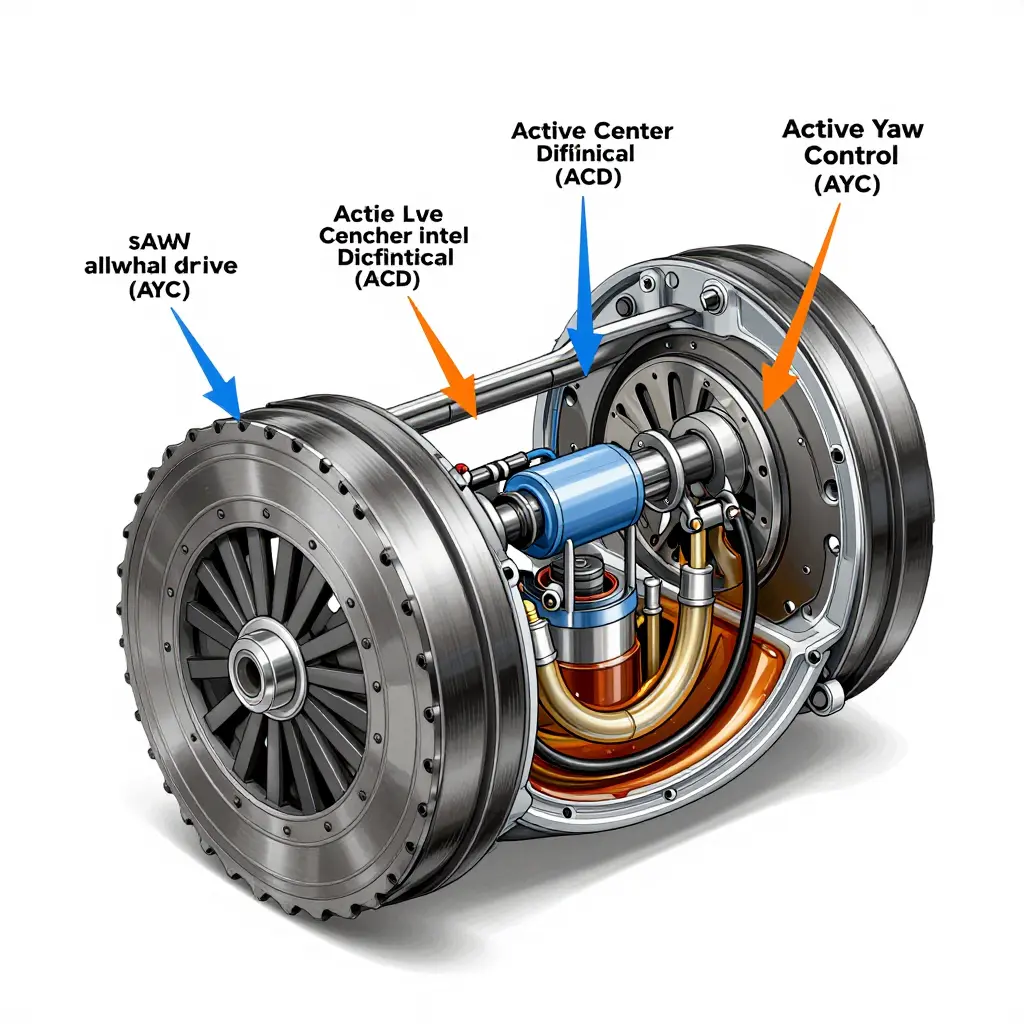
The Fluid Does Two Jobs, and Both Are Abusive
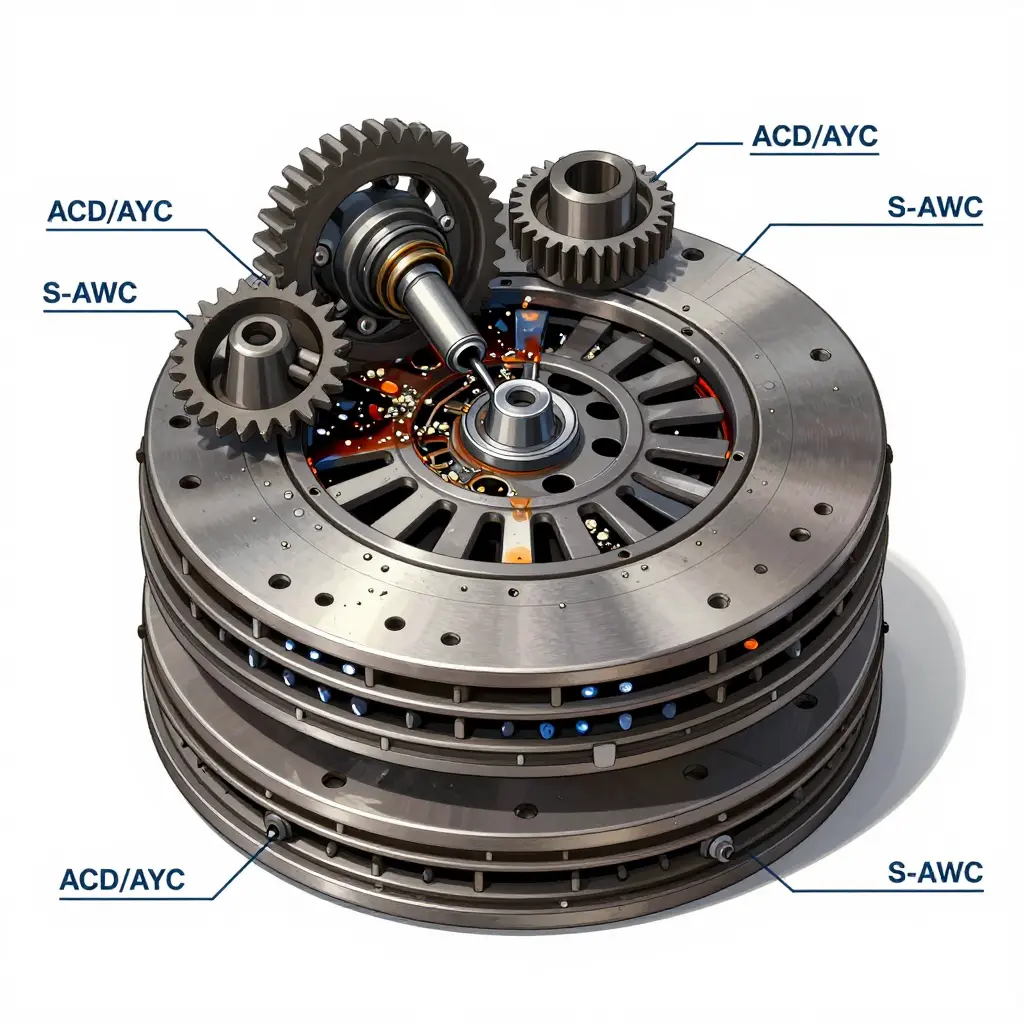
The ACD (Active Center Differential) and AYC (Active Yaw Control) units are hydraulically actuated clutch-pack assemblies. The fluid inside them does two things at once: it is the hydraulic pressure medium that clamps the clutch packs and the friction and cooling medium that keeps those same plates from welding themselves together. Every torque transfer event, whether a hard launch, a mid-corner throttle adjustment, or a wet-weather correction, slips a clutch plate and sheds a thin layer of friction material into the oil. The fluid is a consumable by design, and the wear goes with it.
How S-AWC Fluid Breaks Down
Three things happen at once, and they compound each other.
- Heat. The ACD/AYC pump builds serious hydraulic pressure, and every clutch engagement converts slip into thermal energy. Sustained canyon runs or repeated track sessions push fluid temperatures well past what a commuting Evo X ever sees. Heat shears the long-chain viscosity modifiers and accelerates oxidation, thinning the fluid and weakening its film strength just when the pump needs a predictable pressure response.
- Contaminant buildup. As clutch plates wear, they release fine friction material and metallic fines. Those particles do not disappear. They circulate through the hydraulic circuit, abrade valve bodies, lodge in the pump’s filtration, and act as an abrasive slurry on the very clutch surfaces producing them. A darkened, gritty sample is the signature of an overdue service.
- Time and moisture. Even a garage-kept Evo X degrades its S-AWC fluid by sitting. Oxidation, condensation, and additive depletion occur regardless of mileage. A 25,000-mile car that has been stored intermittently can have older, more oxidized fluid than a 40,000-mile daily driver.
| Degradation Driver | What Happens to the Fluid | Real-World Trigger |
|---|---|---|
| Heat | Viscosity loss, additive breakdown, oxidation | Track days, repeated hard launches, summer traffic |
| Clutch material | Friction debris, altered friction coefficient | Aggressive AYC/ACD activity, tight-corner driving |
| Metal fines | Abrasion of valves and pump internals | Long service intervals, no filter change |
| Time / moisture | Additive depletion, corrosion, sludge | Low-mileage cars that sit for months |
Symptoms of Neglected S-AWC Fluid
Degraded S-AWC fluid rarely fails all at once. Drivers notice it through behavior long before a repair bill shows up:
- Jerky or grabby torque transfer. The system clamps and releases in steps instead of a smooth ramp, felt as a shudder or bind during low-speed tight turns.
- Hesitation and delayed response. Turn-in feels lazy, the rear axle reacts a beat late, and the car loses the yaw adjustment that defines the Evo X.
- Warning lights. An ACD/AYC or general “Service Required” message appearing intermittently means the system is detecting pressure or position deviation it cannot explain.
- Differential whine or growl. Pump cavitation and bearing wear from contaminated fluid produce a rising whine that tracks with speed, not engine RPM.
- Slow pump priming. A whirring pump that takes several seconds to build pressure after startup points to aeration and thickened, sludgy fluid.
Any of these symptoms mean the fluid is already out of specification, not that it is about to be.
Realistic S-AWC Fluid Service Intervals
Mitsubishi’s factory schedule lists long intervals. Shops and owners who drive these cars hard recommend shorter ones. The table below is practical guidance, not a warranty position:
| Usage Profile | Recommended S-AWC Fluid Interval | Notes |
|---|---|---|
| Daily driver, light use | 30,000-40,000 miles | Also service by age: every 3-4 years regardless of mileage |
| Mixed street and spirited driving | 20,000-25,000 miles | Inspect fluid color and level annually |
| Track days or heavy AYC use | 10,000-15,000 miles | Some owners change fluid every 4-6 track events |
| Stored / low-mileage examples | Every 3-4 years | Mileage does not protect fluid from oxidation |
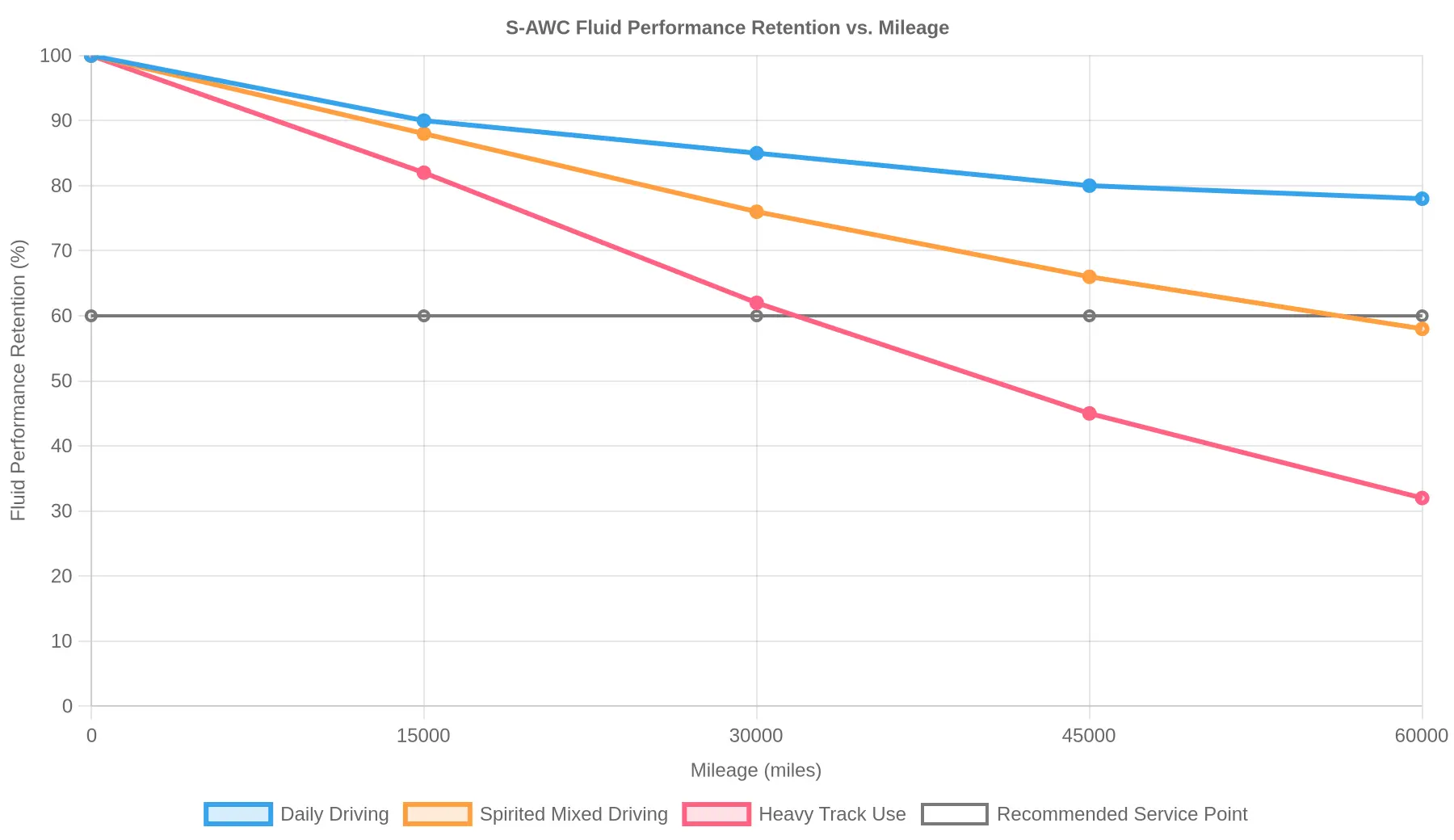
Daily-driven cars lose fluid performance gradually. Track-focused Evo Xs cross the 60 percent performance threshold around 30,000 miles, which is roughly where owners start to feel the difference. If you want one simple rule, replace the fluid while you can still justify taking the risk, and always measure what you drain.
OEM vs Aftermarket S-AWC Fluid
The OEM-versus-aftermarket question matters here, and it plays out differently than it does with something like brake pads.
The ACD/AYC units are friction-sensitive hydraulic systems. The fluid’s friction coefficient is a design input, not a generic property. Genuine Mitsubishi fluid is formulated against the exact clutch materials, seal compounds, and pump tolerances in the ACD/AYC hardware, which makes it the low-risk, known-quantity choice, especially for a stock or lightly modified car and absolutely for anything under coverage.
Aftermarket options fall into two camps:
- Reputable fluids that explicitly list Mitsubishi S-AWC / ATF-J2 compatibility. Often cheaper and widely available, these can work well when they match the required specification. Confirm the spec on the label, not just the marketing copy.
- Generic “universal” ATF. The false economy. Friction characteristics that are wrong for the clutch packs cause slip, chatter, or premature plate wear that costs far more than the fluid you saved.
On a 25,000-mile Evo X, the sensible path is to use fluid that meets the factory specification, change it on a mileage-or-time basis, and keep the receipts. The turbo will get the attention. The S-AWC fluid will decide whether the car still feels like an Evo in five years.
If you are evaluating a used example like our 25,000-mile 2015 Evolution X GSR reference car, ask for the AWD fluid service history before you ask about the turbo. A documented S-AWC fluid change tells you more about how the car was treated than any boost gauge will.
S-AWC & Driveline Fluid Service Reference
On a 25,000-mile 2015 Lancer Evolution X GSR, fluid condition tells you more than turbo health does. This grid ranks each driveline service by urgency.
| Fluid/Component | Recommended Interval | Typical Neglect Consequence | Priority Level |
|---|---|---|---|
| S-AWC / ACD-AYC fluid | 20,000-30,000 miles | ACD pump failure, jerky AWD engagement, lost active yaw control | Critical |
| Transfer case fluid | 30,000 miles | Whine under load, gear and bearing wear, driveline binding | High |
| Rear differential fluid | 30,000 miles | LSD clutch chatter, metallic debris, eventual diff seizure | High |
| Transmission fluid (5MT) | 30,000-60,000 miles | Notchy or grinding shifts, synchro wear, hard engagement | Medium-High |
| Clutch hydraulic fluid | 30,000 miles | Spongy pedal, delayed engagement, clutch drag and slip | Medium |
The ACD-AYC fluid sits at the top because it feeds the hydraulic pump that keeps S-AWC’s torque vectoring alive, and contamination is a leading cause of pump failure and the four-figure repair bill that follows. Fresh clutch hydraulic fluid matters nearly as much on a manual GSR, since a spongy pedal masks the friction-disc wear that decides whether the car still drives the way an Evo should. Turbo failures get talked about. These fluid services are what keep the car out of the shop.
Evo X GSR Clutch Wear: Why the Five-Speed Manual Takes a Beating
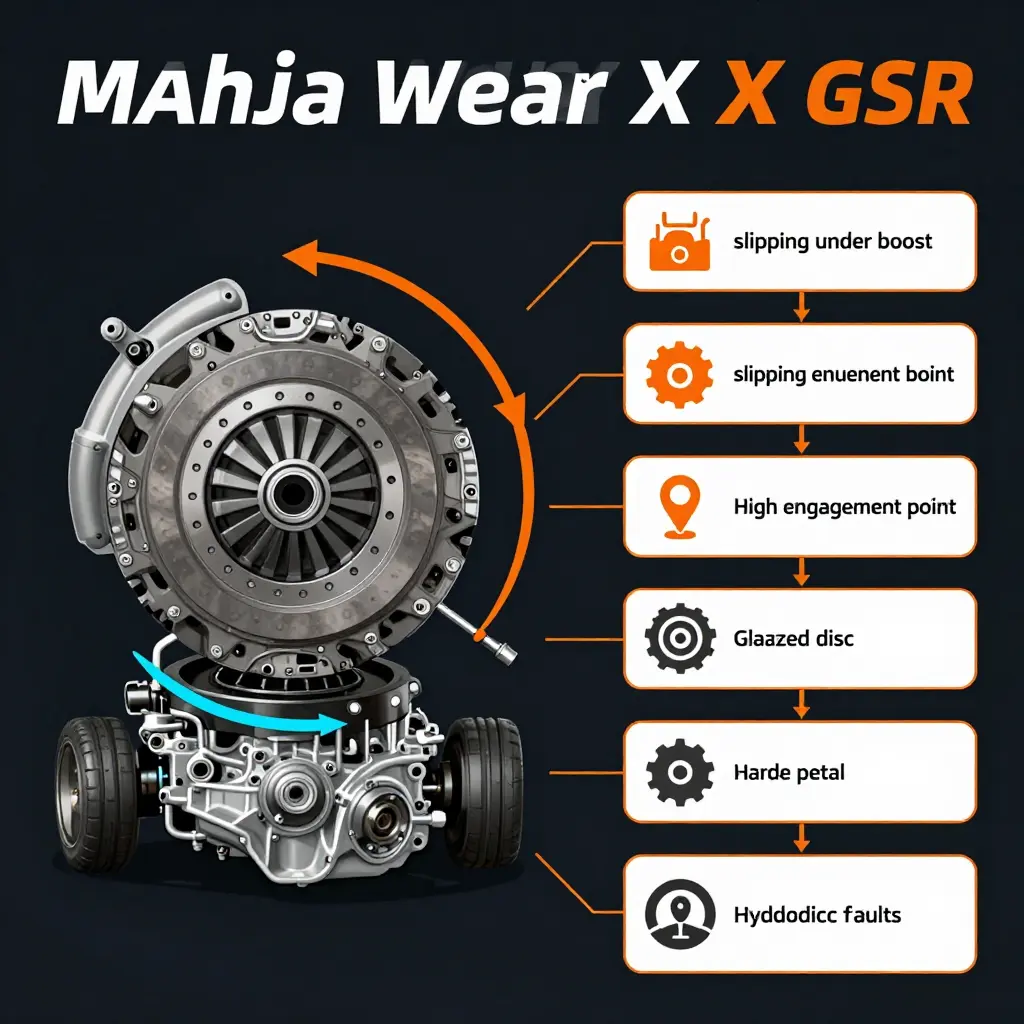
Why AWD and Turbocharging Load the Clutch
On a 2015 Lancer Evolution X GSR with its turbocharged 2.0-liter four and S-AWC all-wheel-drive system, the clutch absorbs every bad habit the driver has. The Evo X GSR uses a five-speed manual that has to send the 4B11T’s torque to four driven wheels instead of two. The AWD layout puts more grip and rotating inertia downstream of the clutch, so clutch wear happens faster than on a comparable front-wheel-drive car.
How Launch Habits and Drivetrain Resistance Accelerate Wear
A hard launch is the fastest way to burn friction material. A FWD car relieves stress by spinning its tires: the wheels break loose and the clutch survives. An AWD Evo X cannot do that. When you dump the clutch at 5,000 rpm, all four tires bite, and the only element left to slip is the clutch disc itself. That energy converts directly into heat and material loss.
Ongoing drivetrain resistance compounds the problem:
- Four driven wheels and a transfer case add drag and inertia the clutch must overcome on every engagement.
- Heavier curb weight means more torque is required just to move the car from rest.
- Boost arrives abruptly, dumping a sudden torque spike through a disc that is still mid-engagement.
Recognizing Clutch Wear: Symptoms That Matter
Clutch wear usually shows up gradually. These are the signals:
| Symptom | What It Usually Means |
|---|---|
| Slipping under boost | RPM climbs without matching acceleration in higher gears |
| High engagement point | Pedal must be released near the top before the disc bites |
| Chatter or judder | Hot spots or contamination on the flywheel or disc surface |
| Hard or stiff pedal | Weak pressure plate diaphragm or a fault in the hydraulics |
OEM Organic vs Performance Clutch: The Street Trade-off
The OEM clutch is an organic disc chosen for smooth, quiet, low-effort street manners and predictable engagement. Its weakness is finite torque capacity once you add bolt-ons or track the car. A performance clutch – typically ceramic or puck-style – raises that capacity, but the trade-off is real: harsher engagement, chatter at low speed, higher pedal effort, and more shock loading on synchros and the AWD drivetrain during daily driving. For a mostly-street Evo X, a mild upgraded organic or segmented disc often hits the sweet spot, preserving drivability while adding headroom for occasional hard use.
Why the 4B11T Turbo Is More Robust Than Buyers Assume
The 4B11T’s turbocharger has a reputation as the Evo X’s weak link that it does not deserve. On a maintained car, the factory turbo is one of the more durable parts in the drivetrain. Mitsubishi specced a water-cooled center housing and a stout shaft assembly, and with oil changes on schedule and a cool-down after a hard pull, these units often pass 100,000 miles without a rebuild. Turbo reliability on the Evo X is high; neglect, not design, is what ends their lives early.
What Actually Kills a Turbo
Turbos rarely fail on their own timetable. They fail when owners break the fundamentals:
- Oil starvation – the number one killer. Sludged oil, a clogged feed line, or low oil pressure from stretched intervals starves the journal bearings and takes the shaft with it.
- Excessive boost – cranking boost past the turbo’s efficiency range spikes shaft speed, drive pressure, and heat.
- Heat soak – shutting down immediately after a hard pull cooks the oil sitting in the bearing housing, coking it over time.
None of these is a design flaw. Each is a maintenance or driving-habit failure, which is why disciplined turbo maintenance produces predictable results. If you want to strengthen the foundation these units bolt to, proven 4B11T engine internals are a better spend than pre-emptively replacing a healthy turbo.
The Systems Worth Watching
Enthusiasts fixate on the turbo and ignore the parts that degrade on a schedule. S-AWC fluid and the clutch are the real stories on a used Evo X. The driveline fluids (transmission, transfer case, rear differential) break down with age and change how the car behaves long before anything fails. Clutch wear depends on the previous owner’s driving, and a worn clutch or tired S-AWC fluid is far more common on a low-mileage car than a blown turbo.
Maintenance Cost and Failure Predictability, Side by Side
| System | Typical Service Interval | Failure Predictability | Cost Reality |
|---|---|---|---|
| 4B11T turbo | No fixed interval; oil every 3-5k miles | Low if maintained; fails predictably from neglect | Expensive if it fails, but rarely does on a cared-for car |
| S-AWC / driveline fluid | ~30k miles for trans, transfer, rear diff | High – degrades on a known schedule | Low per service, costly if ignored |
| Clutch | Varies widely with driving style | Medium – wear is measurable and progressive | Moderate; labor-heavy, but predictable |
The turbo is the component most likely to outlast the owner’s attention. S-AWC fluid and clutch wear are the costs that come due on schedule. Prioritize the fluids and the clutch, keep clean oil flowing to the turbo, and the 4B11T’s blower becomes the least of your worries.
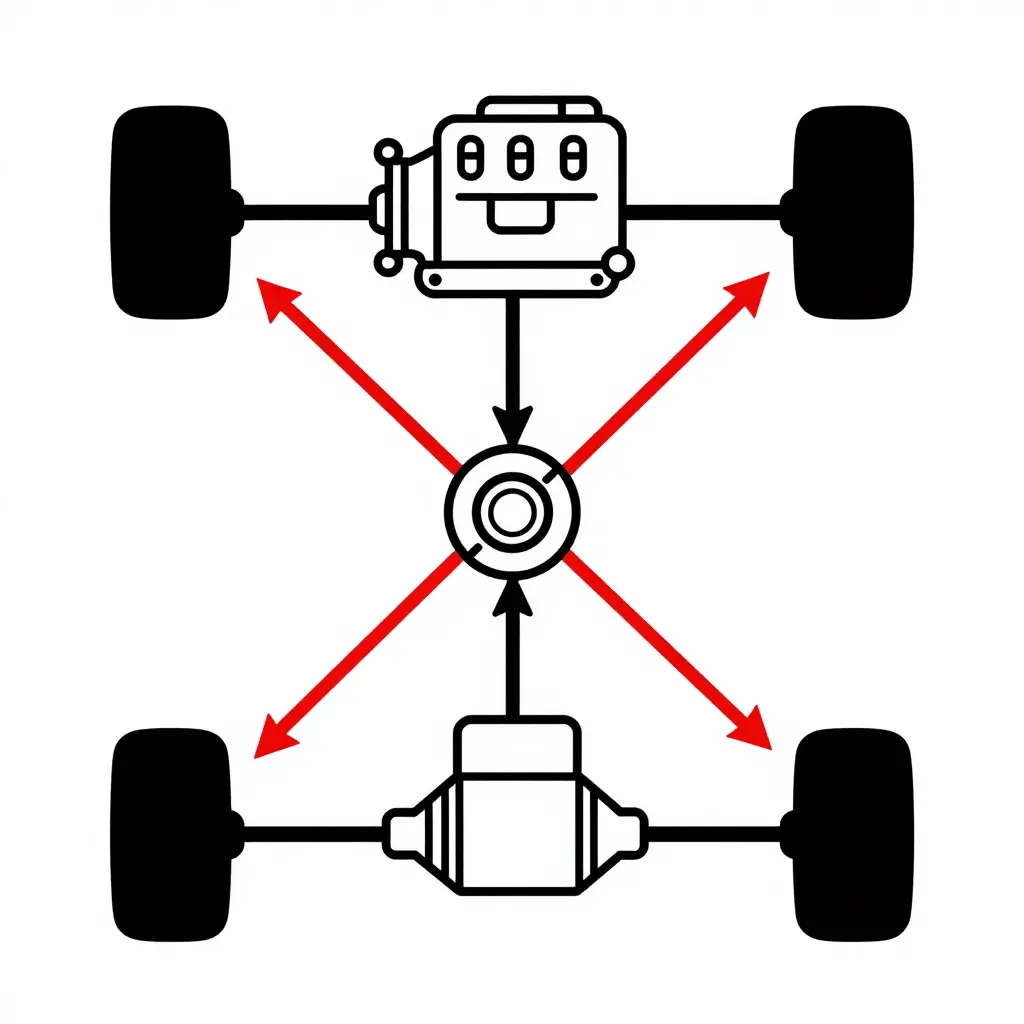
The diagram above maps the Evo X Super All-Wheel Control layout. Torque leaves the engine and splits through the transfer case and the ACD center coupling. One path runs forward to the front axle; the other feeds the AYC rear differential, which shuffles power left to right between the rear wheels. Every one of those connections relies on fluid and friction surfaces that degrade over 25,000 miles.
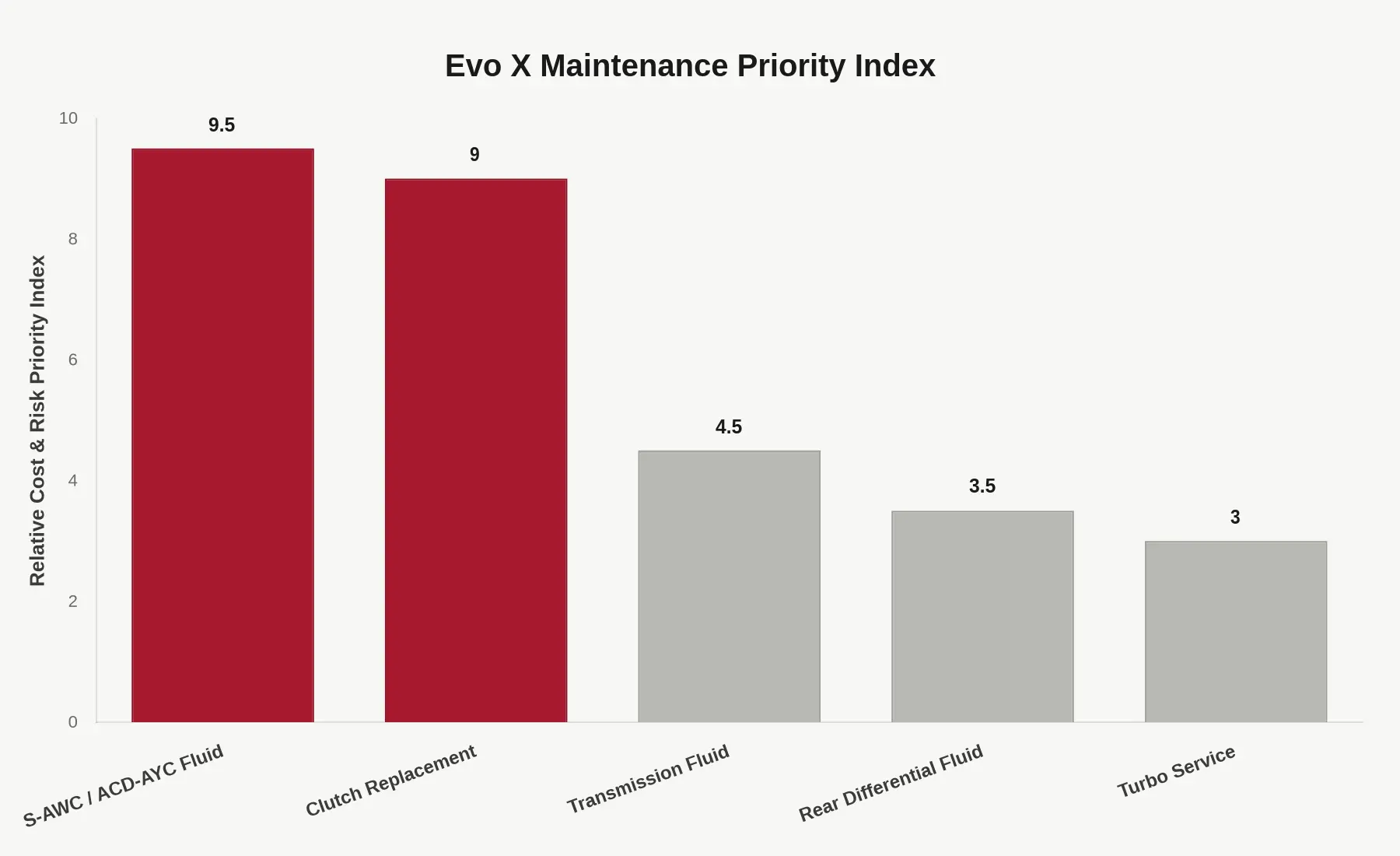
Caption: S-AWC/ACD-AYC fluid health and clutch wear rank highest in both cost and reliability impact, which is why they belong at the front of your service schedule, ahead of turbo items.
Reading the Priority Index
The chart above plots each major Evo X system on a 0-10 scale that blends parts and labor cost with reliability risk if the service is deferred. It is not a hard dollar figure, but a relative ranking that shows where attention and budget do the most good.
The S-AWC / ACD-AYC fluid service (9.5) and clutch replacement (9.0) sit well above everything else. Transmission fluid (4.5), rear differential fluid (3.5), and turbo service (3.0) cluster in the lower half of the range.
| System | Priority Index | Why It Matters |
|---|---|---|
| S-AWC / ACD-AYC Fluid | 9.5 | Pump, clutch packs, and hydraulic control rely on clean fluid; neglect causes AWD malfunction and drivetrain wear |
| Clutch Replacement | 9.0 | Wear item on manual GSRs; slippage is expensive and affects every launch and shift |
| Transmission Fluid | 4.5 | Long intervals, lower failure risk, but still worth periodic attention |
| Rear Differential Fluid | 3.5 | Durable, lower cost, replace on interval |
| Turbo Service | 3.0 | Robust 4B11T turbo; usually outlasts the above with good oil habits |
Why the S-AWC and Clutch Bars Dominate
The all-wheel-drive brain of the Evo X is only as good as the fluid feeding it. The electronically controlled pump and multi-plate clutch assemblies inside the ACD and AYC units shear and degrade fluid over time, and when it breaks down you get hesitation, warning lights, and eventually mechanical damage that dwarfs the cost of a simple drain and refill. On a low-mileage example, you can explore a documented 25,000-mile 2015 Evo X GSR reference build to see how these systems present on an otherwise healthy car.
The clutch tells a similar story. On the five-speed manual GSR, it is a wear item that takes the brunt of aggressive launches and hard shifts. A slipping clutch is not just a comfort problem; it strands the car and forces a job that touches the transmission, which is why it is the second-highest bar on the chart.
Where to Spend First
If you are budgeting for an Evo X, do not let the turbo take the whole budget. Prioritize S-AWC fluid service and plan for clutch health first, then handle the transmission, differential, and turbo as intervals and symptoms dictate. The systems that wear out unseen are the ones that cost the most.
Buying a Used Evo X GSR: What Actually Matters
When you shop for a used Evo X, the spec sheet is the least honest part of the car. Dyno sheets are easy to fake, and a big-turbo build tells you almost nothing about how the car was treated. That is why buyers hunting a Lancer Evolution X GSR look past peak horsepower and focus on two unglamorous items: a verified S-AWC fluid service history and the condition of the clutch.
Inspection Priorities, in Order
- S-AWC fluid service records. The Super All-Wheel Control system runs on hydraulic fluid that degrades with heat and time. Look for documented changes at sensible intervals. Fresh fluid and dated receipts are worth more than a folder of bolt-on parts invoices.
- Clutch wear. The stock clutch does not tolerate abuse, and replacing it is a transmission-out job. Feather the pedal on a test drive: chatter, slipping under boost, a high engagement point, or a mushy pedal all signal imminent, expensive work.
- Driveline health. Listen for whine from the transfer case or rear differential, and check for leaks around the driveshaft and half-shafts.
Low-mileage stocker vs. modified example
A clean, low-mileage survivor usually wins, but only if its records prove maintenance rather than neglect. A tastefully modified car with full receipts and a fresh S-AWC service can be the smarter buy, because you inherit someone else’s already-sorted setup. The real trap is the heavily “built” car with no fluid history: cheap power hiding expensive neglect.
| Factor | Stock Low-Mileage | Documented Modified | Red-Flag Modified |
|---|---|---|---|
| S-AWC records | Full history, on time | Present and dated | Missing or vague |
| Clutch | Original, still tight | Replaced with receipt | Slipping, unknown miles |
| Turbo | Factory, reliable | Supporting mods + tune | Big turbo, no fuel mods |
| Verdict | Safest long-term pick | Great if sorted | Walk away |
Planning for OEM parts over the long haul
Even a well-kept Evo X will eventually need body panels and driveline wear items. Budget for quality OEM parts instead of cheap aftermarket lookalikes, which often fit poorly and rust early. Sourcing a proper OEM hood, correct rear bumpers, and genuine driveline components keeps resale strong and fitment clean. When you compare two cars, the one with honest maintenance and straight bodywork almost always outlasts the one chasing the highest dyno number.
How Clutch Wear Progresses With Mileage
A clutch disc does not fail overnight. It wears gradually, and knowing the curve tells you when the drivetrain is getting close to the end of the disc’s life. The diagram below shows three stages: a fresh disc with full friction material, a mid-life disc with partially consumed facing, and a heavily worn disc with very little surface left.
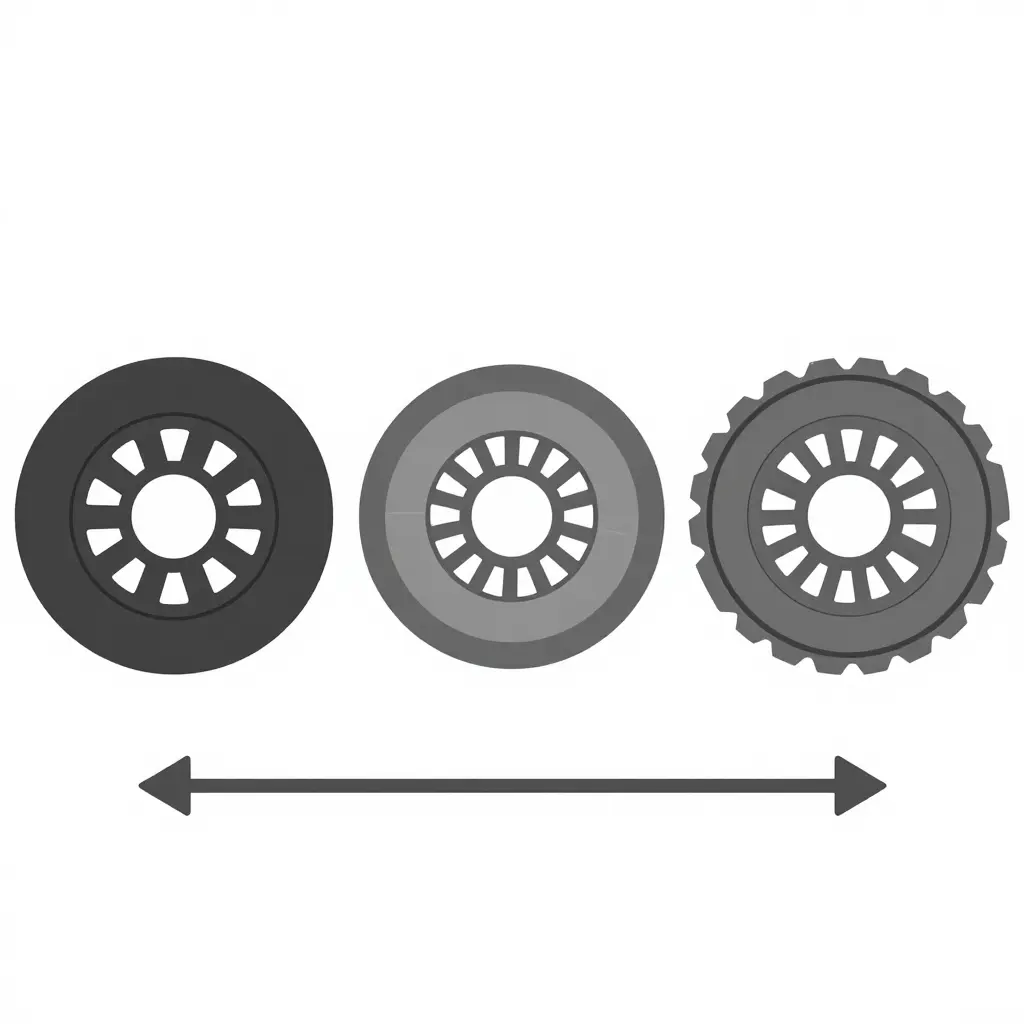
Every hard launch, every slipping engagement in traffic, and every high-torque pull removes friction material. On a 2015 Evo X GSR with a five-speed manual, how much life is left depends on how the previous owner drove, which is why a used 2015 Mitsubishi Lancer Evolution X GSR with 25,000 miles deserves a clutch check before you assume low mileage means low wear.
The Three Stages
- New (0-15k miles): Full friction material, crisp engagement, minimal pedal travel variance.
- Moderate (15-60k miles): Facing thins gradually; take-up feels slightly softer and demands a touch more slip.
- Worn (60k+ miles, or sooner with abuse): Rivets approach the surface, engagement gets vague, and slipping under load signals imminent replacement.
The Takeaway: Discipline Beats Boost
On a 25,000-mile Lancer Evolution X GSR, the parts that decide whether the car still drives like new in five years are the ones most owners overlook. Consistent S-AWC fluid service and honest clutch wear tracking protect the driving experience and Evo X reliability far more than chasing turbo upgrades. The 4B11T’s turbocharger is a durable piece; the hydraulic AWD system and the clutch are what age on a schedule you actually control. Treat the turbo as an item to monitor, not a problem to solve.
What to Do Next
- Service the S-AWC fluid by mileage, not by feel – fresh fluid keeps the rear differential pump and clutch packs working predictably.
- Read clutch wear early: soft engagement, slipping under load, or a creeping pedal means act before you are sidelined.
- Keep a written log of every fluid, filter, and clutch measurement so trends, not guesses, guide your spending.
- Favor OEM-spec or proven aftermarket parts, and replace wear items before they fail, not after.
Prevention is cheaper than reaction on an Evo X. Whether you need OEM versus aftermarket parts or straight maintenance guidance, mitsubishiautopartsshop.com is the resource to lean on. Start with the full reference listing for this 25,000-mile Lancer Evolution X GSR.