
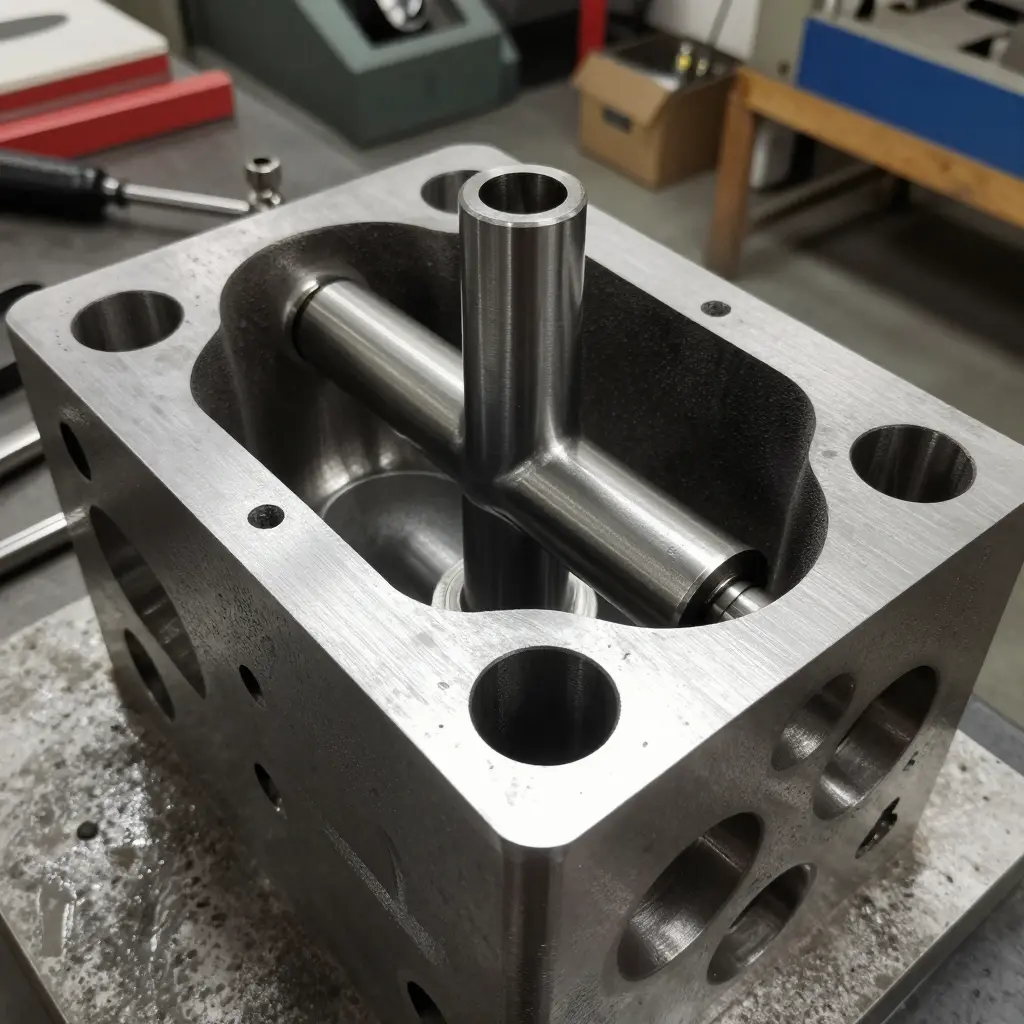
4B11T Billet Block: Why Cylinder Wall Thickness and Main Bore Alignment Decide Big-Power Survival
For Evo X owners chasing power the factory aluminum casting can’t take, the 4B11T billet block has become the default starting point. Above roughly 700 hp the block is no longer just a container for the rotating assembly; it carries the combustion load. Cylinder wall thickness decides how much cylinder pressure each bore holds before it distorts, cracks, or lifts a head gasket. Main bore alignment decides whether the crank spins straight under load or walks, wipes a bearing, and takes the bottom end with it. Those two dimensions set the ceiling of a build, not the alloy grade. A well-specified 4B11T billet block is the starting point; the machining decides the outcome.
Alloy choice matters less than most people assume. Once a block is cut from a sound billet forging, the alloy mainly affects machinability and fatigue behavior — it doesn’t change the hard limits. Thick walls and straight, stable main bores are what turn a promising short block into one that survives repeated drag passes, long circuit sessions, or years of high-HP street duty.
The sections below cover the machining and metallurgical decisions that separate a durable build from one that lets go: how wall thickness is measured and specified, how main bore alignment is verified and corrected, and how both interact with boost pressure, head gasket sealing, and bearing life.
The scope here is 4B11T billet blocks in drag programs, motorsport, and high-HP street builds. It assumes you already know what a torque plate is for and how to tension main studs, so it stays on the engineering decisions that determine how long the investment lasts.
The Alloy-Grade Misconception: Why the Aluminum Alloy Barely Decides Survival
Ask ten builders which aluminum alloy belongs in a 4B11T billet block and you’ll get ten confident answers. Ask how thick the cylinder walls are, or how straight the main bore stays, and the room gets quiet. The second question is the one that governs a big-power build.
What 6061-T6 and 2618 Really Change
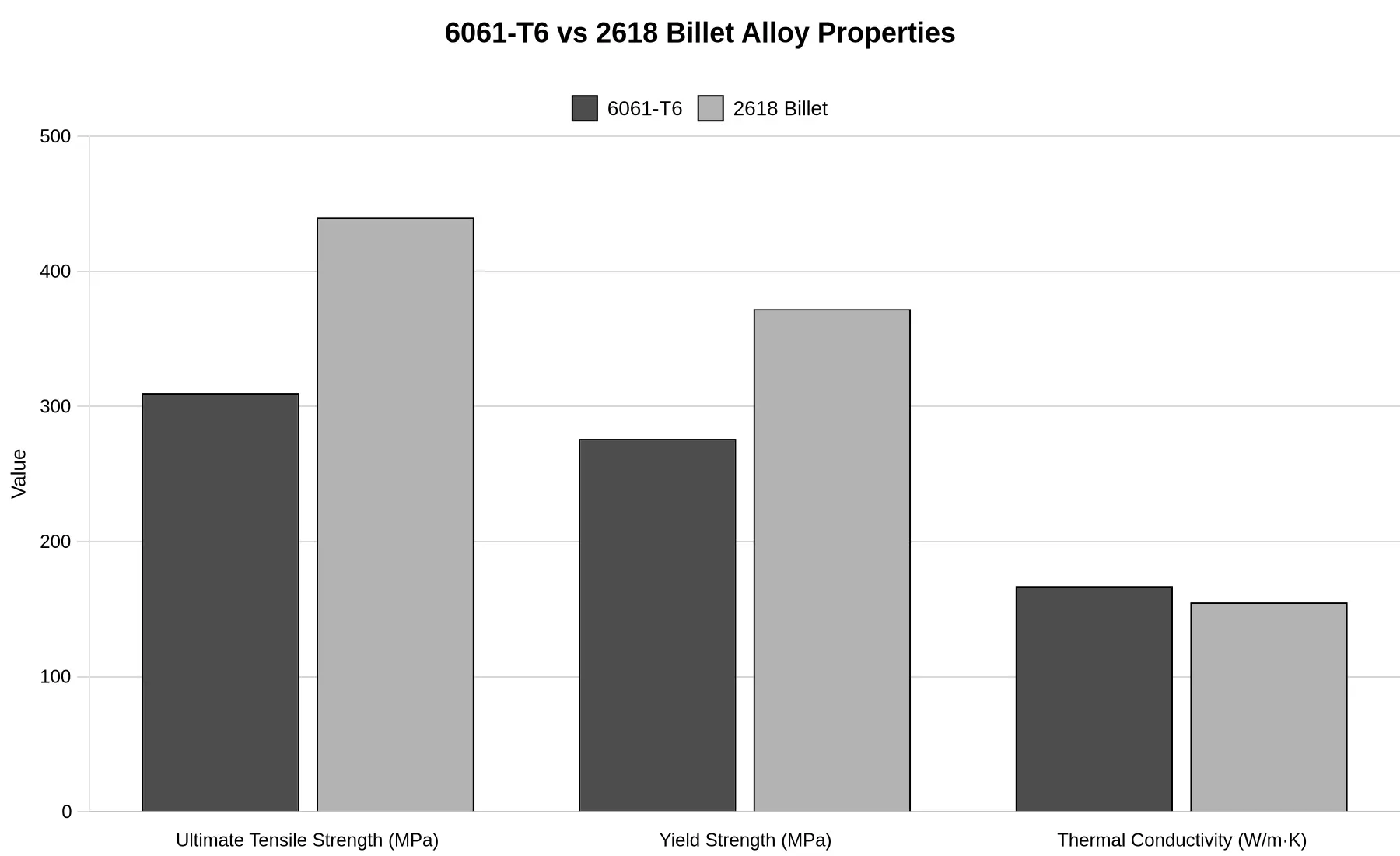
6061-T6 machines cleanly, resists corrosion, and holds tight tolerances without much movement from residual stress. 2618 gives up some of that machinability and corrosion resistance for higher strength at temperature and better fatigue life under sustained heat. That’s the whole of what the alloy controls: strength and machinability. A few shops cut 4B11T blocks from 7075-T6 instead, but it doesn’t change the argument — the alloy is stronger, not stiffer.
| Property | 6061-T6 | 2618 |
|---|---|---|
| Ultimate tensile strength | ~310 MPa (45 ksi) | ~440 MPa (64 ksi) |
| Yield strength | ~276 MPa (40 ksi) | ~372 MPa (54 ksi) |
| Elastic modulus | ~68.9 GPa | ~70 GPa |
| Thermal conductivity | ~167 W/m·K | ~155 W/m·K |
| Elevated-temp fatigue resistance | Moderate | High |
| Machinability | Excellent | Fair |
| Corrosion resistance | High | Moderate |
Why the Gap Shrinks Under Boost
Add cylinder pressure, detonation, and thermal load, and the alloy difference stops mattering much. A detonation event can spike cylinder pressure far above steady-state combustion, and what keeps the block together during that spike is how much material surrounds the bore. Every aluminum alloy has an elastic modulus near 68 to 70 GPa, so changing grade doesn’t stiffen the wall at all. The modulus is fixed by the metal; only geometry moves the needle.
What the Alloy Cannot Control
The alloy sets a baseline for machinability and strength, and nothing about wall stiffness, ring seal stability, or main bore distortion. Those outcomes track wall thickness, bore geometry, and how rigid the deck and main saddle are. A thick 6061-T6 wall will outlast a thin 2618 wall every time, because a wall’s resistance to deflection comes from section thickness and moment of inertia, not chemistry.
Where Your Attention Belongs
Pick your aluminum alloy for machinability and heat tolerance, then spend your attention where it pays. Wall thickness, bore roundness, and main bore alignment decide how long a big-power build holds together. Get them wrong and no grade rescues you; get them right and the alloy debate becomes background noise.
Cylinder Wall Thickness: The Numerical Limit on Boost
In a high-HP 4B11T, the aluminum isn’t doing the work — it only holds the geometry you machine into it. What decides how long a big-power build survives is how much material you leave around each bore. Cylinder wall thickness is the dominant structural variable, and it drives four things at once: hoop stress, bore distortion, ring seal, and heat rejection.
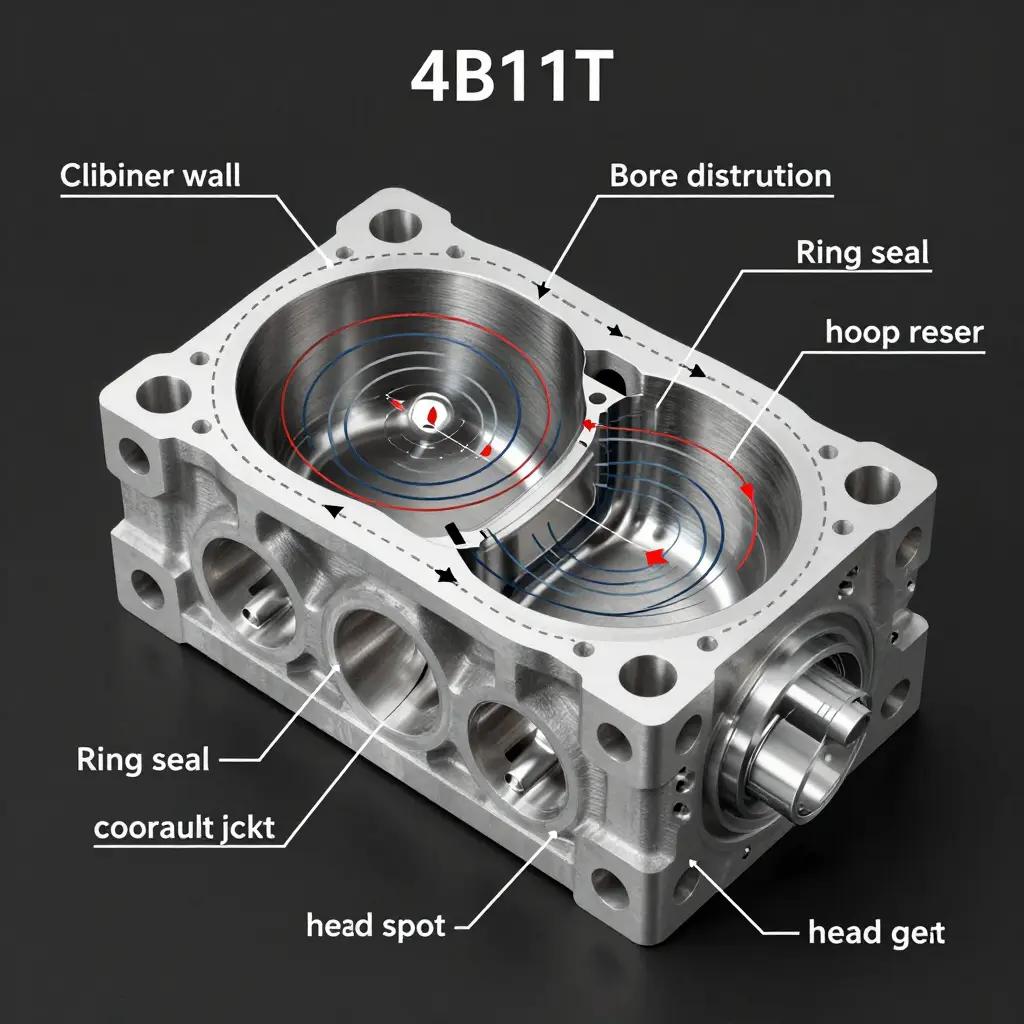
A 4B11T billet block earns its price by letting you specify that wall thickness, instead of taking whatever a factory casting gives you.
Wall thickness sets hoop stress
Combustion pressure pushes each bore outward like a balloon, and the wall fights back with tensile hoop stress.
- Hoop stress rises with bore diameter and falls with wall thickness.
- First-order estimate: hoop stress = (peak cylinder pressure x bore) / (2 x wall thickness).
- At the same bore, doubling wall thickness roughly halves hoop stress.
That ratio is why thicker walls lift the cylinder-pressure ceiling almost linearly — until friction and cooling become the limit instead.
Thin walls deflect, and the seal breaks
Thin walls don’t just carry stress; they move. At 100+ bar of peak cylinder pressure a thin wall flexes and goes oval.
- Ovality breaks the ring’s seal against the wall.
- Blow-by climbs, compression drops, crankcase pressure rises.
- Ring flutter and lost tension accelerate wear.
The instant the ring seal fails, power falls and local heat loads spike.
Heat has to leave through the wall
The cylinder wall is the piston’s heat path to the coolant. Keep the bore round and rigid and the ring stays in uniform contact, which moves heat steadily into the jacket.
- A deflecting wall creates localized hot spots.
- Hot spots cook the head gasket and distort the deck.
Quantifying the trade
The payoff from extra wall thickness is steep in effort, but the direction is clear.
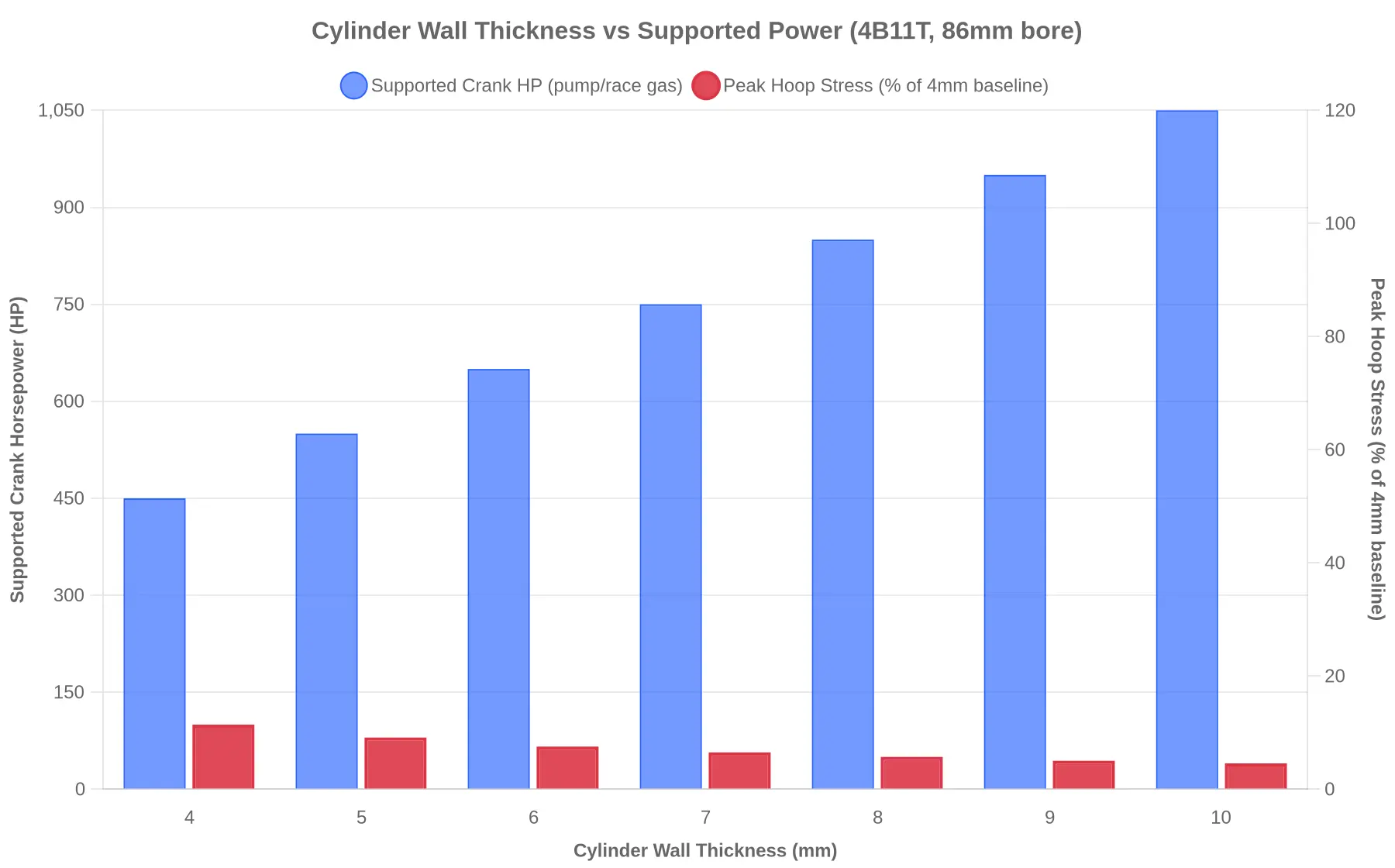
| Cylinder Wall Thickness | Relative Hoop Stress (4 mm = 100%) | Typical Supported Crank HP (86 mm bore, race gas) |
|---|---|---|
| 4 mm | 100% | ~450 hp |
| 5 mm | 80% | ~550 hp |
| 6 mm | 66% | ~650 hp |
| 7 mm | 57% | ~750 hp |
| 8 mm | 50% | ~850 hp |
| 10 mm | 40% | ~1,000+ hp |
A bigger bore also needs a thicker wall to hold the same stress: going from 86 mm to 90 mm at constant wall thickness raises hoop stress by roughly 5 percent before you add any boost.
The engineering takeaway
Treat cylinder wall thickness as a budget you spend on boost. Trade it away for displacement and you trade away reliability. In a 4B11T billet block, the build with a thick wall and a modest bore usually outlasts the one chasing cubes.
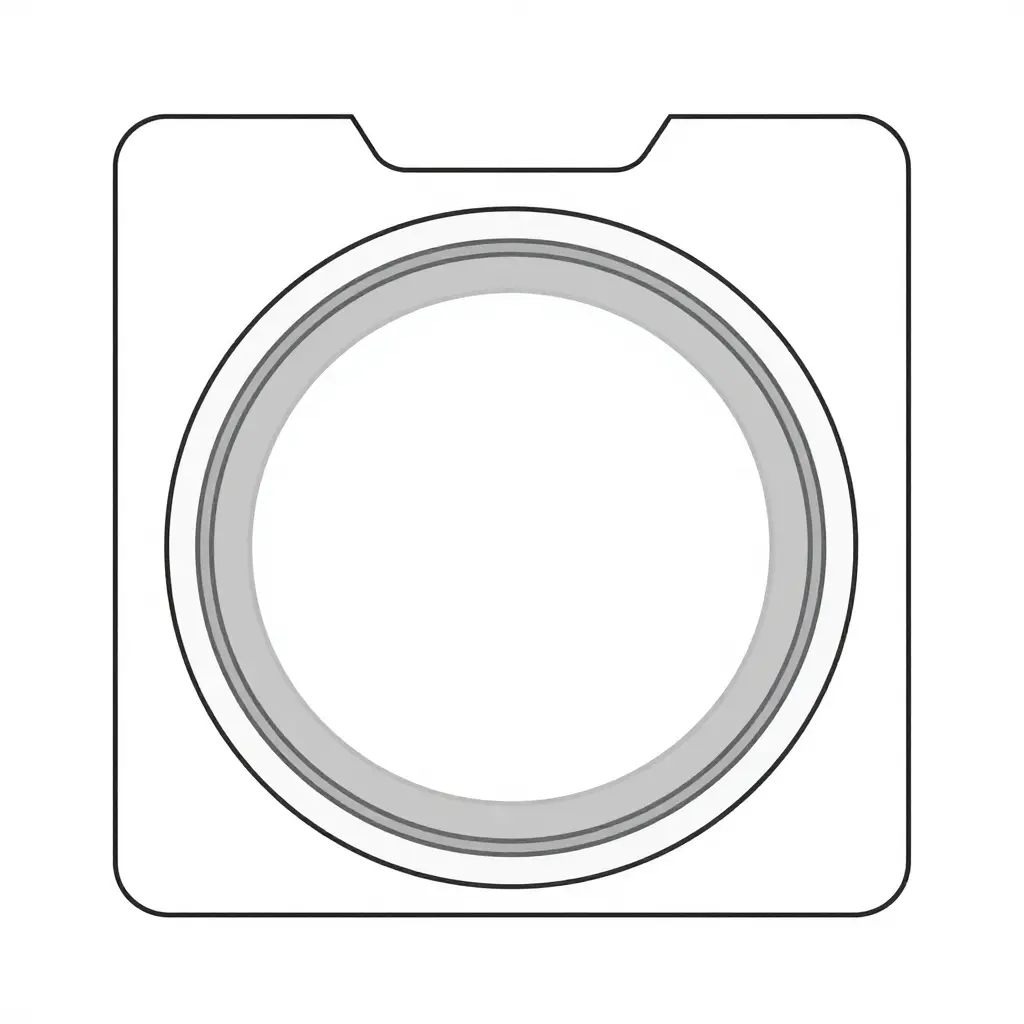
Main Bore Alignment: The Other Decisive Factor in 4B11T Billet Block Durability
Wall thickness sets how much combustion pressure a 4B11T billet block can contain; main bore alignment sets whether the rotating assembly survives it. The two go together. A block that holds enormous cylinder pressure but lets the crank orbit a crooked tunnel still fails — usually at full boost and peak RPM, which is the worst possible moment.
What “Aligned” Really Means
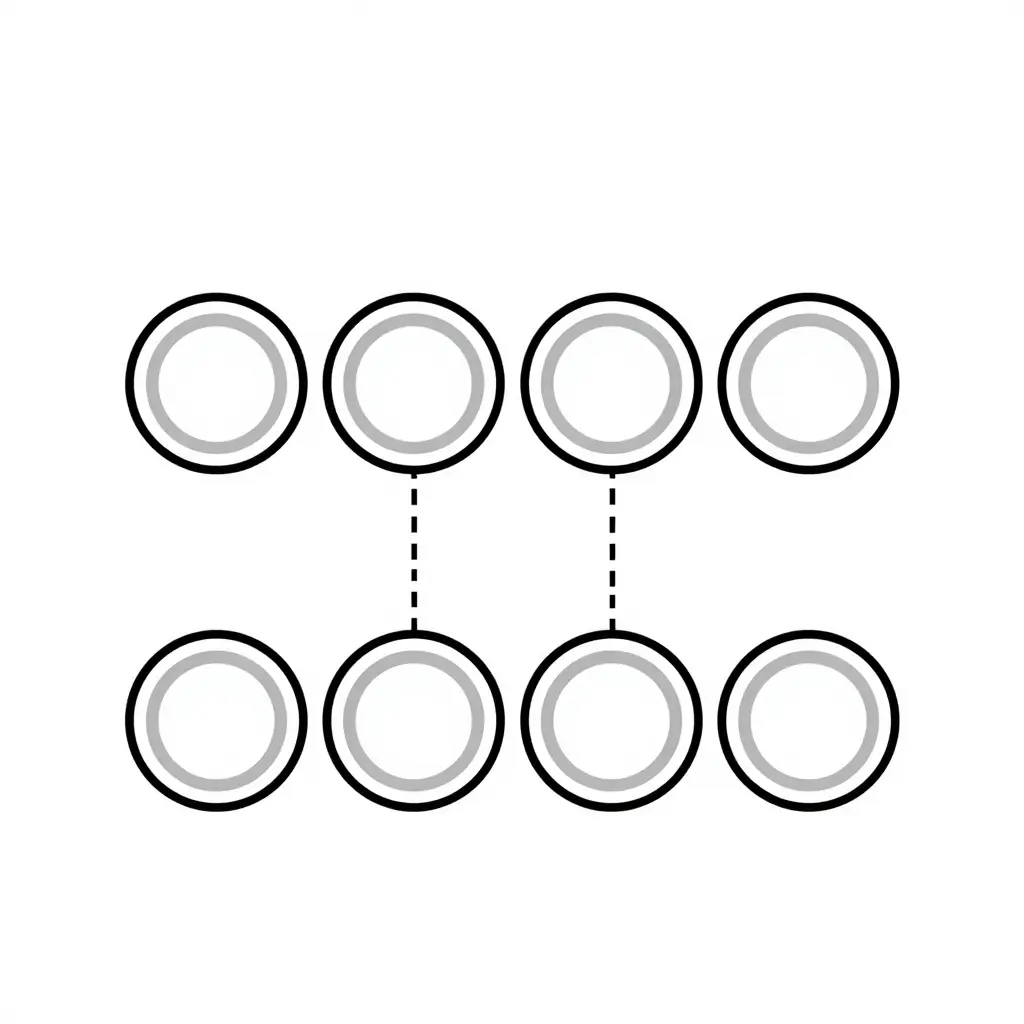
A main bore is aligned only when two things are true at once. Every saddle along the block must be coaxial — sharing one straight centerline from the front saddle to the rear. And that centerline must sit at the correct height and lateral position relative to the deck surface and the cylinder centerlines above it. Miss either relationship and you force the crankshaft into a path it was never designed to follow.
A billet block gives you the material and rigidity to hold these tolerances, but only if the finish machining actually delivers them. The alloy doesn’t align bores; the machining does.
Failure Modes When Bores Are Not Coaxial
Even a few thousandths of twist, bow, or height deviation changes how the crank loads its bearings, and the damage rarely stays confined to one journal:
- Crankshaft bending and flexing as the crank follows a curved axis, loading journals in alternating directions every revolution.
- Uneven main bearing load — the high saddle takes most of the firing load while the others carry almost nothing.
- Oil film breakdown at the overloaded journals, where the hydrodynamic wedge can no longer be maintained.
- Accelerated bearing wear and spin, then wiped journals, and eventually crankshaft fatigue failure.
The Role of Line Boring, Honing, and Torque Plates
This is why good shops don’t stop at a measurement. Line boring and honing re-establish a single true centerline after welding, sleeving, or billet machining, correcting distortion left by heat or material removal. The work is done with a torque plate bolted in place to simulate cylinder head clamping load, so the bores are cut in the block’s stressed, assembled state — not its relaxed state on the bench.
Thermal expansion consistency matters just as much. The block, caps, and crank grow at different rates as the engine reaches operating temperature, so an alignment that measures well cold has to still hold hot. When the block and caps expand predictably, the bore stays true across the whole load range instead of only at room temperature. On a full 4B11T billet block platform built around these principles, the machine work is what converts potential into reliability.
Why Misalignment Compounds With Power and RPM
Misalignment is never a fixed penalty — it multiplies. As cylinder pressure rises, so does the bending load on a crooked crankshaft. As RPM climbs, the crank sees that load more times per second, and bearing eccentricity swings faster, pushing the oil film closer to collapse. A block that survived 400 hp with minor misalignment can destroy bearings at 800 hp, because both the force and the frequency scaled up together.
Stiffness and wall thickness set the ceiling. Main bore alignment decides whether you ever reach it.
Build Approach Comparison: Block and Bore Specifications
Before you commit to a foundation for your next 4B11T build, line the measurable specs up side by side. The table below compares three common paths — a mild stock-displacement setup, a sleeved OEM casting, and a full billet 4B11T block race foundation — on the numbers that actually govern durability at big boost.
| Build Scenario | Block Type | Typical Cylinder Wall Thickness | Main Bore Alignment Tolerance | Supported Power Ceiling | Common Failure Mode |
|---|---|---|---|---|---|
| Street / mild turbo build | OEM cast aluminum (semi-closed deck, as-cast) | 5.5-6.5 mm | within +/-0.0007 in | ~450-550 whp | Cylinder wall flex and head gasket lift under detonation |
| Sleeved OEM cast build | OEM cast block + ductile iron sleeves | 8-9 mm (sleeve wall) | within +/-0.0005 in | ~700-850 whp | Sleeve walk and deck cracking at sustained high boost |
| Full billet race build | Billet aluminum (solid deck) | 10-12 mm | within +/-0.0002 in | 1,200+ whp | Main bore distortion under extreme load if main caps and hardware are not matched |
Treat this as a decision aid: choose the block whose weakest measurable spec — wall thickness, main bore alignment, or power ceiling — still clears your target with margin rather than landing right on the limit.
How to Read the Specification Table: A Priority Model, Not a Checklist
The comparison table isn’t a flat list of features. It’s a ranked decision model, and for a high-HP forced-induction 4B11T the ranking is unambiguous: cylinder wall thickness first, main bore alignment second, alloy grade a distant third. Read it top-to-bottom instead of weighting the columns and you end up paying for a premium alloy bolted to a compromised casting.
Cylinder wall thickness is the controlling variable because it defines how much combustion pressure and heat the bore can contain before the cylinder moves under load. Uniform, generous walls hold their roundness at 40+ psi; a thin wall distorts, breaks ring seal, and lifts the head gasket long before the material grade has any influence on the outcome.
Main bore alignment ranks next because it governs the entire rotating assembly. If the five main bores aren’t concentric within a tight tolerance, bearing crush is uneven, oil clearance drifts, and the crank flexes against the girdle. A perfect crank ground into a misaligned tunnel just fails faster.
Alloy grade — whether 6061 or 2618 — is a material property, not a machining outcome. It can’t rescue poor wall thickness or a skewed main line, which is why it should never drive the purchase decision.
The supported-power ceiling is a readout of inspection and machining quality, not a marketing number. That figure is earned through ultrasonic wall mapping, verified main bore alignment, and torque-plate honing. Treat it as an audit score: the higher the ceiling, the more documented process sits behind it. A block marketed on alloy alone rarely publishes a defensible figure.
Order of Priority When Specifying
- Confirm the cylinder wall thickness map across all four bores.
- Verify the main bore alignment tolerance and ask for the inspection report.
- Match the supported-power ceiling to your target boost and fuel.
- Select alloy grade last, once the structural basics are settled.
A 4B11T billet block specified in this order survives big power because the geometry was prioritized over the label. Choose one documented for high-HP forced induction rather than the flashiest material callout.
Build Variable vs. Survival Outcome: High-HP 4B11T Billet Blocks
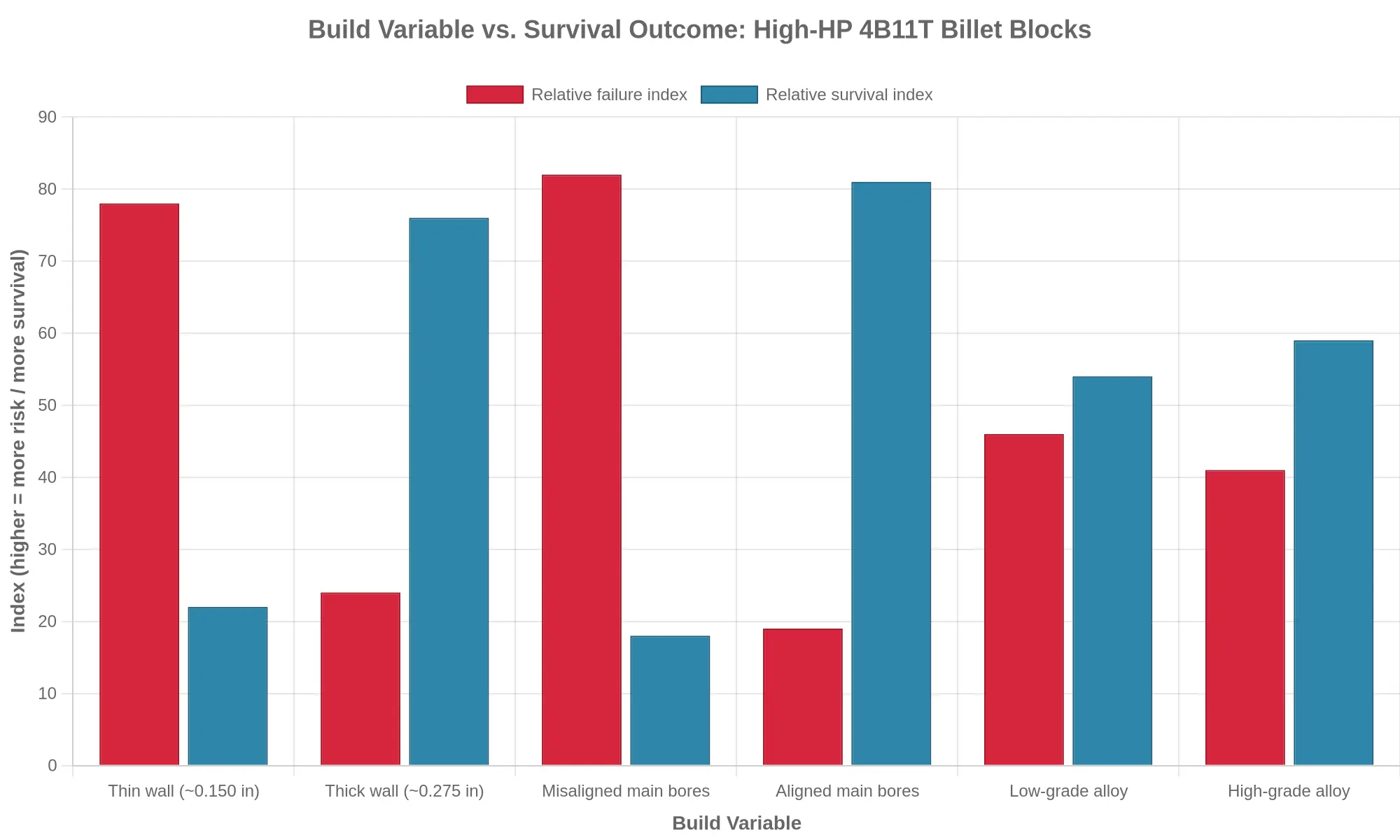
The chart ranks six common build variables by a relative failure index (red) against a paired relative survival index (blue), both normalized so a higher value means more of that outcome. Group the bars into three direct comparisons and the message is hard to miss:
- Cylinder wall thickness is the single biggest lever. Stepping from a thin ~0.150 in wall to a robust ~0.275 in wall drops the failure index from 78 to 24 — a 54-point swing, or roughly a 3.3x reduction in risk.
- Main bore alignment is the second dominant factor. A misaligned main bore sits at a failure index of 82 (the worst single score in the dataset), while a properly line-honed, aligned bore falls to 19 (the best). That is a 63-point spread — even wider than the wall-thickness variable.
- Alloy grade barely moves the needle. Comparing a low-grade billet alloy (46) against a high-grade alloy (41) yields only a 5-point difference, essentially within the noise of the surrounding machining variables.
Wall thickness and main bore alignment dominate survival outcomes; the headline-grabbing alloy spec is a distant third-order consideration. Builders chasing big power on the 4B11T should invest first in wall-thickness margin and precision main-bore alignment, long before they pay a premium for exotic aluminum. Keep that in mind when you shop a purpose-built 4B11T billet block for a serious forced-induction build.
Inspection and Verification Steps Before a 4B11T Billet Block Goes Together
Before any 4B11T billet block is trusted with 700-plus crank horsepower, run it through a documented inspection sequence rather than assuming the machine work is correct out of the crate. Record each item as a number; don’t eyeball it.
- Measure cylinder wall thickness at multiple points: the thrust and non-thrust sides plus front and rear of every bore, at the top, mid, and bottom of the stroke, using an ultrasonic gauge to map the thinnest wall in the unsupported areas above the main webbing.
- Verify main bore alignment across all five saddles with a mandrel or dial-bore gauge, confirming straightness to within 0.001 in. total, and check roundness and taper of each main bore to a target of 0.0005 in. or tighter.
- Check deck flatness along both axes with a straight edge and feeler gauge or a CMM, holding total distortion under 0.002 in. across the full deck length to protect head gasket sealing under boost.
- Confirm the bore-to-deck centerline relationship: each bore center square to the deck and correctly indexed to the crank axis so piston-to-valve clearance and ring-seating geometry stay consistent.
- Review torque-plate honing: confirm the plate matches the intended head gasket and fastener torque sequence, that honing was performed with the plate installed, and that final bore size, roundness, and cross-hatch were measured with the plate still torqued in place.
A block that passes all five checks gives you the cylinder wall thickness and main bore alignment figures you need to predict how the short block behaves at peak cylinder pressure.
FAQ: Common 4B11T Billet Block Concerns
Does the aluminum alloy grade matter more than machining quality?
Neither factor wins in isolation, but machining discipline is what your build actually depends on. A premium billet alloy delivers solid fatigue strength and thermal stability, yet perfect material with loose tolerances will still distort under load and lose ring seal. The 4B11T billet block thesis is simple: alloy sets the ceiling, but machining quality decides whether you ever reach it. Treat the alloy as the baseline, not the deciding variable.
How much cylinder wall thickness is enough for high boost?
There is no single universal number, because cylinder pressure, bore size, and cooling capacity all interact. As a working reference, many builders target roughly 0.300 in (7.6 mm) of wall at the thrust side for builds around 800 hp, while aggressive 1,000 hp-plus setups push toward 0.350 in (8.9 mm). Cylinder wall thickness is a trade-off: more wall resists bore distortion and head-gasket failure, but it takes volume away from the water jacket and hurts heat rejection. Balance is the goal, not maximum thickness.
How is main bore alignment verified?
Verification starts before assembly. The block is measured on a coordinate measuring machine or with a precision bore gauge to confirm all five mains share a single centerline within a few ten-thousandths of an inch. Line-boring or line-honing follows any correction, and the check is repeated after the main caps and fasteners are torqued to final specification. Main bore alignment is only valid when measured under real clamping load, never on a bare block.
Does a billet block alone guarantee long-term big-power survival?
No. A billet block removes one common failure point, but it can’t compensate for poor tuning, detonation, or an unbalanced rotating assembly. Long-term survival comes from the whole system: correct cylinder wall thickness, verified main bore alignment, proper fastener torque, cooling, and a calibration that keeps combustion in check. The block is a foundation, not a warranty.
Conclusion: Thickness and Alignment Decide the Outcome
The alloy gets the attention. The geometry decides the outcome. A 4B11T build makes big power through sustained cylinder pressure, and what survives that pressure is not the marketing name on the casting — it is cylinder wall thickness and main bore alignment. Get those wrong and even premium aluminum will crack a wall or hammer a main bearing loose. Get them right and a properly specified block holds together far longer than the intake manifold ever suggests.
What Builders and Tuners Should Take Away
- Wall thickness sets your ceiling. Thin walls flex, distort the bore under boost, and lose ring seal. Support and cooling only go as far as the metal allows.
- Main bore alignment holds the bottom end together. If the mains drift, the crank fights the block every revolution, and no fastener upgrade saves it.
- The alloy is a supporting actor, not the plot. It matters for strength and heat, but it can’t cover for thin walls or a misaligned bore.
- Inspection beats assumption. Measure before you machine, and reject any core that measures short on thickness or out of line at the mains.
For builders who want a foundation that solves these problems from the casting up, review the site’s dedicated 4B11T billet block resource before finalizing a spec sheet.
What to Prioritize
When you specify or inspect a block, start with measurement, not material. Confirm cylinder wall thickness at the thrust sides, verify main bore alignment on the align-bore fixture, and only then weigh the aluminum alloy. Honor that order and your 4B11T billet block build has a real chance of a long life. Reverse it, and you’re buying parts to fix a problem you never diagnosed.