
Advance Auto Parts is closing stores as part of a significant restructuring aimed at addressing a complex web of financial, strategic, and market pressures. This evolution is not merely a business decision; it reflects broader trends that every business owner must recognize and navigate. From financial pressures triggering losses to strategic restructuring plans, and shifts in consumer behavior, each chapter of this article will unpack these critical components. Understanding these dynamics will provide valuable insight into how similar challenges might be met in your own operations.
Shifting Gears Under Pressure: The Financial Strain and Strategic Overhaul Behind Advance Auto Parts’ Store Closures
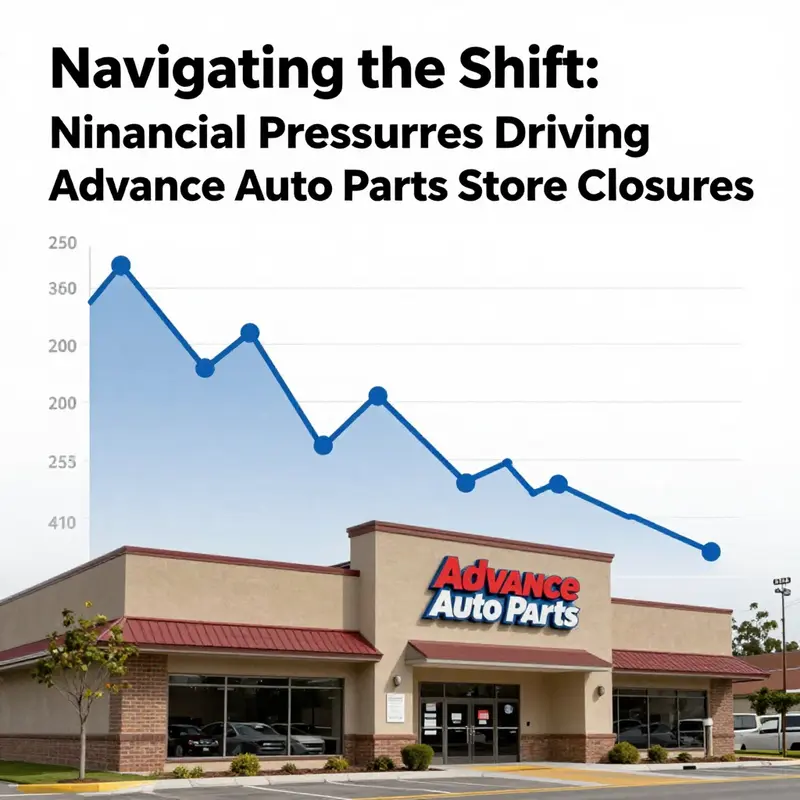
When a retailer announces closures, the instinct is to view it as a sign of failure. Yet in Advance Auto Parts the decision to shrink the store footprint is best understood as the result of financial strain, managerial recalibration, and a shifting market landscape. The 2024 third-quarter results showed pressure: net sales declined, comparable-store sales slipped, and margins were squeezed by rising costs. Even with inventory discipline helping gross profit margins, the company signaled that a near-term adjusted earnings per share could move toward breakeven. The closures are thus a deliberate reallocation of capital toward higher-return opportunities in an environment that rewards efficiency over sheer footprint size.
The strategic response began with a broad restructuring plan. Management signaled the sale of Worldpac, a source of liquidity measured in the hundreds of millions, and announced roughly 700 store closures, approximately 523 partnerships and 204 company-operated locations, plus four distribution centers. The aim was not to shrink for its own sake but to prune underperforming assets, cut operating costs, and redeploy resources to core operations where cost-to-serve and inventory velocity could improve. The realignment emphasized fewer, smarter stores and a supply chain footprint better suited to higher fill rates and faster replenishment for omnichannel demand.
Across the macro backdrop, consumer spending remained weak, storms disrupted patterns in several regions, and competition intensified from more affordable, foreign-made vehicles that could shift repair demand. The aging U.S. vehicle fleet added complexity, with demand moving in tandem with tighter margins and a more digital shopping experience. The result is a structural transformation in the automotive aftermarket that favors capital efficiency and tighter unit economics over a broad real estate footprint. The closures are a structural corollary to a plan aimed at building a leaner, more resilient platform that can sustain profitability through cycles.
Looking ahead, the company framed its long-horizon targets in terms of margin expansion and capital efficiency rather than square footage. In 2025, net sales were down about 5% year over year, but adjusted operating profit rose, and adjusted EPS turned positive after a loss in 2024. The company spoke of cost savings around $70 million tied to the closure program and outlined a path to 40-45 new stores and 10-15 market centers in 2026. The 2024-2027 plan aims to lift adjusted operating margins by more than 500 basis points by 2027, with a sharper focus on core parts, tools, services, and a leaner distribution network. The narrative centers on disciplined capital allocation, improved working capital efficiency, and a more predictable earnings profile that can support a sustainable dividend in a more digital, capital-light era.
Why Advance Auto Parts Is Closing Stores: A Strategic Restructuring to Rebuild Profitability
Advance Auto Parts’ wave of store closures is best understood as an orchestrated pivot, not a sudden retreat. Years of margin pressure, shifting customer behavior, and structural change in the automotive market forced leaders to choose between maintaining a sprawling physical footprint and refocusing resources where they can deliver sustainable returns. The closures are painful in the short term, but they are deliberate. They aim to cut ongoing losses, free up capital, and create a leaner, more digitally oriented business that can adapt to long-term industry trends.
Retail stores are expensive to operate. Leases, utilities, staffing, local taxes, and inventory carry costs that add up across hundreds of locations. When foot traffic falls or locations cannibalize each other, those fixed expenses become a drag. Advance Auto Parts faced precisely that reality: too many stores in low-traffic or overlapping trade areas. Keeping those outlets open diluted profitability across the chain. Closing them lets the company stop subsidizing underperforming assets. The immediate effect is saving operating expenses. The longer effect is allowing management to redeploy resources to higher-return initiatives.
This is not merely a pruning exercise. It is part of a broad restructuring that seeks to remake the company’s cost base and operational model. Management has announced a program to exit several hundred stores and reduce the number of distribution centers. Those moves aim to eliminate redundant costs and simplify the supply chain. Fewer distribution centers mean lower fixed overhead and a more focused logistics footprint. Fewer stores reduce lease commitments and shrink the workforce that must be managed at local levels. Together, these measures create breathing room on the balance sheet.
Liquidity improvements were critical to this shift. By divesting non-core assets, the company generated significant cash. That liquidity has two uses. First, it pays down debt and stabilizes the balance sheet. Second, it funds investments in digital capabilities and inventory systems. The company is betting that a smaller, smarter physical footprint combined with better online services will capture the customers who still prefer brick-and-mortar while reaching a growing base of digital-first shoppers.
E-commerce is central to the plan. Shoppers now expect fast delivery, accurate inventory visibility, and seamless pickup options. The company has been investing in digital infrastructure to meet these expectations. Improved online platforms, better fulfillment software, and integrated store pickup systems give customers choice without forcing the company to maintain marginal stores. Redirecting capital to distribution and digital systems increases fulfillment speed and accuracy. It also lowers the unit cost of serving each online order over time. This shift recognizes that growth will come from omnichannel efficiency, not from more storefronts.
Closures also address inventory inefficiency. Brick-and-mortar stores often carry overlapping or slow-turn inventory. That ties up working capital and increases markdowns. By consolidating inventory into fewer stores and smarter distribution centers, the company improves turns and reduces write-offs. Better inventory allocation means the right parts are in the right place at the right time. It reduces emergency shipments and improves margins on every sale.
Leadership restructuring has been aligned with these operational changes. Senior roles were reshaped to emphasize professional sales, independent dealer channels, and improved store operations oversight. Those moves show a focus on customer segments that still matter. They also reflect the need for faster decision-making and clearer accountability during a transformation. Appointing leaders with remit over both field operations and digital fulfillments helps align strategies across channels. That alignment is necessary when closing stores and redirecting customers to other channels.
The strategy carries targets and milestone goals. Management has set an adjusted operating margin objective that is materially higher than current levels. Achieving this requires both cost reduction and revenue stabilization. The closures contribute to margin improvement by cutting ongoing losses. Investments in digital and logistics aim to stabilize and grow revenues through improved customer experience. In combination, these actions are intended to raise profitability to a sustainable level within a multiyear horizon.
Market context matters. The aftermarket is changing. Vehicle technology is evolving, influencing parts demand. Electric vehicles, different diagnostic needs, and changing ownership models will shift the types of parts and services consumers buy. While an older vehicle parc suggests steady parts demand, emerging trends create uncertainty. The company’s pivot provides flexibility. A smaller, better-served network can more easily shift inventory assortments and training to match new product mixes.
Macro factors also accelerated the decision. Soft consumer spending reduced traffic for certain categories. Weather disruptions and temporary IT outages added volatility to recent quarters. Those shocks made it harder to justify maintaining underperforming locations. Restructuring during a period of cyclical weakness is tougher, but it can produce faster benefits once costs are removed.
Closures also help eliminate geographic redundancy. Many retail chains expanded heavily during growth years. Over time, the cost of maintaining closely spaced locations rises, and sales per store drop. Rationalizing the footprint returns customers to fewer locations that can be better stocked and staffed. With omnichannel capabilities, the company can still serve customers near closed stores through online ordering, same-day pickup, or faster delivery. That reduces customer friction while lowering fixed costs.
There is a trade-off between convenience and efficiency. Each closed store removes a local point of contact. For some customers, that reduces immediacy and may erode loyalty. The company intends to offset this by improving omnichannel service and professional customer outreach. For example, prioritizing faster fulfillment and clearer inventory visibility can preserve convenience without the cost of a thousand marginal stores.
Investors also view closures through a capital allocation lens. A company with recurring losses cannot sustain indiscriminate capital spending. By selling non-core units and exiting unprofitable leases, management signals fiscal discipline. That can improve market confidence and lower the cost of capital. In turn, this makes future investments in technology and supply chain more affordable. The restructuring is therefore both an operational and a financial repositioning exercise.
The human cost is real. Store closures mean layoffs and local economic effects. The company will need to manage severance, relocations, and transitions for affected employees. Communicating transparently and supporting transitions is essential to maintain morale in remaining stores. It also matters for the brand with customers who still interact with local teams. A thoughtful approach to workforce changes helps preserve customer trust and reduces reputational risk.
Execution risk remains. Closing hundreds of stores and reshaping logistics is complex. Missteps in inventory migration, poor communication, or slow digital upgrades could cause service disruptions. Management has to sequence closures to avoid gaps in coverage. They must ensure fulfilment capacity scales in step with online growth. Early signs of execution problems can set back margin progress and frustrate customers. That is why the company is coupling closures with visible investments in fulfillment and digital tools.
The company also needs to track changing consumer preferences closely. If consumers increasingly prefer full-service repair shops or subscription-based maintenance, parts retailing will shift. A leaner, more agile network can respond faster. It can experiment with partnerships, professional channels, or dedicated B2B offerings without the drag of a large, fixed store base.
Long-term success depends on balancing three elements: disciplined cost control, high-quality digital customer experiences, and a nimble supply chain. Cost control alone will not restore growth. Digital capability without a reliable fulfillment network fails to meet customer expectations. Likewise, a strong supply chain without the right digital experience leaves efficiency gains unleveraged. The restructuring is designed to knit these elements together.
Investors and analysts will watch three metrics closely. First, comparable sales and e-commerce growth show whether customers are migrating successfully. Second, adjusted operating margin indicates whether cost cuts and investments are improving profitability. Third, inventory turns and distribution efficiency reveal whether the supply chain is becoming more effective. Positive movement on those indicators would validate the strategy.
There is precedent for this kind of transformation in other retail sectors. Companies that reduced footprint while investing in digital and logistics often emerged more profitable. However, the auto parts market has unique technical and service-oriented features. Parts availability, fitment accuracy, and local technical support are critical. The company must preserve those capabilities while trimming overhead.
In practice, this means a new balance between stores and digital touchpoints. Flagship and well-located stores will remain as fulfillment hubs and brand showcases. Smaller or overlapping stores will make way for larger distribution centers and improved online systems. Professional customers—independent shops and fleet operators—will be targeted with tailored programs and improved delivery reliability. That focus helps protect a valuable revenue stream while the retail side evolves.
Ultimately, the closures answer a hard question: how to rebuild profitability in a changing market. The company chose to confront structural and cyclical pressures by reducing frictional costs and reallocating capital to high-priority growth areas. Success will depend on careful execution, clear customer communication, and the ability to convert savings into superior service. If the company can maintain customer trust while delivering faster, more reliable fulfillment, the network shrinkage will prove a necessary step toward a healthier business.
For more reporting on the restructuring and store closures, see this detailed coverage.
https://www.wsj.com/articles/advance-auto-parts-closes-stores-amid-restructuring-posts-profit-11708055200
Shifting Gears: How Consumer Behavior Is Rewriting the Rules for Auto-Parts Retail and Driving Change at Advance Auto Parts
Consumer behavior in the auto-parts space is not a static feature of the market; it is a responsive system that tightens or loosens like a dial based on what households can afford, how confident they feel about the economy, and how they perceive the value of professional repair versus DIY maintenance. In recent quarters, that dial has moved toward caution. The third-quarter results for 2024 laid out a landscape where net sales declined by 3 percent year over year, and comparable store sales slipped by 2.3 percent. Even as the company managed to improve gross profit somewhat through inventory adjustments, the guidance for the full year pointed toward a potential loss of earnings per share or only a breakeven outcome. These financial signals are not just numbers on a page; they map consumer choices in the real world of wallets and calendars, influencing when and where people decide to spend on parts, tools, and the services that enable vehicle upkeep. The immediate reaction to such pressures is a recalibration of priorities, and that recalibration has a direct, measurable impact on the kind of demand that auto-parts retailers experience each day. The demand pattern shifts from a steady, predictable cadence to a more sporadic, value-driven flow. And that shift, in turn, changes the calculus behind every store footprint, every inventory decision, and every staffing plan. The narrative about why stores are closing cannot be divorced from how customers are choosing to allocate limited resources in a tightening macro environment. It is not simply a corporate strategy play; it is a consumer behavior story that plays out in parking lots, on websites, and in the aisles where a shopper weighs the cost of a part against the cost of a home repair project or a deferred service. The numbers from the quarter underscore the scale of the challenge. A near-term profit picture looked uncertain, and even as there was a modest uptick in some metrics during a turnaround, revenue still declined and the market’s expectations for same-store growth did not fully materialize. In practical terms, this means fewer visits per store, lower basket sizes on average, and a heightened emphasis on efficiency and core capabilities that can sustain profitability even when demand is uneven. These dynamics are not unique to one company; they reflect broad shifts in consumer sentiment and spending patterns that ripple through a whole sector that consistently relies on a mixture of discretionary and essential purchases. The company’s response—restructuring through the sale of a major subsidiary that contributed substantial liquidity, a large wave of store closures, and a realignment of distribution and operating costs—speaks to a recognition that the path to stability lies in aligning the asset base with where demand is strongest, and in pruning away assets that no longer fit the new demand profile. This kind of strategic contraction is rarely glamorous, but it is a familiar route for retailers navigating secular changes in consumer behavior that are intensified by macroeconomic pressures and a rapidly evolving market environment. The broader context makes this logic more tangible. The industry is undergoing structural changes driven by the aging of the vehicle stock, the rise of electric powertrains, and a paradigm shift in how people use and maintain their vehicles. Although the aging of vehicles in the United States—an average age of around 12.6 years—would, in theory, create more opportunities for parts and service demand, the shift toward electrification and new ownership models is altering the traditional repair mix. Fewer fuel-powered vehicles mean different maintenance needs, and this, combined with more cost-conscious consumer behavior, translates into a thinner margin of error for traditional retailers who rely on steady, recurring demand for common parts. The company’s strategic response—streamlining operations to concentrate resources on the most productive segments of the business—reflects a logic of resilience: the ability to reallocate capital and capital-intensive assets toward the activities most likely to deliver sustainable profitability as consumer behavior evolves. The decision to exit or restructure underperforming assets—closing hundreds of stores, including a combination of partner outlets and company-operated locations, and reducing footprint in distribution—serves a dual purpose. It reduces fixed costs and overhead that weigh on earnings, and it concentrates scarce resources on markets with stronger demand signals or higher potential for margin expansion. The aim is to improve the operating profit margin by a meaningful number of basis points over the next few years, a target that would require not just better selling prices or mix but also a disciplined approach to inventory and cost management in a market that remains sensitive to macro shocks. Yet the decision to tighten the physical footprint is not without consequences. It reshapes how customers interact with the brand, how quickly they can access parts, and how resilient the business remains in the face of disruptions. In times of adversity, customers may shift toward more digital or blended shopping experiences, seeking convenience and value rather than proximity alone. The company’s results hint at the delicate balance between preserving cash flow and maintaining a broad enough presence to capture opportunistic demand. The quarterly performance in the year of the restructuring provides a snapshot of the fragility and the fragility’s payoff. A profitable fourth quarter—$6 million, or $0.10 per share, versus a $415 million loss, or $6.92 per share, in the prior year—signaled that the turning point toward profitability remains possible, but the revenue decline of 1.2 percent to $1.97 billion and a same-store sales increase of 1.1 percent—below the consensus estimate of about 2.2 percent—underscore a recovery that is uneven and highly dependent on consumer sentiment and household budgets. The precise interplay between consumer behavior and store-level outcomes is best understood as a chain of effects: cautious spending reduces frequency of visits, which compresses both sales volume and average transaction value; slower top-line growth heightens the emphasis on cost discipline and portfolio optimization; and that, in turn, fuels strategic actions aimed at reallocating capital toward areas with clearer pathways to profitability. The company’s 2026 outlook, which projects a modest same-store sales increase of 1 percent to 2 percent, reflects a market that remains fragile and data-driven in its expectations. Analysts’ projections were slightly more buoyant, which adds to the tension between internal capabilities and external realities. In other words, the consumer is signaling a preference for value, convenience, and predictable costs, while the supply environment and competitive pressures push retailers to sharpen their operations. The result is a powerful incentive to prune, streamline, and reallocate—precisely the kind of corporate reconfiguration that can stabilize earnings in the near term even if it reduces the breadth of the store footprint in the short term. The consumer behavior story behind these moves is not a single thread but a tapestry woven from several strands. First, there is the economic constraint: households face tighter budgets, and every purchase decision—especially discretionary spending on non-essentials or non-urgent repairs—gets pushed to the back burner. Second, there is emerging behavior around repair spending itself. When funds are tight, households often delay non-critical repairs, seek more affordable parts, and lean into do-it-yourself maintenance where feasible. This DIY tilt can lower the average ticket per transaction and shift the demand toward lower-cost parts and more entry-level tools, affecting the mix of items that stores stock and promote. Third, there is a behavioral shift toward seeking value rather than proximity alone. Consumers increasingly expect broader, more seamless shopping experiences that blend physical and digital channels, and they reward retailers that can deliver availability, clear pricing, and rapid fulfillment at a fair price. The net effect on Advance Auto Parts—and on the entire aftermarket landscape—is a pace of change that pressures traditional retail models to adapt quickly. The financial results reflect these pressures, but they also reveal the underlying resilience of a company that can turn a sharp pencil toward its asset base and still produce a modest turnaround in profitability if the conditions align. The challenge, of course, is that consumer behavior is influenced by a complex set of external factors beyond the retailer’s control. Hurricanes and other disruptions, for example, ripple through supply chains and dent foot traffic in affected markets. The recent outages in critical digital platforms, such as security and data systems, add layers of operational risk that amplify the impact of a weaker demand environment. Global competition—in particular, the emergence of low-cost entrants from other regions—can influence consumer expectations about price and service, pressuring incumbents to price more aggressively or to double down on value-added services that may not pay off immediately. In this sense, consumer behavior is a moving target that requires a dynamic set of responses. Retailers must balance short-term liquidity and cash flow with long-term investments in capabilities that can sustain demand as it evolves. That includes a deeper focus on core operations, a more disciplined approach to inventory, and a willingness to restructure the store network so that the footprint remains aligned with where customers are most likely to spend. The strategic narrative around store closures—an essential component of the restructuring plan—is a testament to this balancing act. It is not a retreat from the future but a redesign of the path toward it. By concentrating resources on markets with stronger growth profiles and more predictable demand, the company aims to create a more resilient platform capable of weathering volatility in consumer spending and macro conditions. The aim is not merely to shrink but to shrink intelligently—removing low-performing assets while preserving or accelerating access to the channels that customers rely on for timely, affordable parts and repairs. In this light, the closures become a tool for safeguarding the long-term sell-through of the inventory that remains and the margin on that inventory. Such a move is never easy for communities that lose a neighborhood store or a distribution hub, and it raises legitimate questions about the social and regional impacts of consolidation. Yet the logic of the strategy rests on a careful alignment of operational scale with demand intensity, ensuring that profitability can be achieved not by expanding endlessly but by focusing on what customers will support in the near to medium term. The consumer behavior side of the equation suggests that this approach has a reasonable chance of success if demand signals improve, but it will continue to hinge on the external environment. The forecast for 2026 implies that the recovery will be gradual and sensitive to macroeconomic conditions, which means several quarters of careful execution and measurement will be required before a durable rebound can be claimed. The broader implication for the industry is that consumer choices during economic challenges are not merely about saving money; they are about recalibrating what value means in the context of vehicle maintenance. Value, in this sense, transcends price alone. It encompasses reliability, speed, convenience, and the certainty that the parts and services needed will be available when they are needed. Retailers that succeed in this environment will be those who can translate these intangible dimensions into tangible outcomes: predictable costs for customers, consistent product availability, and a shopping experience that makes the repair journey straightforward rather than fraught with friction. The lesson for stakeholders is that consumer behavior will continue to evolve, sometimes in ways that seem at odds with intuition. A longer-lived customer relationship in a period of volatility may require more investment in digital interfaces, better analytics for demand forecasting, and more flexible logistics that keep inventories lean yet responsive. In the end, the change is not only about how much a customer buys but about how a company can adapt its operations to a shifting rhythm of demand. The chapters that follow will further illuminate how this rhythm interacts with the financial and strategic choices companies must make. For now, the central takeaway is clear: consumer behavior is a powerful driver of both revenue and the structural decisions that determine which stores stay open and which doors close. It shapes the contours of the business in ways that are not always visible in quarterly reports but become evident in the reliability of supply, the efficiency of operations, and the consistency of the customer experience. As the market continues to redefine repair and maintenance in a world of evolving vehicles and evolving consumer expectations, the companies that survive will be the ones that translate consumer signals into disciplined capital allocation and nimble, data-informed execution. External forces will always press on these decisions, and the path forward will require a blend of prudence and adaptability, a willingness to restructure when required, and a steadfast focus on delivering value where it matters most to customers. For a broader framework on how consumers adjust purchasing in economic challenges, see this resource: https://www.nap.edu/read/27890/chapter/3#page=1
Final thoughts
The closure of Advance Auto Parts stores highlights a multifaceted challenge faced by many businesses today. Financial difficulties, strategic restructuring, and shifts in consumer behavior converge to necessitate these closures, urging business owners to remain vigilant and adaptable. By understanding these ongoing trends, leaders can better prepare for unpredictable market dynamics and respond proactively to shifts within their own industry. This episode in the automotive aftermarket serves as a crucial lesson for all businesses: adaptability is key to survival.